

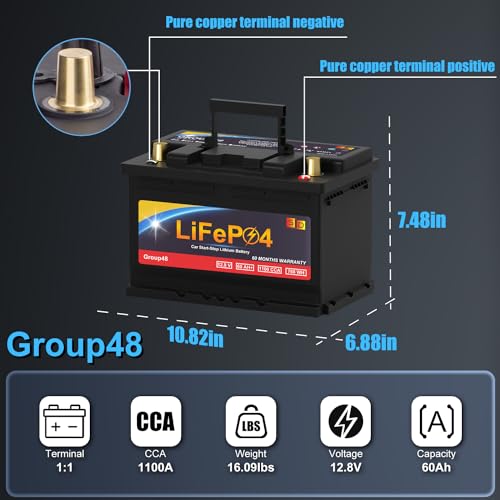

Massive 1100 CCA Starting Performance
The headline specification is difficult to ignore:
1100 Cold Cranking Amps.
That’s substantial cranking capability for a battery in the Group 48 footprint.
High starting current can be useful for:
- Performance engines
- Trucks
- SUVs
- High-compression engines
- Cold-weather starting
- Vehicles with substantial startup electrical loads
LiFePO4 cells are capable of delivering high discharge current while maintaining relatively stable voltage.
The result can be strong starter-motor performance when the battery and vehicle charging system are correctly matched.
60Ah Lithium Capacity
This battery is rated at:
60 amp-hours
Capacity becomes increasingly important as modern vehicles continue adding electrical systems.
Today’s cars may have:
- Infotainment systems
- Electric seats
- Driver-assistance modules
- Dash cameras
- Alarm systems
- Keyless-entry receivers
- Telematics
- Electric pumps
- Aftermarket gauges
- Audio amplifiers
- Start-stop electronics
The battery isn’t simply responsible for spinning the starter anymore.
Modern cars continue consuming electricity even when the engine isn’t running.
Built-In Battery Management System
One of the major differences between a modern LiFePO4 battery and a conventional lead-acid battery is the integrated Battery Management System, or BMS.
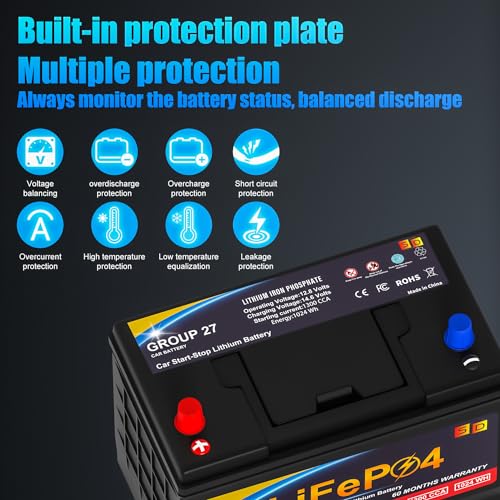
The BMS monitors the lithium battery pack and is designed to protect it against potentially damaging operating conditions.
Depending on the battery design, protection may include:
- Overcharge protection
- Over-discharge protection
- Over-voltage protection
- Over-current protection
- Short-circuit protection
- Cell monitoring
- Cell balancing
That additional electronic control is particularly important with lithium chemistry.
A BMS isn’t just a nice extra feature.
It’s one of the core components that allows a LiFePO4 battery pack to operate safely and consistently in automotive applications.
What Happens If You Leave the Lights On?
A conventional lead-acid battery can be severely damaged if it’s deeply discharged and left that way.
A BMS-equipped lithium battery may be able to disconnect the cells from the external load when voltage falls too far.
In some designs, this can cause a multimeter connected to the battery terminals to show very low or even near-zero voltage even though the cells themselves have not actually been discharged to zero volts.
That’s an important distinction.
Do not intentionally discharge a LiFePO4 automotive battery to zero volts.
If the battery’s BMS activates low-voltage protection, follow the manufacturer’s specified recovery and charging procedure.
Never force-charge an unknown lithium battery with an incompatible charger.
Group 48 / H6-Style Dimensions
The battery measures approximately:
10.82 × 6.89 × 7.48 inches
That puts it in the general physical range associated with many Group 48 / H6-style automotive batteries.
However, dimensions alone do not guarantee compatibility.
Before ordering, check:
- Battery tray dimensions
- Battery height
- Hold-down position
- Positive terminal position
- Negative terminal position
- Battery cable length
- Charging voltage
- Factory battery chemistry
- Battery-management requirements
A battery being physically able to sit in the tray does not automatically make it electrically compatible with the vehicle.
Terminal Orientation Matters
This battery uses:
Negative terminal: left
Positive terminal: right
Terminal orientation should be compared directly against the battery currently installed in the vehicle.
Don’t assume every Group 48 battery uses the same configuration for every application.
The battery cables should reach their terminals naturally without:
- Stretching
- Crossing
- Sharp bends
- Contacting metal brackets
- Contacting moving components
The positive terminal must also maintain safe clearance from the hood and chassis.
Designed for Compatible Start-Stop Vehicles
The seller describes this battery as compatible with start-stop applications.
That can be an important advantage because start-stop vehicles place very different demands on their batteries than traditional vehicles.
A conventional car may start once during a trip.
A start-stop vehicle may restart the engine dozens of times.
At the same time, electrical systems continue operating while the engine is stopped.
That requires a battery capable of handling frequent high-current events and repeated cycling.
However, not every start-stop vehicle can automatically accept a LiFePO4 replacement battery.
Some vehicles are designed specifically around:
- AGM batteries
- EFB batteries
- Intelligent alternators
- Battery current sensors
- Battery temperature sensors
- Battery-management modules
- Controlled charging strategies
Always verify lithium compatibility for the exact vehicle.
Battery Registration May Be Required
This is particularly important for Group 48 applications.
Many newer European, domestic and luxury vehicles using Group 48/H6 batteries also use intelligent battery-management systems.
The vehicle may track:
- Battery capacity
- Battery chemistry
- Battery age
- State of charge
- Charging history
- Battery temperature
Installing a new battery may require battery registration or coding.
Our guide to What Is Battery Registration, and Does Your Car Need It? explains why some modern vehicles need to be told when a replacement battery has been installed.
Changing from AGM or flooded lead-acid to LiFePO4 is a much larger chemistry change than simply installing another battery of the same type.
Do not assume battery registration alone makes an incompatible charging system compatible with lithium.
LiFePO4 vs. Lead-Acid Battery
LiFePO4 batteries operate differently from conventional flooded or AGM lead-acid batteries.
| Feature | LiFePO4 Battery | Conventional Lead-Acid |
|---|---|---|
| Starting current | Very high potential | High |
| Weight | Typically lower | Higher |
| BMS | Usually integrated | Usually none |
| Voltage stability | Strong | Gradually declines |
| Cycle life | Potentially high | Lower |
| Deep-discharge protection | BMS dependent | Usually none |
| Charging compatibility | Must be verified | Broad automotive compatibility |
| Cold-weather behavior | Different from lead-acid | Familiar performance profile |
| Maintenance | Low | Low to moderate |
LiFePO4 can offer major advantages, but only when it is properly matched to the charging system.
Lightweight Performance Advantage
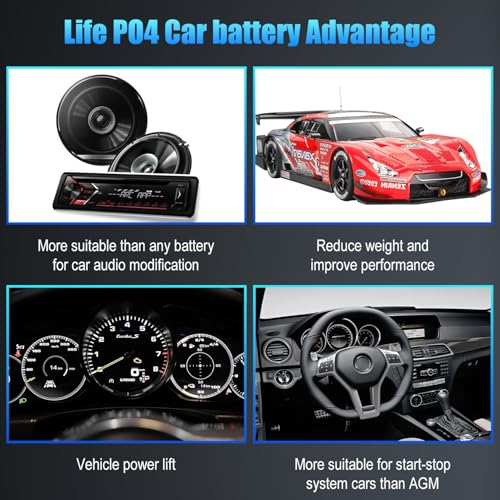
One of the major reasons performance enthusiasts move to lithium is weight reduction.
Traditional lead-acid automotive batteries contain a substantial amount of lead.
Lithium iron phosphate cells can deliver high power and useful capacity while generally using significantly less mass.
Reducing battery weight can be especially attractive for:
- Performance cars
- Track builds
- Autocross cars
- Modified street cars
- Sports cars
- Off-road vehicles
Weight reduction benefits the entire vehicle.
Every pound removed is one less pound that needs to be accelerated, stopped and carried through a corner.
Excellent Voltage Stability
LiFePO4 chemistry tends to maintain relatively stable voltage through much of its usable state of charge.
That can benefit electronics that prefer consistent supply voltage.
Potential applications include:
- ECU systems
- Fuel pumps
- Ignition systems
- Audio equipment
- Auxiliary electronics
- Lighting
- Data acquisition equipment
However, stable voltage does not mean unlimited capacity.
Once a lithium battery approaches its lower operating limit, the BMS may disconnect the output to protect the cells.
That cutoff can be much more abrupt than the slowly weakening behavior drivers associate with a traditional lead-acid battery.
Strong Choice for High Electrical Loads
The combination of:
60Ah capacity
and:
1100 CCA
makes this battery appealing for compatible vehicles with significant electrical demand.
Potential applications include:
- Performance vehicles
- Trucks
- SUVs
- Modified cars
- Audio-equipped cars
- Vehicles with extensive electronics
- Start-stop vehicles specifically approved for lithium batteries
Our Car Audio System Guide explains how battery capacity, alternator output, cable size and grounding work together in vehicles with upgraded amplifiers and subwoofers.
A Lithium Battery Won’t Fix an Undersized Alternator
This is just as true for lithium as it is for AGM.
The battery stores electrical energy.
The alternator creates electrical energy while the engine is running.
If the vehicle consistently consumes more current than the alternator can provide, the battery supplies the difference.
Eventually the battery becomes discharged.
Before installing high-current accessories, inspect:
- Alternator capacity
- Charging voltage
- Power cable size
- Ground cable size
- Terminal condition
- Voltage drop
- Electrical demand
A 1100CCA sticker doesn’t repeal electrical engineering.
Check Charging-System Compatibility
This is one of the most important steps before installing a lithium automotive battery.
LiFePO4 batteries require charging voltages and charging behavior that fall within the battery manufacturer’s specifications.
Problems can arise with:
- Excessive alternator voltage
- Charging spikes
- Desulfation modes
- Battery reconditioning modes
- Poor voltage regulation
- Intelligent alternators not calibrated for lithium
- Incompatible external chargers
Never use an old charger simply because the clamps fit the terminals.
When externally charging a lithium battery, use a charger explicitly compatible with the manufacturer’s battery requirements.
Battery Light On After Installation?
If your battery warning lamp remains illuminated while driving, diagnose the charging system instead of immediately blaming the new battery.
Potential causes include:
- Alternator failure
- Charging-system incompatibility
- Faulty voltage regulator
- Damaged charging cable
- Poor ground
- Open fuse
- Fusible-link failure
- Battery-monitoring fault
- Battery-management coding issue
Our Why Is My Battery Light On? guide explains how to troubleshoot charging-system faults before replacing additional parts.
Check the Fusible Link and High-Current Wiring
The battery and alternator are connected by some of the highest-current wiring in the vehicle.
Many vehicles protect those circuits with:
- Fusible links
- Mega fuses
- Battery terminal fuses
- High-current strip fuses
A failed connection can prevent the battery from charging correctly.
Read our What Is a Fusible Link? Fusible Link vs. Fuse Explained guide for a deeper look at these high-current circuits.
Never bypass a failed fusible link with ordinary wire.
Turning the wiring harness itself into the fuse generally ends poorly.
What If the Car Has Power but Won’t Start?
Dashboard lights don’t require anywhere near the current needed by a starter motor.
That means a vehicle can still have:
- Interior lights
- Radio
- Instrument cluster
- Power locks
- Infotainment
while being unable to crank the engine.
If the vehicle has electrical power but won’t start, use our Car Has Power but Won’t Start diagnostic guide before assuming the battery is responsible.
Possible causes include:
- Battery voltage drop
- Starter failure
- Poor connections
- Ignition switch faults
- Starter relay failure
- Ground problems
- Immobilizer issues
Rapid Clicking During Starting
Rapid clicking commonly occurs when system voltage collapses as the starter solenoid tries to engage.
Potential causes include:
- Discharged battery
- Loose terminal
- High-resistance battery cable
- Poor engine ground
- Starter problem
- Charging-system fault
Our Rapid Clicking When Starting a Car guide explains how to test the battery and starter circuit rather than guessing.
Integrated Protection
According to the supplied product specifications, the internal BMS provides protection against conditions including:
- Overcharge
- Over-discharge
- Over-voltage
- Over-current
Those are useful features for a lithium automotive battery.
However, BMS protection should be considered the last line of defense, not a substitute for a correctly functioning vehicle charging system.
The vehicle still needs proper:
- Voltage regulation
- Alternator operation
- Wiring
- Grounding
- Circuit protection
60-Month Warranty
The seller advertises a:
60-month warranty
Warranty coverage can be a significant advantage for a lithium battery, but buyers should verify the complete warranty terms before purchase.
Check whether coverage includes:
- Full replacement period
- Prorated period
- Commercial use
- Start-stop applications
- Modified vehicles
- Over-discharge
- Charging-system damage
- Racing or competition use
Warranty length and warranty coverage aren’t always the same thing.
Is This Group 48 LiFePO4 Battery Right for Your Vehicle?
This battery makes the most sense when your vehicle is confirmed to support its:
Group 48-size case
12.8V LiFePO4 chemistry
60Ah capacity
1100CCA starting rating
and:
Left-negative / right-positive terminal configuration
It can be particularly attractive for owners looking for:
- High cranking output
- Lithium weight savings
- Integrated BMS protection
- Stable voltage
- Long cycling potential
- Maintenance-free operation
But don’t choose it solely because your old battery says “Group 48.”
Electrical compatibility matters.
Verify These Five Things Before Ordering
1. Physical Size
Battery dimensions:
10.82 × 6.89 × 7.48 inches
Measure the original battery and battery tray.
2. Terminal Orientation
This battery uses:
Left: Negative
Right: Positive
3. Cranking Requirement
Battery rating:
1100 CCA
Verify that the battery meets or exceeds the vehicle’s required starting specification.
4. Battery Chemistry Compatibility
Confirm the vehicle can safely charge a 12.8V LiFePO4 automotive battery.
5. Battery Management Requirements
Determine whether the vehicle requires:
- Battery registration
- Coding
- Adaptation
- Battery-type configuration
Our Battery Registration Guide is an excellent starting point for understanding modern battery-management systems.
Why Buy This Group 48 LiFePO4 Automotive Battery?
For a compatible vehicle, this lithium starter battery offers an impressive combination of high output and modern battery technology.
Key features include:
- 1100 Cold Cranking Amps
- 60Ah capacity
- 12.8V LiFePO4 chemistry
- Group 48-size case
- Integrated Battery Management System
- Overcharge protection
- Over-discharge protection
- Over-voltage protection
- Over-current protection
- High cranking capability
- Strong voltage stability
- Maintenance-free operation
- Potential weight savings versus lead-acid
- Seller-advertised 60-month warranty
For drivers who have verified that their charging system supports LiFePO4 technology, this Group 48 60Ah 1100CCA lithium automotive battery can provide a serious upgrade in cranking performance, electrical stability and battery technology.
Specifications at a Glance
Battery Chemistry: LiFePO4 / Lithium Iron Phosphate
Nominal Voltage: 12.8V
Capacity: 60Ah
Cold Cranking Amps: 1100 CCA
Battery Size: Group 48 / seller-listed DIN60
Length: 10.82 inches
Width: 6.89 inches
Height: 7.48 inches
Negative Terminal: Left
Positive Terminal: Right
Battery Management System: Integrated BMS
Application: Compatible car, truck and SUV starting applications
Start-Stop: Vehicle compatibility must be verified
Warranty: Seller advertises 60 months; verify complete terms








There are no reviews yet.