


What Vehicles Does the GDSMOTU 130A Alternator Fit?
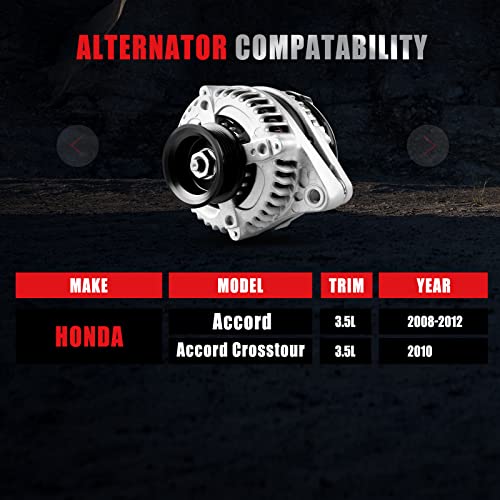
According to the supplied product listing, the alternator is advertised for the following Honda applications.
Vehicle Fitment Chart
| Year | Make | Model | Engine | Fitment notes |
|---|---|---|---|---|
| 2008–2010 | Honda | Accord | 3.5L V6 | Verify OE number |
| 2011–2012 | Honda | Accord | 3.5L V6 | Manual transmission only, per listing |
| 2010 | Honda | Accord Crosstour | 3.5L V6 | Verify OE number |
This fitment information is based on the manufacturer’s supplied listing and should be confirmed against the original alternator.
The listing does not establish compatibility with Honda Accord four-cylinder models or 2011–2012 Accord V6 automatic-transmission applications.
2008–2010 Honda Accord V6 Alternator
The eighth-generation Honda Accord offered a 3.5-liter V6 engine with substantial electrical requirements.
The GDSMOTU 130A alternator is advertised for 2008, 2009, and 2010 Accord 3.5L V6 applications.
If the original alternator is no longer charging properly, this replacement may be worth considering after confirming the OE number and physical configuration.
2011–2012 Honda Accord V6 Manual Transmission
The manufacturer’s listing specifically identifies 2011–2012 Honda Accord 3.5L V6 models equipped with a manual transmission.
This distinction matters because alternator configurations can vary by vehicle application.
Owners of automatic-transmission V6 models should not assume compatibility without additional verification.
2010 Honda Accord Crosstour Alternator
The 2010 Honda Accord Crosstour 3.5L V6 is another advertised application.
Although the Crosstour shares powertrain engineering with the Accord, buyers should still verify the original alternator’s reference number, mounting configuration, and electrical connector.
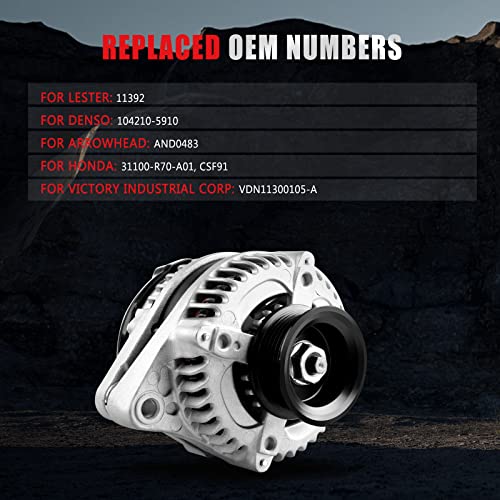
GDSMOTU Alternator OEM Cross-Reference Numbers
Comparing replacement-part numbers is one of the most useful ways to confirm compatibility.
GDSMOTU advertises the following interchange references:
| Reference number | Type |
|---|---|
| 11392 | Aftermarket alternator reference |
| AND0483 | Alternator interchange |
| VND0483 | Alternator interchange |
| 104210-5910 | Alternator reference |
| 31100-R70-A01 | Honda OE reference |
| CSF91 | Alternator interchange |
| VDN11300105-A | Alternator interchange |
| 12871 | Additional reference |
These are manufacturer-advertised reference numbers and have not been independently confirmed as interchangeable for every listed vehicle.
Before purchasing, compare the original alternator’s OE number, mounting points, pulley diameter, pulley grooves, and electrical connector.
Why a 130-Amp Alternator Matters on the Honda Accord V6
The alternator supplies electricity to the vehicle while the engine is running.
On the Honda Accord 3.5L V6, electrical power supports systems such as:
- Engine control module
- Ignition coils and fuel injectors
- Exterior and interior lighting
- Climate-control blower motor
- Rear-window defroster
- Audio and navigation equipment
- Battery charging
- Other electronic accessories
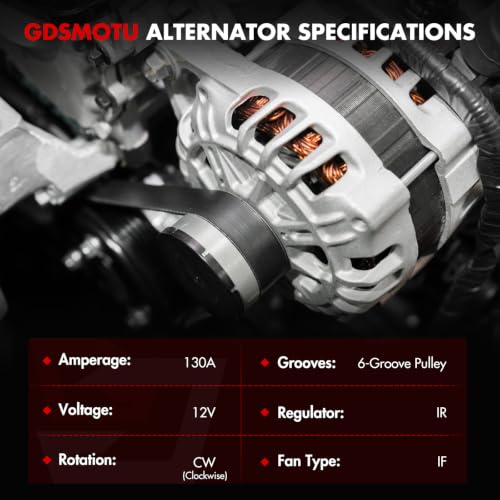
The GDSMOTU alternator’s advertised 130-amp rating is intended to support compatible factory electrical systems.
However, a 130-amp replacement is not automatically a high-output performance upgrade.
Owners running powerful aftermarket amplifiers or additional electrical equipment should evaluate their actual current requirements before choosing an alternator.
Signs Your Honda Accord V6 Alternator Is Failing
Alternator failure can develop gradually, producing warning signs before the charging system stops working.
1. Battery Warning Light
An illuminated battery warning light while driving may indicate a charging-system problem.
The issue could involve the alternator, wiring, belt, battery connections, or charging controls.
For additional troubleshooting, read our guide to why your battery warning light is on.
2. Battery Keeps Dying
If your Accord repeatedly needs jump-starting, the alternator may not be replenishing the battery correctly.
However, battery deterioration, parasitic electrical draw, and damaged wiring can produce similar symptoms.
Our guide to testing alternator output with a multimeter explains how to begin checking charging performance.
3. Flickering or Dimming Headlights
Headlights that change brightness unexpectedly can indicate unstable charging voltage.
The problem may become more noticeable when the climate-control blower, rear defroster, or other electrical accessories are operating.
4. Whining or Grinding Noise
Worn alternator bearings may produce whining, grinding, or rattling sounds that change with engine speed.
Other belt-driven accessories can produce similar noises, so inspect the entire accessory-drive system.
5. Electrical Accessories Malfunction
Low system voltage may contribute to warning lights, intermittent electronic problems, or unusual accessory behavior.
Because these symptoms have multiple potential causes, electrical testing should come before replacement.
How to Test Your Honda Accord Alternator
Before buying a replacement, verify that the alternator is actually responsible for the charging problem.
A digital multimeter provides a useful starting point.
Step 1: Measure Battery Voltage
With the engine off and the battery rested, measure voltage across the battery terminals.
A fully charged conventional 12-volt lead-acid battery typically reads approximately 12.6 volts.
Step 2: Start the Engine
Measure voltage again with the engine running.
Many conventional charging systems operate around 13.5–14.8 volts under typical charging conditions.
However, Honda’s charging controls can vary alternator output according to electrical demand.
A lower reading under certain operating conditions does not automatically establish alternator failure.
Step 3: Apply Electrical Load
Turn on the headlights, cabin blower, and rear defroster.
Observe the charging-system response and compare results with Honda service specifications.
Step 4: Inspect Electrical Connections
Check the battery terminals, alternator output cable, engine grounds, accessory belt, and related fuses.
Our automotive voltage-drop testing guide explains how excessive resistance can interfere with charging performance.
Safety warning: Never disconnect the battery while the engine is running to test alternator output. This can damage vehicle electronics.
GDSMOTU Alternator Construction and Features
The manufacturer advertises several features intended to support durability and reliable electrical operation.
Die-Cast Aluminum Housing
GDSMOTU describes the alternator housing as die-cast aluminum.
Aluminum housings provide structural support while helping manage weight and dissipate heat.
Copper Windings
The manufacturer advertises copper windings designed to conduct electrical current within the alternator.
The listing does not provide independent material testing or comparative performance data.
Internal Voltage Regulator
The alternator uses an internally regulated configuration.
The regulator controls alternator excitation and output as required by the charging system.
Correct compatibility with Honda’s charging controls is essential.
Internal Cooling Fan
The internal fan helps circulate air through the alternator housing.
Managing heat is important because excessive temperatures can shorten the life of bearings, rectifiers, and electronic components.
Six-Groove, 66 mm Pulley
The GDSMOTU alternator features an advertised six-groove pulley with a 66 mm outside diameter.
Matching pulley diameter and alignment is important for proper belt operation and alternator speed.
Advertised Electrical Protection
The manufacturer claims overload and overheating protection, along with insulating coatings intended to reduce electrical short-circuit risks.
Independent testing results and protection thresholds were not provided.
How to Replace the Alternator on a Honda Accord 3.5L V6
Alternator replacement on the Honda Accord V6 requires careful attention to electrical safety, belt routing, and component access.
The following is a general overview rather than a substitute for the factory service manual.
General Replacement Procedure
- Park on level ground, switch off the ignition, and allow the engine to cool.
- Disconnect the negative battery terminal.
- Identify the alternator location and accessory belt routing.
- Remove components necessary for safe access according to the service manual.
- Release belt tension using the specified tensioner procedure.
- Disconnect the alternator electrical connector and main charging cable.
- Remove the alternator mounting fasteners.
- Remove the original alternator and compare it with the replacement.
- Install the GDSMOTU alternator using factory torque specifications.
- Reinstall the accessory belt and verify pulley alignment.
- Reconnect the battery and perform charging-system checks.
Use the correct Honda repair documentation for vehicle-specific instructions.
Common Installation Mistakes
Wrong transmission application: Verify manual-transmission fitment restrictions on 2011–2012 Accord V6 models.
Incorrect pulley: Confirm the original alternator uses the correct six-groove pulley and diameter.
Loose charging cable: Poor connections can cause excessive resistance and charging problems.
Skipping battery testing: A damaged battery may continue causing starting problems after alternator replacement.
Is the GDSMOTU 130A Alternator Worth Buying?
The GDSMOTU 130A alternator is worth considering for owners of compatible Honda Accord and Accord Crosstour 3.5L V6 models.
Potential Advantages
- 130-amp rated output
- 12-volt electrical configuration
- Six-groove, 66 mm pulley
- Internal voltage regulator
- Internal cooling fan
- Advertised aluminum housing and copper windings
- Multiple aftermarket and OE reference numbers
- Replacement option for select Honda V6 applications
What Buyers Should Consider
The supplied listing does not establish independent long-term durability, verified comparative performance, warranty duration, or a current selling price.
Therefore, buyers should compare the product’s actual price, seller warranty, return policy, and fitment against genuine Honda and other aftermarket alternatives.
Frequently Asked Questions
Does the GDSMOTU alternator fit a 2008 Honda Accord V6?
According to the supplied listing, it is advertised for the 2008 Honda Accord 3.5L V6. Verify the original alternator reference number before purchasing.
Will this alternator fit a 2012 Honda Accord V6?
The listing specifies 2011–2012 Accord 3.5L V6 models equipped with a manual transmission. Automatic-transmission compatibility is not established.
Does this alternator fit the 2010 Honda Accord Crosstour?
The 2010 Accord Crosstour 3.5L V6 is an advertised application.
Is this a 130-amp alternator?
Yes. GDSMOTU advertises a 130-amp output rating and 12-volt electrical configuration.
What is Honda alternator part number 31100-R70-A01?
31100-R70-A01 is a Honda OE reference included in the manufacturer’s advertised interchange list.
Does this alternator fit the Honda Accord 2.4L?
The supplied listing covers select 3.5L V6 applications. Compatibility with the 2.4L four-cylinder engine is not established.
Can a bad alternator cause my Honda Accord to stall?
Yes. If the charging system fails and battery voltage falls too low, essential engine electronics may stop operating.
Final Verdict: GDSMOTU 130A Alternator for Honda Accord V6
The GDSMOTU 130A alternator offers an aftermarket replacement option for select 2008–2012 Honda Accord 3.5L V6 models and the 2010 Honda Accord Crosstour.
Its advertised 130-amp output, internally regulated design, six-groove pulley, and multiple cross-reference numbers make it worth evaluating when the original alternator has failed.
However, proper fitment is essential, especially for 2011–2012 Accord V6 models with transmission-specific applications.
Confirm the original alternator’s OE number, test the charging system, and inspect the battery and belt before ordering.
Because buying the wrong alternator and taking everything apart twice is an excellent way to turn a Saturday repair into a Sunday argument with your toolbox.



There are no reviews yet.