


130 Watts x 4 at 4 Ohms
With compatible 4-ohm speakers, the G4000.5D provides a stated 130 watts per channel across four full-range channels.
That’s substantial power for many aftermarket component and coaxial speakers.
Compared with powering upgraded speakers directly from a typical head unit, a dedicated amplifier can provide considerably more electrical headroom and speaker control.
When properly installed and tuned, the additional amplifier power can improve perceived:
- Midbass impact
- Vocal clarity
- Dynamic range
- High-volume performance
- Speaker control
- Overall system output
Speaker power handling should always be verified before finalizing amplifier gain and crossover settings.
220 Watts x 4 at 2 Ohms
With appropriate 2-ohm loads, the supplied specifications rate the G4000.5D at up to 220 watts x 4 channels.
The additional output makes the amplifier suitable for more demanding speaker configurations, provided the connected speakers and wiring remain within DS18’s approved impedance requirements.
Never assume lower impedance automatically means a better system.
Speaker impedance affects amplifier current demand, heat and output. The final configuration should be based on the amplifier’s supported loads and the speakers being installed rather than simply chasing the largest wattage figure.
Bridgeable Full-Range Channels
The G4000.5D also supports bridged operation, providing up to a stated 420 watts x 2 at 4 ohms on the applicable channels.
Bridging combines amplifier channels to produce higher output for compatible loads.
This can be useful for custom installations that don’t require four independent full-range channels.
Possible configurations include higher-powered component systems or other specialized speaker arrangements where greater output from fewer channels makes more sense.
Always follow DS18’s approved bridging and impedance requirements when wiring the amplifier.
Dedicated Subwoofer Channel
Unlike a conventional four-channel amplifier, the G4000.5D incorporates a fifth channel intended for bass duty.
That dedicated channel allows a subwoofer to operate alongside four full-range speakers without requiring a separate mono amplifier.
For many daily-driven systems, this provides an excellent balance between output and installation simplicity.
Instead of finding space for two amplifiers, separate power distribution and additional signal wiring, one chassis can handle the primary system.
Included Remote Bass Knob
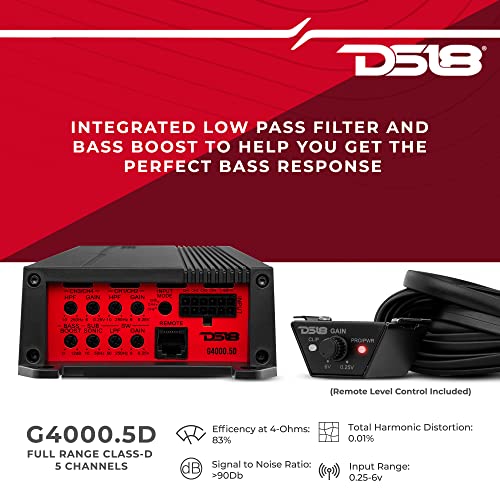
The DS18 G4000.5D includes a remote bass level control.
Mounted within reach of the driver, the remote knob allows bass output to be adjusted without accessing the amplifier itself.
That’s useful because the ideal amount of bass can change considerably between recordings and music genres.
A bass-heavy hip-hop track may need considerably less subwoofer level than an older rock recording, for example.
The remote provides convenient day-to-day adjustment without requiring the amplifier’s primary gain settings to be changed.
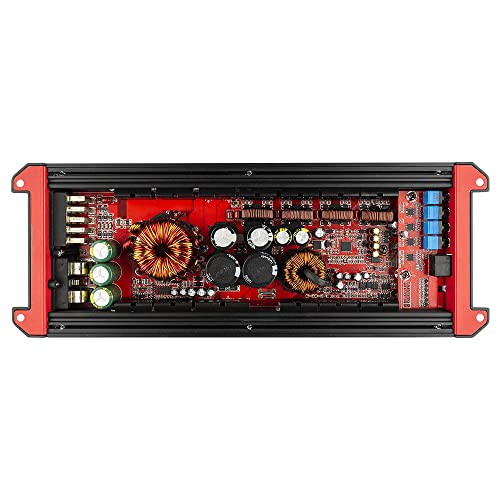
Compact Class D Design
The G4000.5D measures approximately:
- 12.8 inches long
- 4.72 inches wide
- 1.96 inches high
Those compact dimensions are one of the amplifier’s major advantages.
Class D architecture allows substantial output capability to fit into a smaller chassis while generally reducing wasted electrical energy and heat compared with less efficient amplifier topologies.
Potential mounting locations may include:
- Under a seat
- Behind interior trim
- Against a trunk panel
- Beneath a false floor
- Inside a custom amplifier rack
- Behind rear seating where appropriate
Always provide adequate ventilation and follow DS18’s installation-clearance recommendations.
Compact doesn’t mean you should wrap it in carpet and bury it somewhere with the thermal properties of an oven mitt.
High-Pass Filter Control
The G4000.5D incorporates high-pass filtering for system tuning.
A high-pass filter limits lower frequencies from reaching speakers that aren’t intended to reproduce deep bass.
This is particularly useful for door speakers and smaller full-range drivers.
Removing unnecessary low-frequency information can reduce speaker excursion and distortion while allowing those speakers to focus on midbass, midrange and higher frequencies.
In systems using a dedicated subwoofer, proper high-pass filtering also helps create a smoother transition between the full-range speakers and bass system.
Low-Pass Filter Control
The amplifier also provides low-pass filtering, allowing higher frequencies to be removed from channels assigned to low-frequency reproduction.
For the subwoofer portion of a system, this helps keep vocals and higher-frequency content out of the bass driver.
Correct crossover settings can dramatically improve the way an audio system blends together.
A properly configured system shouldn’t sound like four speakers playing music while a subwoofer in the trunk is conducting an entirely separate concert.
Class D Efficiency
The DS18 G4000.5D uses a full-range Class D design.
Class D amplification is popular in modern car audio because it can provide substantial output from a relatively compact chassis while improving electrical efficiency.
That matters in high-powered automotive systems because every amplifier ultimately depends on the vehicle’s battery and charging system.
More efficient amplification can reduce unnecessary electrical demand and heat, although a high-output amplifier still requires properly sized power and ground wiring.
Power and Ground Wiring Matter
An amplifier capable of this level of output should not be installed using bargain wiring.
Proper installation requires appropriately sized:
- Power cable
- Ground cable
- Main fuse
- Fuse holder
- Speaker wire
- RCA or signal wiring
- Remote-turn-on wiring
- Electrical terminals
The amplifier’s main power circuit should be fused close to the battery according to proper car-audio installation practices.
Ground wiring should be appropriately sized, kept reasonably short and connected securely to clean conductive chassis metal.
A poor ground can cause voltage loss, noise, overheating, protection-mode problems and reduced amplifier performance.
Check the Vehicle Charging System
A higher-powered audio system increases electrical demand on the vehicle.
Battery condition, alternator output and wiring condition should be evaluated when planning the installation, especially when the amplifier will regularly operate at high output.
If the vehicle already has charging-system problems, adding a high-powered amplifier won’t improve matters.
Our guide explaining why the battery warning light comes on covers common charging-system issues involving alternator output, wiring and related electrical faults.
Fix existing electrical problems before adding additional high-current accessories.
Voltage Drop Can Reduce Amplifier Performance
Even appropriately sized cable can’t perform correctly if connections introduce excessive resistance.
Loose terminals, poor grounds and damaged cables can create voltage drop between the battery and amplifier.
Our guide to automotive voltage-drop testing explains how resistance can be identified by measuring voltage while a circuit is operating under load.
The same diagnostic principle is useful when troubleshooting car audio systems.
If battery voltage looks healthy but voltage measured directly at the amplifier falls excessively under load, inspect the power and ground path before blaming the amplifier.
Set Amplifier Gain Correctly
The G4000.5D’s gain controls should be used to match amplifier input sensitivity to the source unit—not as additional volume controls.
Excessive gain can drive the amplifier into clipping and introduce distortion.
That can produce harsh sound and potentially damage speakers.
For best results:
- Confirm speaker impedance
- Set crossovers appropriately
- Disable excessive source-unit EQ during initial setup
- Set amplifier gain according to source output
- Avoid audible clipping
- Fine-tune bass level after primary gain setup
The included remote bass knob should be used for convenient bass-level adjustment rather than compensating for an incorrectly configured amplifier.
Match Speakers Using RMS Power
When pairing speakers with the G4000.5D, concentrate on the amplifier’s output at the impedance you’ll actually use.
For example, a four-speaker 4-ohm system should be planned around the stated 130 watts per channel rather than the amplifier’s 4,000-watt maximum rating.
Similarly, a 2-ohm configuration should consider the stated 220 watts per channel.
Proper RMS matching helps create a system with useful headroom while reducing the temptation to tune everything around marketing numbers.
Key Features
- DS18 GEN-X G4000.5D
- Five-channel car audio amplifier
- Full-range Class D design
- 4,000 watts maximum power
- Four full-range speaker channels
- Dedicated fifth channel for subwoofer use
- 130W x 4 at 4 ohms
- 220W x 4 at 2 ohms
- 420W x 2 at 4 ohms bridged on applicable channels
- Supports multiple compatible speaker impedances
- Bridgeable operation
- High-pass filter
- Low-pass filter
- Included remote bass knob
- Compact amplifier chassis
- Approximately 12.8 x 4.72 x 1.96 inches
- Suitable for full-system car audio installations
- Designed for aftermarket speakers and subwoofer systems
- Space-saving single-amplifier configuration
Big Car Audio Power Without a Huge Amplifier Rack
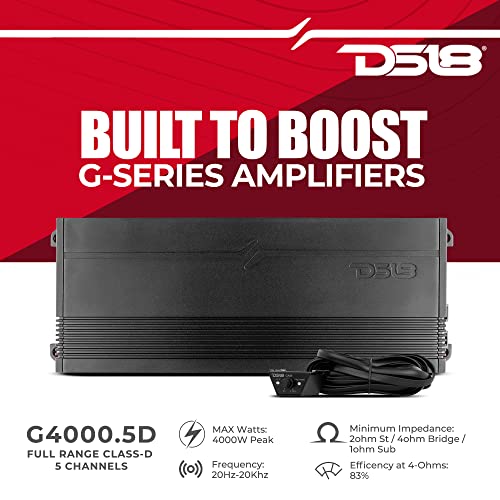
The DS18 G4000.5D GEN-X 4000W Max 5-Channel Class D Amplifier is designed for enthusiasts who want to power a complete speaker and subwoofer system without installing multiple amplifiers.
Its four full-range channels can deliver 130 watts each at 4 ohms or 220 watts each at 2 ohms, while bridgeable operation provides additional flexibility for custom installations. The dedicated fifth channel handles subwoofer duties, allowing one compact amplifier to serve as the heart of a complete car audio system.
Adjustable high- and low-pass filtering helps integrate the speakers and subwoofer, while the included remote bass knob provides convenient control from the driver’s seat.
And at just 12.8 inches long and under 2 inches tall, it provides serious system-building flexibility without requiring your trunk to look like the electrical room at a small casino.






There are no reviews yet.