




Why Fuel Pressure Monitoring Matters
Fuel pressure directly affects:
- Injector performance
- Air/fuel ratios
- Engine safety
- ECU fueling calculations
If fuel pressure drops unexpectedly, the engine can run dangerously lean.
A lean condition under boost can quickly cause:
- Knock
- Piston damage
- Ring land failure
- Burned valves
- Catastrophic engine failure
And turbocharged engines already have enough personality problems without fuel starvation joining the party.
Perfect for Turbocharged Applications
Turbocharged engines place enormous stress on fuel systems.
As boost rises:
- Injector demand increases
- Fuel volume rises
- Pressure stability becomes critical
A fuel pressure gauge helps verify:
- Proper regulator operation
- Consistent fuel delivery
- Stable pressure during tuning
Especially important on:
- Big turbo builds
- Flex fuel setups
- Street/strip cars
- Roll racing applications
Because “the fuel pump should be fine” is not a valid tuning strategy.
Why E85 Builds Need Fuel Pressure Monitoring
Modern performance tuning heavily revolves around E85 because ethanol offers:
- Better knock resistance
- Cooler combustion temperatures
- Increased timing capability
- Higher boost tolerance
But ethanol also demands:
- More fuel volume
- Higher injector duty cycle
- Greater fuel system stress
That makes fuel pressure monitoring even more important.
Because E85 engines consume fuel aggressively enough to expose weak fuel system components immediately.
Usually at full throttle.
Usually while somebody’s recording.
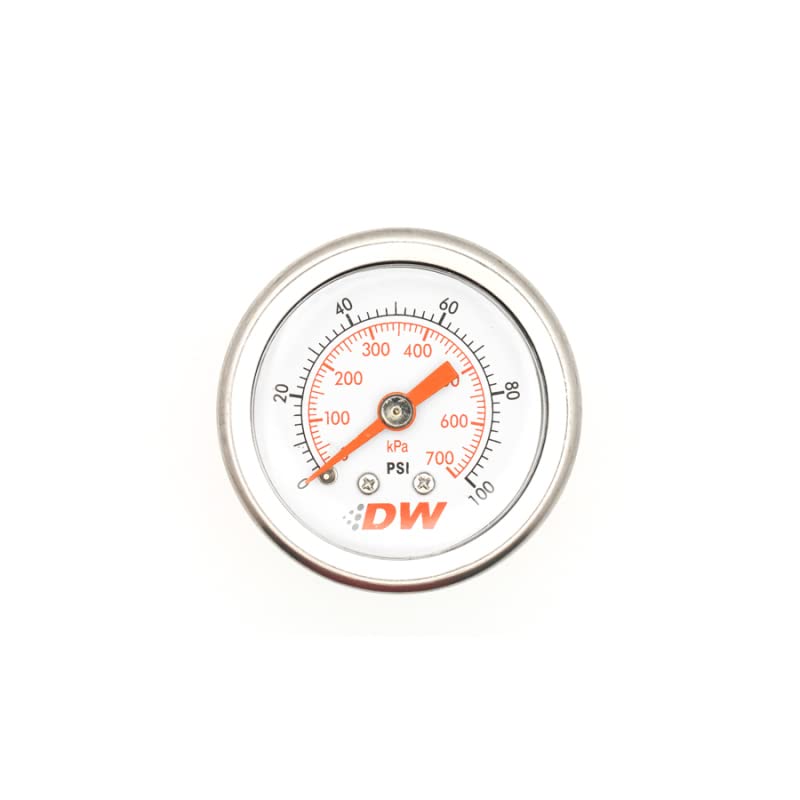
DW 6-01-G Mechanical Gasoline Drive Gauge
Mechanical Gauges Still Matter
Modern digital systems are incredibly advanced, but mechanical gauges still offer major advantages:
- Instant visual verification
- Simplicity
- Reliability
- No electrical dependency
This makes them ideal for:
- Engine bay diagnostics
- Base pressure setup
- Quick troubleshooting
- Tuning verification
Sometimes the simplest tools remain the most effective.
Which is ironic considering modern project cars now require laptops to idle correctly.
Ideal Uses for the DW 6-01-G
The DeatschWerks fuel pressure gauge is ideal for:
- Fuel pressure regulator setups
- EFI tuning
- Return fuel systems
- Fuel rail monitoring
- Diagnostic troubleshooting
Especially vehicles running:
- Large injectors
- E85
- Turbochargers
- High-flow fuel pumps
Basically:
Anything modified enough to make factory fuel system assumptions questionable.
Important During Fuel System Installation
Whenever installing:
- New injectors
- Fuel pumps
- Regulators
- Flex fuel systems
…fuel pressure should always be verified.
A gauge helps confirm:
- Proper pressure settings
- Regulator response
- Pump operation
- Fuel system health
Because guessing fuel pressure is an excellent way to accidentally build a very expensive paperweight.
Why Fuel System Diagnostics Matter
Many drivability issues are actually fuel-related:
- Hesitation
- Misfires
- Lean spikes
- Poor throttle response
- Boost breakup
A mechanical gauge helps quickly identify:
- Pressure instability
- Weak pump behavior
- Regulator failure
- Fuel delivery problems
Which can save:
- Time
- Tuning frustration
- Engine components
- Entire weekends
And anyone who’s diagnosed intermittent fueling problems knows how spiritually exhausting that process becomes.
Why Enthusiasts Trust DeatschWerks
DeatschWerks has become one of the most respected names in aftermarket fueling thanks to their focus on:
- Fuel system engineering
- Injector technology
- Performance pumps
- Ethanol compatibility
- Motorsport durability
Their products are trusted across:
- Drag racing
- Street performance
- Drift competition
- Roll racing
- Time attack
Reliable fueling remains one of the most important foundations of reliable horsepower.
And accurate fuel pressure monitoring is a huge part of that equation.
Final Thoughts
The DeatschWerks DW 6-01-G Mechanical Fuel Pressure Gauge is a simple but essential tool for enthusiasts building reliable high-performance fuel systems.
With:
- Accurate pressure monitoring
- Simple mechanical operation
- Easy regulator integration
- Reliable diagnostic capability
…it’s an ideal addition for:
- Turbocharged builds
- E85 fuel systems
- Custom EFI setups
- Performance street and race cars
Because when horsepower goals start climbing, monitoring fuel pressure stops being optional and starts becoming engine insurance.
And engine rebuilds remain dramatically more expensive than gauges.






There are no reviews yet.