
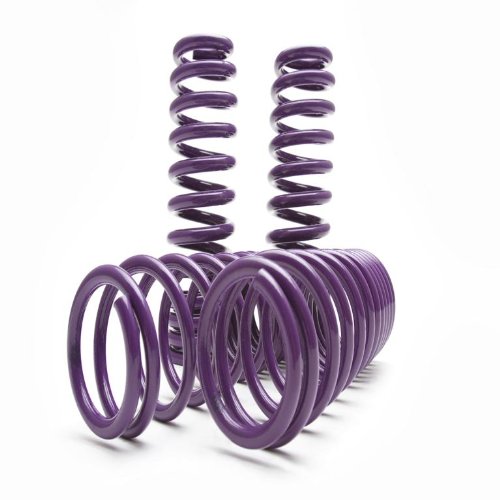
D2 PRO Lowering Springs for 1996–2000 Honda Civic EK
The D2 PRO Series lowering spring kit is designed for 1996–2000 Honda Civic models commonly grouped under the EK-generation platform. Its progressive-rate springs reduce ride height, tighten body control and give the sixth-generation Civic a much more deliberate stance.
Manufactured from 55-grade chrome-silicon steel in an ISO 9001-certified facility, the springs are intended for street builds that need firmer handling without moving to a fully adjustable coilover system.
There is one major issue in the supplied specifications: the product title claims a 2.5-inch front and 2.25-inch rear drop, while the description claims 1.8 inches front and 1.4 inches rear. Those are materially different ride heights. The exact D2 part number must be verified before publishing or ordering.
Vehicle Fitment
| Years | Make | Model | Platform |
|---|---|---|---|
| 1996–2000 | Honda | Civic | Sixth generation/EK-family |
Potential body styles include:
- Two-door Coupe
- Three-door Hatchback
- Four-door Sedan
Fitment must be verified by exact body style, chassis code and D2 part number. Although enthusiasts commonly call the entire 1996–2000 generation “EK,” North American Civics used several chassis codes, including EJ6, EJ7, EJ8, EK1 and EM1.
This kit should not automatically be listed for:
- 1993–1997 Honda del Sol
- 1990–1993 Acura Integra
- 1994–2001 Acura Integra
- 2001-and-newer Honda Civic
- Vehicles already equipped with coilovers
- Cars using converted suspension components
Shared Honda styling cues do not equal shared suspension parts. Honda made sure of that.
$170.00
Conflicting Lowering Specifications
Two different drops are presented in the source material:
| Source | Front drop | Rear drop |
|---|---|---|
| Product title | 2.5 inches | 2.25 inches |
| Product description | 1.8 inches | 1.4 inches |
Do not combine these measurements or select the more exciting number for the product title. A difference of nearly three-quarters of an inch can materially affect:
- Ground clearance
- Shock travel
- Bump-stop clearance
- Wheel and tire fitment
- Camber correction
- Exhaust clearance
- Daily drivability
The manufacturer’s exact SKU and application chart should be checked through D2 Racing before the drop measurement is published as confirmed.
Until that information is available, the safest product-page language is:
Designed to lower compatible 1996–2000 Honda Civic models. Exact front and rear drop depends on the confirmed D2 part number and vehicle application.
Progressive-Rate Spring Design
D2 PRO lowering springs use a progressive-rate design. Instead of maintaining the same rate throughout the spring’s compression, progressive springs become firmer as they are compressed.
This design can provide:
- More compliant response over smaller road imperfections
- Increased support during hard cornering
- Reduced body roll
- Less nose dive under braking
- More controlled weight transfer
- Improved street manners compared with an extremely stiff linear spring
Progressive springs do not guarantee factory ride quality. The final result depends on damper condition, available suspension travel, tire sidewall and the actual lowering amount.
Improved Civic Handling
Lowering the Civic’s center of gravity can make the chassis feel more responsive during steering transitions and reduce excessive body movement.
Potential handling benefits include:
- Quicker initial response
- Reduced body roll
- More stable cornering
- Less front-end rise under acceleration
- Reduced brake dive
- Cleaner wheel-to-fender fitment
Springs cannot create grip on their own. Tires, alignment, bushings and shock control remain critical. A Civic sitting beautifully on the bump stops is not a handling upgrade; it is automotive furniture.
For additional suspension comparisons, read the My Pro Street guide to daily-driver coilovers.
55 Chrome-Silicon Steel Construction
D2 states that its PRO Series springs are manufactured from 55-grade chrome-silicon steel. This material is selected for its ability to withstand repeated compression and extension without permanently deforming under normal operating conditions.
The manufacturing process is intended to support:
- Consistent spring dimensions
- Resistance to fatigue
- Stable ride height
- Reliable spring response
- Long-term structural durability
The springs are manufactured in a facility described as ISO 9001 and TÜV approved. Buyers should consult the exact product documentation for the certification scope and applicable testing standards.
Will These Springs Work With Factory Shocks?
Lowering springs may physically fit factory-style shocks and struts, but the actual drop determines whether the original dampers remain practical.
If the kit lowers the Civic by 1.8 inches, factory dampers will operate with substantially less compression travel. If the true drop is 2.5 inches, shortened performance dampers become even more important.
Potential problems with worn or mismatched shocks include:
- Repeated bottoming
- Excessive bouncing
- Poor rebound control
- Damaged bump stops
- Accelerated shock wear
- Unsettled behavior over rough pavement
- Tire cupping
Read Can Lowering Springs Wear Shocks? for a detailed explanation of damper travel, spring rates and bump-stop clearance.
For a Civic this old, inspect or replace the shocks during installation. Paying for suspension labor twice is a wonderfully inefficient way to save money.
Suspension Parts to Inspect
Before installing the D2 springs, inspect:
- Front struts
- Rear shocks
- Upper strut mounts
- Front compliance bushings
- Lower control-arm bushings
- Ball joints
- Tie-rod ends
- Rear trailing-arm bushings
- Sway-bar links
- Spring isolators
- Bump stops
- Wheel bearings
Worn bushings can cause poor alignment, clunking and unstable handling. New springs will not correct those conditions and may make them more noticeable.
Visit the My Pro Street How-To section for additional Honda repair and installation resources.
Camber and Tire Wear
Lowering a 1996–2000 Civic changes suspension geometry. Negative camber will usually increase, particularly at the rear.
Moderate negative camber is not automatically responsible for rapid tire wear. Excessive or incorrect toe is often more destructive. A complete alignment should measure both rather than correcting the car based on appearance.
Depending on the finished height, the Civic may require:
- Adjustable rear upper control arms
- Front camber adjustment components
- Replacement toe links
- Corrective bushings
- Fender-clearance adjustments
Never use generic alignment targets for a heavily lowered car without considering its street use and tire setup.
Wheel and Tire Clearance
The title’s claimed 2.5-inch front drop would create an aggressive stance. Wheel fitment must be checked throughout the full steering and suspension range.
Inspect:
- Tire-to-fender clearance
- Tire-to-strut clearance
- Inner wheel-well clearance
- Wheel offset
- Tire width and diameter
- Full steering lock
- Front bumper clearance
- Exhaust and oil-pan clearance
Oversized wheels, low offsets and wide tires increase rubbing risk. What clears in a parking lot may not clear during braking or cornering.
Professional Installation Recommended
Replacing the springs requires removal and disassembly of the suspension. Front coil springs store substantial energy and must be handled using suitable spring-compression equipment.
Installation generally includes:
- Measuring the original ride height.
- Raising and safely supporting the vehicle.
- Removing the front strut assemblies.
- Compressing and removing the factory springs.
- Inspecting the mounts, boots and bump stops.
- Installing the D2 springs in the correct orientation.
- Removing and replacing the rear springs.
- Confirming each spring is properly seated.
- Checking brake-hose and ABS-wire routing.
- Torquing all hardware correctly.
- Inspecting wheel and tire clearance.
- Performing a four-wheel alignment.
Professional installation is recommended, especially if the final drop approaches the 2.5-inch specification.
Alignment Is Required
A complete four-wheel alignment should be performed after installation and repeated if the springs settle enough to change the ride height.
The alignment should include:
- Front toe
- Rear toe
- Front camber
- Rear camber
- Caster comparison
- Steering-wheel centering
- Thrust angle
The NHTSA tire-safety guide provides additional information about tire inspection, pressure and abnormal tread wear.
Lifetime Warranty
D2 PRO lowering springs are advertised with a lifetime warranty. Warranty terms, original-purchaser requirements, installation exclusions and proof-of-purchase rules should be reviewed before installation.
Track use, improper installation, collision damage, corrosion from damaged coating and use on an unlisted application may affect coverage.
Package Contents
The package is expected to include:
- Two front progressive-rate lowering springs
- Two rear progressive-rate lowering springs
Unless specifically listed, the following are not included:
- Shocks or struts
- Upper mounts
- Bump stops
- Camber kits
- Adjustable control arms
- Spring compressors
- Alignment service
Frequently Asked Questions
What year Civic does this kit fit?
It is advertised for 1996, 1997, 1998, 1999 and 2000 Honda Civic models. Confirm the body style and chassis code before ordering.
Is this for an EK Civic?
Yes, it is marketed for the sixth-generation Civic commonly known as the EK. However, North American models used several specific chassis codes.
How much does it lower the Civic?
The supplied information conflicts. The title states 2.5 inches front and 2.25 inches rear, while the description states 1.8 inches front and 1.4 inches rear. Verify the D2 part number before publishing a confirmed drop.
Does it fit the 1999–2000 Civic Si?
Do not assume Si/EM1 compatibility without checking the exact D2 application chart. The Si’s suspension configuration and factory rates may differ from other Civic trims.
Can I use factory shocks?
They may physically fit, but shortened performance dampers are recommended for aggressive drops. Worn factory shocks can produce poor control and reduced suspension travel.
Will I need a camber kit?
Possibly. The need depends on the actual drop and available factory adjustment. Perform an alignment first and use the measurements to determine what corrective parts are required.
Final Verdict
D2 PRO lowering springs can give a 1996–2000 Honda Civic a much cleaner stance and sharper street response. The progressive-rate design and chrome-silicon construction make the kit appealing for an EK-generation build that does not need adjustable coilovers.
The conflicting drop measurements must be resolved before purchase or publication. A 1.8-inch drop and a 2.5-inch drop require different planning for shocks, alignment and ground clearance.
Confirm the D2 part number, install suitable dampers and align the car afterward. Visit My Pro Street for more Honda guides, suspension articles and practical build advice.
Specification: D2 PRO Lowering Springs for 1996–2000 Honda Civic EK
|
User Reviews
Be the first to review “D2 PRO Lowering Springs for 1996–2000 Honda Civic EK”
You must be logged in to post a review.



There are no reviews yet.