
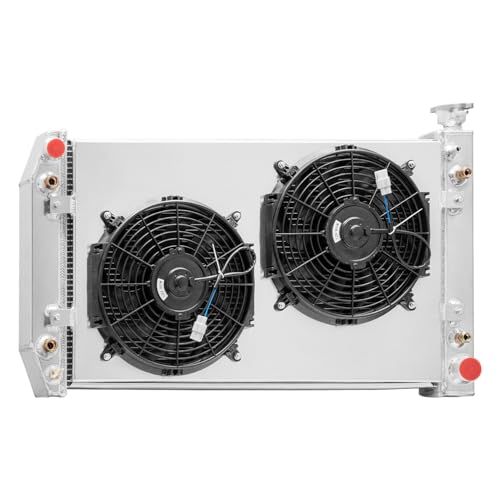
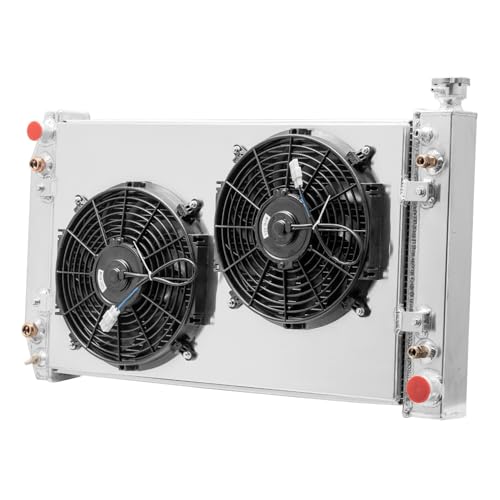
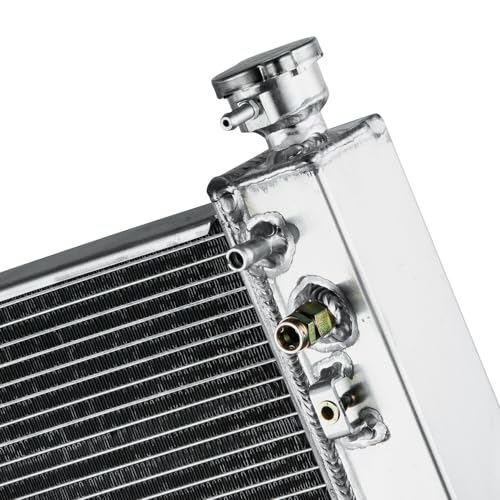
High-Efficiency 2-Row Aluminum Radiator Construction
The radiator features a two-row aluminum core measuring approximately 17.25 inches high and 28.25 inches wide.
Its high-density, multi-louvered cooling fins are designed to increase the surface area exposed to passing air.
As hot engine coolant circulates through the radiator tubes, heat transfers into the aluminum fins and is carried away by airflow.
The included dual electric fans help maintain airflow when the vehicle is stationary or traveling slowly.
Is a 2-Row Radiator Better Than a 3-Row Radiator?
Not necessarily. Radiator performance depends on more than the number of rows.
Core thickness, tube dimensions, fin density, coolant flow, and airflow all influence cooling efficiency.
A properly engineered two-row aluminum radiator can outperform an older multi-row radiator with restricted passages or inefficient airflow.
For a classic Chevy or GMC truck, selecting a radiator with the correct dimensions and cooling capacity is more important than choosing the highest possible row count.
Our Complete Car Cooling System Guide explains how these components work together to regulate engine temperature.
Dual 12-Inch Electric Fans for Improved Low-Speed Cooling
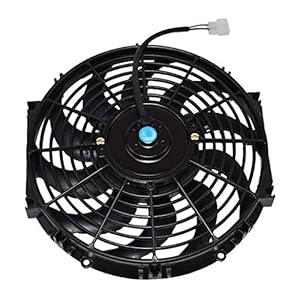
The included electric fan assembly features two 12-inch cooling fans mounted to an aluminum radiator shroud.
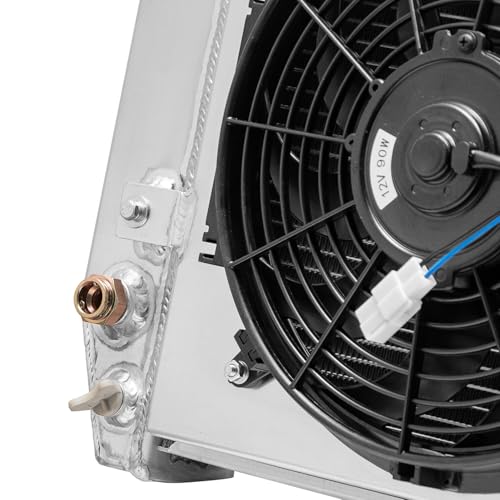
Each fan uses a 10-blade S-type design intended to move air through the radiator core.
Electric cooling fans can be especially useful for trucks that spend considerable time idling, operating in traffic, or running modified engines.
Benefits of Electric Radiator Fans
Consistent Low-Speed Airflow: Electric fans can operate independently of engine RPM when controlled by an appropriate switching system.
Improved Packaging Flexibility: Slim electric fans may provide additional clearance for certain engine bay configurations.
Reduced Mechanical Fan Dependence: Converting from an engine-driven fan eliminates the original mechanical fan assembly, although electrical system demand increases.
Custom Cooling Control: Electric fans can be configured to operate through suitable temperature switches, relays, or engine management controls.
The supplied fan information lists airflow ratings between 1,730 and 2,150 CFM, depending on the specification version. Confirm the actual fan model and whether the published rating applies per fan or to the complete assembly.
Installation note: The package includes fan mounting kits, but a thermostat controller or relay kit is not explicitly listed. Properly rated electrical controls may need to be purchased separately.
2-Row Aluminum Radiator Technical Specifications
| Specification | Details |
|---|---|
| Product Type | Aluminum Radiator with Dual Fan Shroud |
| Radiator Core | 2-Row Aluminum |
| Core Height | 17.25 inches |
| Core Width | 28.25 inches |
| Overall Height | Approximately 20.25–20.44 inches |
| Overall Width | Approximately 33.88–33.89 inches |
| Upper Inlet | Approximately 1.25–1.31 inches |
| Lower Outlet | Approximately 1.56 inches |
| Upper Inlet Location | Driver Side |
| Lower Outlet Location | Passenger Side |
| Transmission Cooler Fitting | 1/2-20 UNF, verify |
| Engine Oil Cooler Fitting | M20 × 1.5, verify adapters |
| Fan Quantity | 2 |
| Fan Diameter | 12 inches |
| Fan Voltage | 12V DC |
| Fan Blade Design | 10 S-Type Blades |
| Listed Maximum Airflow | 1,730–2,150 CFM, rating basis unconfirmed |
| Listed Fan Current Draw | 12.7 amps, rating basis unconfirmed |
| Fan Thickness | Approximately 2.5 inches |
| Radiator Cap | Included |
| Fan Mounting Kits | Included |
Important: The supplied listing contains conflicting specifications for overall dimensions, fan airflow, inlet diameters, and tank construction. Verify the actual product configuration before purchasing.
Chevy GMC C/K Radiator Vehicle Fitment
This aluminum radiator package is advertised for selected Chevrolet and GMC full-size pickup and SUV applications.
| Vehicle | Advertised Application |
|---|---|
| Chevrolet C1500 / C2500 / C3500 | Selected 1988–1999 models |
| Chevrolet K1500 / K2500 / K3500 | Selected 1988–1999 models |
| GMC C1500 / C2500 / C3500 | Selected 1988–1999 models |
| GMC K1500 / K2500 / K3500 | Selected 1988–1999 models |
| Chevrolet / GMC Suburban | Selected 1992–1995 models |
| Chevrolet R/V Series | Selected 1989–1991 models |
| GMC R/V Series | Selected 1989–1991 models |
| Chevrolet Full-Size Blazer | 1994 5.7L V8 |
| Chevrolet P30 / GMC P3500 | Selected 1996–1997 4.3L V6 applications |
Engine Applications: Selected 4.3L V6, 5.0L V8, and 5.7L V8 configurations, with additional fitment requiring verification.
Important Fitment Information
Not every Chevrolet or GMC truck within the advertised year range uses the same radiator. Find any coolant leak in your vehicle using this guide.
Factory cooling configurations vary based on engine size, transmission, air-conditioning equipment, towing packages, and radiator dimensions.
Some 1999 trucks also belong to different GM platform generations, making model identification especially important.
Before ordering, compare your original radiator’s core dimensions, overall dimensions, hose connections, oil cooler fittings, and mounting locations.
The supplied listing references radiator interchange numbers 622, CU622, DPI622, CR622, and RA1217, but these numbers should be treated as fitment references rather than confirmed universal equivalents.
A Performance Cooling Upgrade for Chevy 350 Small-Block Trucks
The Chevrolet 5.7L small-block V8 is one of the most recognizable engines found in OBS Chevy and GMC trucks.
Whether equipped with throttle-body injection or later Vortec fuel injection, the 350 small-block depends on a properly functioning cooling system for consistent performance.
During towing, hauling, or extended high-load driving, the radiator must dissipate the heat generated by the engine.
An upgraded aluminum radiator and electric fan assembly can help maintain adequate cooling when correctly matched to the vehicle.
Ideal for OBS Chevy Restoration Projects
Many owners restoring 1988–1998 Chevrolet and GMC trucks want to preserve the classic appearance while improving mechanical reliability.
Replacing an aging radiator with an aluminum unit can be a practical way to refresh the cooling system.
The included dual electric fans also provide an alternative to the original mechanical fan arrangement for properly engineered conversions.
Cooling Considerations for Modified Engines
Performance camshafts, increased compression, forced induction, and engine swaps can change the engine’s heat output.
A properly sized radiator is essential, but additional modifications may require upgraded coolant hoses, fan controls, water pumps, and transmission cooling.
A radiator upgrade alone cannot compensate for insufficient airflow or a malfunctioning cooling system.
How to Install an Aluminum Radiator and Dual Fans on a Chevy C1500 or GMC Sierra
Installing a radiator in a Chevrolet or GMC OBS truck is a manageable project for experienced DIY mechanics.
However, converting from a mechanical fan to dual electric fans requires additional attention to wiring, fan control, and electrical load.
Step 1: Drain the Cooling System
Allow the engine to cool completely before opening the radiator cap.
Position a drain pan beneath the radiator and drain the coolant according to the factory service procedure.
Inspect the coolant for rust, contamination, or evidence of internal corrosion.
If the cooling system contains significant deposits, consider flushing it before installing the replacement radiator.
Step 2: Remove the Factory Radiator
Disconnect the upper and lower radiator hoses.
Remove the original fan shroud and any components obstructing radiator removal.
Disconnect transmission and engine oil cooler lines if equipped, taking precautions to contain fluid loss.
Remove the radiator mounting hardware and carefully lift the factory radiator from the engine bay.
Step 3: Install the Aluminum Radiator
Position the new radiator into the factory mounting area.
Confirm that the radiator fits correctly without contacting the frame, engine accessories, or surrounding components.
Verify that the inlet and outlet connections match the vehicle’s radiator hose configuration.
Secure the radiator using the appropriate mounting hardware and isolators.
Step 4: Connect Transmission and Engine Oil Cooler Lines
For automatic transmission applications, connect the transmission cooler lines using fittings compatible with the radiator and factory plumbing.
If the vehicle uses a radiator-integrated engine oil cooler, verify the appropriate fitting specifications and adapter requirements.
Do not force incompatible fittings into the radiator.
Step 5: Install the Dual Electric Fans
Attach the aluminum shroud and both 12-inch cooling fans.
Verify clearance between the fans and engine accessories.
Route electrical wiring away from belts, pulleys, exhaust manifolds, and sharp metal edges.
If using through-core mounting hardware, follow the manufacturer instructions carefully to avoid damaging radiator tubes.
Step 6: Wire the Electric Fan Controls
Connect the fans using properly rated relays, fuses, and wiring.
A suitable temperature controller or compatible ECU fan-control arrangement is necessary for automatic operation.
Verify the fans’ combined running current and startup current before selecting electrical components.
Do not connect high-current fans directly to an undersized factory switch or temperature sensor.
Step 7: Refill and Bleed the Cooling System
Refill the radiator with coolant that meets the engine manufacturer’s specifications.
Follow the applicable coolant bleeding procedure to remove trapped air.
Air pockets can interrupt coolant circulation and cause overheating, even with a new radiator.
Our Complete Car Cooling System Guide explains how coolant flow, thermostats, and radiators work together.
Step 8: Test the Cooling System
Start the engine and monitor coolant temperature.
Verify that the thermostat opens, the cooling fans operate when commanded, and all hose connections remain leak-free.
Inspect the transmission and engine oil cooler connections for leaks.
Allow the engine to cool before rechecking coolant level and mounting hardware.
Why Integrated Transmission and Engine Oil Coolers Matter
Many Chevrolet and GMC C/K trucks use radiator-integrated fluid coolers to help manage transmission and engine oil temperatures.
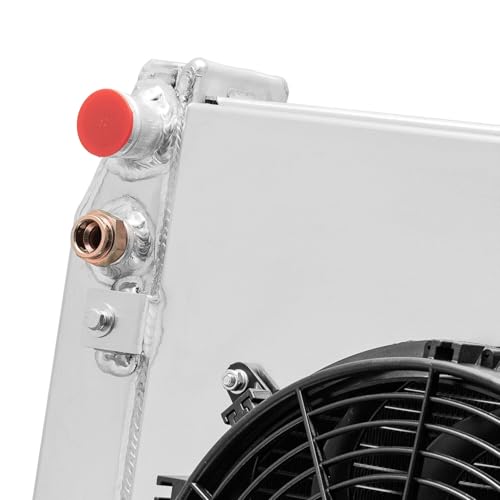
The supplied radiator includes provisions for both transmission and engine oil cooling.
This is especially relevant for trucks equipped with automatic transmissions, factory towing packages, or heavy-duty cooling systems.
Transmission Oil Cooling
Automatic transmission fluid generates heat during operation, particularly when towing or hauling heavy loads.
A radiator-integrated transmission cooler helps manage fluid temperature and can work alongside an auxiliary transmission cooler when properly configured.
Engine Oil Cooling
Some Chevrolet and GMC trucks use an engine oil cooler integrated into the radiator assembly.
Maintaining appropriate engine oil temperatures helps preserve lubricant performance during demanding operation.
Before installation, verify that the new radiator’s oil cooler connections match the vehicle’s factory plumbing.
For vehicles without an engine oil cooler, unused ports must be handled according to the radiator manufacturer’s instructions.
Common Chevy C1500 and GMC Sierra Overheating Problems
A new radiator can restore cooling performance when the original radiator is leaking, corroded, or internally restricted.
However, overheating may also result from other mechanical problems.
Failing Thermostat
A thermostat that fails to open can prevent adequate coolant circulation and cause rapid engine temperature increases.
Weak Water Pump
A worn water pump may reduce coolant flow or develop leaks around the shaft seal.
Clogged Radiator
Internal corrosion and mineral deposits can restrict coolant passages and reduce heat transfer efficiency.
Damaged Radiator Hoses
A collapsed lower radiator hose can restrict coolant flow, while deteriorated hoses may leak under pressure.
Cooling Fan Problems
A malfunctioning mechanical fan clutch or electric fan control system can cause overheating at idle or low speeds.
Trapped Air
Air pockets can interfere with coolant circulation and cause inconsistent temperature readings.
Combustion Gas Leaks
A failing head gasket or other internal engine problem can introduce combustion gases into the cooling system, causing excessive pressure and overheating.
Before replacing expensive components, diagnose the complete cooling system.
Visit our Complete Car Cooling System Guide for additional information on cooling system operation and maintenance.
Is This 2-Row Aluminum Radiator Kit Worth It for Your OBS Chevy?
For Chevrolet and GMC truck enthusiasts replacing an aging cooling system, this two-row aluminum radiator package offers a convenient combination of components.
Its aluminum core, dual electric fans, integrated oil cooler provisions, and included fan shroud make it an appealing option for selected stock and modified applications.
It may be particularly useful for:
- Restoring an OBS Chevy Silverado or GMC Sierra.
- Replacing a leaking factory radiator.
- Upgrading a 5.7L small-block cooling system.
- Converting from a mechanical fan to electric cooling fans.
- Refreshing cooling components on a high-mileage truck.
- Supporting properly engineered custom engine builds.
However, radiator dimensions, cooler fittings, fan clearance, and electrical compatibility should always be confirmed before purchase.
Upgrade Your Chevy GMC Cooling System at Pro Street Online
Whether you’re restoring a classic C1500, upgrading a GMC Sierra, or maintaining a hardworking Chevrolet 350-powered pickup, proper cooling system performance is essential.
The 2-Row Aluminum Radiator with Dual 12-Inch Electric Fans and Shroud combines performance-oriented aluminum construction with additional low-speed airflow and integrated fluid cooler provisions.
Designed for selected 1988–1999 Chevrolet and GMC C/K applications, this complete radiator package offers a practical cooling upgrade for enthusiasts who want dependable performance and modern electric fan functionality.
Shop Chevrolet radiators, GMC cooling components, aluminum fan shrouds, and performance engine upgrades at www.ProStreetOnline.com.





There are no reviews yet.