

Why Small Radiator Leaks Are So Common
A radiator spends its entire life dealing with heat, pressure, vibration, road debris, and chemical exposure.
When the engine warms up, coolant expands and the cooling system becomes pressurized.
Shut the engine down and everything cools again.
Repeat that process thousands of times.
Eventually, weak areas can develop around:
- Radiator seams
- Plastic end tanks
- Aluminum cores
- Tube connections
- Gaskets and seals
- Hose fittings
- Soldered or bonded joints
Sometimes these failures are obvious.
Other times they’re microscopic.
A tiny radiator leak may release coolant only while the engine is hot and the cooling system is under pressure. The coolant can then evaporate before enough reaches the ground to create a visible puddle.
The only evidence might be dried coolant residue.
Can Bar’s Leaks Seal an Aluminum Radiator?
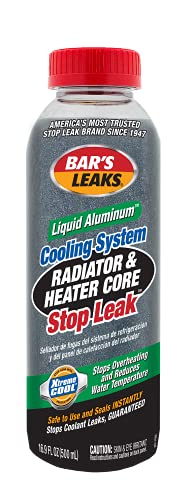
This product is specifically marketed for use with aluminum, plastic, and metal radiators.
That’s important because aluminum radiators are extremely common in modern vehicles and the aftermarket performance world.
A typical modern radiator uses an aluminum core with plastic end tanks, although all-aluminum performance radiators are also common.
Minor leakage can develop around:
- Core tubes
- Tank-to-core connections
- Small seams
- Aging joints
- Minor damage
For small seepage, a stop-leak product may provide a practical solution.
But if an aluminum radiator has a large puncture, damaged tube, separated weld, or major structural failure, replacing or professionally repairing the radiator remains the correct fix.
Can Radiator Stop-Leak Damage Your Cooling System?
Excellent commercial-support link because it directly answers a concern shoppers have before purchasing stop-leak.
Why Does My Engine Overheat at Idle?
Separates radiator leakage from fan and airflow-related overheating.
Can Bar’s Leaks Seal a Plastic Radiator?
Plastic radiator tanks are another extremely common failure point.
Years of heating and cooling eventually make some radiator plastics brittle.
Small cracks can develop around:
- Hose connections
- Tank seams
- Mounting areas
- Pressure points
- Fittings
A tiny seep may be manageable with a cooling-system sealing product.
But plastic radiator cracks deserve attention because they can grow.
A small crack today can become a substantial coolant leak after another pressure cycle.
If you can physically see a crack spreading through the radiator tank, don’t expect stop-leak to restore the structural strength of the plastic.
Plan on replacing the radiator.
Bar’s Leaks for Heater Core Leaks
Bar’s Leaks Liquid Aluminum is also intended to help address minor heater-core leaks.
The heater core is essentially a small heat exchanger located inside the vehicle’s HVAC system. Engine coolant circulates through it, allowing heat from the cooling system to warm the passenger compartment.
Heater-core leakage can produce some distinctive symptoms.
These include:
- Sweet smell inside the cabin
- Windshield fogging
- Greasy film on the windshield
- Damp passenger-side carpet
- Slowly decreasing coolant level
- Reduced heater performance
If you’re noticing an unusual sweet smell, our Why Does My Car Smell Sweet? guide can help determine whether coolant is leaking from the heater core or elsewhere in the system.
Don’t Overdose Heater-Core Stop Leak
Heater cores contain very small coolant passages.
That’s one reason cooling-system sealing products should always be used according to their directions.
Adding more sealant than recommended doesn’t automatically improve the repair.
Excess material inside a dirty or partially restricted cooling system can potentially create additional problems.
Use the correct amount.
Your cooling system isn’t a protein shake. Extra scoops aren’t automatically progress.
Can It Seal Freeze Plug Leaks?
Bar’s Leaks also lists freeze-plug leaks among the applications for Liquid Aluminum Stop Leak.
Freeze plugs—more accurately called core plugs—seal openings created during engine-block manufacturing.
Over time, corrosion can attack these plugs.
Early in the failure process, you may notice:
- Small coolant seep
- Dried coolant residue
- Occasional drops underneath the engine
- Slowly declining reservoir level
A small seep may be an appropriate situation for a cooling-system sealing treatment.
A heavily corroded freeze plug is different.
If the metal has deteriorated substantially, sealant cannot restore its structural strength.
Eventually the plug needs replacement.
What About Gasket Leaks?
The product is also marketed for certain gasket leaks.
That term requires some perspective.
Engines and cooling systems contain numerous gaskets and seals, and the severity of a gasket leak can range from a microscopic external seep to catastrophic internal engine failure.
A minor external cooling-system gasket seep may potentially respond to a stop-leak product.
A severely failed head gasket is another matter entirely.
Symptoms suggesting a more serious internal engine problem include:
- Persistent white exhaust after warm-up
- Rapid coolant loss
- Repeated overheating
- Cooling-system pressurization immediately after startup
- Misfires after sitting
- Coolant contamination in engine oil
- Combustion gases entering the coolant
If you’re seeing white exhaust and losing coolant, read White Smoke From Exhaust: Causes and Warning Signs before assuming radiator sealant is the answer.
Does Bar’s Leaks Liquid Aluminum Lower Coolant Temperature?
Bar’s Leaks also promotes the product as helping lower water temperature.
There is an important distinction here.
A cooling-system additive may improve coolant behavior or heat transfer under certain circumstances, but it cannot overcome a mechanically failed cooling system.
If the engine is overheating because of a:
- Failed water pump
- Stuck thermostat
- Clogged radiator
- Broken cooling fan
- Collapsed radiator hose
- Low coolant condition
- Severe internal engine problem
the underlying fault still needs to be diagnosed.
Think of temperature-reducing additives as helping a functioning cooling system perform its job—not giving a broken cooling system superpowers.
Thermostat or Water Pump? How to Tell Which One Failed
Useful for customers diagnosing overheating or coolant circulation problems.
Why Does My Car Smell Sweet?
Strong supporting link for coolant and heater-core leak symptoms.
White Smoke From Exhaust: Causes and Warning Signs
Helps distinguish an external radiator leak from potentially serious internal coolant loss.
What If the Engine Overheats at Idle?
This is particularly important when diagnosing an overheating complaint.
If the engine runs at a normal temperature while driving but overheats when sitting in traffic, a coolant leak may not be the primary problem.
At road speed, air naturally passes through the radiator.
At idle, electric or mechanical cooling fans must provide that airflow.
A vehicle that overheats mainly while stationary may therefore have:
- Failed radiator fan
- Faulty fan relay
- Fan-control problem
- Restricted radiator airflow
- Low coolant
- Weak coolant circulation
See Why Does My Engine Overheat at Idle? for the diagnostic process.
Adding stop-leak to a dead radiator fan is unlikely to impress the radiator fan.
Thermostat or Water Pump?
Another common mistake is assuming coolant loss or overheating automatically means radiator failure.
Thermostats and water pumps can create similar symptoms.
A thermostat that sticks closed restricts coolant circulation through the radiator.
A failing water pump may:
- Leak coolant
- Develop bearing noise
- Wobble at the pulley
- Lose pumping efficiency
- Stop circulating enough coolant
If you’re trying to determine which component is responsible, see Thermostat or Water Pump? How to Tell Which One Failed.
That’s a much better diagnostic strategy than replacing whichever component looks easiest to reach.
Can Radiator Stop Leak Damage the Cooling System?
It’s a fair question.
After all, you’re intentionally putting something into the cooling system that’s designed to seal an opening.
Modern radiators and heater cores contain narrow passages, so the condition of the cooling system matters.
Before using any stop-leak product, inspect the coolant.
Be cautious if you find:
- Heavy corrosion
- Rust
- Thick sediment
- Sludge
- Oil contamination
- Evidence of excessive previous stop-leak use
We’ve covered this question in detail in Can Radiator Stop-Leak Damage Your Cooling System?.
For a clean cooling system and an appropriately small leak, stop-leak has a much more reasonable job to perform.
A neglected system packed with corrosion and old additives is a different story.
Diagnose Before Adding Stop Leak
Before using Bar’s Leaks Liquid Aluminum Radiator Stop Leak, inspect the vehicle with the engine completely cold.
Check:
- Coolant reservoir level
- Radiator
- Radiator seams
- Radiator tanks
- Upper radiator hose
- Lower radiator hose
- Heater hoses
- Thermostat housing
- Water pump
- Accessible freeze plugs
- Coolant condition
Look closely for dried residue around connections and seams.
Coolant can leave behind white, green, blue, orange, yellow, or pink deposits depending on the antifreeze formulation.
If the leak isn’t visible, perform a cooling-system pressure test.
Pressure testing is especially useful because some coolant leaks only become apparent once the system is pressurized.
How to Find a Coolant Leak You Can’t See
Best supporting article for customers experiencing unexplained coolant loss.
When Bar’s Leaks Liquid Aluminum Makes Sense
This product is most appropriate when dealing with a minor cooling-system leak rather than a major component failure.
Good Candidates Include:
- Small aluminum radiator seep
- Small plastic radiator leak
- Minor metal radiator leak
- Gradual coolant loss
- Small heater-core leak
- Minor freeze-plug seep
- Minor external gasket seep
- Older high-mileage vehicle
- Temporary repair before component replacement
When You Should Repair the Vehicle Instead
Skip the stop-leak approach when you’re dealing with:
- Large radiator crack
- Split radiator tank
- Burst hose
- Rapid coolant loss
- Severely corroded freeze plug
- Failed water-pump bearing
- Broken water-pump impeller
- Stuck thermostat
- Nonfunctioning cooling fan
- Severely restricted radiator
- Major head-gasket failure
- Cracked cylinder head
- Cracked engine block
Stop-leak is a tool.
It isn’t an exemption from mechanical reality.
Bar’s Leaks Liquid Aluminum vs. High Mileage Cooling System Repair
Pro Street also carries and covers Bar’s Leaks 1150 High Mileage Cooling System Repair, so there is a useful distinction between the two products.
The Liquid Aluminum Radiator Stop Leak is especially relevant to shoppers focused on sealing small leaks involving the radiator, heater core, freeze plugs, or cooling-system gaskets.
The High Mileage Cooling System Repair product makes more sense as a broader high-mileage cooling-system treatment where leak control and additional cooling-system conditioning are both priorities.
This creates a natural opportunity to cross-link both product pages rather than making them compete for identical search intent.
Is Bar’s Leaks Liquid Aluminum Radiator Stop Leak Worth Buying?
For a small coolant leak involving an aluminum, plastic, or metal radiator, heater core, freeze plug, or minor cooling-system gasket seep, Bar’s Leaks Liquid Aluminum Radiator Stop Leak offers an inexpensive repair option worth considering.
Its strongest application is an aging vehicle with a relatively small leak where immediate component replacement isn’t practical.
It’s also useful as a product to have available before a small leak becomes a much larger coolant-loss problem.
Just keep expectations realistic.
If you’re topping off the reservoir occasionally because of a tiny radiator seep, a stop-leak product may be appropriate.
If you’re carrying three gallons of coolant everywhere you go, congratulations—you no longer have a “small leak.”
You have a repair appointment.





There are no reviews yet.