
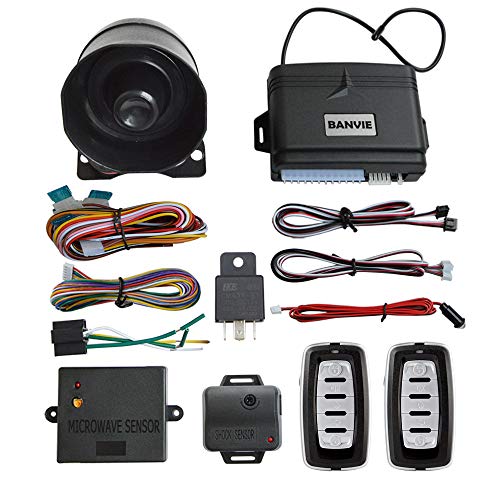


BANVIE Car Alarm System with Microwave Sensor, Keyless Entry & Engine Cut
A basic car alarm watches for someone opening the door.
The BANVIE Car Alarm System goes a little further.
This universal 12V security system combines traditional shock detection with a microwave intrusion sensor, a 110dB six-tone siren, keyless-entry control and an engine-cut relay for an additional immobilization layer.
That makes it especially interesting for older cars and project vehicles where you want more protection than a simple siren-and-shock-sensor setup without moving all the way into GPS tracking or subscription-based connected security.
Key features include:
- Keyless entry
- Remote lock and unlock
- Shock sensor
- Microwave intrusion sensor
- 110dB alarm siren
- Six-tone audible warning
- Engine-cut relay
- Anti-hijacking function
- Remote trunk-release support
- Car-finder function
- Silent arm mode
- Parking-light flash
- Automatic central door locking
- Optional automatic window closing
- Two remote controls
This is a car alarm and keyless-entry system.
It is not a remote-start system.
Shock Sensor Plus Microwave Intrusion Detection
The biggest feature separating this BANVIE system from inexpensive entry-level alarms is its dual-sensor approach.
Most basic alarms use only a shock sensor.
The BANVIE adds a microwave sensor designed to detect intrusion within the protected area.
That gives the alarm two different ways to detect suspicious activity.
Shock Sensor
Responds to physical vibration or impact.
Potential examples include:
- Window impact
- Body-panel impact
- Repeated tampering
- Force against the vehicle
Microwave Sensor
Designed to detect movement or intrusion within its detection field.
This can add another layer of protection when somebody reaches or moves into a protected area without necessarily creating a major impact first.
$34.99
Why Microwave Detection Matters
An impact sensor is useful.
But not every intrusion begins with somebody kicking the door.
Microwave sensing gives the alarm another input that can help detect activity that a conventional vibration sensor may not recognize as quickly.
This makes the BANVIE particularly interesting for vehicles where interior intrusion is a concern.
Sensor placement and sensitivity adjustment are critical.
Set the microwave sensor too aggressively and normal nearby movement can create nuisance alarms.
Set it properly and it becomes a useful second layer.
110dB Alarm Siren
The system includes a dedicated siren rated at approximately 110dB.
When the system detects a valid alarm condition, the siren provides a loud audible warning intended to:
- Draw attention
- Discourage continued tampering
- Alert the owner or people nearby
- Make the vehicle less attractive as an easy target
The system supports a six-tone audible alarm pattern rather than relying solely on the factory horn.
Six-Tone Siren
BANVIE describes the siren as a six-tone alarm siren.
The changing tones help make the alarm noticeable and distinguish it from ordinary traffic noise.
It is still a conventional local alarm rather than a cellular notification system.
If you’re three cities away, the siren cannot text you.
But if somebody is standing beside your car doing something they shouldn’t, 110 decibels makes subtlety considerably more difficult.
Silent Arm Mode
Sometimes you want the security system armed without an audible chirp every time you lock the car.
The BANVIE supports a silent alarm/arming mode.
This allows you to activate supported security functions while reducing normal audible confirmation.
That is especially convenient:
- Late at night
- In apartment complexes
- In quiet neighborhoods
- In parking structures
The alarm can still respond to valid trigger events according to its configuration.
Keyless Entry
When integrated with compatible central door locks, the included remotes can provide:
- Lock
- Unlock
- Arm
- Disarm
This is useful on vehicles that have power locks but either:
- Never had factory remote entry
- Have missing factory remotes
- Have damaged factory remotes
- Have poor factory remote range
The security system and keyless-entry functions can then operate from the same remote.
Two Remote Controls
The system includes two remotes.
That gives you:
- One primary remote
- One spare
or one remote for each regular driver.
BANVIE describes the remote housing as using a zinc-alloy frame for a more substantial feel than extremely lightweight plastic-only fobs.
Remote Car Finder
The system includes a car-finder function.
This can activate the vehicle’s audible and/or lighting outputs so you can identify it in a crowded parking lot.
It also doubles as an attention-getting function if you need to locate or draw attention to the vehicle quickly.
Remote Trunk Release
The system supports remote trunk-release control on compatible vehicles.
Depending on the vehicle, installation may require:
- Additional relay
- Trunk-release solenoid
- Vehicle-specific interface
So this should be marketed as:
Remote trunk-release support
rather than promising direct compatibility with every trunk circuit.
Parking-Light Flash
The alarm can be connected to the vehicle’s exterior lighting circuit to provide visual confirmation.
The lights can flash during supported events such as:
- Arm
- Disarm
- Alarm activation
- Car finder
That gives you visual confirmation in addition to audible feedback.
Engine-Cut Relay
One of the most useful security features in this package is the engine cut-off relay.
When correctly installed, the relay can interrupt a selected starting or engine-control circuit while the alarm is armed.
This creates an additional immobilization layer.
Instead of the alarm merely making noise, the system can also make unauthorized vehicle operation more difficult.
Engine Cut Is Installation Dependent
The effectiveness of the engine-cut circuit depends almost entirely on how it is installed.
A professional installer will choose an appropriate circuit and integrate the relay so that it:
- Does not compromise normal reliability
- Does not create unsafe operating conditions
- Remains difficult for a thief to identify quickly
- Works correctly with the alarm controller
The relay itself should not be marketed as a universal guarantee that every vehicle will be impossible to start.
Vehicle electrical systems vary significantly.
Anti-Hijacking Function
BANVIE also includes an anti-hijacking mode that works with the engine-cut functionality.
This feature is intended to provide an additional response to certain unauthorized-use scenarios.
Because it involves vehicle immobilization, installation and configuration should be handled carefully.
Engine interruption while a vehicle is moving can present obvious safety concerns if implemented incorrectly.
This feature should therefore be installed strictly according to the supplied instructions and applicable safety requirements.
Anti-Hijacking Is Not Remote GPS Shutdown
It is important to distinguish this system from connected telematics products.
The BANVIE does not provide:
- GPS tracking
- LTE communication
- Smartphone vehicle location
- Cloud-based shutdown commands
Its anti-hijacking functionality is part of the locally installed alarm system.
It is not the same as remotely disabling a stolen vehicle from a smartphone.
Automatic Central Door Locking
The system can automatically control compatible central door locks.
According to the documented configuration, the doors can automatically lock after the vehicle begins operating and unlock when the ignition is turned off.
The feature can also be enabled or disabled.
This adds convenience as well as security.
Automatic Door Locking Can Be Disabled
Not everybody wants automatic locking behavior.
BANVIE allows this feature to be configured rather than permanently forcing it on.
That is useful for:
- Project cars
- Work vehicles
- Vehicles with unusual lock configurations
- Owners who prefer manual lock control
Optional Power-Window Closing
The system can support automatic window-closing functionality on compatible vehicles.
However, this depends heavily on the vehicle.
The original vehicle must have a compatible closing circuit or additional hardware may be required.
Do not advertise universal window-closing capability.
The safer description is:
Automatic window-closing output supported on compatible applications.
12V Vehicle Compatibility
The system is designed for conventional DC12V vehicles.
BANVIE markets it as suitable for many 12V cars, but “universal” should not be interpreted as:
Fits every vehicle without additional parts.
Modern vehicles can use:
- CAN-bus networks
- Multiplex door locks
- Factory immobilizers
- Smart keys
- Body-control modules
- Data-based lighting
- Integrated factory alarms
These vehicles may require additional interfaces or may simply be poor candidates for a generic analog alarm.
Particularly Useful for Older Cars
This type of alarm can be an especially good match for older vehicles with traditional electrical systems.
Potential applications include:
- Older Hondas
- Older Toyotas
- Older Nissans
- Mitsubishi platforms
- Classic imports
- Older domestic cars
- Pickups
- Project cars
Many of these vehicles have straightforward 12V door-lock and ignition circuits that are easier to integrate with an aftermarket alarm.
Not Remote Start
This system should not be sold as a remote starter.
Its functions revolve around:
- Security
- Keyless entry
- Alarm triggering
- Immobilization
- Convenience outputs
There is no documented remote engine-start function in this BANVIE configuration.
Keeping that distinction clear prevents buyers from confusing it with alarm/remote-start combinations.
Not a 2-Way Pager Alarm
This is also best positioned as a conventional 1-way remote alarm.
Commands travel from the remote to the vehicle.
The remotes do not provide the detailed return notifications found in 2-way LCD pager systems.
If you need confirmation that the alarm triggered while the vehicle is parked out of sight, a 2-way system such as the EASYGUARD EC206-A or a compatible Compustar/Viper system is the better approach.
No GPS Tracking
The BANVIE does not include GPS.
It cannot:
- Display vehicle location
- Record trip history
- Create geofences
- Track the car through an app
Those features require separate GPS/LTE hardware.
No Subscription Required
Because the system does not depend on cellular connectivity, there is no regular subscription for the core alarm functions.
That makes it attractive to drivers who want conventional vehicle security without another monthly service.
BANVIE vs. Basic Universal Car Alarm
A basic universal alarm may include:
- Shock sensor
- Siren
- Keyless entry
- Two remotes
The BANVIE adds some meaningful upgrades:
- Microwave intrusion sensing
- Engine-cut relay
- Anti-hijacking capability
- 110dB six-tone siren
- More extensive central-lock automation
If the price difference is reasonable, those additions make the BANVIE a considerably stronger basic-security package.
BANVIE vs. EASYGUARD EC206-A
These two alarms target different users.
BANVIE
- 1-way remote
- Shock sensor
- Microwave sensor
- 110dB siren
- Engine-cut relay
- No remote start
- No subscription
EASYGUARD EC206-A
- 2-way LCD pager
- Remote alarm feedback
- Shock sensing
- Keyless entry
- Engine-cut support
- Longer-range pager communication
- No remote start
Choose BANVIE if physical detection and value are the priority.
Choose the EC206-A if receiving alarm feedback on the remote matters more.
Electronic Alarm + Physical Lock
An electronic alarm becomes even more useful when combined with a physical anti-theft device.
A layered configuration could include:
Layer 1 — Visible Steering-Wheel Lock
Creates an obvious physical obstacle.
Layer 2 — BANVIE Alarm
Detects impact, intrusion and unauthorized access.
Layer 3 — Engine Cut
Makes unauthorized starting or operation more difficult.
Layer 4 — GPS Tracker
Provides recovery capability if the other layers are defeated.
Our guide to car alarms that protect your build explains why combining independent security layers generally makes more sense than expecting any single alarm to do everything.
Professional Installation Recommended
A system like this requires direct integration with vehicle electrical circuits.
Potential wiring includes:
- Constant 12V
- Ground
- Ignition / ACC
- Door trigger
- Central locking
- Trunk release
- Parking lights
- Shock sensor
- Microwave sensor
- Siren
- Engine-cut relay
- Optional window output
If you’re not experienced with automotive electrical diagnostics, professional installation is strongly recommended.
Sensor Placement Matters
Both the shock sensor and microwave sensor need proper mounting and adjustment.
Shock Sensor
Should be attached to a solid location where chassis vibration transfers consistently.
Microwave Sensor
Should be positioned where the detection field protects the intended interior area without excessive outside interference.
Bad placement can create:
- False alarms
- Poor detection
- Inconsistent triggering
Spend time tuning the sensors after installation.
Siren Installation
The 110dB siren should be mounted somewhere:
- Secure
- Difficult to reach quickly
- Away from moving components
- Away from extreme exhaust heat
- Protected from direct water accumulation
Installing the siren in a painfully obvious position with its wiring hanging out makes the thief’s troubleshooting process unnecessarily easy.
Security components should require some effort to reach.
Hide the Control Module
The alarm control module should also be hidden inside the vehicle.
Avoid mounting it directly beneath the steering column where it can be unplugged immediately after a trim panel is removed.
A good installation uses:
- Secure connections
- Wrapped harnesses
- Concealed module placement
- Proper fusing
The goal is to make the alarm look like part of the vehicle’s wiring rather than something added during lunch.
Who Should Buy the BANVIE Car Alarm?
This system is a good fit for drivers who want:
Affordable aftermarket security
Shock detection
Microwave intrusion detection
Engine immobilization support
Keyless entry
Two remotes
No monthly subscription
Security for an older or project car
It is particularly attractive for vehicles with straightforward 12V wiring where a sophisticated CAN-based alarm system is unnecessary.
Who Should Choose Something Else?
Consider another system if your priority is:
- Remote engine start
- Smartphone alerts
- GPS tracking
- 2-way LCD feedback
- Three-mile remote range
- Proximity unlock
- OEM-style CAN integration
Those features require a more advanced platform.
BANVIE Car Alarm Specifications
Brand: BANVIE
Product Type: Car Alarm & Keyless Entry System
Vehicle Voltage: DC12V
Communication: 1-Way RF
Remotes Included: 2
Remote Construction: Zinc-alloy-frame design
Keyless Entry: Yes
Shock Sensor: Yes
Microwave Sensor: Yes
Siren: Yes
Siren Output: Approximately 110dB
Siren Tones: 6
Silent Arm: Yes
Door Monitoring: Yes
Remote Trunk Release: Supported
Car Finder: Yes
Light Flash: Supported
Engine-Cut Relay: Yes
Anti-Hijacking Function: Yes
Automatic Door Locking: Yes
Automatic Door Unlock: Supported when configured
Window Closing: Optional/vehicle dependent
Remote Engine Start: No documented remote-start function
2-Way Paging: No
GPS: No
Smartphone App: No
Subscription: No
Professional Installation: Strongly recommended
Frequently Asked Questions
Does the BANVIE alarm include a shock sensor?
Yes. The system includes shock/vibration detection.
Does it also include a microwave sensor?
Yes. This version adds microwave intrusion detection in addition to shock sensing.
How loud is the siren?
The siren is rated at approximately 110dB.
Is it a six-tone siren?
Yes.
Does the BANVIE system include engine cut?
Yes. An engine cut-off relay is included for proper vehicle-specific installation.
Does engine cut mean the car can never be stolen?
No. No security system should be marketed as theft-proof. The relay adds another immobilization obstacle when installed correctly.
Does the system support anti-hijacking?
Yes, according to BANVIE’s documented functionality.
Does it provide keyless entry?
Yes, when integrated with compatible vehicle door locks.
Does it automatically lock the doors?
The system supports automatic central-door locking and unlocking behavior when correctly configured.
Can I disable automatic door locking?
Yes. The feature can be configured.
Can it open the trunk?
Remote trunk release is supported on compatible vehicles. Additional hardware may be required.
Can it automatically close my windows?
Window-closing output is supported on compatible applications, but vehicle-specific hardware may be necessary.
Does this system include remote start?
No documented remote engine-start function is included.
Is it a 2-way alarm?
No. This version uses conventional 1-way remotes.
Does it have GPS?
No.
Does it require a monthly subscription?
No.
Will it work on every 12V vehicle?
No. It is marketed as a universal 12V alarm, but actual compatibility depends on the vehicle’s electrical architecture.
Should it be professionally installed?
Yes. Professional installation is strongly recommended, especially because the system includes engine-cut and anti-hijacking functions.
More Than Just a Noise Maker
Cheap alarms are easy to understand.
Something shakes the car.
The siren screams.
Everyone ignores it.
The BANVIE Car Alarm System is more interesting because it adds several independent security layers:
Shock detection.
Microwave intrusion detection.
Door monitoring.
Engine-cut capability.
Keyless entry.
Automatic door locking.
It still isn’t a GPS tracker or premium 2-way security system.
But for an older daily driver, project car or budget build, it provides considerably more protection than a siren and blinking LED alone.
And sometimes making the thief solve three problems instead of one is exactly the point.
Specification: BANVIE Car Alarm System with Microwave Sensor, Keyless Entry & Engine Cut
|
User Reviews
Be the first to review “BANVIE Car Alarm System with Microwave Sensor, Keyless Entry & Engine Cut”
You must be logged in to post a review.





There are no reviews yet.