
Designed for 2-Ohm and 4-Ohm Systems
The AudioControl EPICFIVE supports 2-ohm and 4-ohm speaker configurations, giving installers flexibility when selecting compatible speakers and subwoofers.
Impedance directly affects the load placed on the amplifier.
Before installation, verify:
- Speaker impedance
- Speaker RMS power handling
- Subwoofer impedance
- Voice-coil configuration
- Final wired subwoofer load
- Amplifier output at the selected impedance
This is especially important when configuring dual-voice-coil subwoofers.
A subwoofer labeled “4 ohms” doesn’t necessarily present a 4-ohm final load once multiple voice coils and wiring configurations enter the equation.
One Amplifier for the Entire Car Audio System
One of the EPICFIVE’s biggest advantages is consolidation.
Instead of installing one amplifier for the cabin speakers and another amplifier for the subwoofer, a five-channel design can handle both jobs.
That can mean:
- Less mounting space
- Fewer power connections
- Fewer ground connections
- Simpler signal routing
- Fewer distribution components
- Cleaner amplifier racks
- Easier troubleshooting
For street cars and daily drivers, this can provide a strong balance between audio performance and installation complexity.
Our car audio system guide covers the relationship between speaker sensitivity, impedance, RMS power and amplifier selection when planning a complete system.
Efficient Digital Class D Amplifier Design
The EPICFIVE uses digital Class D amplification to produce substantial output from a relatively compact package.
Class D architecture offers high electrical efficiency, which is particularly valuable in a five-channel amplifier.
Efficiency helps reduce:
- Power wasted as heat
- Amplifier chassis size
- Electrical demand relative to output
- Cooling requirements
That doesn’t mean a Class D amplifier produces no heat. Proper ventilation is still important, particularly when operating multiple channels at significant output.
Compact Low-Profile Chassis
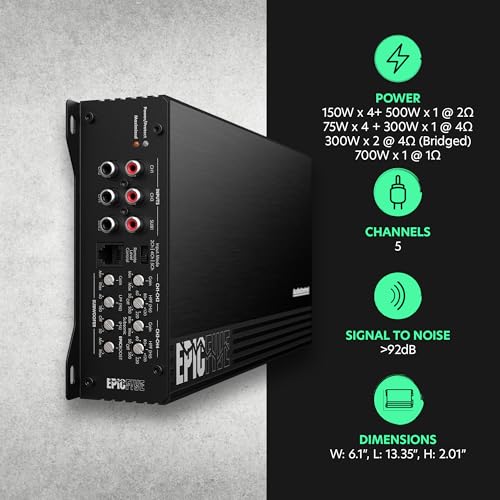
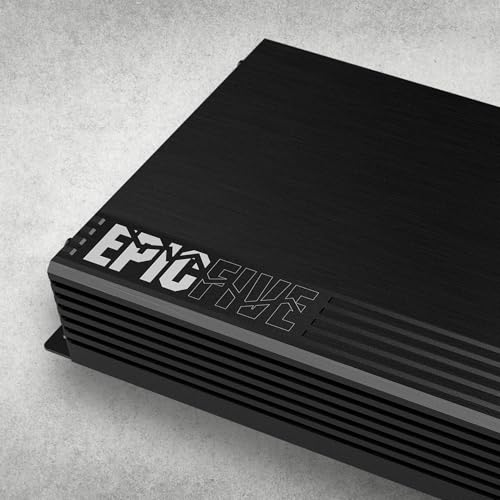
The AudioControl EPICFIVE measures approximately:
6.1 inches wide
13.35 inches long
2.01 inches high
The relatively narrow, low-profile chassis gives installers more freedom when locating the amplifier.
Possible mounting locations may include:
- Under a seat
- Behind rear seating
- Inside a custom trunk panel
- Within an amplifier rack
- Beneath cargo-floor panels
- Inside custom interior installations
Remember to leave additional clearance for wiring and airflow.
An amplifier technically fitting into a space doesn’t help much if the power cable requires violating several known laws of geometry to connect.
Included AudioControl ACR-E Bass Control
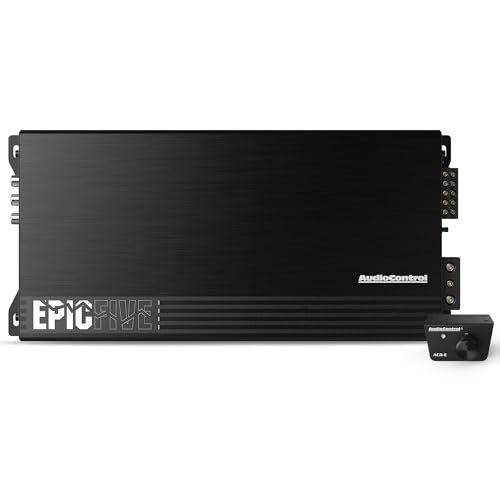
The EPICFIVE includes an AudioControl ACR-E remote bass control.
The controller allows subwoofer output to be adjusted from the driver’s position rather than requiring access to the amplifier.
AudioControl provides options for mounting the controller using the supplied dash bracket or integrating it more directly into a dashboard or console panel.
This makes bass adjustment convenient for different music, recordings and listening environments.
EPIC Variable Bass Enhancement
The EPICFIVE includes a variable 0–12 dB EPIC bass equalizer.
This allows selected low frequencies to be emphasized according to the audio system and listening preference.
Bass enhancement should be used carefully.
Every decibel of additional boost requires the amplifier and subwoofer to work harder at the affected frequencies.
Excessive boost can reduce available headroom and contribute to:
- Clipping
- Distortion
- Excessive subwoofer excursion
- Amplifier heat
- Speaker damage
Establish proper gain and crossover settings before adding significant bass enhancement.
12 dB/Octave Linkwitz-Riley Crossovers
AudioControl equips the EPICFIVE with 12 dB/octave Linkwitz-Riley crossover filtering.
Crossovers control which frequencies reach specific speakers.
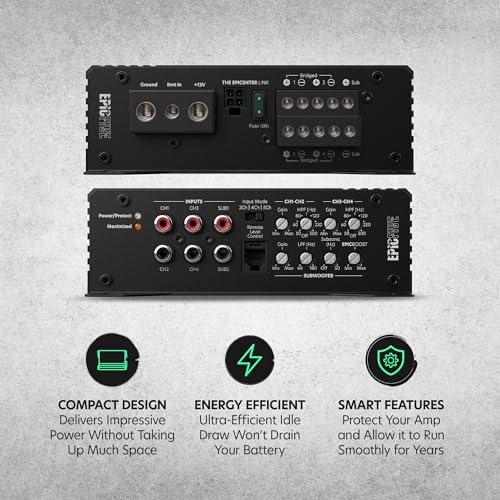
The EPICFIVE provides high-pass, low-pass and subsonic filtering so the system can be divided according to the capabilities of its individual speakers.
Correct crossover setup can improve:
- Midrange clarity
- Bass integration
- Speaker output
- Speaker reliability
- Overall system balance
A properly tuned system doesn’t require every speaker to reproduce every frequency.
That’s not versatility. That’s making a tweeter reconsider its career choices.
High-Pass Filtering
The high-pass filter prevents frequencies below the selected crossover point from reaching the connected speaker channels.
This is especially useful for door speakers and component systems.
Removing deep bass from smaller speakers reduces unnecessary cone excursion and allows them to concentrate on midbass, midrange and higher frequencies.
When a dedicated subwoofer is installed, high-pass filtering can create a cleaner transition between the primary speakers and bass system.
Low-Pass Filtering
The EPICFIVE also incorporates low-pass filtering.
Low-pass filters prevent frequencies above the selected crossover point from reaching speakers intended for lower-frequency reproduction.
In a typical system, the subwoofer should concentrate on bass rather than attempting to reproduce vocals and other higher-frequency content.
Correct low-pass adjustment helps the subwoofer integrate with the front and rear speakers instead of becoming an obvious separate sound source.
Adjustable Subsonic Filter
AudioControl includes a subsonic filter for controlling extremely low frequencies.
Subsonic filtering can be particularly useful when operating a ported subwoofer enclosure.
Below a ported enclosure’s tuning frequency, cone excursion can increase dramatically while useful acoustic output decreases.
Filtering those frequencies can help protect the subwoofer and preserve amplifier power for useful bass reproduction.
91 dB+ Signal-to-Noise Ratio
AudioControl specifies a signal-to-noise ratio greater than 91 dB for the EPICFIVE.
Signal-to-noise ratio describes the relationship between the desired audio signal and background noise.
Actual system noise performance also depends on:
- Source quality
- RCA routing
- Grounding
- Gain structure
- Vehicle electrical noise
- Installation quality
A quality amplifier still needs a quality installation.
No amount of expensive circuitry can negotiate peace with a terrible ground connection.
Line-Level Inputs for Aftermarket Head Units
The EPICFIVE includes line-level inputs designed for integration with compatible aftermarket source units.
RCA preamp outputs from the head unit or signal processor can feed the amplifier directly.
When routing RCA cables, keep signal wiring away from high-current power cables whenever practical to reduce the possibility of induced noise.
For factory-radio installations, verify what additional integration hardware may be necessary before purchasing.
EPICENTER Link Integration
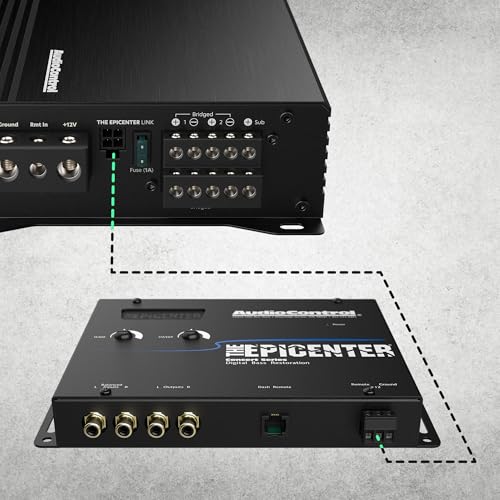
One of the more distinctive features of the EPICFIVE is its dedicated EPICENTER Link port.
The connection is designed to simplify integration with AudioControl’s EPICENTER bass-restoration processor.
The link provides:
- +12V power
- Ground
- Remote turn-on
- Built-in fuse protection
This can reduce wiring complexity when adding a compatible EPICENTER processor to the system.
For bass-focused builds, this provides a cleaner path to integrating AudioControl’s well-known bass-restoration technology.
What Does an EPICENTER Do?
Bass-restoration processors are designed to analyze musical content and enhance low-frequency information that may be weak or missing in the original recording.
This can be particularly useful with older recordings and music where the original production doesn’t contain the deep bass response expected from a modern subwoofer system.
The EPICFIVE doesn’t require an EPICENTER to operate, but its dedicated connection makes adding one considerably easier.
Ultra-Efficient Idle Current Draw
AudioControl designed the EPICFIVE with low idle current consumption.
Reduced idle draw is useful in automotive installations because the amplifier should consume as little unnecessary power as possible when it isn’t producing significant output.
This becomes particularly important in vehicles equipped with multiple electronic accessories or vehicles that may sit for extended periods.
Battery condition still matters, of course. Low idle draw cannot resurrect a battery that has been quietly plotting its retirement since 2014.
Multiple Built-In Protection Modes
The EPICFIVE includes protection against several potentially damaging electrical and thermal conditions.
These include protection related to:
- Low voltage
- High voltage
- Short circuits
- Electrical faults
- Thermal conditions
Protection circuitry helps safeguard the amplifier, but it shouldn’t routinely activate during normal use.
Repeated protection-mode operation indicates an underlying problem that should be diagnosed.
Prevent Amplifier Overheating
Although Class D amplifiers are efficient, they still produce heat.
Install the EPICFIVE where airflow can move around its chassis.
If the amplifier repeatedly enters thermal protection, inspect:
- Speaker impedance
- Mounting location
- Ventilation
- Gain settings
- Power wiring
- Ground wiring
- Vehicle voltage
Our guide explaining why car amplifiers overheat covers the electrical and installation problems that commonly cause amplifier temperatures to climb.
Direct-Wire Power Connections
The EPICFIVE uses direct-wire terminals with hex fasteners for secure electrical connections.
The specified connections include:
- 4-gauge power connection
- 8-gauge speaker terminals
Secure high-current connections are essential in an amplifier capable of producing more than 1,000 watts RMS.
Loose terminals create resistance.
Resistance creates voltage drop and heat.
Neither is particularly welcome in a high-output audio system.
150-Amp Recommended Fuse
The supplied specifications recommend a 150-amp fuse, sold separately.
The main amplifier power cable should be appropriately fused near the battery.
This fuse primarily protects the power cable if it becomes shorted to chassis ground.
The fuse and wiring should be selected according to AudioControl’s installation requirements and the actual cable used.
Why 4-Gauge Power Wiring Matters
High-output amplifiers require significant current.
Undersized power wiring can create excessive resistance, resulting in:
- Voltage drop
- Reduced amplifier output
- Excessive cable heat
- Early clipping
- Amplifier shutdown
- Unstable operation
The EPICFIVE’s 4-gauge power connection provides the physical interface required for a suitably sized power feed.
Don’t spend money on an 1,100-watt amplifier and then starve it through bargain-bin wiring. Electricity remains annoyingly committed to physics.
Check Voltage at the Amplifier
If an audio system behaves normally at low volume but cuts out or distorts when output increases, check supply voltage at the amplifier under load.
Resistance can occur at:
- Battery terminals
- Fuse holders
- Power connections
- Ground points
- Distribution blocks
- Crimp terminals
Our automotive voltage-drop testing guide explains why testing a circuit while current is flowing is often more useful than simply checking continuity.
That same diagnostic method works exceptionally well when troubleshooting amplifier power problems.
Match Speakers and Subwoofers by RMS Power
The EPICFIVE’s 1,100-watt RMS rating provides a much more useful basis for system design than a giant theoretical peak-power figure.
When choosing speakers and subwoofers, compare:
- Amplifier RMS output
- Speaker RMS handling
- Subwoofer RMS handling
- Speaker impedance
- Subwoofer voice-coil impedance
- Final wired load
Correct matching allows the amplifier and speakers to operate within their intended ranges.
Set Gain Correctly
Amplifier gain controls are designed to match the amplifier’s input sensitivity with the output from the source unit.
Gain is not a second volume knob.
Setting gain too high can cause the amplifier to reach clipping prematurely.
Clipping can result in:
- Audible distortion
- Reduced clarity
- Excessive heat
- Speaker damage
- Subwoofer damage
Configure the source, gain and crossover network methodically before adding aggressive equalization.
Excellent for a Complete Daily-Driver System
The EPICFIVE is particularly well suited to systems where installation space matters but substantial output is still required.
A typical setup might include:
- Front component speakers
- Rear coaxial speakers
- Dedicated subwoofer
- AudioControl EPICFIVE
- ACR-E remote control
That provides amplification for the entire system without requiring separate full-range and subwoofer amplifiers.
For a performance car, truck or daily driver where trunk space still needs to perform its revolutionary secondary function of carrying things, that’s a useful advantage.
Key Features
- AudioControl EPICFIVE
- Five-channel car audio amplifier
- Digital Class D architecture
- 1,100 watts RMS total output
- 2-ohm and 4-ohm applications
- 91 dB+ signal-to-noise ratio
- Included ACR-E remote bass control
- Variable 0–12 dB EPIC bass EQ
- High-pass filtering
- Low-pass filtering
- Subsonic filtering
- 12 dB/octave Linkwitz-Riley crossovers
- Dedicated EPICENTER Link
- Low idle current draw
- Low-voltage protection
- High-voltage protection
- Short-circuit protection
- Thermal protection
- Direct-wire hex terminals
- 4-gauge power connection
- 8-gauge speaker terminals
- Recommended 150A fuse
- Line-level inputs
- Compact low-profile chassis
- 6.1 x 13.35 x 2.01 inches
- Designed to power four speaker channels plus a subwoofer
Premium 5-Channel Power Without the Multi-Amp Complexity
The AudioControl EPICFIVE 5-Channel Class D Amplifier is designed for enthusiasts who want substantial system power, sophisticated tuning and a clean installation from a single amplifier.
Its 1,100-watt RMS output provides power for four primary speaker channels plus a dedicated subwoofer channel, while efficient Class D architecture keeps the chassis relatively compact.
AudioControl goes beyond basic amplification with Linkwitz-Riley crossover filtering, high-pass, low-pass and subsonic controls, variable EPIC bass enhancement and the included ACR-E remote control. The dedicated EPICENTER Link also makes the EPICFIVE particularly interesting for bass-focused AudioControl systems.
Add direct-wire 4-gauge power connectivity, multiple protection modes and low idle current draw, and the EPICFIVE becomes a strong foundation for a serious single-amplifier car audio build.
Basically, it’s for the enthusiast who wants five channels, 1,100 watts RMS and proper tuning controls—but would still like to have some trunk left when the installation is finished.









There are no reviews yet.