


Android 13 With AICE 13
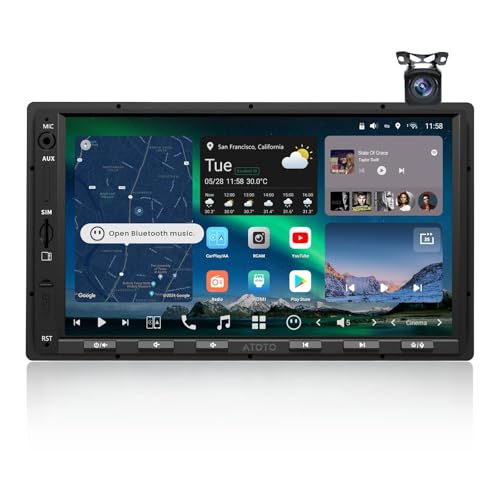
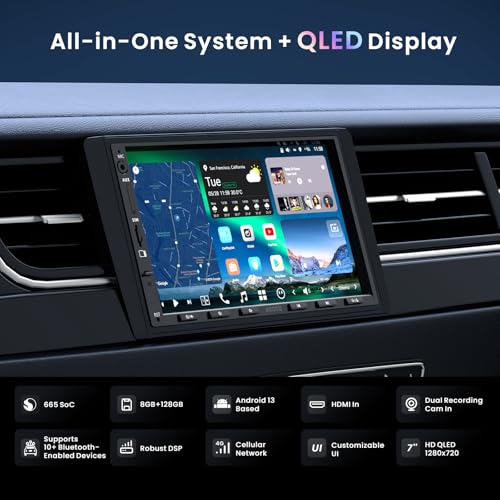
The X10 platform runs Android 13 with ATOTO’s customized AICE 13 interface.
That means compatible Android applications can operate directly on the head unit without requiring your phone.
Google Play and ATOTO’s FindApps platform provide access to compatible applications for navigation, media and other functions.
This gives you two basic ways to use the stereo.
Run applications directly through Android when you want maximum flexibility.
Or connect your phone and use CarPlay or Android Auto when you just want to get somewhere.
7-Inch 1280×720 QLED Display
The X10 uses a 7-inch 1280×720 QLED display rated around 550 nits with a light-suppression treatment.
That traditional screen size is one of the strongest reasons to choose this version of the X10.
It’s large enough for:
- Navigation
- CarPlay
- Android Auto
- Camera feeds
- Audio controls
- Vehicle data
- Android apps
But it still fits into the dashboard like a conventional Double DIN radio.
For an older enthusiast car, that can look much cleaner than installing a 10-, 12- or 14-inch display over half the center console.
More screen is not automatically more better.
Sometimes you still need access to the heater.
Traditional Double DIN Installation
The 7-inch X10 uses a conventional Double DIN installation format.
That makes it suitable for many vehicles with an appropriate Double DIN opening, although vehicle-specific integration components may still be required.
Depending on the vehicle, expect to need some combination of:
- Dash kit
- Wiring harness
- Antenna adapter
- Steering-wheel-control interface
- CAN-bus interface
- Factory amplifier integration
- Factory USB adapter
- Camera integration
For more on radio sizing, see our guide to Single DIN vs Double DIN stereo fitment.
Always check the vehicle before ordering.
Double DIN standardizes the basic radio dimensions.
Automakers apparently decided standardizing everything behind the radio would have been far too convenient.
Built-In 4G LTE
The X10 includes its own cellular communication module.
With compatible service, that lets the Android system maintain internet connectivity without depending entirely on a smartphone hotspot.
That can benefit:
- Google Maps
- Live traffic
- Music streaming
- Internet radio
- TrackHU
- DriveChat
- Android applications
- Software updates
The X10 also supports dual-band 2.4GHz and 5GHz Wi-Fi.
Built-In Wi-Fi Hotspot
The cellular connection can also be shared with compatible passenger devices through the X10’s hotspot functionality.
That can be useful for:
- Tablets
- Passenger phones
- Road-trip devices
- Other compatible Wi-Fi hardware
For family travel or overland builds, having the head unit act as the vehicle’s connectivity hub can be considerably more convenient than constantly enabling a driver’s phone hotspot.
Wireless Apple CarPlay
The X10 supports wireless Apple CarPlay.
Compatible iPhones can access familiar functions including:
- Apple Maps
- Google Maps
- Waze
- Calls
- Messages
- Music
- Podcasts
- Siri
The X10G2A7E family is primarily designed around wireless CarPlay rather than requiring the phone to remain plugged in.
Get into the car, start it and let the connection establish automatically.
The cable can remain in the glovebox where it belongs.
Wireless Android Auto
Wireless Android Auto is supported as well.
Compatible Android phones can access navigation, calls, messaging, music and other supported Android Auto applications through the X10 display.
Phone mirroring provides another option for compatible devices.
Dual 1080P Camera Recording
One of the X10’s biggest upgrades over conventional Android stereos is its integrated camera architecture.
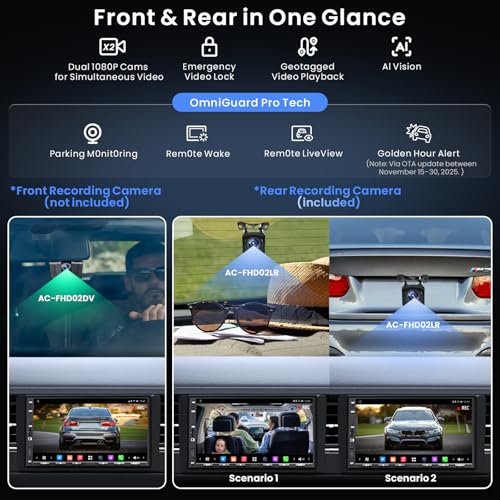
Compatible configurations can connect two 1080P cameras and record them simultaneously.
Possible camera combinations include:
- Front + rear
- Front + cabin
- Rear + cabin
That is fundamentally different from a head unit that merely displays a backup camera when reverse is selected.
The X10 can function as the recording hub.
Included Backup Camera
The exact camera package depends on the X10 SKU.
The X10G2A7E-R2 configuration is currently offered by ATOTO with a backup camera, while other X10 packages can include different camera combinations.
For ProStreetOnline, list exactly which camera is included with your SKU rather than making the broader X10 camera compatibility sound like every package includes two cameras.
The head unit can support dual recording.
That doesn’t mean two cameras automatically appear in every box.
Parking Monitoring
Compatible X10 camera installations can also support parking-monitoring functions.
That can provide recording capability around incidents that occur while the vehicle is parked.
Depending on the camera configuration, the system can also support emergency video locking to protect important clips from routine loop overwriting.
GPS-Linked Video Playback
The X10 can associate supported recorded footage with GPS information.
That gives recorded clips useful location context when reviewing an event later.
Instead of having a random video file and wondering where it happened, GPS-linked playback can help connect footage with the vehicle’s location and route.
Remote Camera Functions
ATOTO’s connected X10 camera ecosystem also supports remote-management and monitoring functions on compatible configurations.
Because remote camera functionality depends on the specific camera, firmware, network connectivity and X10 version, verify the exact supported feature set for the SKU being sold before promising remote LiveView functionality.
That’s particularly important with rapidly evolving X10 software.
AI Vision Is Coming Through OTA
ATOTO is developing more advanced OmniGuard Pro / AI Vision functionality for the X10 camera platform.
Planned capabilities include AI-assisted road recognition and interior monitoring functions.
The important word is:
Planned.
ATOTO currently describes these advanced AI Vision functions as upcoming OTA features.
Do not buy the X10 solely because of a future software feature.
Buy it because the hardware and currently available functionality make sense for your build.
Then anything genuinely useful that arrives later is a bonus.
Software roadmaps are not hardware specifications.
Serious DSP Audio Architecture
Audio is where the X10 separates itself most dramatically from ATOTO’s lower-priced Android stereos.
The built-in DSP provides:
- 36-band EQ
- Time alignment
- Three-way crossover
- Multi-channel output configuration
- 24-bit digital-to-analog conversion
- Advanced speaker routing
This gives an experienced installer much more control over the sound system than the normal bass, midrange and treble adjustments found in factory stereos.
36-Band Equalizer
The 36-band EQ provides detailed frequency adjustment for tuning around the vehicle’s acoustic environment.
That can help compensate for problems caused by:
- Door panels
- Speaker positioning
- Glass reflections
- Dashboard materials
- Seating position
- Cabin resonances
The important part is knowing when not to adjust something.
Thirty-six bands are useful.
Thirty-six bands all pushed to maximum because the graph looked boring are considerably less useful.
Time Alignment
Time alignment compensates for the driver’s unequal distance from each speaker.
Without correction, the left-front speaker may reach the driver’s ears before speakers located farther away.
The DSP can introduce carefully calculated delays so sound from multiple speakers reaches the listening position more consistently.
That can improve imaging and create a much more convincing front soundstage.
For more on system planning, amplification and tuning, see our Car Audio System Guide for Better Sound Builds.
Three-Way Active Crossover
The X10 also provides a three-way crossover for more sophisticated speaker systems.
A properly configured active system can divide frequencies between components such as:
- Tweeters
- Midrange speakers
- Midbass drivers
- Subwoofers
This is particularly useful when building a serious component system without relying entirely on passive crossover networks.
10 Assignable Audio Channels
ATOTO provides 10 assignable audio channels on the X10 architecture.
Those channels can be configured for different speaker roles within a custom system.
That makes layouts involving dedicated tweeters, mids and subwoofers much easier to design around the head unit.
It’s a major distinction between the X10 and a conventional four-channel Android radio.
7.1.2-Channel Audio Capability
Those 10 assignable outputs allow the X10 to support a custom 7.1.2-channel audio architecture.
That makes the X10 particularly interesting for builders pursuing immersive or highly customized car-audio systems.
You don’t need to build a 7.1.2 system to use the X10.
The important advantage is flexibility.
You can configure the outputs around the system you’re actually building instead of designing the entire audio system around the limitations of the radio.
24-Bit DAC
The X10 includes a 24-bit HD DAC for higher-quality digital audio conversion.
That complements its support for high-quality media and advanced DSP processing.
For enthusiasts using high-quality source material and external amplification, the audio architecture is one of the strongest reasons to move from an A5L or S8 into the X10 family.
Optical S/PDIF Output
The X10 also includes optical S/PDIF digital output.
That allows compatible external DSPs, DACs and amplifiers to receive a digital signal directly from the head unit.
For a high-end audio build, this can be extremely valuable.
Instead of converting the signal to analog at the head unit and then processing it again downstream, compatible equipment can maintain a digital signal path deeper into the system.
4V RCA Preamp Outputs
Traditional external amplification is supported too.
The X10 provides 4V RCA preamp outputs for compatible external amplifiers.
A stronger preamp signal can allow amplifier gains to remain lower when the system is configured correctly, helping maintain better signal-to-noise performance.
That makes the X10 a solid starting point for systems using:
- Four-channel amplifiers
- Monoblock subwoofer amplifiers
- Multi-channel amplifiers
- External DSPs
- Active component systems
Stronger Internal Amplifier
The built-in amplifier is rated at approximately:
4 × 49 watts peak
4 × 29 watts RMS
That is stronger than ATOTO’s lower A5L and several S8 configurations.
Twenty-nine watts RMS per channel can provide respectable output for efficient aftermarket speakers.
For a serious 7.1.2 build, however, external amplification is obviously where this is heading.
Nobody plans a 10-channel audio system and then decides four speaker wires behind the radio should probably handle everything.
Qualcomm Bluetooth and aptX HD
The X10 uses Qualcomm Bluetooth technology and supports aptX HD with compatible devices.
That can provide higher-quality Bluetooth audio than basic SBC connections when both devices support the codec.
The X10 also supports dual-phone connections, making it easier for two regular drivers to share the system.
Dual Bluetooth Architecture
A secondary Bluetooth system handles additional connectivity duties.
That can include compatible:
- OBD-II scanners
- Ambient-lighting systems
- BLE accessories
- Bluetooth tethering
This effectively lets the X10 operate as a BLE IoT hub inside the vehicle.
DriveChat AI Assistant
ATOTO integrates its DriveChat voice-assistant platform into the X10.
DriveChat is designed around conversational interaction and supported head-unit control.
That can include asking questions, accessing information, opening supported applications and controlling compatible X10 functions through voice interaction.
I would avoid making specific ChatGPT or Gemini model numbers permanent ecommerce copy.
Cloud AI models change.
The X10 hardware sitting in the dashboard does not.
The useful long-term feature is DriveChat and its OTA-updatable AI architecture.
OBD-II Accessory Support
The BLE ecosystem also allows compatible OBD-II adapters to connect to the X10.
Depending on the adapter, app and vehicle, that can expose information such as:
- RPM
- Coolant temperature
- Vehicle speed
- Fuel trims
- Intake temperature
- Diagnostic trouble codes
For Pro Street customers, this creates a natural bridge between the X10 and our OBD-II diagnostic library.
Remember that reading a trouble code identifies what the ECU detected.
It does not automatically identify which component needs replacement.
The parts cannon remains optional.
TrackHU GPS Tracking
ATOTO’s TrackHU platform adds connected vehicle-location functions to compatible X10 installations.
Combined with built-in cellular connectivity, TrackHU can provide supported vehicle-location and trip information without depending entirely on the driver’s phone.
That can be particularly useful for:
- Project cars
- Shared vehicles
- Touring vehicles
- Overland builds
Vehicle Data Integration
The X10 also supports integration with compatible vehicle-data systems.
Depending on the vehicle and interface, that may include:
- Steering-wheel controls
- Factory amplifier functions
- Vehicle gauges
- Climate information
- Other factory data
This support is highly vehicle-specific.
Do not assume that installing the X10 automatically makes every factory feature appear on the screen.
Check the vehicle and required integration interface first.
HDMI Input
Unlike stereos that only provide HDMI output, the X10 supports HDMI input on applicable configurations.
That allows compatible external video devices to send a signal into the head unit.
Possible applications include compatible:
- Digital television receivers
- Media devices
- External video sources
Video should be used appropriately while parked or for legal passenger-facing applications.
The X10 may be an impressive display.
The windshield remains the recommended display while driving.
Split-Screen Operation
The combination of 8GB RAM and Android 13 also makes split-screen use practical.
Two compatible applications can be displayed simultaneously.
For example:
- Navigation + music
- Navigation + vehicle data
- Camera + navigation
- Media + another supported app
The 7-inch display obviously provides less physical room than the 10-inch X10, but split-screen can still be useful for applications designed around compact interfaces.
OTA Updates
The X10 supports over-the-air firmware updates.
That matters particularly on this platform because so much functionality is software-defined.
Updates can potentially affect:
- DriveChat
- Camera functions
- AI Vision
- CarPlay
- Android Auto
- Application compatibility
- Vehicle integration
- Bluetooth accessories
- User-interface features
The head unit doesn’t need to remain frozen at the software version that shipped in the box.
X10 7-Inch vs X10 10.1-Inch
The biggest difference is obvious.
Screen size.
Choose the 7-inch X10 if you want:
- Traditional Double DIN appearance
- Better dashboard integration
- More HVAC clearance
- Physical-button options
- Smaller visual footprint
- Flagship hardware without a floating screen
Choose the 10.1-inch X10 if you want:
- Larger navigation
- Bigger camera views
- More comfortable split-screen use
- Floating-screen adjustment
- More dramatic visual upgrade
Underneath, both belong to the same high-performance X10 family.
For an older performance car, I actually like the 7-inch approach.
It gives you flagship processing and audio capability without making the dashboard look like someone left an iPad at Cars & Coffee.
X10 vs S8 Gen4
The S8 Gen4 remains a strong enthusiast Android stereo.
The X10 sits above it.
Choose S8 Gen4 if you want:
- Android applications
- Wireless CarPlay
- Android Auto
- LTE
- Good DSP controls
- Lower purchase price
Choose X10 if you want:
- 8GB RAM
- 128GB storage
- Snapdragon hardware
- 36-band DSP
- 24-bit DAC
- Three-way crossover
- 10 assignable channels
- 7.1.2 capability
- Dual-camera recording
- More advanced expansion
For a normal four-speaker daily driver, S8 is already extremely capable.
For a complete audio and electronics build, the X10 gives you considerably more room to grow.
X10 vs A5L
The A5L and X10 target very different buyers.
A5L makes sense for:
- Wireless CarPlay
- Android Auto
- Basic Android apps
- Navigation
- Backup camera
- Everyday audio upgrades
X10 makes sense for:
- High-end audio
- External amplifiers
- Active speaker systems
- Dual-camera recording
- Built-in LTE
- Heavy Android multitasking
- Vehicle-data integration
- Advanced connected accessories
If you just want Maps and Spotify, the A5L can handle the job.
If you’ve already started drawing your audio system on graph paper, keep reading about the X10.
Who Should Buy the X10 7-Inch?
The X10 7-inch is particularly well suited to enthusiast vehicles where powerful electronics are desirable but an oversized floating screen isn’t.
Good applications include:
- Performance cars
- Restomods
- JDM builds
- Trucks
- SUVs
- Overland vehicles
- Touring cars
- High-end audio builds
- Vehicles using external amplifiers and DSP hardware
- Cars requiring multiple cameras
- Owners who want standalone LTE
It’s also one of the more interesting choices for a sleeper-style interior.
The screen looks relatively conventional.
The hardware behind it absolutely is not.
Is the ATOTO X10 7-Inch Worth It?
For someone who intends to use its advanced features, the X10 is a significant step above a typical Android Double DIN stereo.
You get Snapdragon 665 processing, 8GB RAM, 128GB storage, Android 13, built-in 4G, wireless CarPlay and Android Auto, a 7-inch QLED display and dual-camera recording capability.
Then there’s the audio side.
A 36-band DSP, time alignment, three-way crossover, 24-bit DAC, optical S/PDIF, 4V preamp outputs and 10 assignable channels give serious audio builders a much stronger foundation than the typical Android receiver.
The key is deciding whether you’ll actually use those capabilities.
If you’re keeping four factory speakers and only want wireless CarPlay, this is overkill.
If you’re building an active component system, adding external amplification, integrating cameras, running Android applications and monitoring vehicle data, the X10 makes considerably more sense.
And the 7-inch version manages to do all of that without announcing its presence from across the parking lot.
Sometimes the best technology upgrade is the one that doesn’t look like you bolted a television to the dashboard.





There are no reviews yet.