
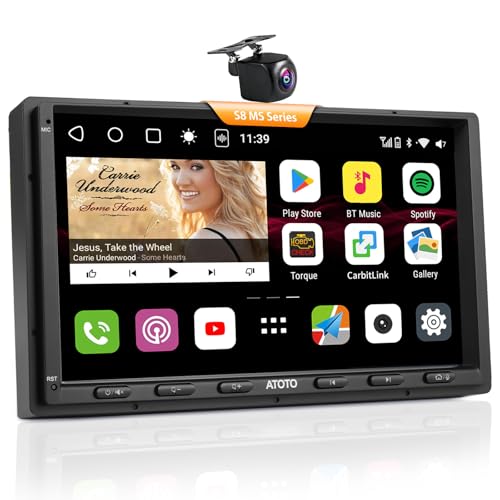
4GB RAM and 32GB Internal Storage
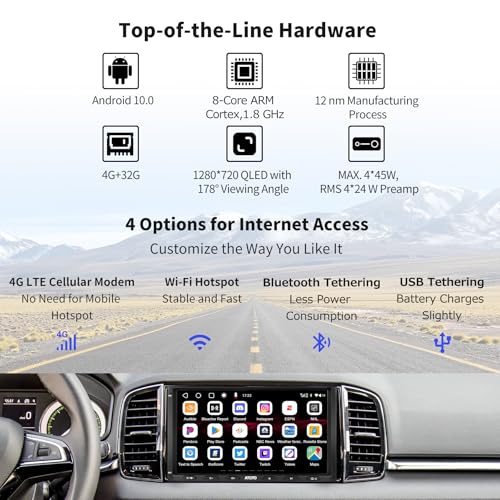
ATOTO’s current listing for this 7-inch S8 Gen3 MS configuration specifies 4GB of RAM and 32GB of internal storage.
That’s worth clarifying because older or third-party product descriptions sometimes show 64GB.
For normal in-car use, 4GB of RAM is arguably the more important specification.
Android head units regularly need to juggle multiple processes at once.
You might have:
- Navigation running
- Music playing
- Bluetooth connected
- A rear camera recording
- A vehicle-monitoring app active
- CarPlay or Android Auto available
Four gigabytes of memory gives the S8 considerably more breathing room than entry-level Android stereos equipped with only 2GB.
12nm Octa-Core Processor
The current S8 Gen3 MS uses a UIS7862 ARM Cortex octa-core processor, manufactured on a 12nm process and operating at up to approximately 1.8GHz. It is paired with an ARM Mali-G52 MP2 GPU.
That hardware is intended to keep everyday navigation, music, camera and Android multitasking responsive.
This isn’t a gaming PC mounted in the dash.
Nor should it be.
The important question is whether maps can stay responsive while audio plays, Bluetooth remains connected and the camera system continues doing its job.
That’s where a more capable processor and 4GB of RAM matter.
Four Ways to Get Online
One of the S8 Gen3’s strongest advantages over basic Android stereos is its connectivity.
The receiver offers four methods of internet access:
- Built-in 4G LTE
- Wi-Fi hotspot
- USB tethering
- Bluetooth tethering
The integrated LTE modem is the standout feature.
With compatible cellular service and a SIM card installed, the stereo can maintain its own internet connection without requiring your phone to act as a hotspot.
That makes features such as streaming, navigation and connected applications much more convenient during everyday driving.
Why Built-In 4G LTE Matters
A phone hotspot works.
It also means pulling out the phone, enabling the hotspot, checking whether the stereo connected and wondering why your battery disappeared halfway through the drive.
Built-in LTE removes much of that friction.
It can be particularly useful for:
- Live navigation
- Traffic information
- Music streaming
- Internet radio
- Connected vehicle services
- Android applications
- Road trips
- Vehicle-location services
For someone who regularly uses the Android side of the stereo, LTE is one of the most meaningful upgrades over a cheaper head unit.
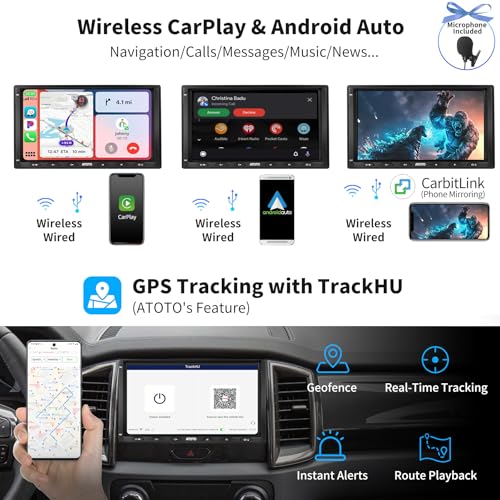
Wireless Apple CarPlay
Drivers who prefer Apple’s interface can use wireless Apple CarPlay.
Once configured, a compatible iPhone can reconnect automatically and provide familiar access to supported functions including:
- Apple Maps
- Google Maps
- Music
- Podcasts
- Calls
- Messages
- Siri
That means you don’t have to abandon CarPlay simply because the stereo itself runs Android.
Think of Android as the underlying platform and CarPlay as another available interface.
Wireless Android Auto
Wireless Android Auto provides the same basic convenience for compatible Android phones.
Navigation, calls, messages, music and supported apps can appear directly on the 7-inch display without requiring a cable every time you start the car.
For drivers who primarily live inside Android Auto, the S8 can behave much like a conventional multimedia receiver.
The difference is that there is still a full Android environment underneath when you want additional functionality.
MirrorLink Support
The S8 platform also supports smartphone mirroring.
This allows compatible phone content to appear on the head-unit display outside the traditional CarPlay or Android Auto ecosystem.
That can be useful while parked or when a passenger is controlling the system.
Naturally, a dashboard capable of displaying something does not make that thing appropriate to watch while driving.
The steering wheel remains disappointingly manual.
7-Inch QLED Touchscreen
The S8 Gen3 uses a 7-inch QLED display with a 178-degree viewing angle, intended to maintain good visibility across different seating positions and lighting conditions.
A traditional 7-inch display has an important advantage over today’s increasingly enormous floating screens:
It tends to integrate much more naturally into older dashboards.
That makes this S8 particularly attractive for:
- 1990s Japanese cars
- 2000s imports
- Trucks
- SUVs
- Muscle cars
- Restomods
- Daily drivers
The screen is large enough for navigation and cameras without dominating the entire center stack.
For anyone unsure about radio sizing, our Single DIN vs Double DIN guide explains how the two common formats differ and what to check before buying. Single DIN vs Double DIN: Which Fits?
Included AC-RCR04W 1080P DVR Rear Camera
This package’s most distinctive feature is the included ATOTO AC-RCR04W camera.
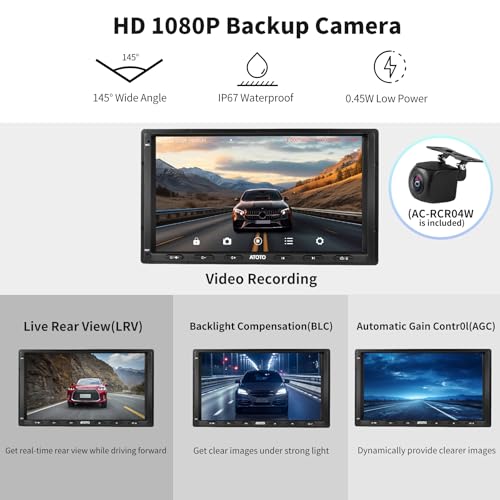
Rather than the more typical 720P reversing camera, the AC-RCR04W produces a 1080P rear image with a 145-degree viewing angle.
ATOTO also specifies:
- HDR imaging
- Live Rear View
- Backlight Compensation
- Automatic Gain Control
- IP67 weather protection
- DVR recording compatibility
- Low 0.45-watt power consumption.
That’s considerably more capability than a basic backup camera.
Live Rear View
Traditional backup cameras typically switch on only when the vehicle is placed in reverse.
The S8 and AC-RCR04W combination can provide Live Rear View, allowing the driver to access the camera while moving forward.
This can be useful for:
- Checking traffic behind the car
- Monitoring a trailer
- Watching bicycles on a rear rack
- Improving visibility in vans or SUVs
- Working around blocked rear windows
It effectively gives the stereo some of the functionality of a digital rearview mirror.
Mirrors still matter, of course.
Electronics are an additional set of eyes, not permission to stop using the original ones.
Rear Camera DVR Recording
The AC-RCR04W can also function as a recording camera with compatible S8 MS models.
Video can be stored through the head unit’s recording system, giving owners footage from behind the vehicle while driving.
ATOTO describes support for loop recording using compatible storage, with the product package designed around rear-camera DVR functionality.
That can provide useful evidence after:
- Collisions
- Road incidents
- Rear impacts
- Insurance disputes
It is an unusually practical addition because it uses equipment that would already be installed for reversing and rear visibility.
145-Degree Rear Viewing Angle
The camera’s 145-degree field of view provides a wider perspective than a conventional rearview mirror.
That can be particularly useful when backing out of parking spaces where adjacent vehicles block lateral visibility.
There’s still a balance to strike.
Extremely wide-angle cameras can make objects appear farther away than they actually are.
Drivers should use the camera for additional situational awareness rather than treating it as an exact distance-measuring device.
Backlight Compensation and Automatic Gain Control
Rear cameras frequently struggle with extreme differences in lighting.
Think about backing out of a dark garage into bright sunlight.
ATOTO’s camera uses Backlight Compensation and Automatic Gain Control to help maintain a usable image as lighting conditions change.
Those are the kinds of features that matter more in actual daily use than another row of icons on a specification sheet.
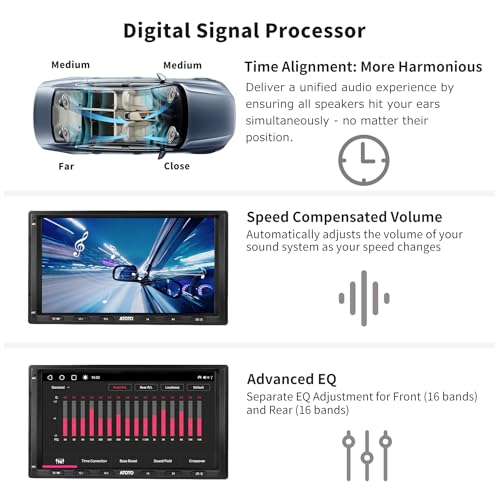
DSP Audio Processing
The S8 Gen3 also includes built-in digital signal processing.
ATOTO’s current 7-inch Gen3 MS listing specifies 32 adjustable EQ bands, along with signal delay, bass boost and bass filtering.
That gives owners considerably more control than a conventional bass/mid/treble interface.
Signal delay is particularly useful in a car because the driver sits much closer to some speakers than others.
Proper time correction can delay the closest speakers slightly so the sound from different locations reaches the listening position more coherently.
Speed Compensated Volume Control
The S8 also supports Speed Compensated Volume Control, or SCVC.
The concept is straightforward.
As road and wind noise increase with vehicle speed, the stereo can compensate by adjusting playback level.
Slow back down and the level can decrease again.
That helps avoid the familiar cycle of turning the music up on the freeway and then getting attacked by your own speakers at the next stoplight.
Internal Amplifier Power
ATOTO rates the internal amplifier at:
Peak output: 4 × 45 watts
RMS output: 4 × 24 watts.
The RMS figure is the useful one for evaluating continuous power.
Twenty-four watts RMS per channel is suitable for many factory speakers and efficient aftermarket replacements.
More demanding speaker systems should still use external amplification.
For help planning speakers, amplifiers, subwoofers and system tuning, see our Car Audio System Guide. Car Audio System Guide for Better Sound Builds
Dual Bluetooth
Another useful S8 feature is its dual-Bluetooth architecture.
ATOTO’s Gen3 implementation uses one Bluetooth connection for common functions such as:
- Hands-free calling
- Music streaming
- Contacts
- Voice functions
while the secondary Bluetooth connection can support compatible accessories and services such as OBD-II equipment.
That means connecting a diagnostic adapter doesn’t necessarily require disconnecting the phone.
For an Android head unit, that is a significant advantage.
Add an OBD-II Scanner
A compatible Bluetooth OBD-II scanner can turn the S8 into a vehicle-data display.
Depending on the vehicle and application, you may be able to monitor parameters such as:
- Engine RPM
- Vehicle speed
- Coolant temperature
- Intake temperature
- Fuel information
- Sensor data
- Diagnostic trouble codes
That can be extremely useful.
But displaying a trouble code is not the same thing as diagnosing it.
A code indicates what the ECU detected.
It does not automatically identify the failed component.
That’s exactly why My Pro Street’s technical library includes dedicated OBD-II troubleshooting guides rather than simply telling readers to replace whatever sensor happens to be named in the code description. My Pro Street Technical Guides
DriveChat AI Driving Assistant
The S8 Gen3 also supports ATOTO’s DriveChat application.
ATOTO describes DriveChat as an AI-based driving assistant with voice interaction, customizable wake words and selectable Drivebots for different types of assistance.
Voice control can also be used for supported stereo functions such as:
- Music playback
- Calls
- Stereo interaction
The advantage of voice-first control is obvious.
Anything that reduces the need to repeatedly tap a touchscreen while driving can make a sophisticated head unit easier to live with.
What You Need to Install the S8 Gen3
A Double DIN designation tells you the general physical radio format.
It does not guarantee a complete plug-and-play installation.
Depending on your vehicle, you may still need:
- Double DIN dash kit
- Vehicle wiring harness
- Antenna adapter
- Steering-wheel-control interface
- CAN-bus interface
- Factory amplifier adapter
- USB retention adapter
- Factory camera interface
Vehicles with premium audio systems can be considerably more complicated.
That’s why Pro Street has spent years building vehicle-specific stereo wiring references.
Whenever possible, use a proper plug-in adapter rather than cutting the factory harness.
The future owner of the car may thank you.
The future owner may also be you six months later when you decide to change everything again.
S8 Gen3 vs S8 Gen4
With the Gen4 lineup now available, the obvious question is whether the older S8 Gen3 still makes sense.
It can.
S8 Gen3 strengths include:
- Proven Android-based platform
- 4GB RAM
- Built-in 4G LTE
- Wireless CarPlay
- Wireless Android Auto
- Dual Bluetooth
- DSP audio controls
- Included 1080P DVR rear camera
- Traditional 7-inch Double DIN installation
S8 Gen4 adds or improves:
- Newer hardware and software platform
- Expanded DSP capabilities on current models
- 4V RCA outputs on applicable configurations
- Optical and coaxial digital outputs on higher configurations
- Newer AI and connected features
- Expanded accessory ecosystem
The better choice depends heavily on price.
If the Gen3 package is significantly less expensive and includes the AC-RCR04W camera, it remains a compelling option for someone who values rear-camera recording and LTE more than having ATOTO’s newest platform.
S8 Gen3 vs ATOTO A5L
The A5L sits further down ATOTO’s Android lineup.
It typically offers:
- Android applications
- Wireless CarPlay
- Android Auto
- DSP controls
- Backup-camera compatibility
The S8 Gen3 provides a stronger overall hardware package with more RAM, integrated 4G LTE and more advanced expansion capability.
For someone simply adding Android and CarPlay to an older daily driver, the A5L can make sense.
For a more serious connected build, the S8 is the stronger platform.
S8 Gen3 vs F7WE
The F7WE belongs to an entirely different category.
It is primarily a CarPlay and Android Auto multimedia receiver, not a full Android head unit.
Choose the F7WE if you want simplicity.
Choose the S8 if you want:
- Standalone Android apps
- 4G LTE
- OBD-II connectivity
- Greater customization
- DVR camera integration
- More independent connected features
One isn’t universally better.
They are designed for different levels of involvement.
Who Should Buy the ATOTO S8 Gen3?
The S8 Gen3 is a particularly good fit for someone upgrading an older enthusiast vehicle who wants more than just wireless CarPlay.
It makes sense for:
- Older Japanese performance cars
- Trucks and SUVs
- Restomods
- Daily drivers
- Project cars
- Vehicles without factory backup cameras
- Owners wanting built-in LTE
- Drivers interested in OBD-II data
- Cars needing rear DVR recording
The conventional 7-inch format is another advantage.
It can add substantial technology without making the dashboard look like someone glued a tablet over the climate controls.
Is the ATOTO S8 Gen3 Still Worth Buying?
Yes—provided the price properly reflects that it is now a previous-generation model.
The S8 Gen3 still combines several features that are highly useful in an older vehicle:
- Full Android operation
- 4GB RAM
- 32GB internal storage
- Eight-core processor
- Built-in 4G LTE
- Wireless CarPlay
- Wireless Android Auto
- Dual Bluetooth
- DSP audio processing
- SCVC
- 1080P rear camera
- Live Rear View
- DVR recording.
The included AC-RCR04W is particularly valuable because it turns what would normally be a simple backup-camera installation into a much more useful rear-monitoring and recording system.
The newer S8 Gen4 is the obvious choice for buyers who want ATOTO’s latest audio architecture and software ecosystem.
But if this Gen3 package is priced competitively, it still provides an impressive amount of capability for a conventional 7-inch Double DIN installation.
And there’s something to be said for giving an older car LTE, navigation, wireless CarPlay, Android apps and a 1080P recording camera without making the dashboard look like a Tesla parts bin exploded inside it.






There are no reviews yet.