
The F7WE Is Not an Android Head Unit
This distinction matters.
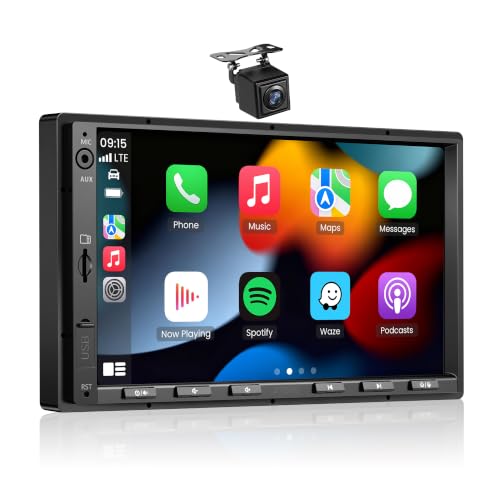
The ATOTO F7WE does not operate like an Android tablet installed in the dashboard. You are not buying it primarily to install Google Play applications directly onto the stereo.
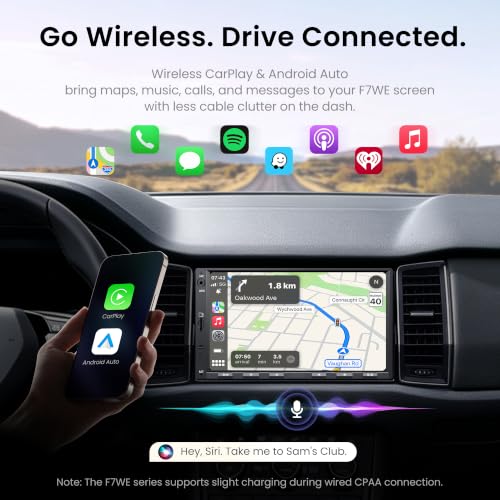
Instead, it relies heavily on your smartphone through CarPlay or Android Auto.
That can actually be an advantage.
A dedicated multimedia receiver requires less management than a full Android head unit and removes much of the temptation to load the dashboard with apps you probably should not be poking at while doing 70 mph.
If your priority is wireless CarPlay, Android Auto, music, navigation and camera support, the F7WE takes a more focused approach.
Drivers wanting downloadable Android apps and extensive standalone customization should instead compare it with a true Android-powered stereo.
7-Inch 1280×720 QLED Display
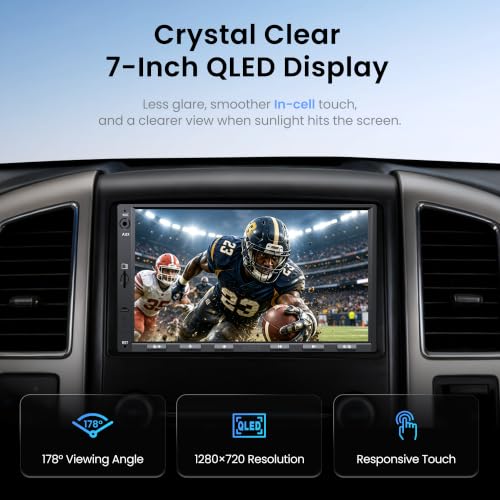
The F7WE uses a 7-inch QLED touchscreen with 1280×720 resolution.
ATOTO also specifies an in-cell capacitive touchscreen and a wide 178-degree viewing angle.
A 7-inch screen remains a sweet spot for traditional Double DIN installations.
It is large enough to display navigation clearly without requiring an oversized floating screen that potentially blocks vents, switches or HVAC controls.
The QLED display can also be useful when viewing camera feeds, where contrast and visibility matter considerably more than having an enormous display simply for bragging rights.
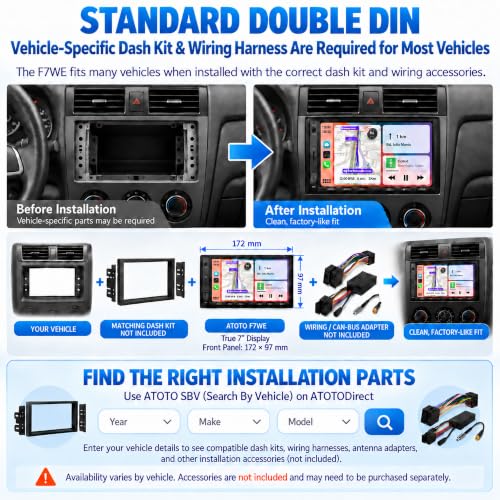
A True Double DIN Form Factor
The F7WE uses a conventional Double DIN format with a front-panel measurement of approximately 172 mm × 97 mm.
That makes it compatible with many aftermarket Double DIN installation kits, but Double DIN does not mean universal vehicle compatibility.
Our Single DIN vs Double DIN guide on My Pro Street explains why radio dimensions are only the beginning of a proper installation.
Depending on the vehicle, you may still need:
- Vehicle-specific dash kit
- Wiring harness
- Antenna adapter
- Steering-wheel-control interface
- CAN-bus interface
- Factory amplifier adapter
- Factory backup-camera adapter
Those components are generally separate from the stereo itself.
Measure the dash and verify the installation kit before pulling everything apart.
There are few things more character-building than discovering the dash kit is wrong after the center console is sitting in twelve pieces on the passenger seat.
Stronger Built-In Amplifier
The F7WE Gen2 also receives a meaningful audio upgrade.
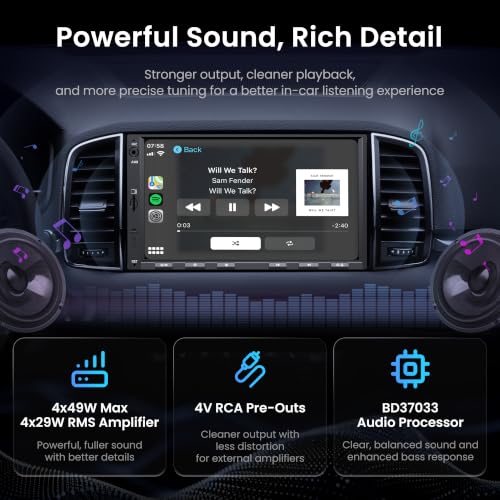
ATOTO uses the TCB502 amplifier chip, the same amplifier family it advertises in higher-end models including the X10.
Output is rated at:
Peak power: 4 × 49 watts
RMS power: 4 × 29 watts.
RMS output is the more useful specification when evaluating continuous audio performance.
A claimed peak output number looks great on a product page, but your speakers unfortunately cannot survive entirely on marketing.
At 29 watts RMS per channel, the F7WE has respectable built-in power for factory speakers and many efficient aftermarket replacements.
4-Volt RCA Preamp Outputs
More serious car-audio builds benefit from another important specification: 4-volt RCA preamp outputs.
The F7WE provides four-channel RCA audio outputs along with a dedicated subwoofer output.
Higher-voltage preamp outputs can provide a stronger signal to an external amplifier, allowing amplifier gain to be kept lower and helping maintain a cleaner signal path when the system is installed and tuned correctly.
That makes the F7WE much more useful than an entry-level touchscreen for someone planning:
- External amplifiers
- Component speakers
- Subwoofers
- Active audio upgrades
- Higher-output aftermarket systems
Our Car Audio System Guide on My Pro Street covers amplifier matching, RMS power, speaker selection, wiring and system tuning in greater detail.
12-Band EQ and Audio Tuning
The F7WE provides more control than simply bass and treble adjustment.
ATOTO lists a 12-band equalizer with seven audio presets, allowing users to make more precise adjustments to system response.
That becomes useful after installing aftermarket speakers.
Every vehicle cabin affects sound differently. Door location, speaker angle, glass, seats and interior materials all alter what reaches your ears.
A reasonable EQ can clean up harsh frequencies or compensate for weak areas.
Just resist the instinct to slide every frequency band upward.
That is not tuning.
That is just making everything louder with extra steps.
Included 720P Rearview Camera
The F7WE package includes ATOTO’s AC-HD01LR rearview camera.
The camera provides a 720P image and approximately 140-degree viewing angle, along with waterproof construction and night-vision capability.
The wider viewing area can help when:
- Reversing from parking spaces
- Backing down narrow driveways
- Maneuvering around obstacles
- Parking larger vehicles
- Checking the area directly behind the bumper
The F7WE also supports Live Rear View.
Rather than displaying the rear camera only when reverse gear is engaged, Live Rear View allows the driver to access the camera feed while traveling forward when properly configured.
That can be particularly useful in vehicles with limited rearward visibility.
Front Camera Support
The F7WE can support a front camera in addition to its rear camera.
A forward-facing camera can be useful when parking a low vehicle, approaching curbs or maneuvering through tight spaces.
Owners of lowered cars already know why this matters.
That front splitter looked fantastic until the first parking block declared war.
Split-Screen Navigation and Front Camera
One of the more unusual F7WE features is the ability to display CarPlay or Android Auto alongside a front-camera view.
ATOTO’s split-screen system allows navigation information and the forward camera feed to remain visible simultaneously.
This can be useful when navigating:
- Narrow streets
- Parking garages
- Tight driveways
- Steep approaches
- Close obstacles
Rather than constantly switching between navigation and the camera, both can remain visible.
Better Bluetooth Calling
Hands-free calling sounds straightforward until highway noise gets involved.
The F7WE supports Bluetooth calling through both a built-in microphone and the supplied external microphone.
ATOTO also incorporates noise-reduction processing intended to reduce cabin and road noise during calls.
For the best results, mount the external microphone reasonably close to the driver’s speaking position without placing it directly in front of an air vent.
A properly placed external microphone will generally outperform one buried inside the stereo halfway across the dashboard.
Wired Smartphone Mirroring
The F7WE also supports wired smartphone mirroring.
This allows compatible phone content that may not normally appear through CarPlay or Android Auto to be mirrored onto the stereo display.
Mirroring should obviously be used responsibly.
The fact that your dashboard can display something does not necessarily mean Interstate 80 is the ideal place to watch it.
Multiple Inputs and Outputs
For a relatively compact receiver, the F7WE offers a useful selection of expansion connections.
ATOTO lists:
- Rear-camera input
- Front-camera input
- Auxiliary audio/video input
- Four-channel 4V RCA outputs
- Dedicated 4V subwoofer output
- Two RCA headrest video outputs
- Two USB connections.
One USB connection can handle smartphone functions such as CarPlay, Android Auto and AutoLink, while the other can be used for external storage.
That gives installers considerably more flexibility than a basic CarPlay-only receiver.
Steering Wheel Control Support
The F7WE supports compatible factory steering-wheel controls.
The exact installation requirements depend on the vehicle.
Some vehicles can connect relatively easily, while others require a separate steering-wheel-control or CAN-bus interface to translate factory commands for the aftermarket radio.
This is another reason buyers should look beyond the physical Double DIN opening before ordering.
Modern factory radios increasingly communicate with other modules in the vehicle, and replacing one can involve more than connecting power and four sets of speaker wires.
OTA Firmware Updates
ATOTO also provides over-the-air firmware update support on the F7WE Gen2.
Available updates can be installed through the receiver’s settings rather than requiring a more complicated manual firmware process.
That is particularly useful for a receiver centered around wireless smartphone compatibility.
Apple and Google continue updating CarPlay, Android Auto and smartphone software, so maintaining head-unit firmware can help preserve compatibility over time.
ATOTO F7WE vs Android Head Unit: Which Is Better?
Neither format is automatically better.
They serve different drivers.
Choose the ATOTO F7WE if you want:
- Wireless Apple CarPlay
- Wireless Android Auto
- Fast smartphone integration
- Strong built-in audio performance
- 4V amplifier outputs
- Front and rear cameras
- A conventional 7-inch Double DIN form factor
- Less dependence on apps installed directly on the radio
Choose an Android head unit if you want:
- Apps installed directly on the stereo
- Standalone Android navigation
- Greater software customization
- Independent internet applications
- More tablet-like functionality
For someone who already handles most digital life through a smartphone, the F7WE’s simpler architecture may actually be the better fit.
Who Should Buy the ATOTO F7WE?
The F7WE makes the most sense in an older vehicle that has a Double DIN-compatible dashboard but lacks modern smartphone integration.
That includes plenty of:
- 1990s and 2000s Japanese cars
- Older trucks
- SUVs
- Muscle cars
- Daily drivers
- Project cars
- Restomods
Adding CarPlay and Android Auto can make an older vehicle substantially easier to live with every day without changing what makes the car worth keeping.
Navigation improves.
Hands-free calling improves.
Music integration improves.
Camera visibility improves.
And unlike some enormous floating displays, a traditional 7-inch Double DIN radio can still look reasonably natural in an older dashboard.
Is the ATOTO F7WE Worth It?
For drivers primarily interested in CarPlay, Android Auto and good audio expansion, the ATOTO F7WE Gen2 has a strong combination of features.
Wireless smartphone connectivity gets the attention, but the audio hardware may be equally important.
The combination of a 4 × 29-watt RMS internal amplifier, 4-volt RCA outputs, dedicated subwoofer output and 12-band EQ gives the F7WE room to grow beyond a basic factory-speaker replacement.
The included rear camera, front-camera compatibility and split-screen feature add useful functionality without forcing buyers into a full Android head unit.
Most importantly, it knows what it is.
The F7WE isn’t trying to turn your dashboard into another smartphone.
It lets the smartphone you already own do the heavy lifting while providing a cleaner automotive interface for it.
For a street car, commuter or older project that needs modern technology without unnecessary complexity, that’s a pretty sensible formula.





There are no reviews yet.