
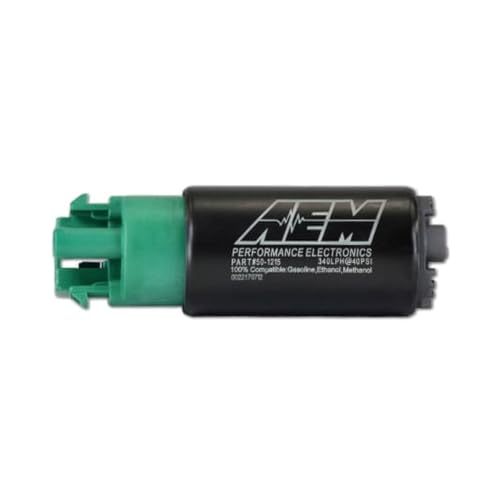
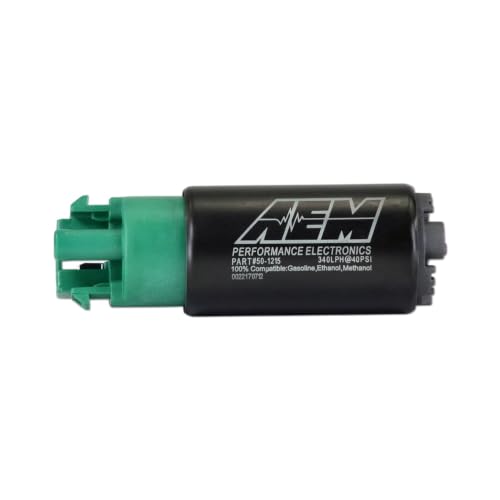
Every AEM 50-1215 Is Tested to 340LPH at 40 PSI
A major advantage of the AEM 50-1215 is its individual flow testing.
According to AEM, every pump is tested to flow 340 LPH at 40 PSI before packaging.
Fuel-pump output isn’t a fixed number under every operating condition.
Actual flow can change with:
- Fuel pressure
- Pump voltage
- Fuel type
- Temperature
- Filter restriction
- Fuel-line restriction
- Electrical resistance
For a performance application, the important question isn’t simply how much the pump can flow.
It’s how much fuel the pump can supply at the pressure your engine actually requires.
E85 Compatible Fuel Pump
The AEM 50-1215 is specifically engineered for use with ethanol-based fuels and is compatible with E85.
That’s particularly useful for high-output turbocharged and supercharged engines.
E85 can require substantially more fuel volume than gasoline, meaning a stock pump that was adequate for a gasoline tune may run out of capacity after converting the same engine to ethanol.
If you’re planning an ethanol conversion, read our How to Convert to E85 guide before selecting the rest of your fuel-system components.
Pump capacity is only one part of a properly designed E85 conversion.
Tested With Ethanol Fuels up to E100
AEM specifies that the 50-1215 has been tested with ethanol fuels up to E100.
The pump’s internal construction is designed to resist the low-lubricity characteristics associated with alcohol-based fuels.
This provides additional flexibility for performance and racing applications using ethanol concentrations beyond typical pump E85.
The rest of the fuel system must still be compatible with the fuel being used.
That includes:
- Fuel lines
- Hoses
- Seals
- O-rings
- Filters
- Fuel rails
- Regulators
- Injectors
One ethanol-compatible component doesn’t make an entire fuel system ethanol compatible.
Methanol Compatible up to M100
The AEM 50-1215 is also specified for use with methanol fuels up to M100.
That makes the pump attractive for specialized motorsports and competition applications where methanol is part of the fuel strategy.
Methanol can be particularly demanding on fuel-system materials, so every component in the system should be verified for compatibility.
Do not assume that conventional gasoline hoses, filters, seals or regulators are suitable simply because the pump itself can handle M100.
Upgrade Fuel Lines for E85
Higher-flow pumps and ethanol fuels place additional demands on the vehicle’s fuel plumbing.
Our guide to upgrading fuel lines for E85 explains why both material compatibility and line capacity need to be considered during an ethanol conversion.
A high-flow pump can’t overcome an excessively restrictive feed line.
When upgrading to the AEM 50-1215, inspect the complete fuel path:
Tank → Pump → Filter → Feed Line → Fuel Rail → Injectors → Regulator
For return-style systems, the return line also needs adequate capacity.
Match Your 340LPH Pump With Proper Injectors
A high-flow pump gets fuel to the rail.
The injectors still need to deliver enough of that fuel to the engine.
High-output E85 and forced-induction applications commonly require larger injectors than comparable naturally aspirated gasoline combinations.
Our guide to fuel injector upgrade benefits explains how injector capacity, fuel pressure and duty cycle affect a performance fuel system.
Size the pump and injectors around the same power goal rather than upgrading them independently.
A 340LPH pump feeding injectors that are already at 100-percent duty cycle isn’t an upgrade plan. It’s just giving the bottleneck more fuel to look at.
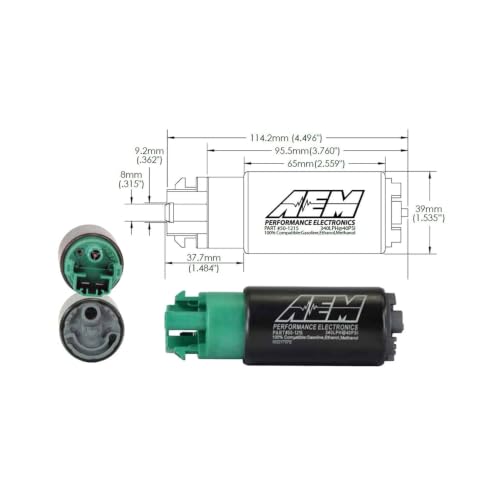
Compact 39mm x 65mm Fuel Pump Body
One of the defining characteristics of the AEM 50-1215 is its compact packaging.
The pump body is listed at approximately:
39mm Diameter × 65mm Length
That compact design can be useful in fuel modules where physical space limits the size of the pump that can be installed.
Before ordering, compare these dimensions with your existing fuel-pump module.
Check:
- Pump diameter
- Pump length
- Inlet position
- Outlet arrangement
- Strainer clearance
- Electrical connector
- Fuel-pump hanger
Physical fitment matters just as much as flow capacity.
Designed for Naturally Aspirated Performance Engines
High-flow fuel pumps aren’t exclusively for turbocharged vehicles.
A heavily modified naturally aspirated engine can also require substantially more fuel than its factory configuration.
Increased displacement, higher compression, aggressive camshaft profiles, increased RPM and alternative fuels can all increase fuel demand.
The AEM 50-1215 is designed for high-output naturally aspirated EFI applications as well as forced-induction builds.
Built for Turbocharged and Supercharged Applications
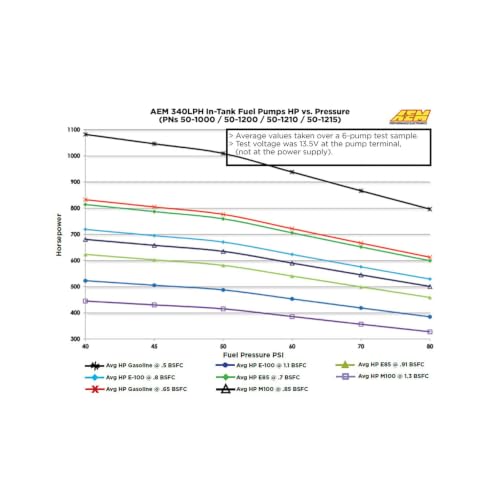
Forced induction adds another variable to fuel-pump selection: increasing operating pressure.
A boost-referenced regulator typically raises rail pressure as manifold boost rises.
For example, a system running approximately 43 PSI base fuel pressure and 20 PSI of boost could require the pump to operate against roughly 63 PSI of rail pressure.
As pressure rises, available pump flow generally decreases.
That’s why builders should evaluate fuel requirements at maximum operating pressure instead of assuming the 340LPH @ 40 PSI specification remains unchanged at higher pressure.
Return vs Returnless Fuel Systems
Before installing a high-flow pump, determine how the vehicle controls fuel pressure.
Traditional return-style systems use a regulator and return line, while many newer vehicles use returnless systems or electronically controlled pump modules.
Our comparison of returnless versus return fuel systems explains the differences.
Installing a significantly larger pump can affect regulator behavior, fuel temperature and pressure control.
Make sure the rest of the system can properly manage the AEM 50-1215’s additional capacity.
Fuel-Pump Wiring Matters
Voltage is a critical part of electric fuel-pump performance.
A high-flow pump connected through undersized wiring, old connectors or poor grounds may not deliver its expected performance under load.
When upgrading the pump, inspect:
- Power wiring
- Ground wiring
- Relay capacity
- Fuse protection
- Electrical connectors
- Fuel-pump controller
- Voltage at the pump
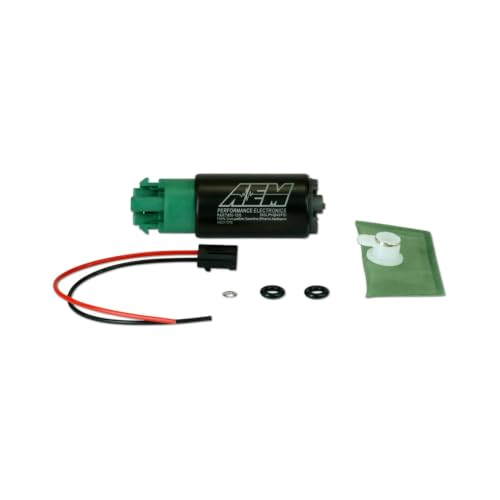
The AEM 50-1215 includes a wiring lead/harness for installation, but vehicle-specific electrical upgrades may still be required.
Whenever possible, check voltage at the pump while the fuel system is operating.
AEM 50-1215 Installation Components
The AEM 50-1215 is supplied with installation components intended to assist with integration into a compatible fuel module.
Kit Includes
- AEM 50-1215 340LPH Fuel Pump
- Fuel Pre-Filter
- Fuel Hose
- Hose Clamps
- Wiring Lead / Harness
- End Cap
- Rubber Buffer Sleeve
- O-Rings as specified
Additional vehicle-specific hardware or modifications may be required.
Verify Vehicle-Specific Fitment
The supplied product information describes the AEM 50-1215 as a vehicle-specific fitment, but compatibility should still be verified against the exact vehicle and fuel-pump module before ordering.
Do not assume that the compact dimensions automatically make the pump a direct replacement for every vehicle.
Verify:
- Year
- Make
- Model
- Engine
- Fuel-pump module
- Electrical connection
- Pump dimensions
- Inlet and outlet configuration
- Fuel compatibility
Professional installation is recommended when modification of the original fuel module or electrical system is necessary.
Ideal Applications
The AEM 50-1215 340LPH E85 fuel pump is designed for performance applications including:
- E85 builds
- Flex-fuel vehicles
- E100-compatible applications
- Methanol-fueled applications
- Turbocharged engines
- Supercharged vehicles
- High-output naturally aspirated engines
- Engine swaps
- Modified street vehicles
- Street/strip cars
- Track builds
- High-performance EFI systems
Why Choose the AEM 50-1215?
The AEM 50-1215 combines 340LPH tested fuel delivery, broad fuel compatibility and compact 39mm × 65mm packaging in an in-tank pump designed for serious EFI applications.
Its compatibility with gasoline, ethanol up to E100 and methanol up to M100 makes it particularly useful for builds that need greater fuel flexibility than a conventional gasoline pump provides.
AEM’s individual 340LPH at 40 PSI testing also gives builders a useful baseline when planning the rest of the fuel system.
Match the pump with appropriately sized injectors, sufficient fuel plumbing, proper pressure control and adequate electrical supply.
The result is a fuel system built around the engine’s actual needs instead of the traditional performance-car strategy of turning up the boost first and asking difficult fuel-pressure questions later.
Product Specifications
Brand: AEM
Part Number: 50-1215
Product Type: High-Flow In-Tank Electric Fuel Pump
Tested Flow: 340 LPH @ 40 PSI
Pump Diameter: Approximately 39mm
Pump Body Length: Approximately 65mm
Fuel Compatibility: Gasoline, ethanol up to E100 and methanol up to M100
E85 Compatible: Yes
E100 Compatible: Yes, as specified by AEM
M100 Compatible: Yes, as specified by AEM
Installation: In-Tank
Applications: High-output naturally aspirated and forced-induction EFI engines
Pre-Filter: Included
Fuel Hose: Included
Clamps: Included
Wiring Lead/Harness: Included
End Cap: Included
Rubber Buffer Sleeve: Included
O-Rings: Included as specified
Fitment Note: Verify AEM part number 50-1215 against the exact vehicle and fuel-pump module before ordering. Confirm pump dimensions, inlet/outlet arrangement, electrical requirements and fuel-system compatibility.





There are no reviews yet.