

Every Pump Tested to 340LPH at 40 PSI
One of the most important specifications of the AEM 50-1200 is its individually tested flow rating.
According to AEM, each pump is tested to flow 340 liters per hour at 40 PSI before packaging.
That’s more useful than simply attaching a maximum LPH number to a product name.
Fuel-pump output is affected by:
-
Fuel pressure
-
System voltage
-
Fuel type
-
Filter restriction
-
Feed-line restriction
-
Temperature
-
Electrical resistance
For high-horsepower applications, pump capacity should always be evaluated at the pressure the engine will actually experience.
Designed for E85 up to E100
The AEM 50-1200 is especially attractive for ethanol-fueled performance vehicles.
AEM specifies compatibility with ethanol fuels up to E100, allowing the pump to be used with conventional E85 as well as higher concentrations of ethanol where appropriate.
This matters because ethanol can be demanding on fuel-system components that weren’t designed around its material and lubrication characteristics.
The 50-1200 uses internal construction designed specifically to resist the low-lubricity characteristics of ethanol and methanol fuels.
If you’re converting a gasoline vehicle to ethanol, our How to Convert to E85 guide covers the additional changes that should be considered.
Methanol Compatible up to M100
Ethanol isn’t the only alcohol fuel supported by the AEM 50-1200.
AEM also specifies compatibility with methanol fuels up to M100.
That broad fuel compatibility makes the pump useful for specialized racing and performance applications where conventional gasoline isn’t the only fuel being considered.
Always verify that every other component in the fuel system—including the hoses, filters, seals, regulator and injectors—is compatible with methanol before use.
A methanol-compatible pump does not magically grant methanol compatibility to everything attached to it.
E85 Requires More Fuel Volume
E85 performance builds can require considerably more fuel volume than comparable gasoline combinations.
That increased demand is one reason a 340LPH E85 pump can become necessary even when a lower-flow pump was adequate on gasoline.
The complete system still needs to be sized accordingly.
Check:
-
Injector capacity
-
Feed-line diameter
-
Filter capacity
-
Fuel-rail capacity
-
Regulator flow
-
Return-line capacity
-
Pump wiring
Our guide to upgrading fuel lines for E85 explains why ethanol compatibility and fuel-line capacity should be addressed during the conversion.
Pair the AEM 340LPH Pump With the Right Injectors
Increasing pump capacity doesn’t automatically increase the amount of fuel entering the cylinders.
That’s the injectors’ job.
Turbocharged, supercharged and E85 engines often require larger injectors to maintain a safe duty cycle as horsepower rises.
Our guide covering fuel injector upgrade benefits explains why pump capacity, injector size and fuel pressure should be planned together.
For a properly engineered system, consider the complete fuel path:
Fuel Tank → Pump → Filter → Feed Line → Fuel Rail → Injectors → Regulator
For return-style systems, the return line also needs enough capacity to manage unused fuel.
Compact 39mm Fuel Pump Body
Fitment is one of the AEM 50-1200’s major advantages.
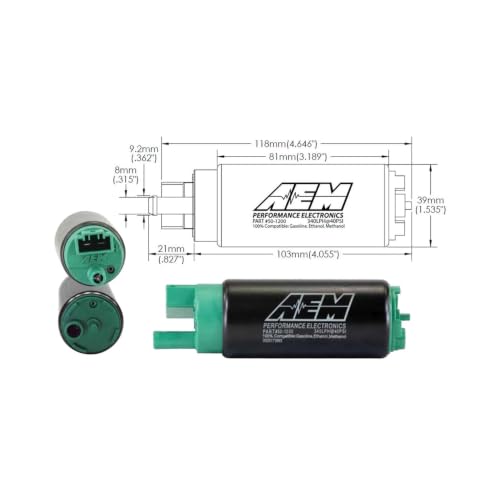
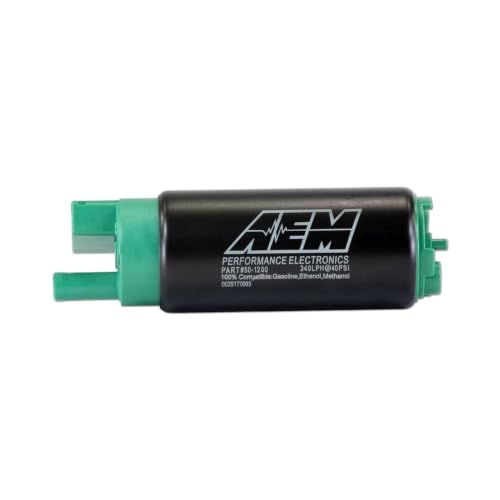
The pump uses a compact 39mm-diameter body, allowing it to fit into many factory and aftermarket fuel-pump modules.
This can simplify installation where larger high-flow pumps create clearance problems inside the fuel-pump hanger or bucket.
The listed pump dimensions are approximately:
4.055 × 1.535 × 1.535 inches
Even with its compact dimensions, always measure the existing fuel-pump module before ordering.
Universal does not mean every fuel tank on Earth suddenly agreed on a standardized pump hanger.
Offset Inlet Simplifies Installation
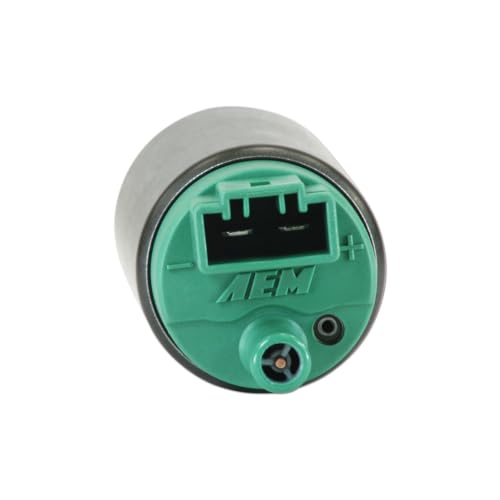
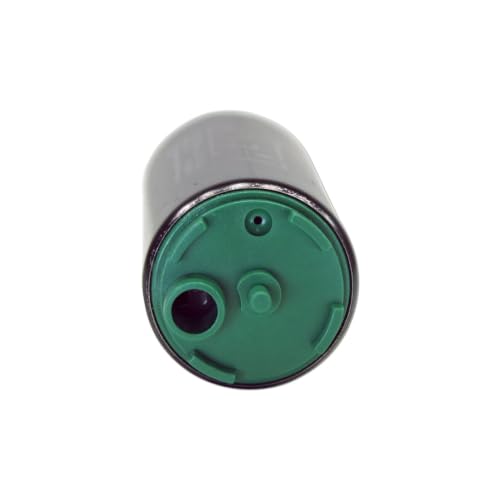
The AEM 50-1200 features an offset inlet configuration.
This distinguishes it from other AEM 340LPH pump configurations and can make routing the strainer and positioning the pump easier in compatible fuel modules.
Before ordering, compare the pump’s:
-
Overall dimensions
-
Body diameter
-
Inlet location
-
Outlet location
-
Electrical connection
-
Strainer orientation
to your existing pump and hanger.
Selecting the correct inlet configuration can make the difference between a clean installation and an afternoon spent inventing new vocabulary underneath the car.
Naturally Aspirated and Forced-Induction Applications
AEM designed the 50-1200 for both high-output naturally aspirated and forced-induction EFI vehicles.
For naturally aspirated engines, increased fuel demand can come from displacement, compression, aggressive camshafts, higher RPM and alternative fuels.
Forced-induction engines add another consideration: increasing fuel pressure under boost.
With a boost-referenced regulator, rail pressure generally rises as manifold pressure increases.
That means a turbocharged engine may require the pump to maintain significant fuel volume at much higher pressure than the base fuel-pressure setting.
Always evaluate required pump flow at maximum expected operating pressure.
Return vs Returnless Fuel Systems
Before installing a substantially larger fuel pump, determine how your vehicle controls fuel pressure.
Some vehicles use a conventional return-style system, while others use returnless systems or electronic pump control.
Our guide comparing returnless versus return fuel systems explains how each design works and why it matters when increasing pump capacity.
A regulator or control system designed around a small stock pump may behave differently when supplied by a 340LPH performance pump.
Don’t Ignore Fuel-Pump Wiring
Fuel-pump performance depends heavily on electrical supply.
Voltage drop through undersized factory wiring, old connectors, poor grounds or an inadequate relay can prevent a high-flow pump from reaching its intended performance.
When upgrading to the AEM 50-1200, inspect:
-
Power wiring
-
Ground wiring
-
Fuse protection
-
Relay capacity
-
Electrical connectors
-
Pump voltage under load
The included wiring lead helps integrate the pump into the installation, but vehicle-specific electrical upgrades may still be required.
Measure voltage at the pump while it is operating whenever possible.
Complete AEM 50-1200 Installation Kit
The AEM 50-1200 package includes the primary components needed for a universal performance installation.
Kit Includes
-
AEM 50-1200 340LPH Fuel Pump
-
Rubber Buffer Sleeve
-
End Caps
-
Fuel Pre-Filter
-
Internal Fuel Hose
-
Hose Clamps
-
Electrical Wiring Lead / Harness
Additional vehicle-specific installation hardware may be required.
Universal Performance Fitment
The AEM 50-1200 is a universal-fit performance fuel pump, not a guaranteed direct replacement for every vehicle.
Before purchasing, verify:
-
Pump dimensions
-
39mm housing compatibility
-
Offset inlet position
-
Fuel-pump hanger
-
Outlet connection
-
Electrical requirements
-
Strainer clearance
-
Fuel compatibility
-
Required flow at operating pressure
Minor modifications may be necessary depending on the application.
Professional installation is recommended when modifications to the fuel module or electrical system are required.
Ideal Applications
The AEM 50-1200 340LPH E85 fuel pump is well suited for:
-
E85 performance builds
-
Flex-fuel vehicles
-
Turbocharged engines
-
Supercharged engines
-
High-output naturally aspirated engines
-
Methanol-compatible race applications
-
Engine swaps
-
Modified street cars
-
Street/strip builds
-
Track cars
-
Custom EFI systems
Why Choose the AEM 50-1200?
The AEM 50-1200 combines three important characteristics in one compact in-tank pump:
340LPH tested flow, broad alcohol-fuel compatibility and a compact 39mm housing.
Its compatibility with E100, M100 and gasoline makes it especially useful for performance builds that need more flexibility than a gasoline-only fuel pump can provide.
The offset inlet and included installation components further improve its usefulness for custom fuel-pump modules.
Most importantly, AEM specifies that every pump is tested to flow 340LPH at 40 PSI before packaging.
Match that capacity with appropriately sized injectors, adequate fuel lines, proper pressure control and a strong electrical supply, and the AEM 50-1200 can become the foundation of a serious performance fuel system.
Because the correct time to discover your stock pump has reached its limit is during the build—not halfway through a full-boost pull.
Product Specifications
Brand: AEM
Part Number: 50-1200
Product Type: High-Flow In-Tank Electric Fuel Pump
Tested Flow: 340 LPH @ 40 PSI
Pump Diameter: 39mm
Approximate Dimensions: 4.055 × 1.535 × 1.535 inches
Inlet Configuration: Offset Inlet
Fuel Compatibility: Gasoline, ethanol up to E100 and methanol up to M100
E85 Compatible: Yes
Installation Type: In-Tank
Fitment: Universal performance fit
Applications: Naturally aspirated and forced-induction EFI engines
Pre-Filter: Included
Fuel Hose: Included
Hose Clamps: Included
Rubber Sleeve: Included
End Caps: Included
Wiring Lead/Harness: Included
Fitment Note: The AEM 50-1200 is a universal performance fuel pump. Verify the 39mm pump diameter, overall dimensions, offset inlet configuration, electrical requirements, fuel-pump hanger and required fuel flow before ordering.






There are no reviews yet.