
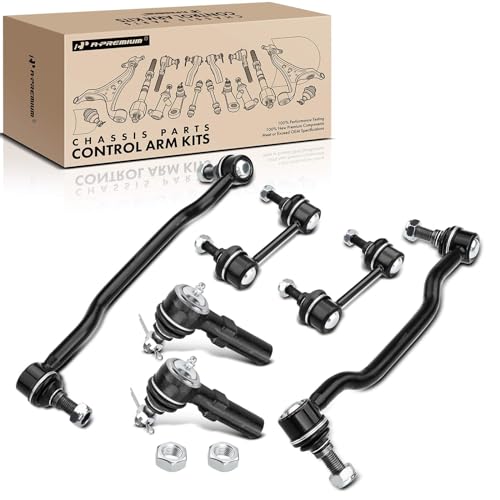
What’s Included?
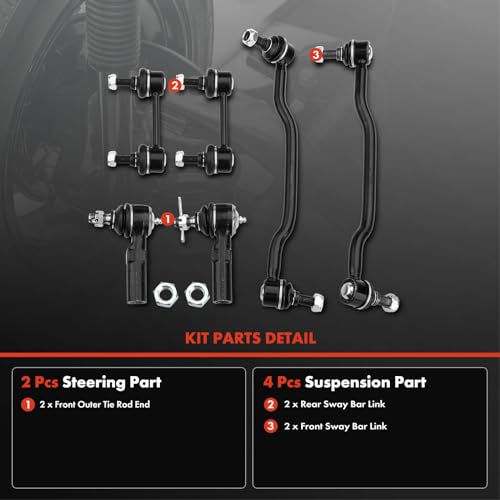
The kit contains six suspension and steering components:
2 Front Sway Bar End Links
2 Rear Sway Bar End Links
2 Front Outer Tie Rod Ends
This provides replacement components for both sides of the vehicle.
That’s particularly useful on older vehicles where wear is rarely confined to one perfectly isolated component.
What Do the Front Sway Bar Links Do?
The front sway bar—or stabilizer bar—connects the left and right sides of the suspension.
During cornering, it resists differences in suspension movement between the two sides of the vehicle.
The end links connect that bar to the suspension.
The basic relationship is:
Suspension → End Link → Sway Bar → Opposite Suspension
When the links wear, excessive movement can develop before the sway bar effectively responds.
Symptoms of Worn Front Sway Bar Links
Common symptoms include:
- Clunking over bumps
- Knocking noises
- Rattling from the front suspension
- Excessive joint movement
- Reduced handling response
- Torn end-link boots
Noise can become particularly noticeable over small repetitive bumps.
Don’t assume every suspension clunk is an end link, though. Control-arm bushings, ball joints, strut mounts and other components can produce similar noises.
Inspection beats firing the parts cannon.
Why Replace Both Front Links?
If one link has failed from age and mileage, the opposite link has experienced essentially the same number of miles and environmental exposure.
Replacing them as a pair provides consistent components on both sides.
It also prevents the deeply satisfying experience of completing the repair only to hear the opposite side start clunking three weeks later.
Rear Sway Bar Links
This package also includes two rear stabilizer-bar links.
They perform essentially the same function as their front counterparts, transmitting suspension movement into the rear stabilizer bar.
Worn rear links can produce:
- Rear suspension clunks
- Rattling
- Knocking over uneven pavement
- Excessive joint movement
- Reduced stabilizer response
Replacing all four links provides fresh connections for both stabilizer bars.
Front Outer Tie Rod Ends
The kit’s other major components are the two front outer tie-rod ends.
These are steering components rather than sway-bar components.
The steering rack moves the tie rods, which transfer steering input to the steering knuckles.
In simplified form:
Steering Wheel
→ Steering Rack
→ Inner Tie Rod
→ Outer Tie Rod
→ Steering Knuckle
→ Front Wheel
Any unwanted play in that chain can affect steering accuracy.
Symptoms of Worn Outer Tie Rod Ends
Potential symptoms include:
- Loose steering
- Steering wander
- Front-end vibration
- Uneven tire wear
- Steering-wheel play
- Clunking
- Poor alignment stability
Severely worn tie-rod ends are also a safety concern because they’re directly involved in controlling the direction of the front wheels.
If a tie-rod end has significant play, replacement shouldn’t be treated as an optional someday-project.
Steering Wander
Steering wander describes a vehicle that requires constant small steering corrections to maintain direction.
Worn steering components can contribute to this because the wheels can move slightly without corresponding steering-wheel input.
Possible causes include:
- Tie-rod wear
- Ball-joint wear
- Control-arm bushing wear
- Incorrect toe
- Worn wheel bearings
- Tire problems
Replacing worn tie-rod ends removes one potential source of unwanted steering movement.
Uneven Tire Wear
Worn tie-rod ends can allow toe alignment to change dynamically.
Toe describes the direction the front edges of the tires point relative to each other.
Excessive toe-in or toe-out can quickly damage tires.
That means ignoring a relatively inexpensive worn steering component can eventually cost considerably more in tires.
Clunking Doesn’t Automatically Mean Tie Rods
Suspension noises travel through the chassis.
What sounds like a tie rod could actually be:
- Sway-bar link
- Control-arm bushing
- Ball joint
- Strut mount
- Engine mount
- Loose fastener
Physically inspect the suspension before replacing components.
For additional diagnostic information, browse Pro Street’s Car Symptoms and Troubleshooting Guides.
Why a Complete Six-Piece Kit Makes Sense
On a twenty-year-old Altima or Maxima, it’s entirely possible for several suspension components to be worn simultaneously.
Replacing multiple related components provides several advantages.
You can restore:
- Front sway-bar connections
- Rear sway-bar connections
- Outer steering joints
in one service.
That can also reduce duplicated labor compared with repeatedly disassembling the vehicle as individual components fail.
OE-Style Replacement Design
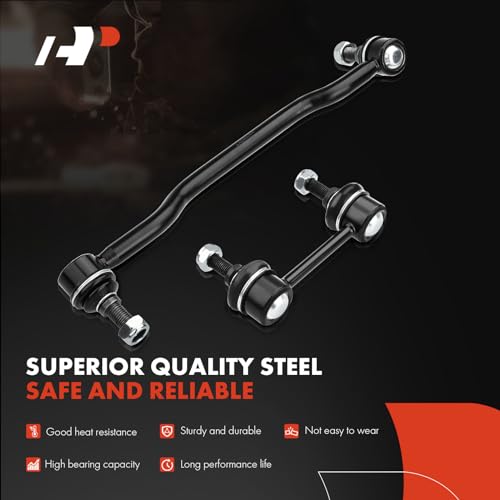
A-Premium describes these components as being manufactured around original dimensions for straightforward replacement.
That’s important for suspension and steering components because proper geometry depends on correct mounting locations and dimensions.
The goal isn’t dramatically changing the suspension.
It’s restoring proper function.
Replacement vs. Performance Suspension
This kit should primarily be considered an OE-style restoration and repair package.
That’s different from components such as:
- Adjustable sway bars
- Coilovers
- Performance springs
- Adjustable control arms
- Geometry correction kits
Those parts modify suspension behavior.
This kit primarily replaces worn components so the factory suspension can work correctly again.
Check the Control Arms While You’re There
On an older Altima or Maxima, inspect the lower control arms and their bushings while replacing tie rods and sway-bar links.
Look for:
- Cracked rubber
- Torn bushings
- Excessive movement
- Ball-joint play
- Corrosion
- Physical damage
Replacing end links won’t solve poor handling caused by a completely destroyed control-arm bushing.
Inspect the Struts
Check the front and rear dampers for:
- Fluid leakage
- Excessive bouncing
- Damaged boots
- Broken mounts
- Corrosion
A worn strut can contribute to:
- Poor body control
- Tire wear
- Reduced grip
- Longer settling after bumps
Suspension repairs work best when the entire system is evaluated rather than assuming one new component magically resets the vehicle to 2004.
Check the Sway Bar Bushings
The stabilizer bars also use chassis-mounted bushings.
Those bushings can deteriorate with age.
Inspect for:
- Cracking
- Deformation
- Excessive clearance
- Bar movement
- Contamination
New end links connected to completely worn sway-bar bushings won’t deliver the restoration you’re looking for.
Does This Kit Require an Alignment?
Yes—plan on a professional wheel alignment after replacing the outer tie-rod ends.
Tie-rod length directly affects front toe.
Even if you carefully measure or count threads while replacing the old ends, that’s only useful for getting the alignment reasonably close before driving to the alignment shop.
It is not a substitute for an actual alignment.
Installation Overview
General installation involves:
- Safely raise and support the vehicle.
- Remove the wheels.
- Inspect surrounding suspension components.
- Remove the existing sway-bar links.
- Install the replacement front and rear links.
- Mark or measure the existing tie-rod position.
- Remove the old outer tie-rod ends.
- Install the new tie-rod ends.
- Torque all fasteners to specification.
- Verify component clearance.
- Reinstall the wheels.
- Have the vehicle professionally aligned.
Steering components are safety-critical. If you’re unfamiliar with suspension repair, professional installation is recommended.
Should You Replace Inner Tie Rods Too?
Not automatically.
Inspect them.
If the inner tie rods have excessive play, replacing only the outer ends leaves looseness elsewhere in the steering system.
Likewise, inspect the steering-rack boots for damage.
A torn boot can allow contamination into the inner joint and steering rack.
What About Ball Joints?
Ball joints should also be checked while the front suspension is accessible.
Any noticeable looseness deserves attention.
Depending on the vehicle application, ball-joint replacement may involve replacing an individual joint or a larger control-arm assembly.
Who Should Buy This A-Premium Suspension Kit?
This six-piece kit makes the most sense for owners experiencing:
Clunking or knocking
Worn sway-bar links
Loose outer tie rods
Steering wander
Poor steering response
Uneven tire wear caused by worn steering components
It’s also worth considering during a broader suspension refresh on a higher-mileage Altima or Maxima.
Is the A-Premium 6-Piece Suspension Kit Worth It?
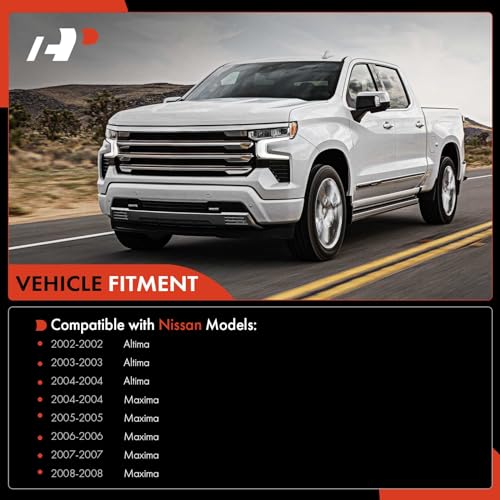
For compatible 2002–2004 Nissan Altima and 2004–2008 Nissan Maxima models, this A-Premium kit provides a convenient package for replacing several commonly worn suspension and steering components simultaneously.
The package includes:
2 front sway-bar links
2 rear sway-bar links
2 front outer tie-rod ends
For an aging daily driver, restoring worn suspension components can produce a far more meaningful improvement than adding performance parts on top of loose factory hardware.
Before making the suspension “better,” making sure the wheels remain pointed where the steering wheel requested is generally a solid opening strategy.
Shop replacement suspension, steering and chassis components through Pro Street Online.





There are no reviews yet.