



Technical Specifications
| Specification | Details |
|---|---|
| Belt Type | Heavy-Duty V-Ribbed Serpentine |
| Effective Length | 112.41 inches |
| Outside Circumference | 113 inches |
| Number of Ribs | 8 |
| Top Width | 1.087 inches |
| Belt Material | EPDM |
| Cord Material | Polyester |
| Cross Section | K |
| Construction | Multi-layer composite |
| Warranty | 1 year, unlimited mileage |
Replacement Part Numbers and Cross-References
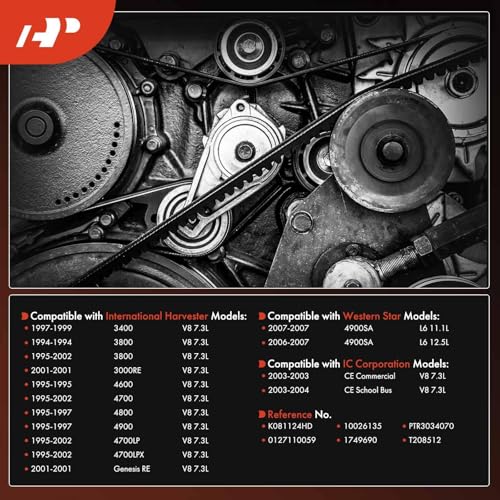
The A-Premium Heavy Duty Serpentine Belt is listed with the following reference numbers:
-
K081124HD
-
0127110059
-
10026135
-
1749690
-
PTR3034070
-
T208512
These numbers are supplied as cross-references. Always verify dimensional specifications and application compatibility before substituting one manufacturer’s belt for another.
Why Heavy-Duty Diesel Engines Need Quality Serpentine Belts
Commercial vehicles often operate for significantly longer periods than typical passenger cars. School buses, delivery trucks, and fleet vehicles may experience extended idling, frequent stop-and-go driving, and substantial electrical demands.
These conditions place continuous stress on engine accessory drive components.
A worn or failing serpentine belt can cause:
-
Alternator charging problems
-
Engine overheating when the water pump is belt-driven
-
Belt squealing, chirping, or vibration
-
Reduced performance from belt-driven accessories
-
Unexpected accessory drive failure
-
Unplanned vehicle downtime and maintenance costs
For commercial operators, an unexpected belt failure can mean more than an inconvenient repair. It can interrupt deliveries, delay transportation schedules, and increase fleet operating expenses.
Replacing a worn belt during scheduled maintenance can help reduce these risks.
For additional information about diagnosing automotive charging problems and engine accessory failures, explore the repair resources at My Pro Street Online.
EPDM vs. Conventional Serpentine Belt Materials
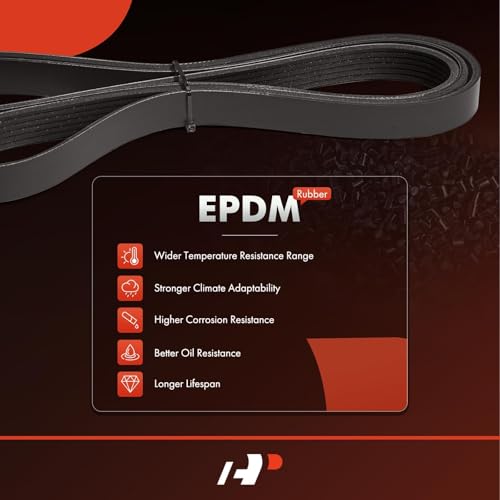
The A-Premium Heavy Duty Serpentine Belt uses EPDM (ethylene propylene diene monomer) rubber, a material commonly used in modern automotive accessory drive belts.
EPDM offers several important advantages:
-
Resistance to elevated engine compartment temperatures
-
Durability under repeated bending and flexing
-
Resistance to ozone and environmental aging
-
Long-term flexibility under normal operating conditions
-
Reduced susceptibility to certain forms of weather-related deterioration
Unlike some older rubber belt formulations, EPDM belts may wear without developing obvious surface cracks.
For this reason, visual inspection alone may not reveal the full extent of belt wear. Inspect rib material loss, belt tension, pulley alignment, and accessory drive operation during routine maintenance.
Heavy-Duty Belt Installation and Maintenance Tips
Proper installation is essential for maximizing serpentine belt service life.
Before installing a replacement belt, inspect the automatic tensioner, idler pulleys, alternator pulley, and other accessory drive components.
Confirm that the belt follows the manufacturer’s specified routing diagram and that all ribs are correctly seated in their pulley grooves.
Never force a belt onto a pulley using a screwdriver or other sharp tool. This can damage the belt’s internal reinforcement and shorten its service life.
Commercial vehicles with specialized alternators, cooling systems, or auxiliary equipment may require different belt configurations, even when the engine displacement is identical.
Buy the A-Premium Heavy Duty 8-Rib Serpentine Belt at Pro Street Online
Restore dependable accessory drive operation with the A-Premium Heavy Duty 112.41-Inch 8-Rib Serpentine Belt.
Designed for select IC Corporation school buses and Western Star commercial trucks, this reinforced EPDM replacement belt offers a durable solution for demanding diesel engine applications.
Shop replacement engine belts and automotive maintenance components at Pro Street Online.



There are no reviews yet.