

44mm Water-Cooled External Turbo Wastegate with V-Band Mount
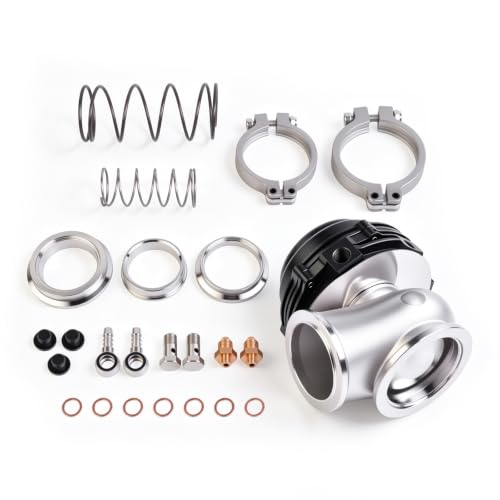
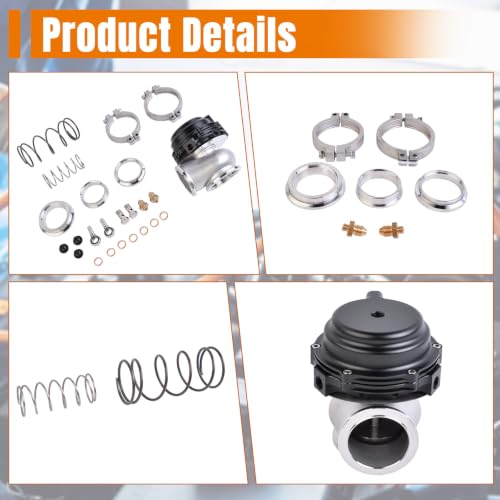
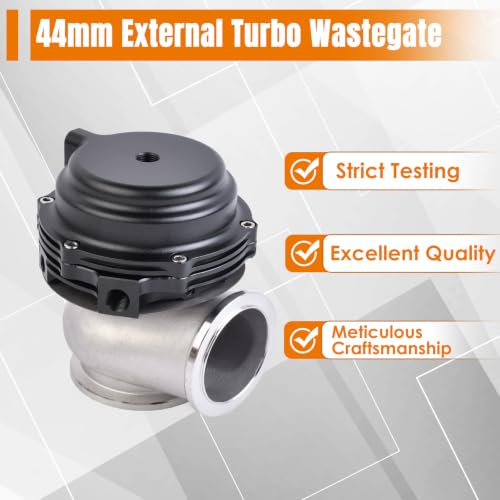
Control boost on a custom turbo build with this universal 44mm external wastegate. The assembly features a V-band mounting design, water-cooled actuator housing and three interchangeable springs for establishing different base-boost ranges.
It’s intended for fabricated turbo systems, upgraded manifolds and applications where an internal wastegate cannot provide enough bypass flow or stable boost control.
Product Highlights
- 44mm external wastegate
- V-band mounting configuration
- Water-cooled actuator housing
- Preinstalled 14 PSI spring
- Additional 7 PSI spring
- Additional 17 PSI spring
- Compatible with manual or electronic boost control
- Designed for custom turbo applications
- Two-year advertised warranty
- Professional installation recommended
Universal Turbo Fitment
This wastegate can be used with many custom turbocharged:
- Four-cylinder engines
- Inline-six engines
- V6 and V8 builds
- Import and domestic performance vehicles
- Street, drag, drift and road-racing applications
The turbo manifold must have a compatible external-wastegate port. The 44mm valve size does not guarantee flange compatibility. Confirm the V-band flange dimensions, clamp profile, valve-seat diameter and available installation space before ordering.
Original price was: $62.99.$49.99Current price is: $49.99.
How the External Wastegate Works
An external wastegate diverts exhaust gas around the turbocharger’s turbine wheel. Opening the valve reduces the exhaust energy driving the turbine, helping regulate turbo speed and boost pressure. Garrett describes external wastegates as exhaust-bypass valves used to manage turbine speed and boost. Garrett Motion
For a complete technical explanation, read What Does a Wastegate Do on a Turbo?.
Three Base-Boost Spring Options
The package is advertised with:
- 7 PSI spring
- 14 PSI spring — preinstalled
- 17 PSI spring
The installed spring establishes the approximate mechanical base-boost level when the wastegate receives a direct pressure reference without controller intervention.
Actual boost may differ because of:
- Exhaust backpressure
- Wastegate placement
- Manifold geometry
- Turbocharger airflow
- Exhaust restriction
- Reference-line routing
- Diaphragm area
- Boost-controller configuration
Treat the spring number as a starting point—not a binding contract with the boost gauge. Manufacturers calculate spring pressure under controlled conditions, and real installations can behave differently. turbosmart.com
Do not combine springs unless the included manufacturer chart specifically approves that combination.
Water-Cooled Housing
Coolant ports allow a small amount of engine coolant to circulate through the actuator housing. This can help stabilize actuator temperature in high-heat applications such as road racing, endurance use or cramped engine compartments.
Comparable performance wastegates use water cooling to reduce actuator temperatures under extreme operating conditions. support.turbosmart.com
Use heat-resistant hose, appropriate fittings and a correctly selected cooling-system connection. Do not route coolant based on guesswork—the turbo system already has enough hot pressurized fluids looking for an excuse to escape.
Boost-Controller Compatibility
The wastegate may be operated using:
- Direct compressor-pressure reference
- Manual boost controller
- Electronic boost-control solenoid
- ECU-controlled boost strategy
A boost controller generally raises boost above mechanical spring pressure. It normally cannot command stable boost below the installed spring’s base pressure.
See How to Install a Boost Controller the Right Way for pressure-source and hose-routing guidance.
Installation Requirements
Professional installation and calibration are strongly recommended. Installation may require:
- Compatible 44mm V-band manifold flange
- V-band clamp and valve seat
- Wastegate dump tube or recirculation pipe
- Boost-reference hose
- Coolant fittings and hoses
- Heat shielding
- Boost controller or solenoid
- ECU tuning
- Reliable boost gauge
Wastegate placement matters. The inlet should receive a smooth path from the exhaust manifold rather than being mounted at an angle that discourages exhaust flow from entering it. Poor placement can produce boost creep even when the valve itself is large enough.
Initial Setup
After installation:
- Pressure-test the actuator before operating the engine.
- Verify the valve moves smoothly and seals correctly.
- Inspect all V-band connections.
- Check boost-reference routing.
- Pressure-test the coolant connections.
- Begin with minimum boost-control duty.
- Monitor boost with a verified gauge or ECU log.
- Stop immediately if boost exceeds the tuned target.
Our aftermarket wastegate review covers sizing, placement and common boost-control problems in more detail.
Product Specifications
- Product type: External turbo wastegate
- Valve size: 44mm
- Mounting style: V-band
- Cooling: Water-cooled actuator housing
- Preinstalled spring: 14 PSI
- Additional springs: 7 PSI and 17 PSI
- Application: Universal custom turbo systems
- Installation level: Professional
- Warranty: Two years, as advertised
Specification: 44mm Water-Cooled External Turbo Wastegate with V-Band Mount
|
User Reviews
Be the first to review “44mm Water-Cooled External Turbo Wastegate with V-Band Mount”
You must be logged in to post a review.



There are no reviews yet.