
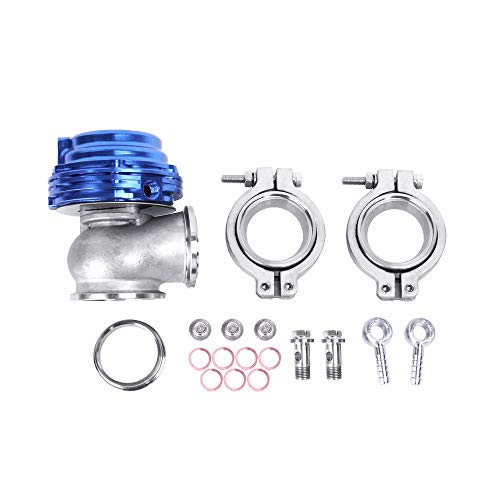
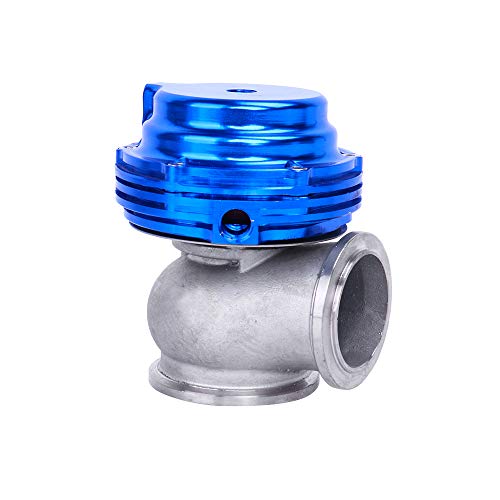
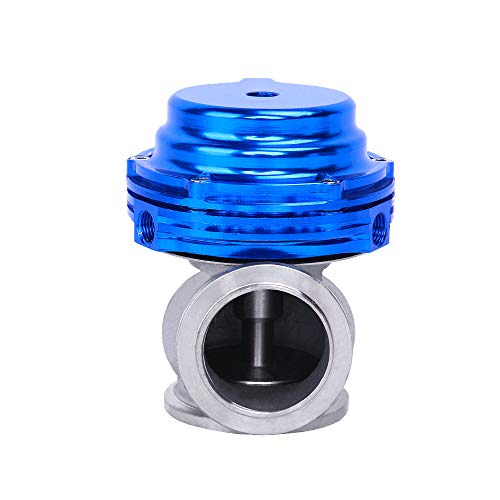
38mm Blue External Turbo Wastegate with V-Band Hardware
Control turbo boost on a custom performance build with this universal 38mm external wastegate. The assembly features a steel valve body, blue anodized-aluminum actuator cap and V-band mounting hardware for the manifold and dump-pipe connections.
A 14 PSI spring is included for establishing mechanical base boost.
Product Highlights
- 38mm external wastegate
- Blue anodized-aluminum actuator cap
- Steel wastegate body
- Preinstalled or supplied 14 PSI spring
- V-band manifold connection
- Weldable dump-pipe flange
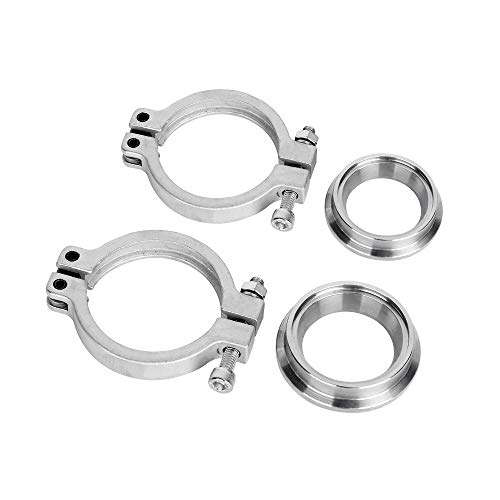
- Stainless-steel V-band hardware
- Barbed and banjo-style pressure fittings
- Designed for custom turbo applications
Universal Turbo Application
This wastegate is intended for turbo systems equipped with a compatible 38mm V-band wastegate port. Common applications may include:
- Turbocharged four-cylinder builds
- Honda and Acura turbo conversions
- Mitsubishi and DSM applications
- Nissan SR and RB engine builds
- Toyota JZ turbo systems
- Mazda rotary applications
- Custom turbocharged V6 and V8 engines
This is not vehicle-specific. Manifold design, flange dimensions, valve clearance, dump-pipe routing and boost-control requirements must all be checked before installation.
$56.99
External Boost Control
The wastegate regulates boost by opening a separate exhaust-bypass passage around the turbocharger’s turbine wheel. Diverting exhaust flow helps control turbine speed and limits additional boost pressure. www.garrettmotion.com
Learn more in our guide explaining what a wastegate does on a turbo.
14 PSI Base Spring
The included 14 PSI spring establishes the approximate mechanical base-boost target when the bottom wastegate port receives a direct pressure reference.
Actual engine boost can vary because of:
- Exhaust backpressure
- Manifold and wastegate placement
- Turbocharger size
- Dump-pipe restriction
- Exhaust-system flow
- Reference-line routing
- Diaphragm area
- Spring tolerance
A 14 PSI spring does not guarantee exactly 14 PSI on every engine. Treat it as the mechanical starting point and verify actual pressure with a boost gauge or ECU log.
A boost controller can generally raise pressure above the spring setting, but it normally cannot provide dependable boost below that mechanical base.
V-Band Installation
The V-band design allows the wastegate to be removed without unbolting a traditional two-bolt flange. The supplied weldable outlet flange can be incorporated into a recirculated dump pipe or an application-appropriate separate discharge pipe.
Do not assume every 38mm V-band flange shares identical dimensions. Compare:
- Flange outside diameter
- V-band groove profile
- Valve-seat diameter
- Clamp dimensions
- Wastegate inlet and outlet orientation
“Universal 38mm” describes the application category, not a legally binding promise that every random flange in the garage will cooperate.
Wastegate Placement Matters
The wastegate inlet should receive a smooth path from the exhaust manifold. A poorly positioned port may not divert enough exhaust gas, potentially causing boost creep even when the wastegate valve is working correctly.
Garrett recommends a smooth wastegate takeoff angled toward exhaust flow; mounting the inlet at an unfavorable angle can substantially reduce bypass capacity. www.hpacademy.com
Boost-Control Connections
The supplied barbed or banjo fittings provide pressure-reference connections for:
- Direct spring-pressure control
- Manual boost controller
- Electronic boost-control solenoid
- ECU-controlled boost management
Follow the controller manufacturer’s routing diagram. Incorrect top- and bottom-port connections can produce unstable boost or prevent the gate from opening properly.
Our boost-controller installation guide explains basic pressure-source and hose-routing requirements.
Installation Checklist
Before operating the engine:
- Confirm the manifold flange matches the wastegate.
- Verify the valve and seat move freely.
- Install and tighten both V-band clamps correctly.
- Fabricate a properly supported dump pipe.
- Route pressure hoses away from exhaust heat.
- Secure every hose connection.
- Pressure-test the diaphragm.
- Begin with minimum boost-controller duty.
- Monitor boost during the first controlled test.
- Lift immediately if pressure exceeds the tuned limit.
Professional fabrication, installation and ECU calibration are strongly recommended.
Included Components
Based on the supplied description, the package includes:
- One 38mm external wastegate
- One 14 PSI spring
- Weldable V-band flange for the dump pipe
- Stainless-steel V-band flanges or clamps
- Sealing rings
- Barbed or banjo pressure fittings
Confirm the complete hardware list before purchase because the original description does not clearly separate included clamps, flanges and seals.
Product Specifications
- Product type: External turbo wastegate
- Valve size: 38mm
- Color: Blue
- Body material: Advertised steel construction
- Actuator cap: Anodized aluminum
- Base spring: 14 PSI
- Mounting configuration: V-band
- Application: Universal custom turbo systems
- Installation: Professional installation recommended
Specification: 38mm Blue External Turbo Wastegate with V-Band Hardware
|
User Reviews
Be the first to review “38mm Blue External Turbo Wastegate with V-Band Hardware”
You must be logged in to post a review.



There are no reviews yet.