
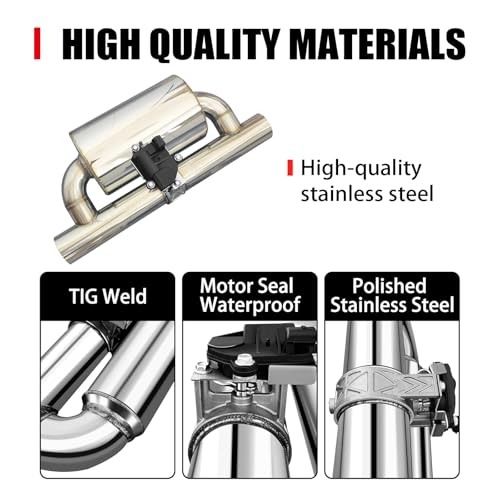
Three Exhaust Sound Modes
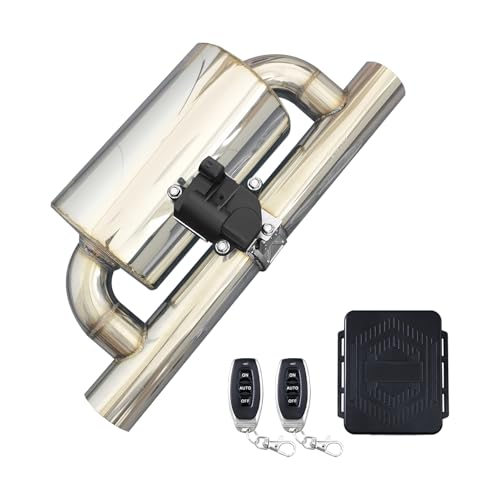
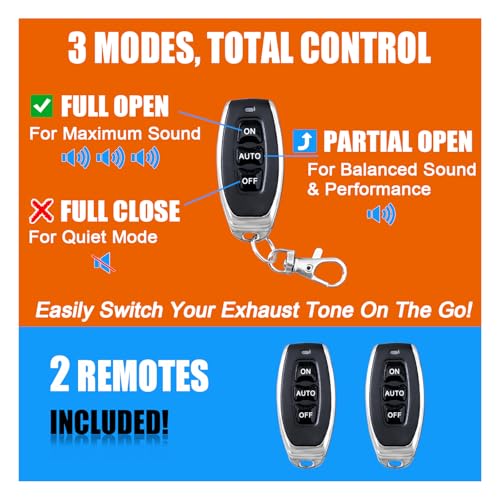
The biggest advantage of this valved muffler is its ability to provide three different exhaust configurations from one assembly.
Fully Closed
Close the valve and exhaust is routed through the integrated muffler section.
This provides the quietest configuration and is intended to produce a deeper, more restrained exhaust note.
Partially Open
Partially opening the valve creates an intermediate exhaust path.
This provides a balance between the quieter muffled setting and maximum straight-through exhaust sound.
For many street-driven cars, this may be the most useful everyday setting.
Fully Open
Fully open the valve and exhaust takes the straighter internal path.
This provides:
- Maximum exhaust volume
- More aggressive exhaust character
- Reduced muffler restriction
- Straighter exhaust flow through the assembly
This is the system’s loudest operating mode.
Valved Muffler vs. Electric Exhaust Cutout
Although the product may be described as an exhaust cutout, its construction makes:
electric valved muffler
the more useful description.
A conventional cutout generally creates an alternate exhaust outlet.
This product integrates:
Straight-Through Path + Muffled Path
into one assembly.
That allows it to function as both the muffler and the sound-control valve in a compatible custom exhaust system.
How the Valved Muffler Works
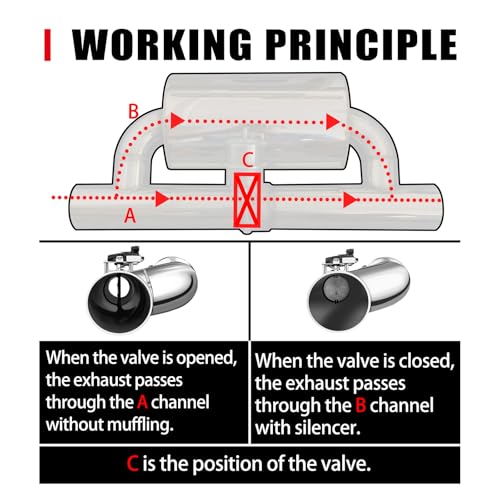
The basic operating principle is straightforward.
Valve Open
Engine → Exhaust → Straight-Through Path → Tailpipe
Valve Closed
Engine → Exhaust → Muffled Path → Tailpipe
Valve Partially Open
Exhaust flow is divided according to valve position, creating an intermediate sound level.
Instead of dumping exhaust directly underneath the vehicle like many traditional cutouts, this design changes the route exhaust takes through the muffler assembly.
Straight-Through Open Mode
With the valve fully open, exhaust follows the straighter internal route.
Reducing muffler restriction can increase exhaust-flow capacity compared with forcing all exhaust through the quieter section.
That can be useful on higher-flow engines.
However, there is no universal horsepower gain.
Actual performance depends on the complete exhaust system.
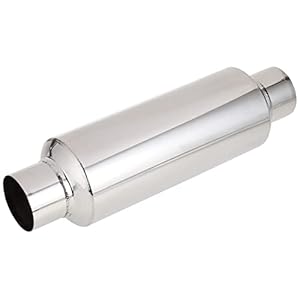
Glass-Pack-Style Closed Mode
Close the valve and exhaust is redirected through the integrated:
glass-pack-style muffler
section.
Glass-pack-type mufflers generally use sound-absorbing material surrounding an exhaust passage to reduce sound energy.
The resulting exhaust note depends heavily on the vehicle.
Factors include:
- Engine configuration
- Displacement
- Turbocharger
- Headers
- Catalytic converters
- Resonators
- Exhaust diameter
- Tailpipe length
No universal muffler can guarantee an exact sound on every engine.
Why Three Modes Are Better Than Two
Many electric exhaust valves provide only:
OPEN
and:
CLOSED
That works, but the difference can be dramatic.
Three-position control adds:
PARTIALLY OPEN
between those extremes.
That gives the driver more flexibility when maximum volume isn’t necessary but the fully muffled setting is too restrained.
Think of it as:
Quiet → Sport → Loud
rather than:
Quiet → Neighbors Know You’re Home.
Two Wireless Remotes Included
The system includes:
two wireless remotes.
One can serve as the primary controller and the second as a spare.
Remote control eliminates the need to physically access the valve whenever you want to change exhaust modes.
It also avoids adding a conventional mechanical control to the cabin.
12V Electric Actuator
The valve is operated by a:
12V electric actuator.
The actuator changes the internal valve position in response to commands from the remote-control system.
A proper installation should provide:
- Reliable 12V power
- Good electrical ground
- Appropriate circuit protection
- Protected wiring
Follow the supplied electrical instructions for the specific controller.
Weather-Resistant Actuator
The seller describes the actuator as waterproof.
Unless the product carries a documented waterproof/IP rating, a more conservative description is:
weather-resistant actuator designed for automotive underbody use.
Underbody exhaust components can encounter:
- Rain
- Road spray
- Dirt
- Dust
- Condensation
- Vibration
Avoid unnecessary high-pressure water exposure to the actuator and electrical connectors.
Keep Electrical Components Away From Extreme Heat
Exhaust components operate at extremely high temperatures.
The electrical actuator and wiring should be positioned to minimize unnecessary heat exposure.
Keep wiring away from:
- Headers
- Turbochargers
- Catalytic converters
- Exhaust tubing
- Muffler surfaces
Use appropriate heat shielding and wire protection where necessary.
3-Inch Exhaust Compatibility
This valved muffler is intended for compatible:
3-inch exhaust systems
which is approximately:
76.2mm
Three-inch exhaust is commonly found on:
- Turbocharged performance cars
- Supercharged vehicles
- Modified V8s
- Performance trucks
- Street/strip cars
- High-output custom builds
However, exhaust diameter should be selected according to engine airflow requirements.
Bigger isn’t automatically better.
Verify the Connection Diameter
Measure the actual exhaust before ordering.
Confirm:
- Outside diameter
- Inlet dimensions
- Outlet dimensions
- Available tubing length
Do not assume that every exhaust advertised as “3-inch” uses identical connection dimensions at every component.
Adapters may be necessary in some custom installations.
Check Installation Space
The manufacturer specifically recommends verifying available underbody space before ordering.
A valved muffler requires room for:
- Muffler body
- Valve mechanism
- Electric actuator
- Exhaust tubing
- Electrical wiring
Check:
- Length
- Width
- Height
- Ground clearance
before purchasing.
Why Clearance Matters
A conventional straight exhaust pipe takes relatively little space.
A valved muffler assembly does not.
Potential interference points include:
- Driveshaft
- Differential
- Suspension
- Fuel tank
- Spare-tire well
- Floorpan
- Chassis braces
The actuator also requires clearance as it cannot simply be pressed against the floorpan because the muffler technically fits.
Universal Fitment Means Custom Installation
This product should be treated as a:
universal performance exhaust component
rather than a vehicle-specific bolt-on cat-back.
Installation may require:
- Cutting
- Measuring
- Welding
- Clamping
- Exhaust adapters
- Custom hangers
- Electrical wiring
Professional installation is recommended when fabrication is required.
This Is Not Necessarily a Complete Cat-Back
The supplied product description uses the phrase:
cat back exhaust system kit.
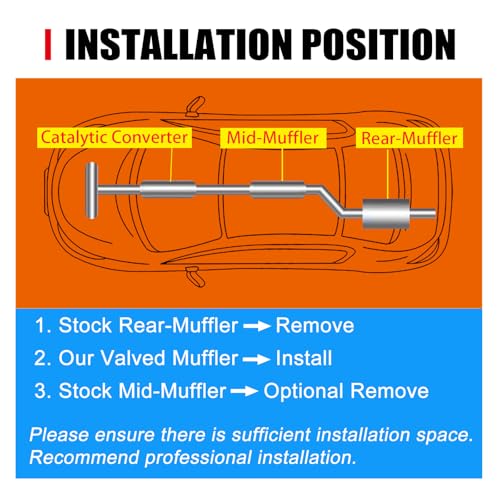
However, a true vehicle-specific cat-back system normally includes the tubing and components necessary to replace the exhaust from approximately the catalytic-converter area rearward.
This product is better described as a:
universal electric valved muffler kit
unless the actual package contains all vehicle-specific cat-back tubing, hangers and hardware.
That distinction prevents customers from expecting an entire bolt-on exhaust system when they’re actually purchasing a universal muffler assembly.
Mock Up Before Welding
Before permanently installing the muffler:
- Measure the existing exhaust.
- Position the muffler.
- Check inlet and outlet direction.
- Check actuator clearance.
- Check suspension clearance.
- Check ground clearance.
- Plan wiring.
- Test the valve.
- Tack or temporarily clamp the assembly.
- Recheck fitment.
Only then should the installation be finalized.
Check Ground Clearance
This is especially important on:
- Lowered cars
- Sports cars
- Custom suspension builds
The muffler or actuator should not become the lowest component underneath the vehicle.
Electric exhaust valves can survive thousands of heat cycles.
A concrete parking stop may require considerably less time to end the relationship.
Support the Muffler Correctly
A valved muffler is heavier than a simple exhaust tube.
Proper exhaust hangers should support the assembly.
Do not rely entirely on:
- Welds
- Clamps
- Adjacent tubing
to carry its weight.
Poor support can contribute to:
- Cracked welds
- Exhaust leaks
- Rattling
- Broken hangers
- Premature component failure
Test All Three Modes Before Final Installation
Connect the electronics before completing permanent fabrication.
Test:
Fully Closed
Partially Open
Fully Open
Confirm:
- Smooth valve movement
- Correct remote response
- No binding
- No unusual actuator noise
- Both remotes function
Fix any electrical or mechanical issue before final welding.
Can a Valved Muffler Increase Horsepower?
Possibly, but there is no guaranteed power increase.
The fully open position reduces the amount of exhaust restriction created by the muffler.
If the existing muffler is restrictive at the engine’s airflow level, the straighter route may improve exhaust flow.
Potential results depend on:
- Engine airflow
- Headers
- Turbocharger
- Catalytic converter
- Exhaust diameter
- Existing exhaust restriction
- Engine calibration
For some vehicles, the primary difference will simply be sound.
The Accurate Performance Claim
The best technical description is:
fully open mode can reduce muffler restriction.
That is more accurate than promising a specific horsepower increase.
If the engine is already operating with a sufficiently free-flowing exhaust, reducing muffler restriction further may produce little measurable improvement.
Turbocharged Applications
Three-inch exhaust tubing is common on turbocharged performance vehicles.
A valved muffler can provide:
Quieter street operation → closed
and:
Lower-restriction exhaust path → open
without requiring two completely separate exhaust systems.
Potential applications include:
- Turbo four-cylinder cars
- Turbo six-cylinder cars
- Single-turbo V8 builds
- Modified imports
- Custom turbo vehicles
Actual exhaust sizing should match the engine and target output.
V8 Applications
Three-inch valved mufflers can also work well with higher-output V8 combinations.
Potential applications include:
- Mustangs
- Camaros
- Corvettes
- Challengers
- Chargers
- LS swaps
- Restomods
- Performance trucks
For true dual exhaust, determine whether the vehicle requires:
two valved mufflers
rather than one.
X-Pipe and H-Pipe Systems
Valved mufflers can be installed downstream of either an X-pipe or H-pipe in compatible dual-exhaust systems.
These crossover designs affect exhaust character differently.
Read our X Pipe vs H Pipe: Which Sounds Better? guide for more information.
Building a Custom Cat-Back
This muffler can be incorporated into a custom cat-back exhaust system.
A fabricated system might include:
Mid-Pipe → Resonator → Valved Muffler → Tailpipe
or another configuration appropriate to the vehicle.
If you’re deciding how much of the exhaust to replace, see our Catback Exhaust vs Axleback: Which Wins? guide.
Valved Muffler vs. Traditional Exhaust Cutout
A conventional electric cutout generally creates a bypass outlet from the main exhaust.
For installation guidance on that style of system, read How to Install Exhaust Cutout the Right Way.
This valved muffler takes a different approach by integrating the quiet and high-flow paths into the muffler itself.
Check for Exhaust Leaks
After installation, run the engine and inspect every connection.
Look for:
- Ticking
- Soot
- Exhaust odor
- Loose clamps
- Leaking welds
Test the exhaust in all three modes.
Recheck connections after several complete heat cycles.
Two-Year Advertised Warranty
The seller advertises this kit with a:
2-year warranty.
Before purchase, verify the current warranty terms.
Check whether coverage includes:
- Muffler
- Valve
- Electric actuator
- Controller
- Remotes
- Wiring
Also determine whether labor, shipping and installation costs are excluded.
Street-Legal Considerations
Adjustable exhaust systems may be subject to local noise and equipment regulations.
Potential restrictions can involve:
- Exhaust volume
- Muffler requirements
- Adjustable exhaust valves
- Modified exhaust systems
For California readers, our Is My Exhaust Legal? guide provides additional background.
Always verify current state and local requirements.
Keep Required Emissions Equipment
A valved muffler should not be installed in a manner that unlawfully removes or bypasses required:
- Catalytic converters
- Oxygen sensors
- Emissions equipment
For street use, preserve legally required emissions components.
Who Should Buy This 3-Inch Electric Valved Muffler?
This product makes the most sense for someone building a compatible:
3-inch custom performance exhaust
who wants multiple exhaust sound levels from one muffler assembly.
Potential applications include:
- Turbo cars
- Muscle cars
- Performance trucks
- Restomods
- LS swaps
- Street/strip vehicles
- Custom cat-back exhausts
It is particularly useful for drivers who want a quieter exhaust when needed without giving up access to a more aggressive straight-through exhaust path.
Why Buy This 3-Inch Valved Muffler?
Key features include:
- 3-inch exhaust compatibility
- Three exhaust sound modes
- Fully closed setting
- Partially open setting
- Fully open setting
- Straight-through open path
- Integrated glass-pack-style muffler path
- Two wireless remotes
- 12V electric actuator
- Weather-resistant actuator design
- Universal custom-exhaust fitment
- Advertised two-year warranty
For a custom 3-inch performance exhaust, this electric valved muffler offers considerably more flexibility than a fixed performance muffler while maintaining an integrated exhaust outlet.
Specifications at a Glance
Product: Electric Valved Performance Muffler
Exhaust Size: 3 inches
Approximate Metric Size: 76.2mm
Sound Modes: 3
Valve Positions: Fully Closed / Partially Open / Fully Open
Open Path: Straight-through
Closed Path: Glass-pack-style muffler
Control: Wireless
Remotes: 2
Actuator: 12V electric
Fitment: Universal/custom
Advertised Warranty: 2 years
Primary Application: Adjustable performance exhaust sound control
Always verify pipe diameter, inlet/outlet dimensions, muffler orientation and available installation space before ordering.





There are no reviews yet.