
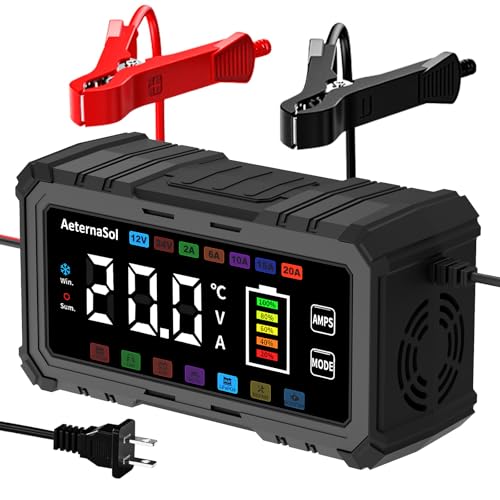
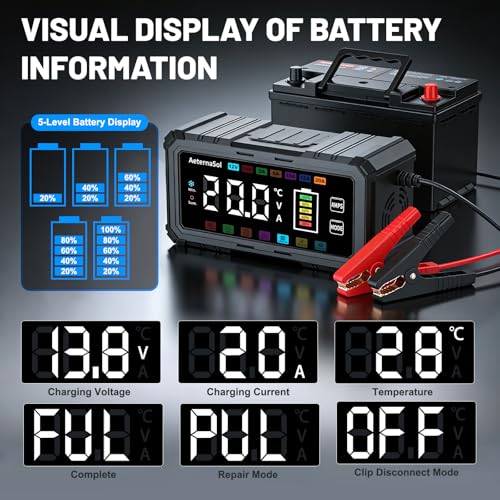
20A Smart Car Battery Charger – 12V/24V Trickle Charger & Battery Maintainer
Whether you’re maintaining a weekend car, bringing a truck battery back up to charge or keeping an RV ready between trips, the 20A Smart Car Battery Charger combines high-current charging, automatic 12V/24V detection, selectable charging rates and long-term battery maintenance in one versatile unit.
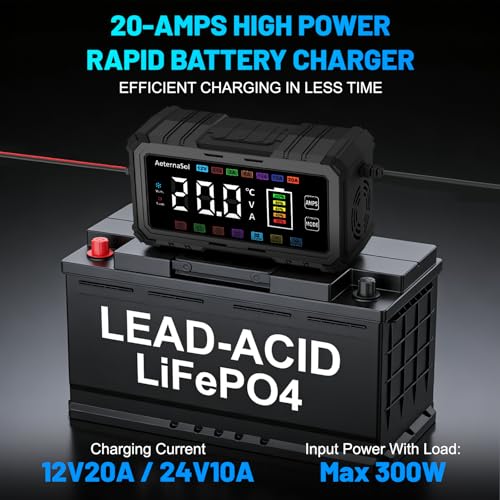
The charger provides up to 20 amps for 12V batteries and 10 amps for 24V batteries, with support for battery capacities from 4Ah to 400Ah. Dedicated charging modes accommodate common lead-acid batteries as well as compatible LiFePO4 and lithium-ion batteries, making this a useful charger for garages containing several different battery technologies.
High-Output 20A 12V Battery Charging
Compared with a basic low-amperage maintainer, this charger provides substantially more charging capacity for larger automotive batteries.
Maximum rated output is:
- 12V batteries: up to 20A
- 24V batteries: up to 10A
- Battery capacity: 4Ah–400Ah
- Automatic 12V/24V voltage recognition
That makes the charger suitable for compatible batteries found in cars, SUVs, pickup trucks, motorcycles, boats, RVs and other automotive or recreational applications.
A higher charging rate can significantly reduce charging time on a large, discharged battery, but the appropriate charging current should always be based on battery type, capacity and manufacturer recommendations.
Five Adjustable Charging Rates
Not every battery needs 20 amps thrown at it simply because 20 amps are available.
The charger provides five manually selectable current settings:
- 2A
- 6A
- 10A
- 15A
- 20A
Lower charging rates can be selected for smaller batteries and maintenance applications, while higher rates are available for appropriately sized automotive and deep-cycle batteries.
This flexibility makes the charger useful for owners working with everything from motorcycle batteries to substantially larger truck and RV batteries.
$42.99
Lead-Acid, AGM and Lithium Battery Compatibility
One of the charger’s biggest advantages is its support for multiple battery chemistries.
Compatible battery types include:
- AGM
- GEL
- SLA
- Flooded/Wet lead-acid
- EFB
- LiFePO4
- 12.6V lithium-ion/NMC
- Other specifically supported batteries according to the charger’s operating instructions
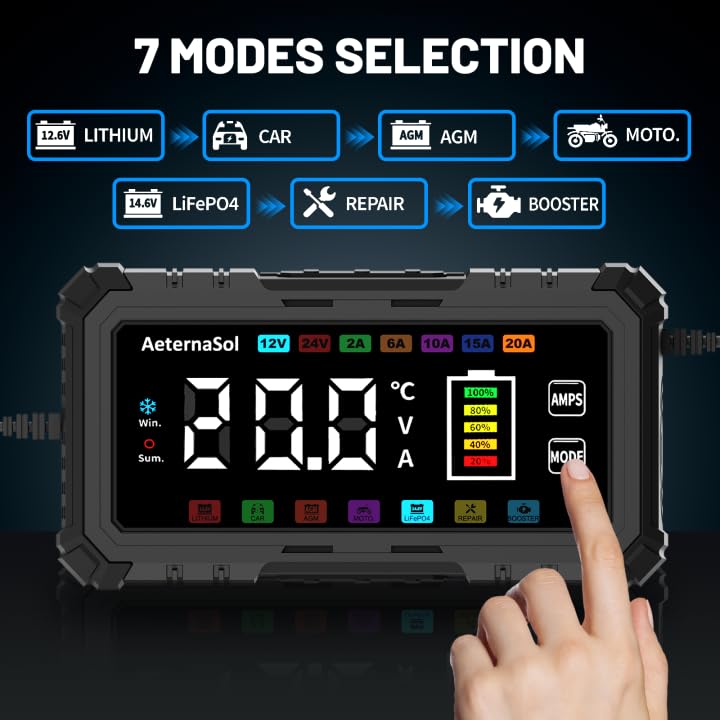
Dedicated charging modes adjust the charging strategy for the selected battery chemistry rather than treating every battery as though it were an old-school flooded lead-acid unit.
Selecting the correct battery mode is critical, particularly when charging lithium batteries. Verify the battery chemistry and charging requirements before connecting the charger.
200-Second Booster Mode
For compatible 12V lead-acid batteries, the charger includes a dedicated 200-second Booster Mode.
This function provides a targeted high-rate charging period intended to add enough surface charge to assist with starting a vehicle. The LCD displays a countdown so the boost cycle can be monitored.
Booster Mode can be useful when a battery is discharged but otherwise serviceable. However, this is an AC-powered battery charger, not a self-contained portable jump starter. It must be connected to an electrical outlet to operate.
If the vehicle clicks rapidly but won’t start, low battery voltage is one possible cause, but loose terminals, excessive cable resistance and other starting-system faults can create similar symptoms.
Do not use Booster Mode on lithium batteries.
Automatic Trickle Charging for Battery Maintenance
Switching to Motorcycle Mode allows the charger to enter a lower-rate maintenance or trickle-charging strategy designed to keep a compatible battery charged during extended storage.
This makes the charger useful for:
- Motorcycles
- Weekend cars
- Classic vehicles
- Project cars
- Boats
- RVs
- Seasonal vehicles
- Lawn and utility equipment
A maintainer can help compensate for normal battery self-discharge and small standby loads, but a battery that repeatedly becomes severely discharged may indicate another problem.
Our guide explaining why a car battery keeps dying covers common causes including aging batteries, parasitic electrical draws and charging-system faults.
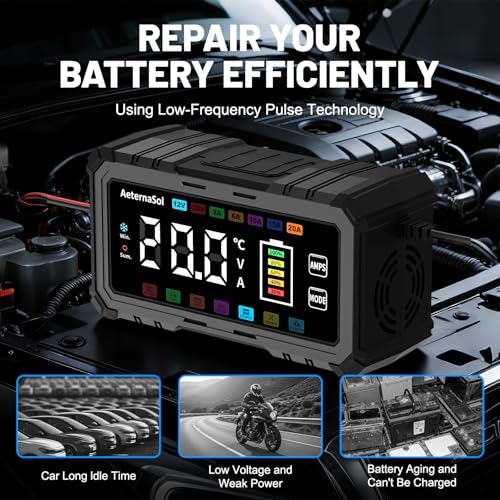
Pulse Repair for Lead-Acid Batteries
The charger includes a pulse repair mode intended for compatible older, idle, stratified or sulfated lead-acid batteries.
Its high- and low-frequency pulse strategy is designed to address certain sulfation conditions and potentially improve the performance of recoverable batteries.
Battery repair modes have limitations. They cannot reverse physical plate deterioration, internal shorts, damaged cells, severe corrosion or other permanent battery failures.
The charger also cannot charge a battery below 0.3V or a physically damaged battery.
Most importantly, do not use Repair Mode on lithium batteries.
Automatic Temperature Compensation
Battery charging behavior changes with temperature. A charging voltage suitable for mild conditions may not be ideal when the battery is extremely cold or hot.
Integrated temperature compensation provides Winter and Summer modes designed to adjust charging behavior according to environmental conditions.
Winter compensation helps address potential undercharging in cold weather, while hot-weather compensation helps reduce the risk of excessive charging voltage as temperatures increase.
Real-Time LCD Monitoring
A built-in LCD provides charging information including:
- Battery voltage
- Charging current
- Temperature
- Operating mode
- Booster countdown information
Real-time data makes it easier to confirm charger operation and monitor the battery during the charging process.
If a battery reaches full charge but the vehicle still struggles to crank, further diagnosis may be required. A proper automotive voltage-drop test can reveal excessive resistance in battery cables, terminals, grounds and starter connections that may appear perfectly normal during visual inspection.
Intelligent Cooling for High-Amperage Charging
Higher charging current creates heat, particularly during prolonged charging of larger batteries.
The charger uses an integrated high-efficiency cooling fan to dissipate heat during high-current operation.
Its internal microprocessor also continuously monitors charging conditions and provides multiple electrical protection functions.
Built-In Charging Protection
Integrated safety functions include protection against:
- Reverse polarity
- Short circuits
- Over-current
- Overheating
- Improper charging conditions
These safeguards make routine charging easier, but they do not replace correct battery identification and safe connection procedures.
Always connect the charger according to the product manual and vehicle or battery manufacturer’s recommendations.
Useful for Charging-System Diagnosis
Starting with a fully charged battery is one of the first steps when troubleshooting many automotive electrical problems.
If the battery charges normally but repeatedly becomes discharged while driving, the problem may lie elsewhere in the charging system. Our guide to why the battery warning light comes on explains how alternator output, drive belts, wiring, grounds and battery condition interact.
Likewise, if the car has electrical power but still won’t start, don’t assume another charging cycle will solve it. Starter motors, relays, cables, grounds and control-system problems can all produce a no-start condition.
Important Lithium Battery Restrictions
Although this charger supports compatible lithium battery chemistries, lithium batteries require the correct operating mode.
Never use Booster Mode or Repair Mode on lithium batteries.
Before charging:
- Identify the battery chemistry.
- Confirm the battery manufacturer’s charging requirements.
- Select the appropriate charger mode.
- Verify that the battery is not damaged.
- Follow the charger’s operating instructions.
The charger requires an external AC power source and cannot function as a standalone jump pack.
Key Features
- Up to 20A charging for 12V batteries
- Up to 10A charging for 24V batteries
- Automatic 12V/24V recognition
- Supports 4Ah–400Ah batteries
- Five selectable current settings: 2A, 6A, 10A, 15A and 20A
- AGM battery charging mode
- GEL battery compatibility
- SLA battery compatibility
- Flooded/Wet battery compatibility
- EFB battery compatibility
- LiFePO4 charging support
- 12.6V lithium-ion/NMC mode
- 14.6V LiFePO4 mode
- 200-second Booster Mode for compatible 12V lead-acid batteries
- Pulse repair function for compatible lead-acid batteries
- Winter/Summer temperature compensation
- Motorcycle trickle/maintenance mode
- Real-time LCD display
- Voltage, current and temperature monitoring
- Intelligent cooling fan
- Reverse-polarity protection
- Short-circuit protection
- Over-current protection
- Overheat protection
One Charger for a Garage Full of Batteries
The 20A Smart 12V/24V Battery Charger and Maintainer provides the versatility needed for garages where one battery charger needs to handle multiple jobs.
High-current 20A charging helps replenish larger 12V batteries, while adjustable current settings allow more appropriate charging for smaller batteries. Automatic voltage recognition, multiple chemistry-specific modes, maintenance charging, temperature compensation and pulse repair further expand its usefulness.
For enthusiasts maintaining everything from motorcycles and project cars to trucks, boats and RVs, that’s considerably more convenient than owning a small collection of chargers whose primary purpose eventually becomes tangling their cables together in a drawer.
Specification: 20A Smart Car Battery Charger – 12V/24V Trickle Charger & Battery Maintainer
|
User Reviews
Be the first to review “20A Smart Car Battery Charger – 12V/24V Trickle Charger & Battery Maintainer”
You must be logged in to post a review.





There are no reviews yet.