
Important Active Damper System Exclusion
This maXpeedingrods kit does not fit vehicles equipped with Honda’s factory Active Damper System.
Honda offered electronically controlled adaptive dampers on selected tenth-generation Accord Touring configurations. The system changes damping force electronically and operates differently from conventional passive shocks. hondanews.com
Before ordering, check for:
- A Touring trim designation
- Adaptive suspension settings
- SPORT-mode damper changes
- Electrical connectors attached to the original struts or shocks
- Active Damper System references in the owner’s manual
- Factory build information listing adaptive dampers
Do not rely solely on the engine or chassis code. Equipment varies by year and trim.
Installing passive coilovers on a car equipped with adaptive dampers may create warning messages, electrical faults or compatibility problems. This kit avoids the issue by excluding those vehicles entirely—refreshingly sensible, considering the alternative is usually a dashboard full of expensive opinions.
Tenth-Generation Accord Suspension Design
The tenth-generation Accord uses:
- MacPherson-strut front suspension
- Multi-link rear suspension
- Electric power steering
- Front and rear stabilizer bars
Honda’s technical specifications confirm that every 2018 Accord used a MacPherson-strut front layout and multi-link rear suspension, while the Active Damper System was limited to selected trims. hondanews.com
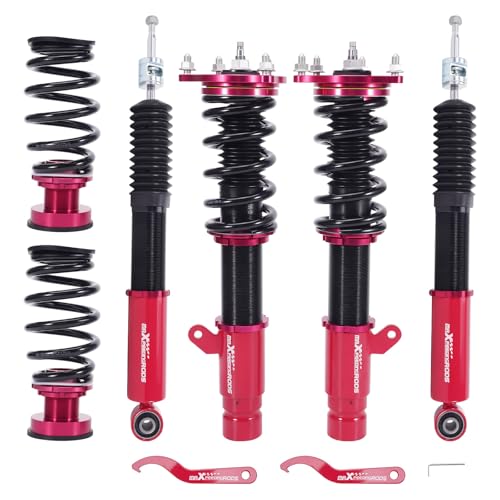
The front of the maXpeedingrods kit uses strut-style coilover assemblies. The rear suspension may retain a separate spring-and-damper arrangement depending on the exact kit design.
Verify the package contents before describing all four corners as identical coilover assemblies.
Why Install Coilovers on a Honda Accord?
The tenth-generation Accord already has a capable chassis, but its factory suspension must balance handling with the comfort expected from a midsize sedan.
Coilovers let owners shift that balance toward:
- Lower ride height
- Reduced wheel gap
- Firmer suspension response
- Less body roll
- Reduced brake dive
- Faster steering response
- More controlled weight transfer
- Adjustable rebound damping
- More aggressive appearance
This is especially useful for an Accord running larger wheels, wider tires or other street-performance modifications.
For a complete comparison, read Lowering Springs vs. Coilovers.
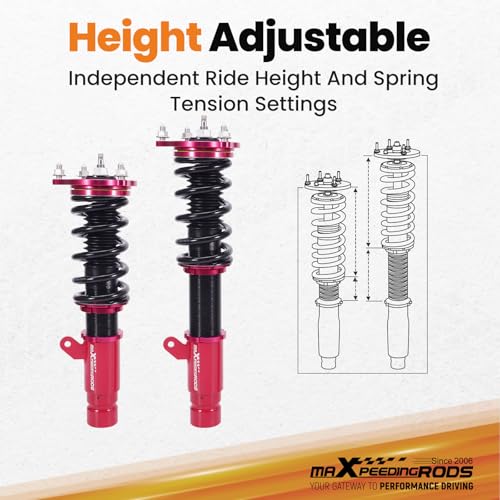
Adjustable 1–3-Inch Lowering Range
The coilovers provide approximately 1–3 inches of lowering.
The kit is not designed to maintain the original factory ride height.
Ride-height adjustment allows the owner to:
- Reduce fender gap
- Match the suspension to a wheel-and-tire package
- Create a moderate daily-driver drop
- Build a more aggressive show stance
- Balance left-to-right ride height
- Lower the vehicle’s center of gravity
The lowest possible setting is not necessarily the best one. A three-inch drop can substantially affect tire clearance, suspension travel and alignment.
A practical street setup should retain:
- Bump travel
- Tire clearance
- Steering movement
- Exhaust clearance
- Axle clearance
- Brake-hose movement
- Room for passengers and cargo
- Access to real-world driveways
Does Height Adjustment Preserve Suspension Travel?
The supplied description confirms adjustable ride height but does not provide enough technical detail to guarantee that every height change occurs independently of spring preload or damper stroke.
Before adjusting the kit, determine whether height is changed through:
- An independently threaded lower mount
- The spring perch
- A separate rear height adjuster
- A combination of these methods
If the spring perch controls height, changing its position may also affect preload and usable travel.
Follow the instructions supplied with the exact product. Avoid claiming independent height adjustment unless the physical kit and manual confirm it.
Twenty-Four Rebound Settings
The dampers provide 24 levels of rebound-force adjustment.
Rebound damping controls how quickly the suspension extends after it has been compressed.
Changing rebound can affect:
- Body control
- Steering response
- Transition speed
- Bump recovery
- Chassis stability
- Ride firmness
- Tire contact over uneven pavement
The adjuster does not necessarily provide independent compression control. Describe this as 24-level rebound adjustment, not 24-way compression-and-rebound adjustment.
Suggested Damper Settings
The manufacturer provides the following general starting points:
| Setting | Suggested use |
|---|---|
| Full soft | Comfortable street driving |
| Approximately 16 clicks | Spirited road driving |
| Full stiff | Occasional closed-course use |
Treat these as broad starting recommendations rather than guaranteed ideal settings.
The best position depends on:
- Tire construction
- Wheel diameter
- Vehicle load
- Road quality
- Alignment
- Ride height
- Driving style
Begin near full soft and increase damping in small increments. Test the car after every change and record the settings.
Do not begin at full stiff because “track” appeared in the product description. Maximum damping is still maximum damping, not a personality upgrade.
How to Adjust the Dampers
A practical adjustment process is:
- Confirm which direction increases rebound force.
- Turn each adjuster gently to the full-soft reference point.
- Set matching positions from side to side.
- Drive the Accord on a familiar road.
- Increase rebound two clicks at a time.
- Evaluate steering response and bump recovery.
- Record the front and rear positions.
- Stop increasing firmness when grip or compliance declines.
Avoid forcing an adjustment knob beyond its end position.
Excessive rebound may cause the suspension to pack down over repeated bumps. The car may feel harsh, lose travel or skip over broken pavement.
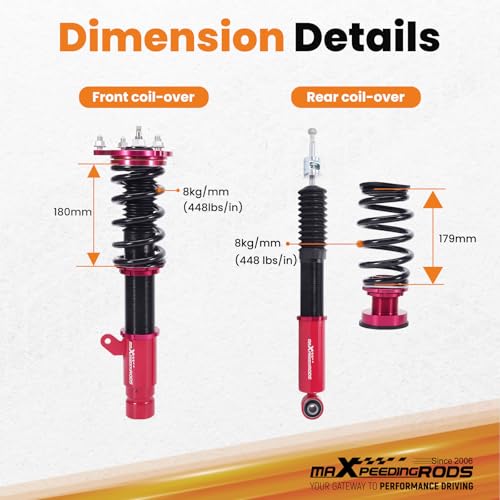
Equal 8K Front and Rear Spring Rates
The supplied spring rates are:
- Front: 8 kg/mm or 448 lb/in
- Rear: 8 kg/mm or 448 lb/in
An equal numerical rate does not mean the front and rear behave identically. Suspension motion ratios, corner weights and mounting geometry affect how each spring rate is experienced at the wheel.
Compared with the original Accord suspension, the 8K springs should provide:
- Reduced body roll
- Firmer response
- Less brake dive
- More controlled transitions
- Faster steering feedback
- Reduced suspension movement
Expect a firmer ride than stock, even at the softest damper position. Rebound adjustment can change motion control, but it cannot turn an 8K spring into a factory comfort spring.
High-Tensile Steel Springs
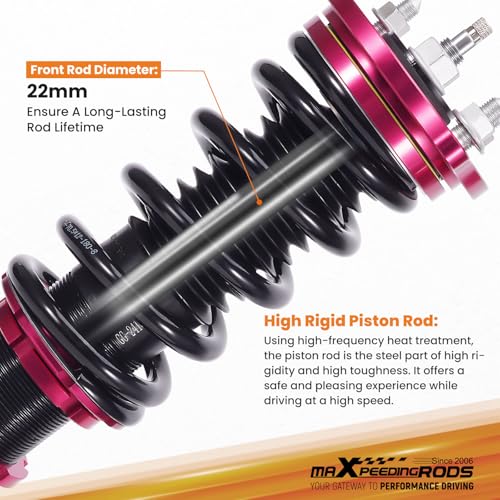
The kit uses high-tensile steel coil springs with a protective surface treatment.
According to the manufacturer, the springs are tested through 600,000 continuous compression cycles, with reported distortion remaining below 0.04 percent.
That manufacturer-supplied test claim addresses spring durability. It does not mean the complete suspension is maintenance-free or that every component has undergone the same cycle test.
Regularly inspect the springs for:
- Damaged coating
- Surface corrosion
- Improper seating
- Coil contact
- Cracks
- Uneven height
- Binding
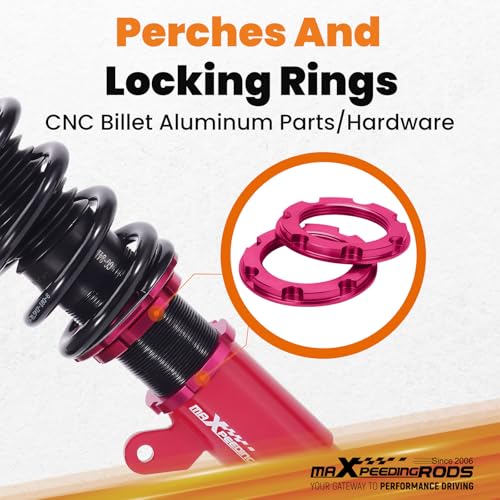
T6-Treated 6061 Aluminum Components
The product uses selected components made from 6061 aluminum alloy with T6 heat treatment.
This material may be used for:
- Upper plates
- Spring perches
- Adjustment collars
- Lower mounting components
- Other machined hardware
T6-treated 6061 aluminum offers:
- Good strength-to-weight ratio
- Corrosion resistance
- Machinability
- Dimensional stability
- Durable threads when maintained correctly
Exact material use should be confirmed from the physical kit. Do not describe the entire shock body or every bracket as aluminum unless the supplied parts confirm it.
Improved Steering Response
Lowering the center of gravity and reducing suspension movement can make the Accord respond more quickly to steering input.
Potential changes include:
- Faster turn-in
- Reduced delay during lane changes
- Less body lean
- More direct road feedback
- Improved transitional control
The result still depends heavily on tires and alignment.
Coilovers cannot correct:
- Worn ball joints
- Loose tie-rod ends
- Damaged bushings
- Failing wheel bearings
- Poor tire condition
- Incorrect wheel offset
Reduced Body Roll
The firmer springs resist compression as the car loads its outside tires during cornering.
This may provide:
- Flatter cornering
- More consistent steering response
- Better driver feedback
- Increased transitional stability
- Reduced chassis delay
Body roll is also controlled by sway bars, suspension geometry, tires and vehicle weight.
For additional chassis tuning, see How to Upgrade Sway Bars.
Braking and Acceleration Control
The 8K springs can reduce forward pitch during braking and rearward weight transfer during acceleration.
This may make the Accord feel:
- More stable under braking
- Less prone to nose dive
- More controlled during acceleration
- Faster to settle after transitions
Coilovers do not automatically shorten braking distance or improve acceleration. Those outcomes depend primarily on tires, brakes, road conditions, engine output and available traction.
The accurate benefit is improved body control.
Daily-Driver Setup
For a daily-driven Accord, use:
- Moderate lowering
- Softer rebound settings
- Conservative alignment
- Adequate suspension travel
- Verified tire clearance
- Equal left-to-right ride height
A one- to two-inch drop will generally be more practical than using the entire three-inch range.
Daily use should account for:
- Passengers
- Cargo
- Driveways
- Parking ramps
- Speed bumps
- Broken pavement
- Highway expansion joints
The suspension will still be firmer than stock. “Daily drivable” means the car can be used daily—not that it suddenly forgets about the 8K springs.
See 7 Best Coilovers for Daily Driving for additional setup guidance.
Spirited Driving
For back-road or autocross-style driving:
- Increase rebound gradually
- Monitor front-tire grip
- Check rear stability
- Avoid excessive ride-height reduction
- Record each adjustment
- Inspect tire wear
- Recheck alignment periodically
A front-wheel-drive Accord needs usable front suspension travel to maintain grip. Excessive front stiffness or lowering may reduce traction on uneven roads.
Occasional Track Use
The full-stiff setting should be viewed as an available maximum, not a mandatory track configuration.
At a track or autocross:
- Begin below maximum rebound
- Check tire pressures
- Monitor tire temperatures
- Inspect suspension fasteners
- Verify brake condition
- Watch for excessive understeer
- Recheck wheel torque
- Adjust in small increments
If the car skips over curbing or loses grip over bumps, reduce rebound force.
Installation Recommendations
Professional installation is recommended.
Before installation, inspect:
- Front upper mounts
- Lower control-arm bushings
- Ball joints
- Tie-rod ends
- Rear suspension links
- Sway-bar links
- Wheel bearings
- CV axles and boots
- Brake hoses
- ABS wiring
- Wheels and tires
- Suspension mounting points
Confirm that the car does not have the Active Damper System before removing any original components.
Basic Installation Process
A typical installation includes:
- Verify vehicle and trim compatibility.
- Confirm the absence of adaptive damper connectors.
- Record the original ride height.
- Raise and safely support the vehicle.
- Remove all four wheels.
- Support the suspension components.
- Disconnect applicable brake-hose and ABS-wire brackets.
- Remove the original front strut assemblies.
- Install the front coilovers.
- Remove the original rear shocks and springs.
- Install the rear suspension components.
- Set initial spring preload.
- Establish equal left-to-right heights.
- Reconnect every bracket and sensor wire.
- Tighten all hardware to factory specifications.
- Reinstall the wheels.
- Lower and settle the vehicle.
- Check tire and suspension clearance.
- Set initial rebound positions.
- Perform a professional four-wheel alignment.
Never work beneath a vehicle supported only by a hydraulic jack.
Setting the Ride Height
Measure ride height from the center of each wheel to a fixed point on the fender.
This method avoids errors caused by:
- Tire-pressure differences
- Tire-size differences
- Uneven tread wear
- Floor irregularities
After adjustment:
- Roll the vehicle forward and backward
- Allow the suspension to settle
- Compare left and right measurements
- Tighten the locking collars
- Turn the steering from lock to lock
- Check tire clearance
- Inspect axle and brake-hose clearance
- Verify usable suspension travel
- Recheck the height after driving
Four-Wheel Alignment Required
A professional four-wheel alignment is mandatory after installation.
Lowering can change:
- Front camber
- Rear camber
- Front toe
- Rear toe
- Caster
- Steering-wheel position
- Straight-line stability
- Tire-wear patterns
Complete the major ride-height changes before alignment.
Read Wheel Alignment 101 for a clear explanation of camber, caster and toe.
Will Additional Camber Parts Be Required?
Possibly.
A moderate drop may remain within an acceptable alignment range. More aggressive lowering can require:
- Adjustable rear camber arms
- Front camber bolts
- Adjustable upper mounts
- Adjustable rear toe links
Install the coilovers, establish the intended height and measure the alignment before ordering correction parts.
Excessive negative camber combined with poor toe can wear the inner tire edges rapidly. The outer tread may still look perfect, which is a lovely surprise right until the cords appear.
Wheel and Tire Clearance
Check clearance using the actual wheels and tires installed on the car.
Inspect around:
- Front spring perches
- Rear spring components
- Fender liners
- Fender lips
- Inner wheel wells
- Brake hoses
- ABS wiring
- Tie rods
- CV axles
Wheel width, offset and tire profile all affect clearance.
A wheel package that clears the original suspension may contact the wider spring or threaded body of an aftermarket coilover.
Coilover Maintenance
Adjustable suspension requires periodic inspection and cleaning.
Maintenance should include:
- Cleaning the threaded bodies
- Removing dirt from adjustment collars
- Inspecting the spring finish
- Checking for corrosion
- Confirming collar tightness
- Inspecting for fluid leakage
- Checking upper mounts
- Monitoring tire wear
- Recording ride height
- Exercising the damper adjusters
Use only manufacturer-approved corrosion protection or anti-seize compounds. Keep all lubricants away from brakes and tire surfaces.
Post-Installation Inspection
Reinspect the suspension after approximately 50–100 miles.
Check:
- Upper mounting hardware
- Lower mounting hardware
- Spring seating
- Height-adjustment collars
- Locking collars
- Rebound settings
- Brake-hose routing
- ABS-wire routing
- Wheel and tire clearance
- CV-axle clearance
- Fluid leakage
- Alignment
- Unusual noises
Stop driving and inspect the installation if the vehicle develops severe pulling, binding, metal contact or persistent clunking.
Frequently Asked Questions
Do these coilovers fit every 2018–2022 Honda Accord?
No. They fit listed CV1, CV2 and CV3 applications without the factory Active Damper System.
Will they fit an Accord Touring?
Some Touring models use Honda’s Active Damper System and are excluded. Verify the original equipment using the VIN and physical damper connectors.
Will they fit an Accord Hybrid?
The listing includes applicable CV-series configurations, but hybrid fitment must be confirmed by VIN, trim and suspension equipment. Touring Hybrid models may have adaptive dampers.
What are the spring rates?
The front and rear springs are both rated at 8 kg/mm or 448 lb/in.
How much do the coilovers lower the Accord?
The advertised adjustment range is approximately 1–3 inches below factory height.
Can they maintain the original ride height?
No. The kit is designed to lower the car and does not retain the original ride height.
Is damping adjustable?
Yes. The kit provides 24 levels of rebound-force adjustment.
Are compression and rebound independently adjustable?
No independent compression adjustment is specified. The external control should be described as rebound adjustment.
What setting should be used for daily driving?
Begin near full soft and increase rebound gradually until the car feels controlled without becoming harsh.
Is full stiff the best setting for track use?
Not necessarily. Begin below full stiff and adjust according to grip, surface conditions and driver feedback.
Are the spring rates adjustable?
No. Spring preload and ride height may be adjustable, but the actual 8 kg/mm spring rate is fixed.
Is a wheel alignment required?
Yes. A four-wheel alignment is required after installation and after major ride-height changes.
Is professional installation recommended?
Yes. Correct installation requires safe vehicle support, proper torque procedures, accurate height adjustment and alignment equipment.
Final Thoughts
The maXpeedingrods 24-level coilover kit for the 2018–2022 Honda Accord provides the three adjustments most street enthusiasts want: ride height, rebound control and stance.
Its equal 8K front and rear springs provide considerably firmer chassis control than the factory suspension, while the 24-position rebound adjusters allow the response to be tuned for commuting, spirited road use or occasional closed-course driving.
The Active Damper System exclusion is critical. Verify the original suspension before ordering, especially on Touring models.
For the best street setup, use a moderate drop, begin with softer rebound settings and complete the installation with a professional four-wheel alignment. Three inches lower may look dramatic, but so does reversing out of a driveway diagonally while everyone waits.
For more suspension guidance, visit:
- Lowering Springs vs. Coilovers
- 7 Best Coilovers for Daily Driving
- Car Suspension Upgrades That Transform Your Ride
- How to Upgrade Sway Bars
- Wheel Alignment 101
- Honda’s Tenth-Generation Accord Chassis Overview








There are no reviews yet.