
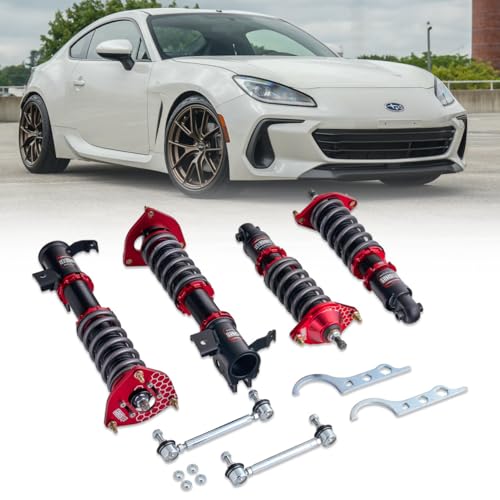
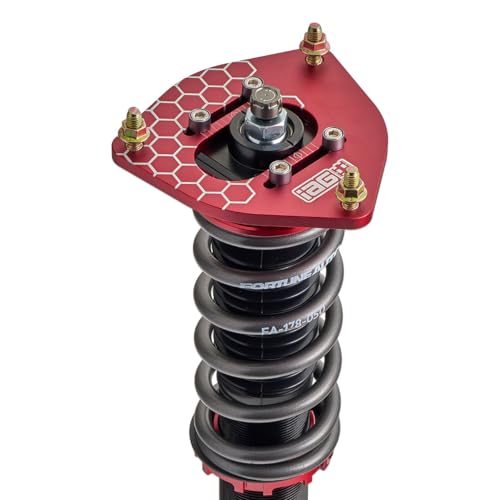
One Coilover Kit for Two Generations
The IAG-SUS-1001 spans both generations of the Subaru and Toyota rear-wheel-drive coupe platform.
That includes:
- First-generation ZC6 Subaru BRZ
- First-generation ZN6 Scion FR-S
- First-generation ZN6 Toyota 86 or GT86
- Second-generation ZD8 Subaru BRZ
- Second-generation ZN8 Toyota GR86
Before ordering, verify the exact production year, chassis and current product revision. Do not assume that every spring, top mount or installation component remains identical across both generations simply because the complete kit shares a part number.
The IAG Spec Difference
The IAG Spec Street Series is based on the Fortune Auto 500 Series, but the package uses different travel, spring and valving specifications for the BRZ and 86 platform.
IAG-specific changes include:
- Custom front and rear damper valving
- An additional 9 mm of front shock travel
- Softer 5K front springs
- Seven-inch front springs
- Six-kilogram rear springs
- One-inch extended rear top hats
- Street-and-track chassis tuning
These changes address a common problem with lowered sports cars: achieving the desired ride height while losing the suspension travel needed to maintain grip and ride quality.
Custom Valving for the BRZ and 86 Chassis
The BRZ and 86 platform is relatively light, responsive and naturally balanced. Installing excessively stiff springs can make the chassis feel immediate on smooth pavement while reducing grip on real roads.
The IAG-SUS-1001 uses custom valving matched to its 5K front and 6K rear springs.
The suspension is designed to manage:
- Brake dive
- Acceleration squat
- Body roll
- Steering transitions
- Mid-corner surface changes
- Uneven pavement
- Repeated track use
Matching the springs and dampers allows the chassis to move when weight transfer is useful while controlling movement that delays response.
24-Position Rebound Adjustment
This is a single-adjustable coilover system with 24 rebound settings.
Rebound damping controls how quickly the suspension extends after being compressed.
The adjustment can be used to tune the car for:
- Daily commuting
- Rough pavement
- Highway driving
- Back-road use
- Autocross
- Drifting
- Track days
- Different wheels and tires
The adjustment does not independently control compression damping. The internal Flow Digressive piston determines the compression curve.
Calling it “24 clicks of rebound and compression adjustment” would imply a two-way adjustable damper. It is not. One adjustment knob remains one adjustment circuit, despite what the marketing department had for breakfast.
How to Set the Rebound Adjustment
Begin with the dampers toward the softer end of their range.
A practical setup process is:
- Confirm the adjustment direction.
- Turn each adjuster gently to the full-soft reference point.
- Set matching left-to-right positions.
- Begin near the middle-to-soft portion of the range.
- Test the car on a familiar road.
- Increase rebound two clicks at a time.
- Record the front and rear settings separately.
- Stop increasing firmness when grip or compliance declines.
Front and rear settings do not necessarily need to be identical. The ideal balance depends on tires, alignment, sway bars, road quality and driver preference.
Excessive rebound can prevent the wheels from returning quickly enough after bumps. This can make the suspension pack down and lose travel over repeated surface changes.
Additional Front Shock Travel
The front dampers provide 117 mm of stroke, approximately 9 mm more than the comparable standard specification described by IAG.
Additional stroke helps compensate for travel normally lost when a vehicle is lowered.
Potential benefits include:
- Reduced bottoming
- Better bump absorption
- More usable suspension movement
- Improved tire contact
- Better rough-road compliance
- Increased mechanical grip
- More practical lowered ride height
Additional stroke does not make every ride height functional. Tire clearance, suspension geometry and bump-stop engagement still need to be checked.
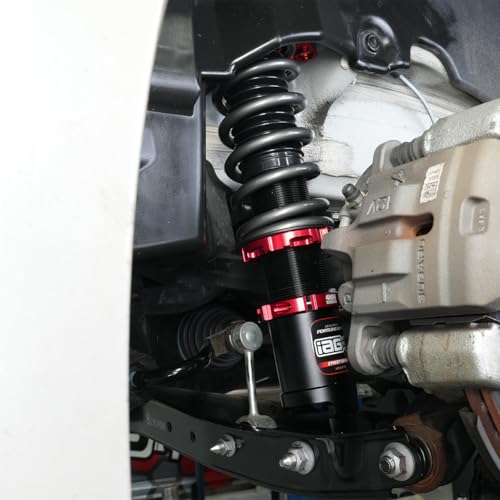
Seven-Inch Front Springs
The front suspension uses seven-inch-long springs with a 5 kg/mm rate.
The longer, relatively soft spring supports the additional front travel and lets the chassis transfer weight during braking and corner entry.
Potential benefits include:
- More usable spring movement
- Reduced coil-bind risk
- Better compliance
- Controlled braking weight transfer
- Improved grip over uneven pavement
- Less dependence on excessive spring preload
A softer spring is not automatically less capable. When matched with properly controlled damping, it can produce more usable grip than a stiffer spring that forces the tire to skip across the road.
Six-Kilogram Rear Springs
The rear coilovers use seven-inch springs rated at 6 kg/mm.
The slightly firmer rear rate helps maintain the responsive balance expected from the BRZ and 86 chassis.
Potential benefits include:
- Reduced rear body movement
- Faster response during transitions
- Improved corner-entry rotation
- Better acceleration support
- More predictable chassis balance
- Reduced squat
Rear grip remains affected by alignment, sway bars, tire pressure, differential operation and driver input. The 6K spring does not automatically turn every commute into a drift exhibition—and your local police department appreciates the distinction.
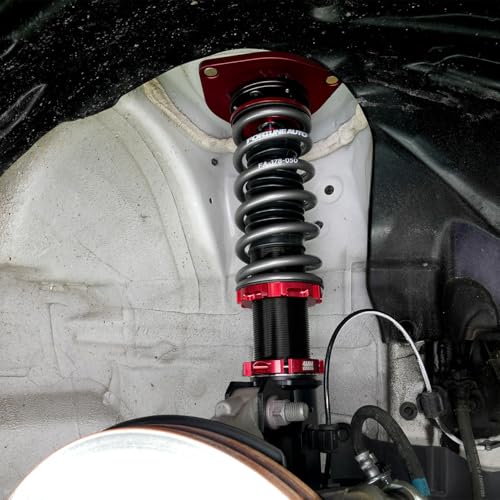
One-Inch Extended Rear Top Hats
The rear dampers use one-inch extended top hats.
The extended mount moves the damper attachment point upward, allowing more of the available shock travel to remain usable after lowering.
This helps:
- Preserve rear suspension stroke
- Maintain piston position
- Reduce bottoming risk
- Protect the dampers
- Preserve spring preload
- Improve ride quality
- Maintain contact over uneven pavement
A lowered car that retains suspension travel will generally perform better than one sitting on its bump stops while looking extremely committed in photographs.
Flow Digressive Piston Technology
The IAG Spec Street Series uses Fortune Auto’s Flow Digressive Piston Technology.
A digressive piston develops relatively strong force during slower damper-shaft movements. These movements typically correspond to driver inputs and chassis motion such as:
- Steering
- Braking
- Acceleration
- Body roll
- Squat
- Dive
As shaft speed increases over sharp bumps or broken pavement, the force curve becomes less aggressive. That allows the suspension to move more freely over fast impacts.
Fortune Auto describes its 500 Series as a rebound-adjustable system using High Flow Digressive Piston Technology to provide chassis control while remaining compliant over bumps and irregular surfaces. fortune-auto.com
“Low speed” and “high speed” refer to piston speed inside the damper—not how quickly the BRZ approaches the next corner.
High-Pressure Monotube Construction
Each damper uses a high-pressure nitrogen monotube design.
Monotube construction provides:
- Large piston area
- Consistent damping response
- Effective heat transfer
- Separation of hydraulic oil and gas
- Reduced oil aeration
- Stable performance during repeated use
This makes the design appropriate for vehicles that see daily street mileage and occasional closed-course driving.
T6 6061 Aluminum Components
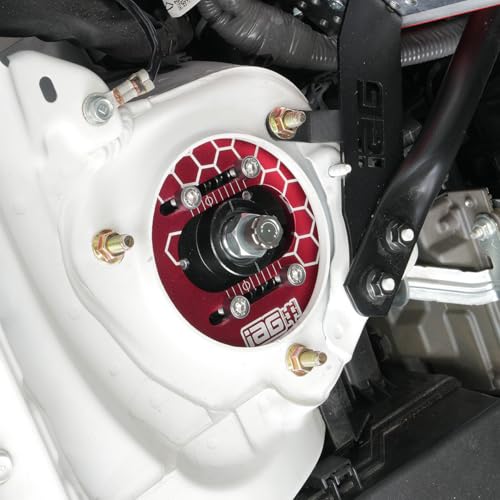
The camber plates and spring perches use lightweight T6 6061 aluminum.
These components are designed to provide:
- Reduced weight
- Structural strength
- Corrosion resistance
- Accurate threaded adjustment
- Durable spring support
- Precise alignment control where applicable
Confirm the exact front and rear top-mount configuration supplied for the vehicle generation being serviced.
Chrome-Silicon Springs
The coilover springs are produced from premium chrome-silicon alloy.
This material is commonly used for performance springs because it offers:
- High tensile strength
- Elasticity
- Fatigue resistance
- Consistent compression behavior
- Reduced permanent deformation
- Long service life
Fortune Auto identifies premium chrome-silicon springs, custom assembly and dyno testing as standard elements of its current 500 Series architecture. staging.fortune-auto.com
Custom Built and Dyno Tested
Fortune Auto states that its 500 Series dampers are custom built and dyno tested rather than mass-produced to one universal setting.
Damper dyno testing allows technicians to verify the force curve and compare matching units before delivery.
That process helps identify:
- Incorrect valving
- Internal leakage
- Mismatched damping
- Abnormal adjustment response
- Manufacturing inconsistencies
The IAG Spec package adds its application-specific valving and dimensional changes to that serviceable Fortune Auto platform.
Rebuildable and Revalveable
The Fortune Auto-based dampers can be rebuilt and revalved at the company’s Virginia facility.
Available service options may include:
- Seal replacement
- Oil replacement
- Nitrogen recharge
- Inspection and cleaning
- Damper rebuilding
- Custom revalving
- Spring-rate changes
- Modular damper upgrades
Fortune Auto also describes the 500 Series as upgradeable to more advanced two-way or three-way canister configurations, depending on application and current product support. fortune-auto.com
Verify current service pricing, warranty requirements and upgrade compatibility directly with Fortune Auto.
Ride-Height Adjustment
The coilovers allow the BRZ or 86 to be lowered for appearance and chassis setup.
A functional drop can provide:
- Reduced fender gap
- Lower center of gravity
- Faster chassis response
- Improved wheel fitment
- More aggressive stance
- Reduced body movement
Do not assume the system can maintain every factory-height configuration. Confirm the safe adjustment range in the supplied installation instructions.
Avoid lowering the vehicle until:
- Tires contact the fenders
- Control arms operate at poor angles
- The exhaust scrapes regularly
- Axles or tie rods bind
- Bump stops replace the springs
- Steering geometry becomes unstable
For additional guidance, read Lowering Springs vs. Coilovers.
Daily-Driving Performance
The IAG-SUS-1001 is designed to maintain reasonable street compliance while improving chassis response.
Properly configured, it should provide:
- More direct turn-in
- Reduced body roll
- Better braking control
- More stable acceleration
- Improved bump recovery
- Greater road feedback
- Adjustable rebound behavior
- Predictable cornering balance
It will still feel firmer and more communicative than the original suspension. “Comfortable for a performance coilover” is not the same as “identical to factory comfort,” and pretending otherwise is how product returns are born.
See 7 Best Coilovers for Daily Driving for more street-suspension considerations.
Autocross and Track Use
The 24-position rebound adjustment allows the suspension to be tuned for autocross or occasional track days.
Track setup should consider:
- Tire compound
- Tire temperature
- Tire pressure
- Alignment
- Sway-bar settings
- Brake condition
- Track surface
- Vehicle weight
- Aero modifications
- Driver experience
Begin below full firmness. Increase rebound only if the car needs additional control.
Maximum stiffness is not automatically maximum grip. If the car skips over curbing or refuses to settle after a bump, the dampers may be adjusted too firmly.
Drift Applications
The BRZ, FR-S and 86 platform is popular for drifting, but suspension setup should match the driver’s experience and tire package.
For drift use, evaluate:
- Front steering angle
- Front tire clearance
- Rear rebound setting
- Rear toe
- Differential setup
- Sway-bar balance
- Control-arm clearance
- Wheel offset
This kit provides adjustable rebound and ride height, but dedicated drift builds may require additional steering, alignment and chassis components.
Alignment After Installation
A professional four-wheel alignment is required after installing the coilovers.
The alignment should measure:
- Front camber
- Rear camber
- Front toe
- Rear toe
- Caster
- Thrust angle
- Steering-wheel position
Complete the major ride-height and preload adjustments before alignment.
For street use, avoid excessive toe or camber that causes poor stability and rapid tire wear. Track alignment should be determined through tire temperatures and wear patterns rather than the traditional method of “it looks aggressive from across the parking lot.”
Read Wheel Alignment 101 for a practical alignment overview.
Installation Recommendations
Professional installation is recommended.
Before installation, inspect:
- Front ball joints
- Tie-rod ends
- Control-arm bushings
- Rear suspension links
- Wheel bearings
- Sway-bar links
- Brake hoses
- ABS sensor wiring
- Wheels and tires
- Suspension mounting points
Worn bushings or loose joints should be repaired before the alignment.
Basic Installation Process
A typical installation includes:
- Measure and record the original ride height.
- Raise and safely support the vehicle.
- Remove all four wheels.
- Support the suspension knuckles.
- Disconnect applicable sway-bar links and brackets.
- Remove the original front strut assemblies.
- Install the front coilovers.
- Remove the original rear suspension assemblies.
- Install the rear coilovers and extended top hats.
- Reconnect brake-hose and ABS-wire brackets.
- Set initial spring preload.
- Set equal left-to-right ride heights.
- Tighten all fasteners to factory specifications.
- Reinstall the wheels.
- Lower and settle the vehicle.
- Check tire and suspension clearance.
- Set initial rebound positions.
- Perform a professional four-wheel alignment.
Never work beneath a vehicle supported only by a hydraulic jack.
Setting Spring Preload
Fortune Auto states that its coilovers do not arrive with final preload set because maintaining preload during shipping can risk damage.
The company’s general guidance uses different preload specifications for MacPherson and double-wishbone applications. Follow the exact IAG-SUS-1001 instructions because the BRZ and 86 use different front and rear suspension layouts. fortune-auto.com
Too much preload can cause:
- Harsh ride quality
- Reduced droop travel
- Poor grip
- Unwanted suspension behavior
Too little preload can result in:
- Loose springs at full extension
- Noise
- Inconsistent spring seating
- Poor suspension response
Preload should not be used as a substitute for proper ride-height adjustment.
Post-Installation Inspection
Reinspect the suspension after approximately 50–100 miles.
Check:
- Upper mounting hardware
- Lower mounting hardware
- Spring seating
- Preload collars
- Height-adjustment collars
- Rebound settings
- Brake-hose brackets
- ABS-wire routing
- Wheel and tire clearance
- Fluid leakage
- Alignment
- Unusual noises
Recheck the mounting hardware before any track or drift event.
Frequently Asked Questions
What vehicles fit IAG-SUS-1001?
The kit is designed for compatible Subaru BRZ, Scion FR-S, Toyota 86, Toyota GT86 and Toyota GR86 models within the advertised year range.
Does it fit both BRZ generations?
The listing covers first- and second-generation BRZ applications. Confirm the current product revision and supplied mounting hardware for the exact model year.
Does it fit a 2013–2016 Scion FR-S?
Yes. The Scion FR-S is included in the listed fitment.
Does it fit the Toyota GR86?
Yes. The listing includes applicable GR86 models.
What are the spring rates?
The front spring rate is 5 kg/mm, and the rear spring rate is 6 kg/mm.
What is the front shock stroke?
The front dampers provide 117 mm of stroke.
What is the rear shock stroke?
The rear dampers provide 100 mm of stroke.
What do the extended top hats do?
The one-inch extended rear top hats help preserve damper stroke and piston position after lowering.
Are compression and rebound independently adjustable?
No. This is a single-adjustable system with 24-position rebound control. Compression damping is determined by the internal valving.
Are these coilovers suitable for daily driving?
Yes. The spring rates, custom valving and extended travel are designed to balance street compliance with increased chassis control.
Can they be used on track?
Yes. They are suitable for occasional autocross and track use when properly installed, aligned and adjusted.
Are the dampers rebuildable?
Yes. Fortune Auto’s modular design supports rebuilding and revalving through its service facility.
Is a wheel alignment required?
Yes. A four-wheel alignment is required after installation and after substantial ride-height changes.
Final Thoughts
The IAG Spec Street Series Coilovers by Fortune Auto offer more than adjustable ride height for the BRZ, FR-S and 86 platform.
The IAG-specific combination of 5K front springs, 6K rear springs, custom valving, additional front shock stroke and extended rear top hats addresses suspension travel as carefully as stiffness.
Fortune Auto’s Flow Digressive piston delivers chassis control during steering, braking and acceleration while allowing more compliant movement over rough pavement. The 24-position rebound adjustment lets owners fine-tune the car without wandering into the complexity of a multi-way competition damper.
For enthusiasts who use the same car for commuting, back-road driving and occasional closed-course events, IAG-SUS-1001 provides a practical foundation that can be rebuilt and upgraded as the project evolves.
For more suspension information, visit:
- Lowering Springs vs. Coilovers
- 7 Best Coilovers for Daily Driving
- Car Suspension Upgrades That Transform Your Ride
- How to Upgrade Sway Bars
- Wheel Alignment 101
- Official IAG-SUS-1001 product page
- Fortune Auto 500 Series technical information






There are no reviews yet.