
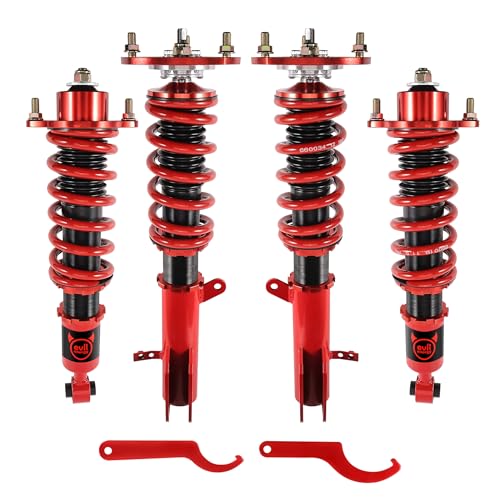
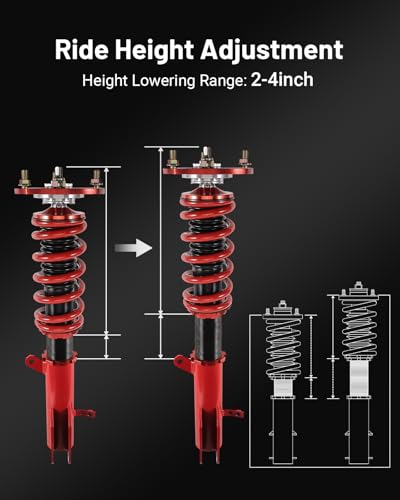
Adjustable 2–4-Inch Lowering Range
The listed lowering range is approximately 2–4 inches below the original ride height.
That is a substantial drop. Even the minimum setting is more aggressive than many mild street-suspension packages.
Height adjustment can be used to:
- Reduce fender gap
- Lower the center of gravity
- Match the suspension to a wheel-and-tire package
- Balance left-to-right ride height
- Create a show-oriented stance
- Change the vehicle’s overall appearance
The kit is not designed to maintain factory ride height or increase ground clearance.
How Is the Height Adjusted?
The listing describes height adjustment through threaded spring seats and locking collars.
Moving the spring perch changes the position of the spring and may also affect:
- Spring preload
- Available suspension travel
- Damper operating position
- Droop travel
- Spring seating
Do not assume the kit provides independent lower-mount adjustment unless the exact product instructions confirm it.
Begin with the manufacturer’s recommended preload and use the supplied adjustment procedure. Threaded collars may look simple, but suspension geometry has an irritating habit of noticing shortcuts.
Twin-Tube Damper Design
This EVIL ENERGY kit uses a twin-tube shock design, not a monotube configuration.
A twin-tube damper has an inner working cylinder and an outer reserve chamber. During suspension movement, hydraulic fluid flows through internal valves to control spring motion.
Potential twin-tube advantages include:
- Longer usable stroke for a given body length
- Lower internal gas pressure
- Reduced sliding friction
- More compliant response over smaller road imperfections
- Compact packaging
- Street-oriented ride characteristics
A twin-tube layout can work well in a lowered daily driver when the internal valving is properly matched to the supplied springs.
Is Damping Adjustable?
No external damping range is provided in the supplied product specifications.
The kit should therefore be described as using fixed-rate twin-tube dampers, unless the current package includes adjustment knobs and documentation stating otherwise.
The owner can adjust:
- Vehicle height
- Spring-seat position
- Spring preload within the permitted range
The owner should not assume adjustment of:
- Compression damping
- Rebound damping
- Low-speed damping
- High-speed damping
Height adjustment and damping adjustment are not the same feature, no matter how enthusiastically the listing uses the word “adjustable.”
Front and Rear Spring Rates
The supplied spring rates are:
- Front: 8 kg/mm or 448 lb/in
- Rear: 6 kg/mm or 336 lb/in
Both front and rear springs measure 180 mm in length.
The higher front rate helps support the engine and control forward weight transfer. The rear rate assists with body control while retaining more compliance than an equally stiff front-and-rear setup.
Compared with the factory suspension, these spring rates may provide:
- Reduced body roll
- Less brake dive
- Faster steering response
- More controlled chassis movement
- Firmer road feedback
- Quicker directional changes
Expect a firmer ride than stock, particularly when the vehicle is lowered near the bottom of the available range.
Heat-Treated Steel Springs
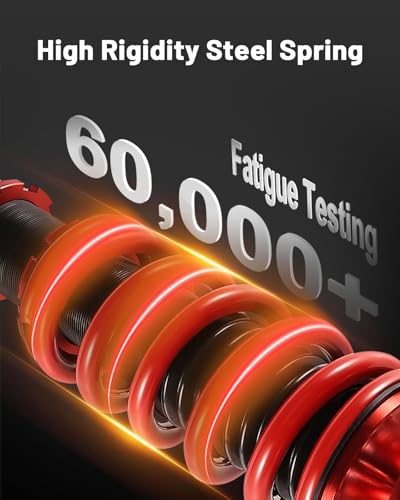
The red coil springs are manufactured from heat-treated high-strength steel and protected by an anti-corrosion coating.
According to the manufacturer, the springs are tested for more than 60,000 compression cycles.
The coating helps protect the springs from:
- Moisture
- Road grime
- Light surface corrosion
- Dirt
- Normal environmental exposure
The fatigue-cycle figure is a manufacturer-supplied specification, not a guarantee that the complete suspension will never require inspection or maintenance.
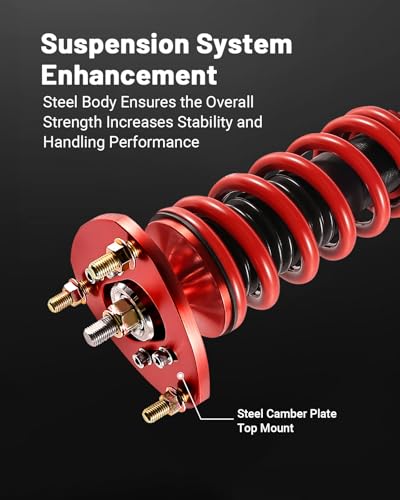
Steel Suspension Construction
The product listing describes steel construction for the:
- Damper bodies
- Upper mounting components
- Springs
- Lower mounts
- Piston rods
- Camber-plate components where included
Steel provides strength and impact resistance but remains vulnerable to corrosion if its protective coating is damaged.
Inspect the suspension periodically, especially in areas exposed to:
- Road salt
- Coastal moisture
- Winter conditions
- Standing water
- Mud
- Gravel
- Chemical deicers
Street Performance and Ride Quality
The EVIL ENERGY kit is intended primarily for lowered street applications.
A correctly installed setup may deliver:
- Firmer chassis response
- Reduced body movement
- More direct steering feedback
- A lower stance
- Better control during transitions
It should not be described as preserving factory comfort. The combination of 8K/6K springs and at least two inches of lowering will noticeably change ride quality.
Tire sidewall, wheel diameter, road quality and remaining suspension travel will strongly influence the final result.
For practical street-suspension guidance, read 7 Best Coilovers for Daily Driving.
Is This an Off-Road Suspension Kit?
No. This is a lowering kit.
Although the Jeep Compass and Patriot are crossover vehicles, reducing their ride height by 2–4 inches will reduce:
- Ground clearance
- Approach angle
- Departure angle
- Breakover clearance
- Suspension travel
- Clearance beneath the exhaust and chassis
The kit should not be promoted for off-road driving. It is intended for street-oriented builds, lower stance and firmer paved-road handling.
The explicit exclusion of Compass models with the Off-Road Package reinforces that distinction.
Reduced Body Roll
The firmer springs and lower center of gravity can reduce body roll during cornering.
Possible benefits include:
- Faster response to steering inputs
- Less body lean
- More controlled lane changes
- Improved transitional stability
- A more planted road feel
Body roll is also affected by sway bars, tires, bushings, vehicle weight and suspension geometry.
For additional chassis tuning, see How to Upgrade Sway Bars.
Braking and Acceleration Control
Firmer springs can reduce forward pitch during braking and rearward weight transfer during acceleration.
This may make the vehicle feel more controlled, but coilovers do not automatically reduce stopping distance.
Actual braking performance depends on:
- Tire grip
- Brake condition
- ABS operation
- Road surface
- Vehicle speed
- Vehicle weight
- Driver input
The accurate benefit is improved body control during braking—not a shorter stopping-distance guarantee.
Is This Kit Suitable for Track Use?
The kit may support occasional autocross or closed-course use, but it is primarily a budget-oriented lowering suspension.
Before performance driving, inspect:
- Tires
- Brakes
- Wheel bearings
- Ball joints
- Tie-rod ends
- Control-arm bushings
- Coilover mounts
- Locking collars
- Alignment
- Wheel fasteners
Fixed-rate dampers cannot be adjusted for different track conditions. Serious competition use may require higher-grade dampers, application-specific spring rates and additional alignment control.
Direct-Replacement Installation
The kit is designed around the original suspension mounting locations of compatible vehicles.
On a confirmed application, installation should not normally require cutting or welding. However, original brackets, upper mounts, fasteners or ancillary hardware may need to be reused depending on the exact package.
Confirm whether the kit includes:
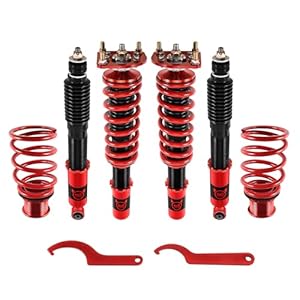
- Four complete damper assemblies
- Upper mounts
- Camber plates
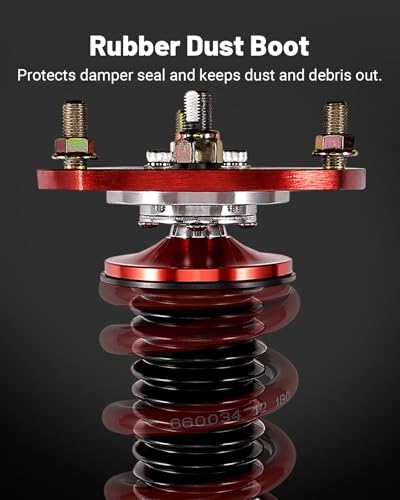
- Dust boots
- Bump stops
- Brake-hose brackets
- ABS-wire brackets
- Spanner wrenches
- Installation instructions
Professional installation is strongly recommended.
Inspect the Original Suspension First
Before installing the coilovers, inspect:
- Upper strut mounts
- Control-arm bushings
- Ball joints
- Tie-rod ends
- Sway-bar links
- Wheel bearings
- CV axles and boots
- Brake hoses
- ABS wiring
- Suspension mounting points
- Wheels and tires
New coilovers cannot correct loose ball joints, damaged bushings or failing wheel bearings. Firmer suspension may simply make those problems louder and considerably less mysterious.
Installation Overview
A typical installation includes:
- Park the vehicle on a level surface.
- Record the original ride height.
- Loosen the wheel fasteners.
- Raise and safely support the vehicle.
- Remove all four wheels.
- Support the appropriate suspension components.
- Disconnect brake-hose and ABS-wire brackets as required.
- Remove the original front suspension assemblies.
- Remove the original rear suspension assemblies.
- Compare each replacement component with the original.
- Confirm spring seating and initial preload.
- Set matching left-to-right starting heights.
- Install the front and rear coilovers.
- Reconnect every bracket and sensor wire.
- Tighten hardware to factory specifications.
- Reinstall the wheels.
- Lower the vehicle carefully.
- Roll the vehicle to settle the suspension.
- Measure and adjust the final height.
- Inspect tire and component clearance.
- Perform a four-wheel alignment.
Never work beneath a vehicle supported only by a hydraulic jack.
Setting the Initial Ride Height
Begin near the highest permitted position rather than immediately selecting the full four-inch drop.
Measure from the center of each wheel to a fixed point on the fender. This produces a more consistent measurement than checking from the ground.
After each adjustment:
- Settle the suspension
- Compare left and right measurements
- Confirm the springs remain seated
- Tighten the locking collars
- Check tire clearance
- Turn the steering from lock to lock
- Inspect axle and brake-hose clearance
- Verify suspension travel
- Check ground clearance
A four-inch drop may require additional parts or body-clearance work depending on wheel offset and tire size.
Four-Wheel Alignment Required
Lowering changes suspension geometry.
A professional four-wheel alignment is required after installation and after any substantial height change.
The alignment should verify:
- Front camber
- Rear camber
- Front toe
- Rear toe
- Steering-wheel position
- Thrust angle
- Straight-line stability
Complete the major height adjustments before alignment. Changing the vehicle height afterward can alter camber and toe again.
Read Wheel Alignment 101 for an explanation of alignment angles.
Will Additional Camber Components Be Required?
Possibly.
A two-inch drop may already create more negative camber than the factory adjustment range can correct. Lower settings may require:
- Camber bolts
- Adjustable upper mounts
- Adjustable control arms
- Adjustable toe links
- Additional alignment hardware
Confirm which adjustment components are included with the kit. The listing mentions camber-plate construction, but that does not guarantee front and rear camber plates are supplied for every application.
Install the suspension, establish the final height and measure the alignment before purchasing correction parts.
Wheel and Tire Clearance
The lowered suspension must be checked with the actual wheels and tires installed.
Inspect clearance at:
- Fender lips
- Fender liners
- Spring seats
- Damper bodies
- Brake hoses
- ABS wiring
- Tie rods
- CV axles
- Inner wheel wells
Check clearance while turning the steering and while the suspension is loaded.
Wheel offset matters. A tire that clears the original strut may contact a wider coilover spring or threaded adjustment collar.
Coilover Maintenance
Adjustable suspension needs periodic cleaning and inspection.
Maintenance should include:
- Cleaning the threaded bodies
- Removing dirt from the collars
- Inspecting the spring coating
- Checking for corrosion
- Confirming collar tightness
- Inspecting for fluid leakage
- Checking upper mounts
- Examining bushings
- Monitoring tire wear
- Measuring ride height
Apply only manufacturer-approved corrosion protection or anti-seize compounds. Keep lubricants away from brakes and tire surfaces.
Post-Installation Inspection
Reinspect the suspension after approximately 50–100 miles.
Check:
- Upper mounting fasteners
- Lower mounting fasteners
- Spring seating
- Adjustment collars
- Locking collars
- Brake-hose routing
- ABS-wire routing
- Tire clearance
- CV-axle clearance
- Fluid leakage
- Alignment
- Unusual noises
Stop driving and inspect the system if the vehicle develops severe pulling, binding, metal contact or persistent clunking.
Frequently Asked Questions
Do these coilovers fit a Dodge Caliber SRT-4?
No. The manufacturer specifically excludes the Caliber SRT-4.
Do they fit every 2007–2012 Dodge Caliber?
They are listed for 2007–2012 Caliber models except the SRT-4. Verify the exact trim and suspension configuration before ordering.
Do they fit a Jeep Compass 4WD?
They are listed for 2008–2017 Compass 4WD models without the Off-Road Package.
Do they fit a Compass with the Off-Road Package?
No. Those models are specifically excluded.
Do they fit a Jeep Patriot?
The listed Patriot application is limited to 2008–2010 FWD models.
How much do these coilovers lower the vehicle?
The manufacturer lists a lowering range of approximately 2–4 inches.
What are the spring rates?
The front rate is 8 kg/mm or 448 lb/in. The rear rate is 6 kg/mm or 336 lb/in.
Are these monotube coilovers?
No. The supplied specifications identify a twin-tube damper design.
Is damping adjustable?
No external damping adjustment is specified. Treat the dampers as fixed-rate unless the exact package documentation states otherwise.
Can the kit maintain the factory ride height?
No. The kit is designed to lower the vehicle at least approximately two inches.
Can these coilovers be used off-road?
They are not recommended for off-road use. Lowering reduces ground clearance and suspension travel.
Is an alignment required?
Yes. A complete four-wheel alignment is required after installation.
Is professional installation recommended?
Yes. Suspension installation requires safe vehicle support, correct torque procedures, accurate adjustment and alignment equipment.
Final Thoughts
The EVIL ENERGY coilover kit for the 2007–2012 Dodge Caliber delivers a substantial 2–4-inch drop, firmer 8K/6K springs and fixed-rate twin-tube dampers.
It is also listed for selected Jeep Compass and Patriot models, but the fitment boundaries matter. The Caliber SRT-4, Compass Off-Road Package and Patriot 4WD are not included.
This kit makes the most sense for a street-oriented project that prioritizes a low stance and firmer body control. It is not a lift kit, an off-road suspension or a damping-adjustable competition system.
Set the height conservatively, verify alignment and leave enough clearance for the roads the vehicle actually encounters. Four inches lower looks dramatic—right up until the first aggressively designed grocery-store entrance.
For more suspension information, visit:
- Lowering Springs vs. Coilovers
- 7 Best Coilovers for Daily Driving
- Car Suspension Upgrades That Transform Your Ride
- How to Upgrade Sway Bars
- Wheel Alignment 101
Product shortcode:







There are no reviews yet.