
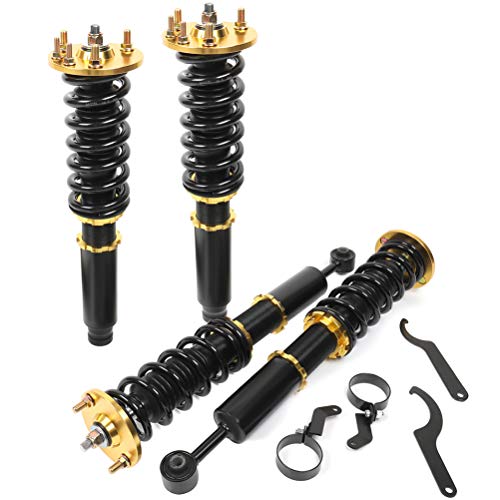
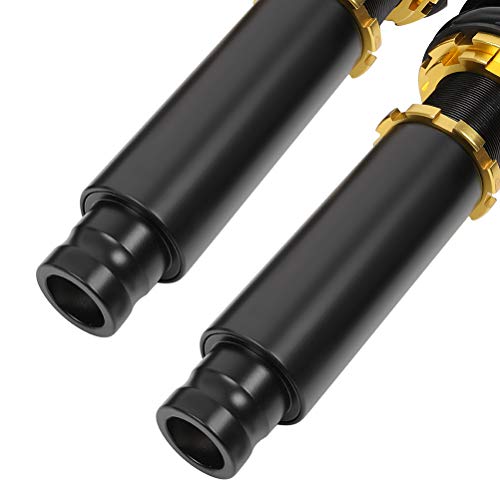
ECCPP Coilover Kit Specifications
| Specification | Product detail |
|---|---|
| Brand | ECCPP |
| Primary application | 2004–2008 Acura TSX |
| Additional listed application | Certain 2003–2007 Honda Accord models |
| Front spring rate | 10 kg/mm |
| Rear spring rate | 5 kg/mm |
| Ride-height adjustment | Yes |
| Adjustment method | Independent threaded lower mounts |
| Spring preload | Adjustable |
| Camber adjustment | Adjustable camber plates where supplied |
| Damping adjustment | Not specified |
| Finish | Gold |
| Vehicle position | Front and rear |
| Recommended installation | Professional installation |
| Alignment required | Yes |
Vehicle Fitment
Acura TSX
- 2004 Acura TSX
- 2005 Acura TSX
- 2006 Acura TSX
- 2007 Acura TSX
- 2008 Acura TSX
The 2004–2008 TSX is commonly identified by its CL9 chassis designation, although shoppers should still confirm the VIN, trim and suspension configuration.
Honda Accord
The product is also advertised for:
- 2003 Honda Accord
- 2004 Honda Accord
- 2005 Honda Accord
- 2006 Honda Accord
- 2007 Honda Accord
Do not assume universal compatibility with every Accord sold during those years. North American, European and Japanese-market Accord models do not all share the same chassis or suspension components.
Before purchase, compare:
- Chassis code
- Sedan or coupe body style
- Front lower mounting design
- Rear mounting configuration
- Upper-mount bolt pattern
- Brake-hose brackets
- ABS wiring brackets
- Original suspension dimensions
Use the Vehicle Fitment and Parts Guide before ordering if the application is uncertain.
Why Install Coilovers on an Acura TSX?
The first-generation Acura TSX was designed to balance responsive handling with everyday comfort. That makes it a capable street car, but its factory suspension was never intended to provide an aggressively lowered stance.
Age is another factor. Every 2004–2008 TSX is now old enough for its factory dampers, bushings and rubber mounts to have accumulated considerable mileage.
Installing coilovers can provide:
- Adjustable vehicle height
- Reduced fender gap
- Firmer suspension response
- Less body roll
- More controlled brake dive
- Quicker steering response
- Additional alignment adjustment
- Replacement for worn original dampers
- A more aggressive stance
Coilovers also allow the owner to adjust the final ride height instead of accepting the fixed drop provided by conventional lowering springs.
For a complete comparison, read Lowering Springs vs. Coilovers.
Independent Ride-Height Adjustment
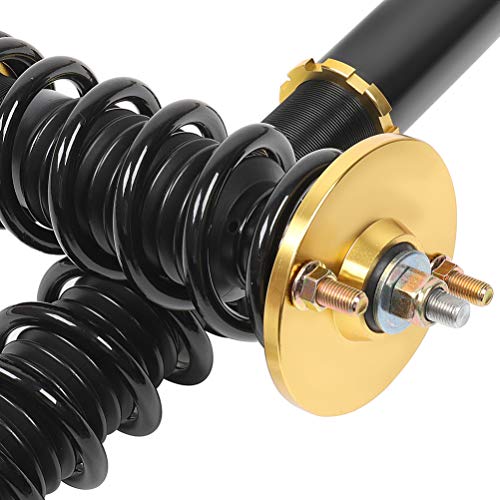
The ECCPP kit uses threaded lower mounts to adjust vehicle height.
With this design, the coilover’s installed length can be changed without using spring preload as the primary height adjustment. That helps preserve the intended damper stroke when the system is configured correctly.
Benefits of independent lower-mount adjustment include:
- More precise ride-height control
- Easier left-to-right height matching
- Better preservation of suspension travel
- Separate preload and height adjustments
- Greater flexibility when setting wheel gap
That does not mean every possible height is equally useful. Excessive lowering can still reduce ground clearance, change steering geometry and move suspension components outside their intended operating range.
The correct goal is a functional ride height—not discovering which part of the exhaust touches the pavement first.
10K Front and 5K Rear Spring Rates
The ECCPP kit uses the following spring rates:
- Front: 10 kg/mm
- Rear: 5 kg/mm
The front spring rate is significantly firmer than the rear rate. This arrangement is intended to support the front-heavy layout of the front-wheel-drive TSX while controlling brake dive and front-end body movement.
The softer rear rate helps preserve some ride compliance while supporting the car during cornering and directional changes.
These rates may provide:
- Reduced suspension compression during braking
- Less body roll during cornering
- Faster response to steering inputs
- More controlled weight transfer
- Firmer feedback through the chassis
Expect the ride to feel firmer than the factory suspension. Spring rates, tire sidewalls, wheel size, road quality, vehicle weight and suspension travel all affect ride comfort.
Adjustable Spring Preload
Spring preload can be adjusted through the threaded spring perch and locking collars.
Preload establishes how firmly the spring is seated when the suspension is extended. It should not be used casually as a substitute for ride-height adjustment.
Too little preload can allow the spring to become loose when the suspension reaches full extension. Too much preload can reduce droop travel and make the car feel unnecessarily harsh.
Set preload according to ECCPP’s instructions, verify that each spring remains seated and use the lower mounts for major ride-height changes.
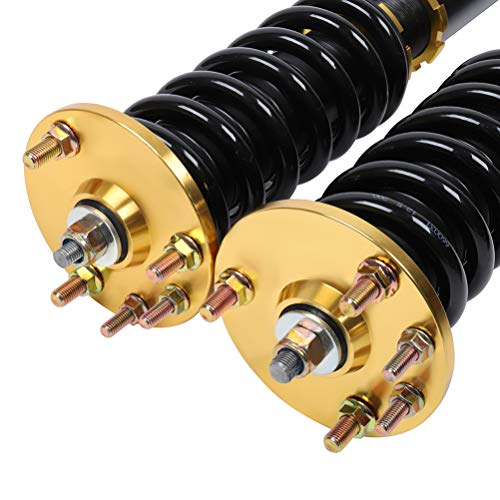
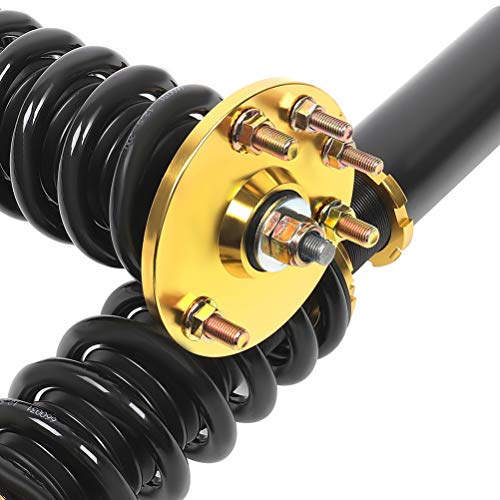
Adjustable Camber Plates
The product listing describes adjustable camber plates. Where included, these upper mounts allow the front camber angle to be changed during alignment.
Camber adjustment may be useful for:
- Correcting alignment after lowering
- Improving front tire clearance
- Increasing cornering grip
- Balancing street and performance alignment
- Reducing undesirable tire wear
Camber plates do not replace a complete alignment. Toe must still be measured and adjusted after the installation.
Also confirm exactly which upper mounts are included with the current kit. Product designs occasionally change while the listing copy remains preserved like an ancient manuscript.
Does This Kit Have Adjustable Damping?
The supplied specifications confirm adjustable ride height, preload and camber plates. They do not provide a specific number of damping settings.
Unless the exact product package includes damping-adjustment knobs and documentation, do not advertise this kit as having adjustable damping.
Ride height and spring preload are suspension adjustments, but neither changes the damper’s internal compression or rebound calibration.
That distinction matters because shoppers searching for “adjustable coilovers” may assume every suspension parameter is adjustable. On this kit, the confirmed feature is adjustable height, not a specified 24-, 30- or 32-position damper.
Improved Steering Response
Lowering the vehicle’s center of gravity and increasing spring stiffness can make the TSX respond more quickly to steering input.
Possible changes include:
- Faster initial turn-in
- Reduced delay during lane changes
- Less body movement in transitions
- More immediate road feedback
- A more connected steering feel
A coilover kit cannot correct worn steering or suspension components. Inspect the ball joints, tie-rod ends, control-arm bushings, wheel bearings and sway-bar links before installation.
A firmer new suspension can make previously hidden looseness far more obvious. It is remarkably effective at converting “I think that noise was always there” into a weekend repair.
Understeer, Oversteer and Chassis Balance
The product description claims improved control of understeer and oversteer. Coilovers can influence vehicle balance, but they do not automatically prevent either condition.
Handling balance depends on:
- Front and rear spring rates
- Damper calibration
- Alignment
- Sway-bar stiffness
- Tire grip
- Tire pressure
- Ride height
- Road conditions
- Driver input
The TSX is a front-wheel-drive vehicle and will generally lean toward understeer when front tire grip is exceeded. A balanced suspension setup can improve response, but making the chassis excessively stiff does not manufacture additional tire grip.
Use predictable alignment settings and make setup changes one at a time.
Braking Performance
Firmer springs can reduce forward body movement and brake dive. This may make the car feel more controlled under braking and help maintain consistent suspension geometry.
However, coilovers do not directly guarantee a shorter stopping distance.
Actual braking distance depends primarily on:
- Tire grip
- Brake condition
- Road surface
- Vehicle speed
- ABS operation
- Brake fluid
- Driver reaction
- Vehicle load
The accurate claim is that coilovers may improve chassis control during braking. They do not transform ordinary tires into physics exemptions.
Street Performance
This ECCPP kit is best suited to owners who want:
- A lower street stance
- Firmer suspension response
- Replaceable factory suspension assemblies
- Adjustable vehicle height
- Front camber adjustment where equipped
- Reduced body movement
- Budget-conscious suspension customization
For daily driving, use a moderate ride height that preserves clearance and suspension travel.
A car lowered primarily for appearance may look impressive in photographs while being deeply offended by every driveway, speed bump and uneven parking lot. Set the height for the roads the vehicle actually uses.
See the 7 Best Coilovers for Daily Driving for additional street-suspension considerations.
Installation Overview
Professional installation is recommended because suspension work involves vehicle support, high spring forces and alignment-sensitive components.
A typical installation includes:
- Park the vehicle on a flat surface.
- Record the original ride height at all four corners.
- Loosen the wheel fasteners.
- Raise and safely support the vehicle.
- Remove the wheels.
- Support the appropriate control arms.
- Disconnect brake-hose and ABS-wire brackets.
- Remove the original front suspension assemblies.
- Remove the original rear suspension assemblies.
- Compare the ECCPP components with the factory parts.
- Confirm spring seating and initial preload.
- Set equal left-to-right starting heights.
- Install the front and rear coilovers.
- Reattach every hose and wiring bracket.
- Tighten the suspension hardware to factory specifications.
- Reinstall the wheels.
- Lower the vehicle carefully.
- Roll the vehicle to settle the suspension.
- Measure and adjust the final ride height.
- Perform a complete four-wheel alignment.
Never work beneath a vehicle supported only by a hydraulic jack.
Inspect the Original Suspension First
Before installing the coilovers, inspect:
- Upper suspension mounts
- Lower control-arm bushings
- Upper control-arm bushings
- Ball joints
- Tie-rod ends
- Sway-bar links
- Sway-bar bushings
- Wheel bearings
- CV axles and boots
- Brake hoses
- ABS wiring
- Suspension mounting points
- Wheels and tires
Installing fresh coilovers beside badly worn bushings can produce noise, poor alignment and unpredictable handling.
Setting the Initial Ride Height
Before installation, set the left and right assemblies to matching lengths.
After the vehicle is on the ground:
- Roll it forward and backward
- Allow the suspension to settle
- Measure from the wheel center to the fender
- Compare both sides
- Adjust in small increments
- Recheck spring seating
- Tighten every locking collar
Avoid measuring only from the ground to the fender. Tire-pressure and tire-diameter differences can alter that measurement.
Leave adequate clearance for:
- Steering movement
- Suspension compression
- Passengers and cargo
- Fender liners
- Tires and wheels
- Brake hoses
- Axles
- Exhaust components
- Road obstacles
Alignment After Installation
A four-wheel alignment is required after installing coilovers or changing ride height.
Lowering a TSX can change:
- Front camber
- Rear camber
- Front toe
- Rear toe
- Steering-wheel position
- Straight-line stability
- Tire wear
Complete the major height adjustments before the alignment. Changing the vehicle height afterward can alter the alignment again.
Read Wheel Alignment 101 for an explanation of camber, caster and toe.
Tire Wear and Alignment
Coilovers do not automatically create even tire wear. Correct alignment does.
Excessive negative camber can wear the inner shoulder of a tire, but incorrect toe often accelerates wear even more quickly. A lowered car with aggressive camber and poor toe can destroy tires with truly impressive efficiency.
For a street-driven TSX:
- Use conservative camber
- Keep toe close to the intended specification
- Rotate tires regularly
- Monitor inner tread depth
- Recheck alignment after the suspension settles
Additional rear camber arms may be needed if the desired alignment cannot be achieved using factory adjustment.
Cleaning and Maintenance
Adjustable suspension components require occasional maintenance, especially in wet, dusty or winter conditions.
Periodically:
- Clean dirt from the threaded bodies
- Inspect for corrosion
- Check for damper leakage
- Confirm locking collars remain tight
- Examine spring seats
- Inspect upper mounts and bushings
- Check brake-hose clearance
- Listen for clunks or binding
- Verify ride height
- Inspect tire wear
Apply an appropriate corrosion-resistant compound or anti-seize to the threads only where permitted by the manufacturer. Keep lubricants away from brake components.
Post-Installation Inspection
Reinspect the suspension after approximately 50–100 miles.
Check:
- Upper-mount fasteners
- Lower-mount fasteners
- Locking collars
- Spring seating
- Brake-hose brackets
- ABS-wire routing
- Tire and body clearance
- Sway-bar link clearance
- Alignment
- Fluid leakage
- Unusual noises
If the vehicle pulls, wanders, clunks or contacts the body, stop and inspect the installation.
Advantages of the ECCPP TSX Coilover Kit
The primary advantages include:
- Complete front and rear suspension replacement
- Adjustable ride height
- Independent lower-mount adjustment
- Adjustable spring preload
- Listed camber-adjustable upper plates
- 10K front and 5K rear springs
- Reduced body movement
- Lowered appearance
- Gold exterior finish
- Budget-oriented pricing
This kit is aimed at drivers who prioritize height control and firmer street handling over premium damper adjustability.
What This Kit Cannot Do
An ECCPP coilover kit cannot:
- Repair damaged control arms
- Eliminate every suspension noise
- Guarantee shorter braking distances
- Prevent understeer or oversteer
- Correct worn wheel bearings
- Create additional tire grip
- Replace a proper alignment
- Make the lowest setting the best setting
- Fit every Accord simply because the model years match
The coilovers are one part of the complete suspension system. Their performance depends on the condition and setup of everything around them.
Frequently Asked Questions
Do ECCPP coilovers fit a 2004–2008 Acura TSX?
Yes. This kit is listed for the first-generation 2004–2008 Acura TSX. Confirm the complete product number and mounting configuration before purchase.
Do they fit a 2003–2007 Honda Accord?
The manufacturer lists certain 2003–2007 Honda Accord applications. Verify the chassis code, market, body style and suspension mounts because not every Accord configuration is identical to the TSX.
What are the spring rates?
The front spring rate is 10 kg/mm, while the rear spring rate is 5 kg/mm.
Is the ride height adjustable?
Yes. The threaded lower mounts allow the installed coilover length and vehicle height to be adjusted.
Is damping adjustable?
No specific damping adjustment is confirmed in the supplied product specifications. Do not assume that adjustable height means adjustable compression or rebound damping.
Does the kit have camber plates?
The listing describes adjustable camber plates. Confirm which front and rear upper mounts are included in the current package before ordering.
Can these coilovers be used on a daily driver?
Yes, but the ride will be firmer than stock. A moderate height setting and proper alignment will produce the most practical street setup.
Will the suspension improve steering response?
The firmer springs and lower ride height can reduce body movement and produce faster steering response. The condition of the tires, bushings and steering components remains important.
Will these coilovers shorten braking distance?
Not by themselves. They may reduce brake dive, but braking distance depends primarily on tires, brakes, road conditions and vehicle speed.
Do I need an alignment afterward?
Yes. A four-wheel alignment is required after installation and after significant ride-height changes.
Will I need a camber kit?
Possibly. The answer depends on the final ride height, included camber adjustment and desired alignment specifications.
Is professional installation recommended?
Yes. Correct installation requires safe vehicle support, suspension knowledge, proper torque procedures and a professional alignment.
Final Thoughts
The ECCPP coilover kit for the 2004–2008 Acura TSX provides adjustable ride height, 10K front springs, 5K rear springs and a firmer suspension setup for owners who want more control than the factory suspension provides.
Its independent lower mounts allow height changes without relying solely on spring preload. That makes it possible to dial in a lower stance while preserving more of the intended damper stroke.
The best street setup will use a moderate drop, verified spring preload and a proper four-wheel alignment. Lowering the car until it can identify loose change on the pavement by texture remains optional—and generally regrettable.
For additional suspension guidance, visit:
- Car Suspension Upgrades That Transform Your Ride
- Lowering Springs vs. Coilovers
- 7 Best Coilovers for Daily Driving
- Air Suspension vs. Coilovers
- Wheel Alignment 101



There are no reviews yet.