
Why Install Coilovers on a Honda Accord?
The 2003–2007 Honda Accord was designed primarily as a comfortable daily driver. Its factory suspension provides a smooth ride, but it allows more body movement than many performance-minded owners prefer.
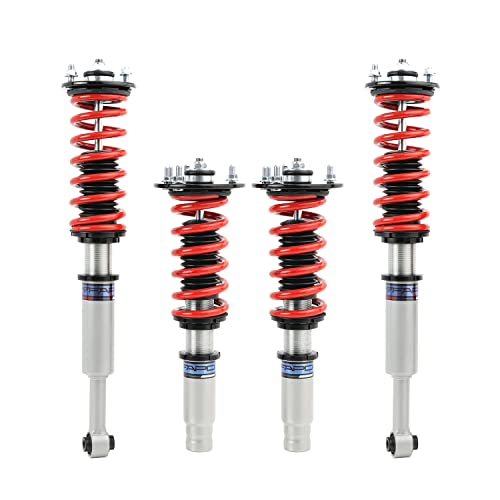
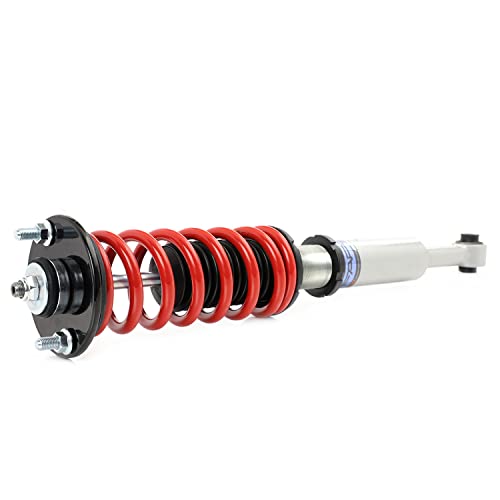
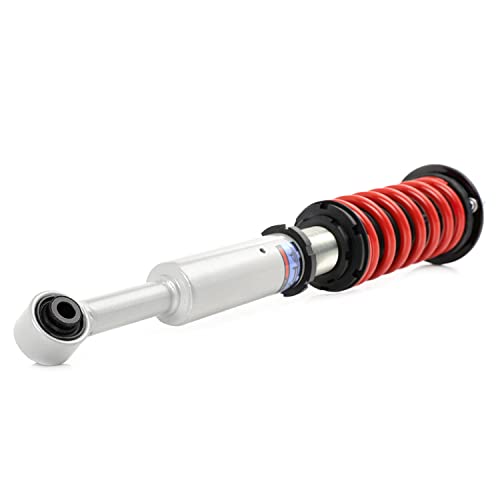
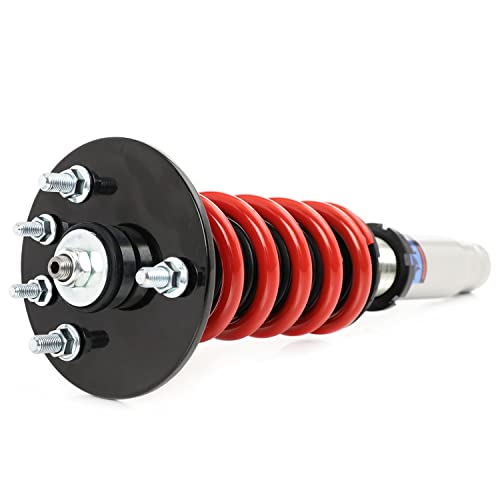
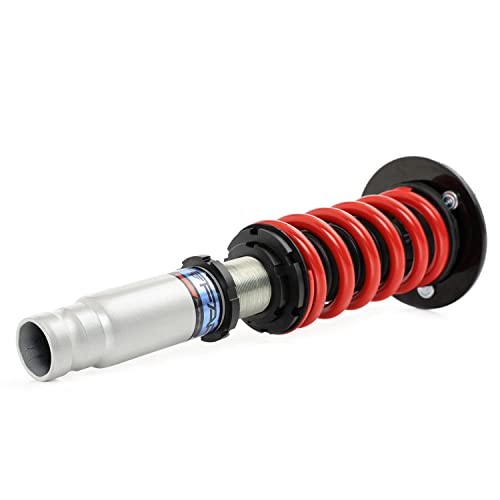
The FAPO coilover kit replaces the original springs and dampers with a firmer, height-adjustable suspension.
Potential benefits include:
- Reduced body roll
- Less brake dive
- Faster steering response
- More controlled weight transfer
- Adjustable fender gap
- Lower center of gravity
- Firmer road feedback
- Replacement of worn factory dampers
- More aggressive exterior stance
A correctly configured coilover system can make the Accord feel more responsive without turning it into a dedicated competition car.
For a detailed comparison of suspension options, read Lowering Springs vs. Coilovers.
Adjustable Ride Height
The FAPO coilovers can lower the vehicle approximately 1–3 inches, depending on the final settings and vehicle configuration.
Threaded adjustment collars allow each corner to be raised or lowered within the kit’s available range. This gives the owner more control than a fixed-height lowering spring.
Ride-height adjustment can be used to:
- Reduce factory wheel gap
- Match the stance to a wheel-and-tire package
- Create a mild street drop
- Lower the vehicle for show use
- Balance left-to-right ride height
- Adjust ground clearance for different roads
The maximum available drop is not necessarily the best setting. Excessive lowering can reduce suspension travel, change axle and steering angles, create tire interference and make speed bumps feel like personal attacks.
Understanding the Adjustment Design
The listing describes the system as full-length adjustable, but also states that height is changed by moving the spring-seat locking collars.
Those are not always the same adjustment method.
Before installation, determine whether this exact kit changes ride height through:
- An independently threaded lower mount
- The spring perch
- A combination of both systems
If the spring perch controls vehicle height, lowering the perch can also change spring preload and available damper travel. Follow FAPO’s supplied instructions rather than treating every threaded collar as an invitation to experimentation.
10K Front and 5K Rear Spring Rates
This FAPO kit uses:
- Front springs: 10 kg/mm or 560 lb/in
- Rear springs: 5 kg/mm or 280 lb/in
The firmer front rate supports the Accord’s front-heavy layout and helps control weight transfer during braking and cornering. The softer rear rate provides more compliance while supporting the vehicle through directional changes.
Compared with factory springs, this combination should produce:
- Firmer front-end response
- Reduced brake dive
- Less body roll
- More immediate steering feedback
- Faster chassis transitions
- A sportier overall ride
Expect a firmer ride than stock. No spring with twice the attitude of the factory unit is going to impersonate an original luxury suspension perfectly.
Recommended Spring Preload
The specified spring-preload range is 7–10 mm.
Spring preload keeps the spring seated and establishes its initial installed tension. It should be adjusted equally from side to side using the procedure supplied with the kit.
Excessive preload may:
- Reduce suspension droop
- Create an unnecessarily harsh ride
- Limit the wheel’s ability to follow uneven pavement
- Place the damper outside its preferred operating range
Insufficient preload may allow a spring to become loose at full suspension extension.
Do not use preload as a shortcut for correcting ride height unless the product instructions specifically require that method.
Monotube Damper Design
Each FAPO coilover uses a monotube damper rather than a conventional twin-tube arrangement.
A monotube shock packages the piston, hydraulic oil and pressurized gas within a single main cylinder. The larger piston area can provide responsive damping and improved heat transfer during repeated suspension movement.
Potential monotube benefits include:
- Consistent damping response
- Better heat dissipation
- Faster reaction to road inputs
- Reduced performance fade
- More direct road feedback
- Stable operation during spirited driving
Monotube construction does not automatically guarantee superior ride quality. Damper valving, spring rates, suspension travel and installation quality still determine how the finished vehicle behaves.
Fixed Damping Calibration
No external damping-adjustment range is specified for this kit. The dampers should therefore be described as fixed-rate or pre-tuned, not driver-adjustable.
The owner can adjust:
- Vehicle height
- Spring-seat position
- Spring preload
The owner cannot assume adjustment of:
- Compression damping
- Rebound damping
- Low-speed damper response
- High-speed damper response
This distinction matters when comparing the FAPO kit with more expensive suspension systems offering 24, 30 or 32 damping positions.
Fixed damping is not inherently a disadvantage. It eliminates setup confusion and allows the dampers to be matched to the supplied springs from the factory.
Street Performance
For a daily-driven Accord or TSX, begin with a conservative ride height.
A practical street setup should preserve:
- Suspension travel
- Tire clearance
- Axle clearance
- Comfortable approach angles
- Brake-hose movement
- Steering range
- Ground clearance
- Passenger and cargo capacity
A mild drop can improve appearance and response without creating unnecessary problems with driveways, parking ramps and broken pavement.
Read 7 Best Coilovers for Daily Driving for more information about choosing a street-oriented suspension setup.
Fast-Road and Closed-Course Use
The FAPO kit may be used for spirited street driving, autocross or occasional closed-course events when installed and maintained correctly.
Before performance driving, inspect:
- Tires
- Brake pads and rotors
- Brake fluid
- Wheel bearings
- Ball joints
- Tie-rod ends
- Control-arm bushings
- Coilover mounts
- Locking collars
- Alignment
- Wheel fasteners
Fixed dampers cannot be softened or stiffened at the track, so chassis tuning must come from ride height, alignment, tire pressure and other suspension components.
Calling any budget coilover kit “ideal for every track and drift application” is enthusiastic marketing. The front-wheel-drive Accord also makes a fairly unconventional drift car unless the parking brake is doing overtime.
Better Steering Response
Lowering the center of gravity and using firmer springs can make the Accord respond more quickly to steering input.
Possible improvements include:
- Sharper initial turn-in
- Reduced delay during transitions
- Less body lean
- More direct road feedback
- Greater confidence during lane changes
The final result depends on alignment and tire condition. Coilovers cannot overcome worn tires or loose suspension joints.
Braking Stability
Firmer front springs can reduce suspension compression during hard braking. This may make the car feel more stable and controlled as weight transfers forward.
However, coilovers do not directly guarantee shorter stopping distances.
Braking distance is primarily affected by:
- Tire grip
- Brake condition
- Vehicle speed
- Road surface
- ABS operation
- Vehicle weight
- Driver response
The accurate benefit is reduced brake dive and improved chassis control—not magical deletion of Newton’s laws.
Reduced Body Roll
The higher spring rates resist suspension compression during cornering, reducing the amount the body leans relative to the wheels.
Less roll can improve:
- Driver confidence
- Steering precision
- Chassis response
- Transitional stability
- Perceived balance
Spring stiffness is only one part of body-roll control. Sway bars, bushings, tires, vehicle weight and suspension geometry also contribute.
For additional setup options, see How to Upgrade Sway Bars.
Corrosion-Resistant Finish
The FAPO coilover bodies use a painted surface treatment intended to reduce corrosion and protect exposed metal.
The coating helps, but adjustable coilovers still require maintenance. Dirt, moisture and road salt can collect around the threaded bodies and locking collars.
Periodically:
- Clean the exposed threads
- Remove road debris
- Inspect for damaged coating
- Check for corrosion
- Confirm the collars move freely
- Apply an approved protective compound
- Inspect for damper leakage
Do not coat brake rotors, pads or friction surfaces with lubricant. That should not need to be stated, yet the internet remains undefeated.
Package Contents
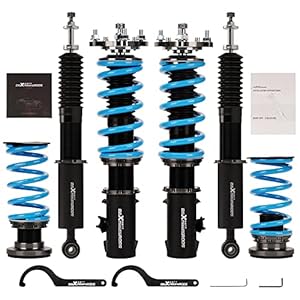
The kit is advertised as a complete front and rear suspension package.
Typical contents include:
- Two front coilover assemblies
- Two rear coilover assemblies
- Adjustable spring perches
- Locking collars
- Adjustment spanner wrenches
- Installation hardware where supplied
Confirm the exact package contents before installation. Some original brackets, fasteners or upper-mount components may need to be reused.
Direct-Replacement Installation
The FAPO coilovers are intended to mount at the factory suspension locations on compatible vehicles.
On a confirmed application, installation should not normally require cutting or welding. However, “bolt-on” does not mean “install while holding a flashlight in your teeth before dinner.”
Proper installation requires:
- Safe vehicle support
- Correct hand tools
- Torque wrench
- Suspension knowledge
- Accurate ride-height measurements
- Manufacturer torque specifications
- Professional alignment equipment
Professional installation is strongly recommended.
Inspect the Factory Suspension First
Before installing the coilovers, inspect:
- Upper suspension mounts
- Control-arm bushings
- Ball joints
- Tie-rod ends
- Sway-bar links
- Sway-bar bushings
- Wheel bearings
- CV axles and boots
- Brake hoses
- ABS wiring
- Suspension mounting points
- Wheels and tires
New coilovers will not repair worn chassis components. Firmer suspension may make existing looseness, vibration or noise more noticeable.
Installation Overview
A typical installation includes:
- Park the vehicle on a level surface.
- Measure and record the original ride height.
- Loosen the wheel fasteners.
- Raise and support the vehicle at approved points.
- Remove the wheels.
- Support the suspension components.
- Disconnect applicable brake-hose and ABS-wire brackets.
- Remove the original front assemblies.
- Remove the original rear assemblies.
- Compare the replacement parts with the originals.
- Confirm spring seating and preload.
- Set equal starting lengths on matching sides.
- Install the front and rear coilovers.
- Reconnect every bracket and suspension attachment.
- Tighten hardware to factory specifications.
- Reinstall the wheels.
- Lower and settle the vehicle.
- Measure the new ride height.
- Check tire and component clearance.
- Perform a four-wheel alignment.
Never work under a vehicle supported only by a hydraulic jack.
How to Set the Initial Ride Height
Begin with a moderate drop instead of immediately selecting the lowest position.
Measure from the center of each wheel to a fixed point on the fender. This avoids errors caused by tire-pressure or tire-diameter differences.
After adjustment:
- Roll the vehicle forward and backward
- Allow the springs to settle
- Compare left and right measurements
- Confirm locking collars are tight
- Check wheel and tire clearance
- Turn the steering from lock to lock
- Inspect brake hoses and ABS wiring
- Verify ground clearance
- Recheck the height after driving
Avoid using coilover threads to compensate for a bent suspension component or uneven body structure.
Wheel Alignment Required
A complete four-wheel alignment is required after installing coilovers.
Lowering the vehicle can change:
- Front camber
- Rear camber
- Front toe
- Rear toe
- Steering-wheel position
- Straight-line stability
- Tire-wear patterns
Complete the major height adjustments before alignment. Changing the ride height afterward can alter camber and toe again.
Read Wheel Alignment 101 for a straightforward explanation of alignment angles.
Will You Need a Camber Kit?
The answer depends on the final ride height and available factory adjustment.
A mild drop may align within an acceptable street range. A larger drop may create more negative camber than the original adjustment points can correct.
Additional components may include:
- Adjustable rear camber arms
- Adjustable front upper control arms
- Adjustable toe arms
- Camber bolts where appropriate
Do not install alignment parts based solely on appearance. Measure the vehicle first and add the components required to achieve the intended alignment.
Post-Installation Inspection
Reinspect the suspension after approximately 50–100 miles.
Check:
- Upper mounting hardware
- Lower mounting hardware
- Locking collars
- Spring seating
- Brake-hose brackets
- ABS-wire routing
- Tire clearance
- Axle clearance
- Fluid leakage
- Unusual noises
- Ride height
- Alignment
Stop driving and inspect the system if the vehicle develops binding, severe pulling, metal-to-metal contact or a persistent clunk.
Frequently Asked Questions
Do these FAPO coilovers fit a 2003–2007 Honda Accord sedan?
The kit is listed for Accord VII four-door sedan chassis CM4, CM5 and CM6. Verify the chassis code and mounting arrangement before ordering.
Do they fit the Accord coupe?
The manufacturer also lists the 2003–2007 Accord coupe with CM7 or CM8 chassis codes.
Do these coilovers fit a 2004–2008 Acura TSX?
The kit is advertised for the 2004–2008 Acura TSX CL9. Confirm the current product number and complete fitment information before purchase.
What are the spring rates?
The front spring rate is 10 kg/mm or 560 lb/in. The rear spring rate is 5 kg/mm or 280 lb/in.
What are the spring lengths?
The listed front spring length is 180 mm, while the rear spring length is 200 mm.
How much do the coilovers lower the car?
The listed lowering range is approximately 1–3 inches.
Is the damping adjustable?
No external damping adjustment is specified. The dampers use a fixed, pre-tuned calibration.
What spring preload should be used?
The manufacturer lists a recommended preload range of 7–10 mm.
Can these coilovers be used for daily driving?
Yes, but the suspension will feel firmer than stock. A moderate ride height will usually provide the most practical street setup.
Are they suitable for track use?
They may support occasional closed-course driving when properly installed, aligned and inspected. They are not a substitute for competition-specific dampers, tires, brakes or safety equipment.
Do I need a wheel alignment?
Yes. A four-wheel alignment is required after installation or any significant ride-height change.
Does installation require cutting or welding?
It should not on a confirmed, unmodified application. Verify the mounting configuration and supplied hardware before beginning.
Final Thoughts
The FAPO monotube coilover kit for the 2003–2007 Honda Accord provides adjustable lowering, firmer suspension response and a complete front-and-rear suspension replacement at an accessible price.
Its 10K front and 5K rear springs are considerably firmer than the factory suspension, while the monotube dampers offer consistent fixed-rate control. The 1–3-inch adjustment range allows owners to choose between a moderate street drop and a more aggressive stance.
The sensible setup is simple: confirm fitment, preserve suspension travel, use the recommended preload and finish with a professional four-wheel alignment. The lowest possible setting may win the parking-lot argument, but the pothole usually gets the final vote.
For more suspension information, visit:
- Car Suspension Upgrades That Transform Your Ride
- Lowering Springs vs. Coilovers
- 7 Best Coilovers for Daily Driving
- Air Suspension vs. Coilovers
- Wheel Alignment 101
Product shortcode:




There are no reviews yet.