
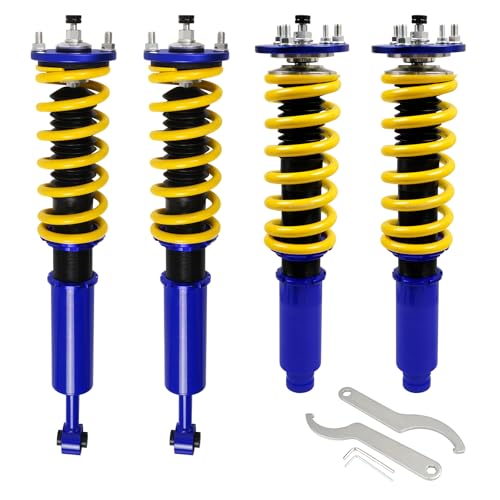

Vehicle-Specific Mounting Design
The suspension is advertised as being developed for the seventh-generation Accord chassis rather than adapted from a universal coilover assembly.
On a confirmed application, the kit is intended to use the original suspension mounting locations.
That means installation should not normally require:
- Cutting the body
- Welding new brackets
- Drilling structural mounting points
- Fabricating suspension adapters
- Permanently modifying the chassis
Original fasteners, brackets or upper-mount hardware may still need to be reused, depending on the exact package.
“Direct fit” does not mean every twenty-year-old suspension bolt will politely remove itself. Rust was not consulted during product development.
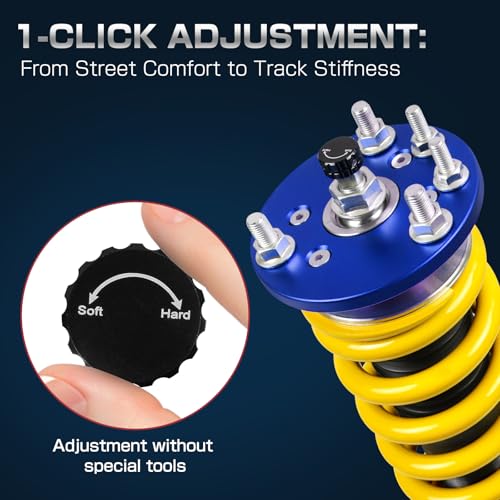
Twenty-Four Damping Positions
The coilovers provide 24 external damping positions.
The adjustment allows the driver to change damper firmness for different conditions, including:
- Daily commuting
- Highway driving
- Rough pavement
- Spirited road use
- Autocross
- Occasional track driving
- Different wheel and tire packages
The supplied product details do not identify whether the external control primarily adjusts rebound, compression or a combined internal circuit.
Unless the manufacturer’s instructions confirm the exact function, describe the feature simply as 24-position damping adjustment.
Do not advertise independent compression and rebound adjustment. That would normally require separate external controls.
How to Set the Damping
Begin near the softer end of the adjustment range.
A sensible setup process is:
- Confirm which direction increases damping force.
- Turn every adjuster gently to the full-soft reference.
- Set matching left-to-right positions.
- Drive the Accord on a familiar road.
- Increase damping two positions at a time.
- Evaluate body control and bump recovery.
- Record the front and rear settings.
- Stop increasing firmness when traction or ride quality declines.
The front and rear settings do not necessarily need to be identical. Vehicle balance, tires, alignment and road quality determine the best combination.
Maximum firmness is not automatically a track setup. Sometimes it is simply the fastest route to discovering every pavement repair in the county.
Adjustable Spring Preload
The product description refers to adjustable “spring pre-pressure,” which means spring preload.
Spring preload establishes the spring’s initial installed tension and keeps it correctly seated when the suspension reaches full extension.
Preload adjustment may affect:
- Spring seating
- Droop travel
- Initial suspension response
- Ride quality
- Available suspension movement
Too little preload can allow the spring to become loose at full extension. Excessive preload can reduce droop travel and produce a harsh or bouncy ride.
Follow the supplied adjustment procedure. Do not use preload casually as a substitute for proper ride-height adjustment.
Adjustable Ride Height
The threaded suspension design allows the Accord to be lowered from its original height.
Ride-height adjustment can be used to:
- Reduce factory wheel gap
- Lower the center of gravity
- Match the stance to aftermarket wheels
- Balance left-to-right height
- Create a mild street drop
- Build a more aggressive show stance
The exact adjustment range was not supplied. Do not advertise a specific one-, two- or three-inch drop until the manufacturer confirms it.
The installation manual should also establish whether height changes are made through:
- An independently threaded lower mount
- The spring perch
- A separate rear adjustment platform
- A combination of these systems
That distinction affects preload and available shock travel.
Preserve Suspension Travel
Lowering a car changes more than its appearance.
Excessive lowering can reduce:
- Bump travel
- Droop travel
- Tire clearance
- Ground clearance
- Exhaust clearance
- Axle clearance
- Practical driveway access
It can also change:
- Camber
- Toe
- Control-arm angle
- Tie-rod angle
- Steering response
- Roll-center position
- Tire-wear patterns
The best street setting is the lowest height that preserves usable suspension movement and alignment—not whichever position produces the most dramatic parking-lot photograph.
For additional guidance, read Lowering Springs vs. Coilovers.
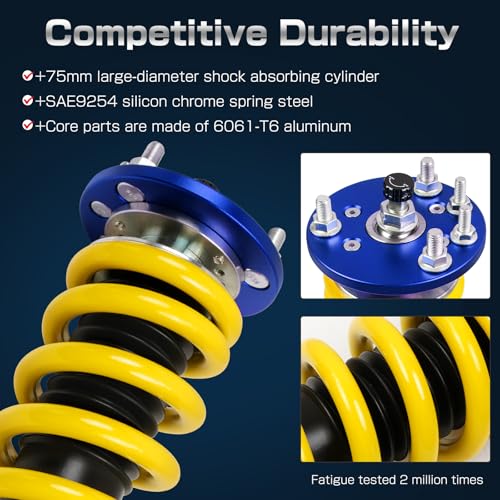
SAE 9254 Chrome-Silicon Springs
The springs are described as being manufactured from SAE 9254 chrome-silicon steel.
This alloy is commonly selected for high-stress spring applications because it offers:
- High tensile strength
- Elasticity
- Fatigue resistance
- Heat resistance
- Consistent compression behavior
- Resistance to permanent deformation
The manufacturer claims the springs passed a fatigue test involving 2 million compression cycles.
That figure should be presented as a manufacturer-supplied claim. It does not mean the entire coilover assembly was tested for two million cycles or that the dampers, seals and mounts will never require maintenance.
What Does “High-Poundage Spring” Mean?
“High poundage” is marketing language rather than a usable suspension specification.
A meaningful spring specification should be expressed in:
- kg/mm
- N/mm
- lb/in
The exact front and rear spring rates were not provided.
Do not invent spring-rate figures or copy rates from another Accord kit. Different dampers and springs may look similar while using completely different internal calibration.
The spring rates should be confirmed before comparing this kit with the FAPO, ECCPP or other Accord suspension packages.
Understanding the Listed 75 mm Dimension
The product description advertises a 75 mm large-diameter shock-absorbing cylinder.
That measurement should be verified against the manufacturer’s technical drawing.
It may refer to:
- An outer spring or assembly diameter
- A threaded adjustment section
- A mounting component
- A packaging measurement
- The widest section of the damper assembly
It should not automatically be presented as the internal piston diameter or working shock-bore diameter. A true 75 mm piston would be unusually large for this application.
Until clarified, describe it as the manufacturer-listed 75 mm damper or assembly dimension.
Improved Body Control
Firmer springs and properly matched dampers can reduce unnecessary chassis movement.
Potential benefits include:
- Reduced body roll
- Less brake dive
- More controlled acceleration squat
- Faster steering response
- Improved transitional stability
- More direct road feedback
These changes depend on the kit’s actual spring rates, damper calibration and final setup.
Coilovers cannot correct:
- Worn ball joints
- Damaged control-arm bushings
- Loose tie-rod ends
- Failing wheel bearings
- Bent suspension components
- Poor tire condition
Street Setup
For a daily-driven Accord, begin with:
- Moderate lowering
- Softer damping positions
- Manufacturer-recommended preload
- Equal left-to-right settings
- Conservative alignment
- Adequate tire clearance
A street setup should account for:
- Passengers
- Cargo
- Driveways
- Parking ramps
- Speed bumps
- Broken pavement
- Highway expansion joints
Read 7 Best Coilovers for Daily Driving for more practical setup advice.
Spirited Driving and Track Use
For autocross, back-road driving or occasional closed-course use:
- Increase damping gradually
- Monitor front-tire grip
- Check rear stability
- Inspect suspension hardware
- Record every adjustment
- Monitor tire temperatures
- Recheck wheel torque
- Preserve enough travel for the track surface
A firmer setting may improve body control on smooth pavement. On a rough course, excessive damping can reduce grip by preventing the wheels from following the surface.
This kit offers adjustment for occasional performance use, but it should not automatically be described as competition suspension without verified damper data.
Installation Recommendations
Professional installation is strongly recommended.
Before installation, inspect:
- Front upper control arms
- Lower control-arm bushings
- Ball joints
- Tie-rod ends
- Sway-bar links
- Wheel bearings
- CV axles and boots
- Rear suspension bushings
- Brake hoses
- ABS wiring
- Wheels and tires
- Suspension mounting points
Older Accords may require replacement fasteners, bushings or mounts before the new suspension can be aligned correctly.
Basic Installation Process
A typical installation includes:
- Confirm the vehicle chassis code.
- Record the original ride height.
- Loosen the wheel fasteners.
- Raise and safely support the vehicle.
- Remove all four wheels.
- Support the appropriate suspension components.
- Disconnect applicable brake-hose and ABS-wire brackets.
- Remove the original front assemblies.
- Compare the replacement parts with the originals.
- Install the front coilovers.
- Remove the original rear suspension assemblies.
- Install the rear coilovers.
- Set initial spring preload.
- Establish matching left-to-right heights.
- Tighten all hardware to factory specifications.
- Reconnect every hose and wiring bracket.
- Reinstall the wheels.
- Lower and settle the vehicle.
- Check tire and component clearance.
- Set the initial damping positions.
- Perform a four-wheel alignment.
Never work underneath a vehicle supported only by a hydraulic jack.
Setting the Ride Height
Measure from the center of each wheel to a consistent point on the fender.
This method avoids measurement errors caused by tire pressure, tread depth or tire-size differences.
After adjusting the height:
- Roll the car forward and backward
- Allow the suspension to settle
- Compare left and right measurements
- Confirm spring seating
- Tighten all locking collars
- Turn the steering from lock to lock
- Check tire clearance
- Inspect brake-hose movement
- Verify axle clearance
- Recheck the height after driving
Do not attempt to correct a bent component or damaged spring mount through unequal coilover adjustment.
Four-Wheel Alignment Required
The Accord requires a professional four-wheel alignment after installation.
Lowering can change:
- Front camber
- Rear camber
- Front toe
- Rear toe
- Caster
- Steering-wheel position
- Straight-line stability
- Tire wear
Complete the major height adjustments before paying for the alignment.
Read Wheel Alignment 101 for an explanation of camber, caster and toe.
Additional Alignment Components
Depending on ride height, the Accord may require:
- Front camber adjustment hardware
- Adjustable rear camber arms
- Adjustable rear toe arms
- Replacement control-arm bushings
Install the coilovers, establish the intended height and measure the alignment before buying correction parts.
Aggressive negative camber may look purposeful, but incorrect toe is usually what turns the inside edge of a tire into automotive confetti.
Wheel and Tire Clearance
Check clearance using the actual wheel-and-tire package installed on the vehicle.
Inspect around:
- Front spring perches
- Rear coilover bodies
- Fender liners
- Fender lips
- Inner wheel wells
- Brake hoses
- ABS wiring
- Tie rods
- CV axles
Wheel width and offset matter. A wheel that clears the original suspension may contact a wider coilover spring or adjustment collar.
Coilover Maintenance
Adjustable suspension requires regular cleaning and inspection.
Maintenance should include:
- Cleaning the threaded bodies
- Removing dirt from adjustment collars
- Inspecting spring coatings
- Checking for corrosion
- Confirming collar tightness
- Inspecting for fluid leakage
- Checking upper mounts
- Monitoring tire wear
- Exercising the damper adjusters
- Measuring ride height
Use only approved corrosion protection or anti-seize products. Keep lubricants away from brakes and tire surfaces.
Post-Installation Inspection
Reinspect the suspension after approximately 50–100 miles.
Check:
- Upper mounting hardware
- Lower mounting hardware
- Spring seating
- Preload collars
- Height-adjustment collars
- Damping settings
- Brake-hose routing
- ABS-wire routing
- Tire clearance
- Fluid leakage
- Alignment
- Unusual noises
Stop driving and inspect the system if the Accord develops severe pulling, binding, metal contact or persistent clunking.
Frequently Asked Questions
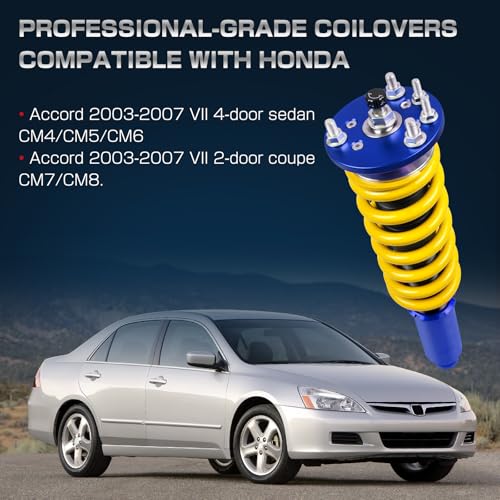
Do these coilovers fit a 2003–2007 Honda Accord sedan?
They are listed for seventh-generation Accord sedans using CM4, CM5 or CM6 chassis codes.
Do they fit the Accord coupe?
Yes. The listing includes CM7 and CM8 two-door coupe applications.
Are these coilovers compatible with both four-cylinder and V6 models?
The listing identifies multiple CM chassis codes, but engine-specific compatibility should be verified before ordering.
How many damping settings are provided?
The dampers offer 24 external adjustment positions.
Is rebound or compression adjusted?
The supplied specifications do not identify the exact circuit. Describe the feature as 24-position damping adjustment unless the product manual provides more detail.
Is spring preload adjustable?
Yes. The threaded spring-seat design allows preload adjustment.
What are the spring rates?
Exact front and rear spring rates were not provided. Confirm them with the seller before purchase.
How much do the coilovers lower the car?
The exact lowering range was not supplied. Verify the maximum and minimum safe heights through the current product documentation.
What does SAE 9254 mean?
SAE 9254 is a chrome-silicon spring-steel alloy selected for its strength, elasticity and fatigue resistance.
Were the springs really tested for two million cycles?
The manufacturer claims a two-million-cycle fatigue test. Treat this as a manufacturer-supplied specification rather than independent certification.
Is the kit suitable for daily driving?
It may be configured for street use by selecting a moderate height and softer damping position. Ride quality depends on spring rates, damping and tire construction.
Can it be used at the track?
The 24-position adjustment allows performance tuning, but the kit’s suitability for serious competition depends on its complete technical specifications and condition.
Is an alignment required?
Yes. A complete four-wheel alignment is required after installation.
Final Thoughts
This blue 24-level coilover kit for the 2003–2007 Honda Accord offers more setup control than a fixed lowering-spring package.
Its core features include chassis-specific mounting, adjustable damping, spring-preload adjustment and SAE 9254 chrome-silicon springs. It fits both sedan and coupe chassis within the listed CM4–CM8 range.
The missing specifications matter. Confirm the spring rates, lowering range, damper construction and exact 75 mm measurement before publishing those details or comparing the kit with other Accord coilovers.
Once fitment is verified, use conservative initial settings, preserve suspension travel and finish the installation with a professional four-wheel alignment. Adjustable suspension works best when someone actually adjusts it correctly. Wild concept, apparently.
For more suspension information, visit:
- Lowering Springs vs. Coilovers
- 7 Best Coilovers for Daily Driving
- Car Suspension Upgrades That Transform Your Ride
- How to Upgrade Sway Bars
- Wheel Alignment 101





There are no reviews yet.