
What Makes This Exhaust Cutout Different?
The primary advantage is:
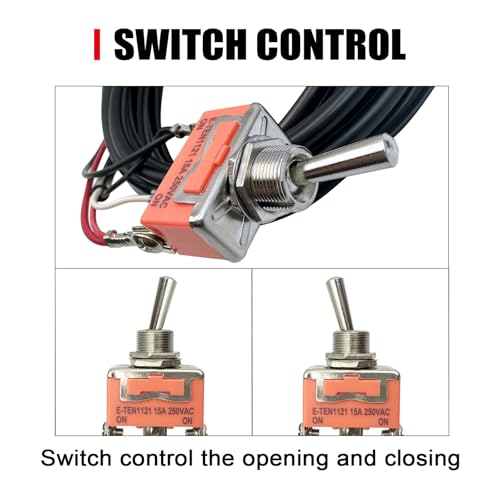
hardwired manual control.
Many electronic exhaust cutouts use wireless key-fob remotes.
This system instead uses a physical dashboard switch connected directly to the valve control circuit.
That means there are:
- No remote batteries
- No remote pairing
- No wireless signal
- No lost key fob
Press the appropriate side of the switch and the motor operates the valve.
Simple systems have their advantages.
Open or Close the Exhaust From the Driver’s Seat
The switch gives the driver direct control over the cutout.
Valve Closed
Exhaust continues through the conventional exhaust system.
Depending on the vehicle, that can include:
Resonator → Muffler → Tailpipe
This is the quieter operating mode.
Valve Open
The cutout creates a shorter alternate exhaust route.
Depending on where it is installed, the open cutout can bypass:
- Resonators
- Mufflers
- Long sections of tailpipe
The result can be a dramatically louder exhaust note.
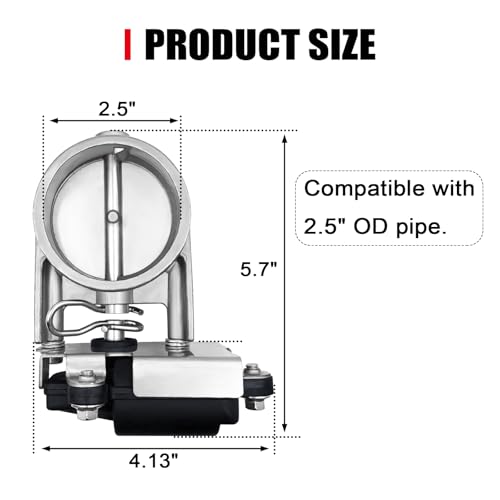
2.5-Inch Exhaust Compatibility
The kit is designed for compatible:
2.5-inch exhaust systems
which corresponds to approximately:
63.5mm
This tubing diameter is common on many aftermarket performance exhaust systems.
Potential applications include:
- Muscle cars
- Performance imports
- Trucks
- Restomods
- Naturally aspirated V8s
- Turbocharged cars
- Street/strip projects
- Custom exhaust systems
Universal does not mean direct-fit.
Measure the existing exhaust before ordering.
Measure the Exhaust Correctly
Before buying any universal exhaust component, determine the actual tubing dimensions.
Check whether the connection is specified by:
- Outside diameter
- Inside diameter
- Slip-fit diameter
Do not rely entirely on what the existing exhaust supposedly is.
Cars get modified.
Previous owners make decisions.
Some of those decisions remain mysteries for decades.
Our How to Install Exhaust Cutout the Right Way guide explains how to measure, position and install a universal cutout correctly.
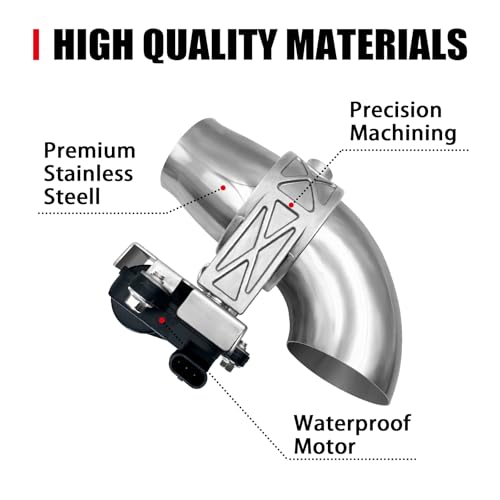
304 Stainless-Steel Valve Body
The cutout is advertised as using:
304 stainless steel
for the valve body.
That’s a sensible material for exhaust components because the valve is exposed to:
- Exhaust heat
- Condensation
- Road water
- Salt
- Dirt
- Repeated thermal cycling
304 stainless steel offers good corrosion resistance and is widely used in automotive exhaust fabrication.
Water-Resistant Electric Motor
The valve is operated by an electric motor designed to withstand underbody conditions.
That’s important because an exhaust-cutout motor doesn’t live in a particularly friendly neighborhood.
It can encounter:
- Water
- Road spray
- Dust
- Dirt
- Heat
- Vibration
The seller describes the motor as water-resistant/waterproof.
For a technically conservative product description, I’d use:
water-resistant electric motor
unless a documented IP waterproof rating is provided.
Water-resistant does not mean the motor should be intentionally submerged or pressure-washed from three inches away.
Hardwired Dashboard Switch
The included wired switch is one of the strongest selling points of this particular kit.
A hardwired control can provide:
- Direct operation
- No wireless interference
- No remote pairing
- No remote battery replacement
- Permanent in-cabin control
Mount the switch where the driver can reach it without interfering with normal vehicle operation.
The switch wiring should also be secured behind the dashboard rather than hanging near:
- Pedals
- Steering column
- HVAC controls
- Moving linkage
Manual Switch vs. Wireless Exhaust Cutout
Neither design is automatically better.
They solve the same problem differently.
Hardwired Switch
Advantages include:
- Direct connection
- No remote battery
- No wireless pairing
- Harder to lose
- Permanent control location
Wireless Remote
Advantages can include:
- Less dashboard modification
- Flexible control location
- Convenient installation on some vehicles
For a permanent performance build, many owners prefer the simplicity of a physical switch.
Complete Installation Components
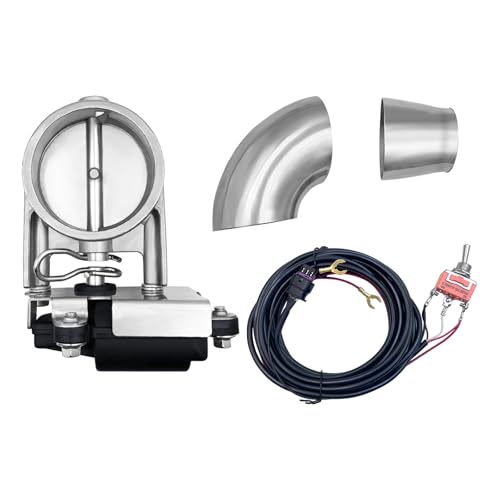
The supplied listing indicates that the kit includes:
- Electric exhaust valve
- Wiring
- Manual switch
- Reducer
- Elbow
That makes this more complete than a cutout-only replacement valve.
However, universal installation can still require additional:
- Exhaust tubing
- Wire
- Connectors
- Heat shielding
- Hangers
- Welding supplies
- Fabrication hardware
“Complete kit” does not mean every possible vehicle installs exactly the same way.
Why the Elbow Is Useful
The included elbow helps control where the open cutout discharges exhaust.
That’s important.
Hot exhaust should not be directed toward:
- Fuel lines
- Brake lines
- Wiring
- Fuel tank
- Transmission
- Rubber bushings
- Plastic panels
- Floor insulation
The elbow gives the fabricator more flexibility when positioning the exhaust outlet.
Don’t Point the Outlet at Sensitive Components
The shortest possible exhaust route isn’t always the safest route.
Before welding the elbow into its final position, check:
- Ground clearance
- Floor clearance
- Fuel-line location
- Brake-line location
- Wiring
- Driveshaft
- Suspension movement
Hot exhaust needs somewhere safe to go.
Pointing it directly at the floor or a fuel line is not performance tuning.
Professional Welding Recommended
This is a universal:
weld-in exhaust component.
Professional welding is recommended to create a strong, leak-resistant installation.
A typical installation involves:
- Measuring the existing exhaust.
- Selecting the cutout location.
- Cutting the exhaust tubing.
- Positioning the cutout assembly.
- Orienting the elbow.
- Tack welding the components.
- Checking clearance.
- Completing the welds.
- Routing the wiring.
- Installing the dashboard switch.
- Testing valve operation.
Our How to Install Exhaust Cutout the Right Way guide goes deeper into the process.
Tack It Before You Weld It
Do not fully weld the system before checking the entire assembly.
A better process is:
Measure → Cut → Fit → Tack → Check → Weld
Check:
- Ground clearance
- Motor clearance
- Elbow orientation
- Driveshaft clearance
- Suspension travel
- Wiring clearance
before finishing the weld.
It’s easier to move a tack-welded cutout than explain why the finished valve now occupies the same physical space as the transmission crossmember.
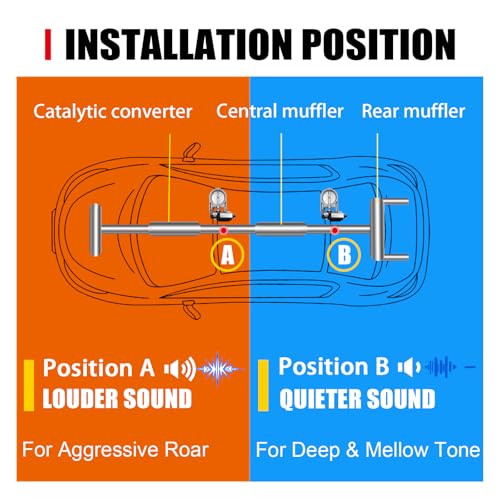
Where Should the Cutout Be Installed?
Cutout location affects:
- Sound
- Heat exposure
- Ground clearance
- Exhaust flow
- Motor durability
Potential installation locations depend on:
- Headers
- Downpipe
- Catalytic converters
- Mid-pipe
- Resonators
- Mufflers
Avoid mounting the electric motor unnecessarily close to extreme heat sources.
Protect the Electric Motor From Heat
The exhaust valve itself is designed to handle exhaust temperatures.
The electric actuator is more sensitive.
Whenever possible, provide distance from:
- Headers
- Turbocharger outlets
- Catalytic converters
Also keep the wiring away from hot exhaust tubing.
Heat-resistant loom or shielding may be appropriate where wiring passes near exhaust components.
Wire the Switch Correctly
The dashboard switch should be installed using proper automotive wiring practices.
That includes:
- Secure electrical connections
- Correct wire gauge
- Circuit protection
- Proper grounding
- Heat protection
- Abrasion protection
Route wiring away from:
- Exhaust
- Driveshaft
- Steering components
- Suspension
- Sharp sheet metal
A motorized exhaust valve is not particularly demanding electrically, but a poorly protected wire can still short to ground.
Fuse the Circuit
The valve-control circuit should have appropriately sized overcurrent protection.
A fuse protects the wiring if:
- Insulation melts
- A wire becomes pinched
- The motor circuit shorts
- A connector fails
Use the fuse size specified for the actual motor/controller system.
Do not simply install a larger fuse if the correct one repeatedly blows.
That’s the electrical equivalent of fixing the check-engine light with black tape.
Will an Exhaust Cutout Add Horsepower?
Possibly.
Opening the cutout can create a shorter, less restrictive exhaust path.
Whether that increases power depends on the existing system.
Important factors include:
- Engine airflow
- Headers
- Catalytic converters
- Exhaust diameter
- Muffler restriction
- Turbocharger
- Engine tuning
If the normal exhaust is already efficient, the horsepower difference may be small.
The sound difference probably won’t be.
Don’t Promise More Torque
A cutout does not automatically increase torque.
Exhaust performance depends on:
- Gas velocity
- Pressure
- Scavenging
- Pulse timing
- Tube diameter
- Tube length
The technically defensible benefit is:
opening the cutout may reduce downstream exhaust restriction where the existing system is restrictive.
That’s considerably more accurate than claiming every vehicle will suddenly discover hidden horsepower.
Turbocharged Applications
Turbocharged engines can be particularly sensitive to exhaust restriction downstream of the turbine.
A properly positioned cutout may reduce downstream restriction when open.
The benefit depends on:
- Turbo size
- Downpipe
- Catalytic converter
- Mufflers
- Exhaust diameter
- Boost level
- Calibration
For higher-output turbo builds, exhaust diameter should be sized around the actual airflow requirement rather than simply matching whatever pipe was already under the car.
Naturally Aspirated V8 Applications
Electric cutouts are especially popular on:
- Muscle cars
- Cammed V8s
- Street/strip cars
- Restomods
- Performance trucks
With the valve closed, the engine retains the conventional muffled exhaust.
Open it and the character of the vehicle can change immediately.
A cammed V8 through open cutouts generally has the acoustic subtlety of a building demolition.
Which, for the correct project, is precisely the appeal.
X-Pipe and H-Pipe Exhaust Systems
A cutout can be incorporated into either:
- X-pipe systems
- H-pipe systems
- Independent dual exhaust
Placement affects both sound and flow.
Our X Pipe vs H Pipe: Which Sounds Better? guide explains the differences between these common dual-exhaust layouts.
Cat-Back Exhaust Systems
An electronic cutout can also complement a complete performance cat-back system.
The cat-back can provide a controlled exhaust tone during normal driving while the cutout provides an alternate exhaust path when desired.
Our Catback Exhaust vs Axleback: Which Wins? guide explains how these exhaust upgrades differ.
Check for Exhaust Leaks
Once installation is complete, test the system with the valve:
OPEN
and:
CLOSED
Check around:
- Welds
- Reducer
- Valve
- Elbow
- Existing exhaust connections
Signs of a leak can include:
- Ticking
- Soot
- Exhaust odor
- Unexpected noise
The valve should also close consistently without binding.
Keep the Valve Mechanism Clean
Because the valve is exposed to exhaust deposits and road contamination, periodically inspect it for:
- Carbon buildup
- Road debris
- Loose hardware
- Wiring damage
- Corrosion
- Abnormal motor noise
If valve movement becomes slow or inconsistent, diagnose the problem before repeatedly operating the motor against a stuck mechanism.
Ground Clearance Matters
The valve, electric motor and elbow take up more space than a simple piece of exhaust tubing.
This is particularly important on:
- Lowered cars
- Sports cars
- Long-wheelbase vehicles
- Cars with low-mounted exhaust systems
The cutout assembly should not become the lowest point underneath the vehicle.
A motorized exhaust valve is expensive enough without also using it as a sacrificial skid plate.
Street-Legal Considerations
Electronic exhaust cutouts may be restricted for street use depending on local law.
Potential legal issues include:
- Exhaust-noise limits
- Muffler requirements
- Exhaust-bypass restrictions
- Emissions regulations
For California readers, our Is My Exhaust Legal? guide provides additional background.
Always verify current state and local requirements before operating an open exhaust cutout on public roads.
Don’t Bypass Emissions Equipment
Do not install or operate the valve in a manner that unlawfully bypasses required:
- Catalytic converters
- Oxygen sensors
- Emissions equipment
For a street-driven vehicle, placement should preserve required emissions-system operation.
A cutout is an exhaust-flow and sound-control device.
It isn’t an emissions delete kit.
Who Should Buy This 2.5-Inch Valved Exhaust Cutout?
This kit makes the most sense for a vehicle with a compatible:
2.5-inch exhaust
where the owner wants a permanently installed, manually switched electronic cutout.
Good candidates include:
- Muscle cars
- Trucks
- Restomods
- Turbo builds
- Street/strip cars
- Performance imports
- Custom exhaust projects
It’s particularly appealing to builders who prefer a physical dashboard switch over a wireless remote.
Why Buy This 2.5-Inch Manual-Switch Exhaust Cutout?
Key features include:
- 2.5-inch exhaust compatibility
- 304 stainless-steel valve body
- Motorized valve
- Hardwired dashboard switch
- Open/closed control
- No wireless remote batteries
- Water-resistant electric motor
- Reducer included
- Elbow included
- Wiring included
- Universal custom fitment
- Professional weld-in installation
For a custom 2.5-inch exhaust build, this kit combines the simplicity of direct wired control with the versatility of an electronic exhaust bypass.
Specifications at a Glance
Product: Motorized Valved Exhaust Cutout Kit
Exhaust Diameter: 2.5 inches
Approximate Metric Diameter: 63.5mm
Valve Material: 304 Stainless Steel
Operation: Electric Motor
Control: Hardwired Manual Dashboard Switch
Positions: Open / Closed
Motor: Water-resistant
Fitment: Universal / custom
Installation: Weld-in
Included: Valve, wiring, switch, reducer and elbow
Professional Installation: Recommended
Primary Application: Driver-controlled exhaust bypass
Always verify pipe diameter, cutout dimensions, available installation space, electrical requirements and package contents before ordering.







There are no reviews yet.