
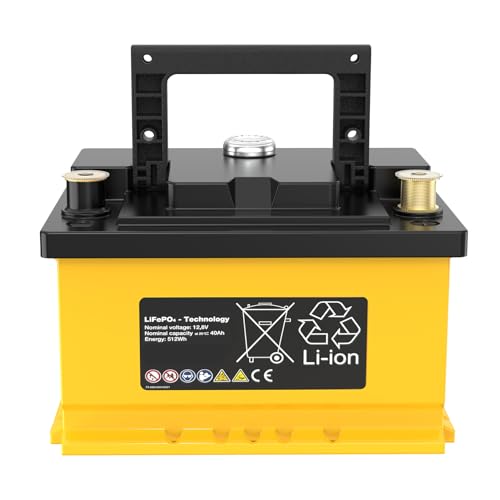

Only 14.8 Pounds
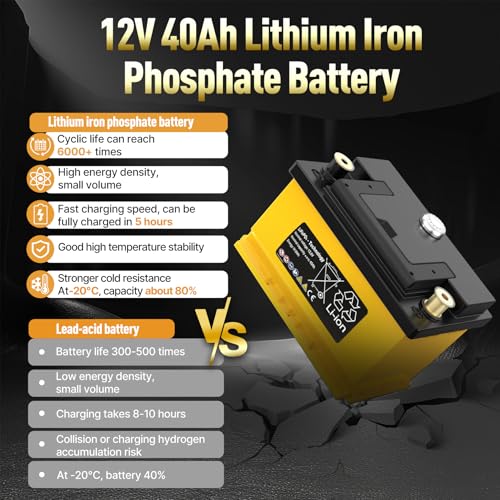
The most obvious performance advantage is weight.
This battery weighs approximately:
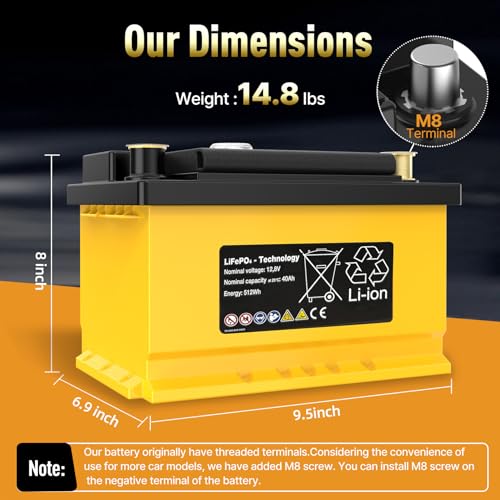
14.8 pounds
A typical H5/H6-size AGM automotive battery can weigh somewhere around 40 to 50 pounds depending on model.
That means a compatible lithium replacement can potentially remove 25 pounds or more from the vehicle.
For performance enthusiasts, that’s meaningful.
Weight reduction benefits:
- Acceleration
- Braking
- Handling
- Front-end weight
- Overall vehicle balance
And unlike replacing interior trim with carbon fiber stickers, this is actual weight reduction.
660 Cold Cranking Amps
Despite weighing less than 15 pounds, the battery is rated at:
660 CCA
Cold Cranking Amps describe the battery’s ability to supply starting current under standardized cold conditions.
That provides enough advertised starting output for many smaller gasoline engines when the battery is properly matched to the vehicle.
The manufacturer recommends applications with engines under:
2.0 liters
That limitation should remain clearly visible on the product page.
Do not simply advertise the battery for every vehicle that happens to have a battery tray large enough to hold it.
Designed as a LiFePO4 Starting Battery
This product is fundamentally different from a standard lithium house battery.
Some LiFePO4 batteries are intended only for:
- RV power
- Solar storage
- Marine house loads
- Inverters
and specifically prohibit starter-motor use.
This ECIENWELL battery, by contrast, is marketed specifically for automotive engine starting and carries a 660CCA rating.
That makes it suitable for consideration as a starter battery—but only in vehicles whose charging systems are compatible with LiFePO4 chemistry.
40Ah Capacity
The battery provides:
40 amp-hours
This is lower nominal capacity than many conventional H6/H7 AGM batteries, but LiFePO4 chemistry behaves differently from lead-acid chemistry.
Lithium batteries typically maintain a flatter voltage curve through much of their usable charge.
That means accessories can continue receiving relatively stable voltage until the battery approaches its lower operating limit.
Once the BMS cutoff point is reached, however, output may shut down very quickly.
That behavior is different from the gradual weakening drivers often experience with a traditional lead-acid battery.
100RC Rating
The seller advertises a:
100RC reserve-capacity rating
Reserve capacity represents how long the battery can support a standardized electrical load before reaching a specified cutoff point.
This can provide useful electrical reserve for:
- Factory electronics
- Lighting
- Audio equipment
- Control modules
- Start-stop operation
However, reserve capacity should not be interpreted as permission to repeatedly run the battery completely flat.
The integrated BMS protects the cells, but frequent extreme discharge is still unnecessary stress.
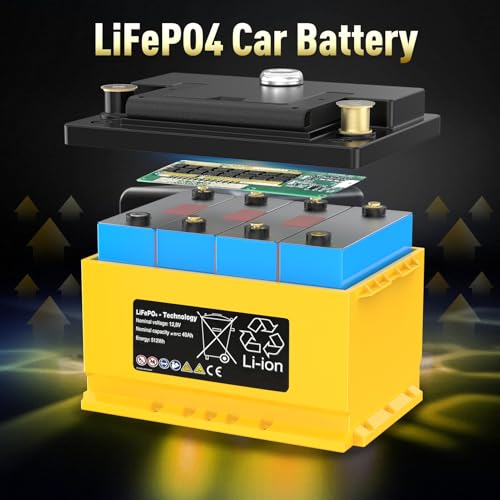
Integrated Battery Management System
The battery includes an internal:
Battery Management System
The seller lists protection against:
- Overcharge
- Over-discharge
- Overload
- Over-voltage
- Over-current
- Over-temperature
- Short circuit
The BMS is one of the most important components in a lithium automotive battery.
It monitors cell conditions and can disconnect the battery if operating limits are exceeded.
That’s particularly important because LiFePO4 cells have different voltage requirements from conventional lead-acid batteries.
Emergency Battery Restart Button
One unusual feature is the battery’s manual emergency restart function.
If the BMS shuts down because the battery reaches its protection threshold, the seller says a white activation button can be pressed to reactivate the battery.
This can potentially provide enough temporary access to stored energy to start the vehicle.
Think of it as an emergency BMS wake-up function.
It should not be treated as a substitute for diagnosing why the battery became discharged in the first place.
If you repeatedly need the emergency button, something is wrong.
Potential causes include:
- Parasitic drain
- Weak alternator
- Charging incompatibility
- Excessive accessory use
- Wiring fault
Battery Heating for Cold Weather
Cold temperatures are one of the challenging areas for lithium batteries.
The seller states this battery includes a low-temperature heating process controlled by the BMS.
Advertised operating ranges are:
Charging: 32°F to 113°F
0°C to 45°C
Discharging: -40°F to 140°F
-20°C to 60°C
Storage: 32°F to 113°F
0°C to 45°C
The heating system is intended to improve low-temperature discharge performance.
That’s particularly relevant for an automotive starter battery, because the battery encounters its most demanding load at exactly the time cold temperatures reduce battery performance.
Do Not Charge Below the Approved Temperature
The advertised minimum charging temperature is:
32°F / 0°C
That limitation matters.
Charging LiFePO4 cells below their approved temperature range can damage them.
The onboard heating system may assist during cold operation, but buyers should still follow the manufacturer’s charging instructions precisely.
Don’t assume that an internal heater means the battery can be charged under any temperature condition.
IP66 Protection
The battery carries an advertised:
IP66 ingress-protection rating
An IP66 enclosure is designed to provide strong protection against dust and powerful water jets.
That can be useful in:
- Engine compartments
- Off-road vehicles
- Utility vehicles
- Harsh environments
However, IP66 does not mean the battery should be submerged.
Battery location and drainage still matter.
Threaded Terminals With M8 Hardware
Terminal configuration deserves special attention on this battery.
The product originally uses threaded terminals, and M8 hardware is supplied to increase compatibility with automotive installations.
The manufacturer specifically notes that the negative-side M8 screw is:
30 mm / 1.18 inches tall
and can increase total installed battery height to approximately:
9.18 inches
That is a critical fitment measurement.
Check Hood Clearance
Before purchasing, measure the available height between:
- Battery tray
- Battery terminal
- Battery hold-down
- Hood
The positive terminal must have adequate clearance from metal bodywork.
A battery that technically fits the tray but allows a terminal to contact the hood is not a fitment.
It’s an extremely efficient short-circuit generator.
H5, H6 and H7 Are Not the Same Size
The supplied title mentions:
H5, H6 and H7
but those battery sizes are not interchangeable dimensions.
This battery measures:
9.5 × 6.9 × 8.0 inches
Compare those actual dimensions with the battery currently installed in the vehicle.
Do not order based only on an H5/H6/H7 search keyword.
The battery tray and hold-down must physically match the actual case.
Check Terminal Orientation
Battery cable orientation is equally important.
Before installation, compare:
- Positive terminal location
- Negative terminal location
- Cable length
- Cable routing
Never stretch battery cables across the battery to make an incorrect terminal configuration work.
Designed for Vehicles Under 2.0L
The manufacturer specifically recommends this battery for:
engines below 2.0 liters
That makes it more appropriate for vehicles such as compatible:
- Compact cars
- Sport compacts
- Small crossovers
- Four-cylinder performance cars
- Smaller turbocharged vehicles
But displacement alone does not determine battery requirements.
A turbocharged 2.0L engine with high compression, extensive electronics and an aggressive start-stop system may have very different requirements from an older naturally aspirated economy car.
Always verify factory battery specifications.
Start-Stop Capability
The battery is marketed for vehicles equipped with:
automatic start-stop systems
Start-stop applications place much greater cycling demand on a battery because the starter may operate dozens of times during a single trip.
LiFePO4 chemistry can potentially handle repeated cycling well.
However, the vehicle’s charging strategy must support the lithium battery.
That distinction matters.
Not Every AGM Vehicle Can Automatically Use Lithium
A vehicle originally equipped with:
- AGM
- EFB
- Intelligent alternator
- Battery sensor
- Battery-management system
may not automatically support LiFePO4 chemistry.
Modern vehicles regulate charging voltage based on battery condition, load and driving conditions.
That strategy may have been calibrated specifically around lead-acid chemistry.
Installing lithium without checking compatibility can cause:
- Charging problems
- Battery-management faults
- Start-stop issues
- Alternator-control problems
- Electrical warnings
- Reduced battery life
Our What Is Battery Registration, and Does Your Car Need It? guide explains how modern vehicles monitor and adapt to replacement batteries.
Battery Registration Does Not Guarantee Lithium Compatibility
This deserves its own warning.
Battery registration simply tells a compatible vehicle that a new battery has been installed.
Battery coding may allow certain vehicles to specify:
- AGM
- Flooded
- Battery capacity
But that does not automatically mean the vehicle supports LiFePO4 chemistry.
Before changing battery chemistry, verify the charging system is designed or approved to support lithium.
Real-World Lithium Conversion Problems Can Happen
Replacing a conventional battery with lithium can sometimes produce unexpected interactions with modern charging systems.
The vehicle may interpret lithium’s higher resting voltage differently from a lead-acid battery.
An intelligent alternator can then adjust output in a way the lithium battery—or the vehicle’s electrical modules—doesn’t expect.
That’s why charging compatibility is just as important as physical fitment.
Great Potential for Performance Cars
Where the battery is properly compatible, the weight savings are difficult to ignore.
A 14.8-pound starting battery is highly attractive for:
- Track cars
- Autocross cars
- Performance street cars
- Lightweight builds
Removing 25 to 35 pounds from the front of the car is a real performance modification.
It may not add horsepower, but the engine has less mass to move.
Useful for Car Audio—With Limits
The battery’s lithium chemistry and BMS can also provide stable electrical output.
That can appeal to vehicles with:
- Amplifiers
- DSP processors
- Upgraded speakers
- Auxiliary electronics
Our Car Audio System Guide explains how batteries, alternators, grounds and cable sizing work together.
However, a 40Ah battery is not automatically the ideal solution for an enormous audio system.
High-current systems still require sufficient:
- Alternator output
- Battery capacity
- Power wiring
- Grounding
A Battery Cannot Fix a Weak Alternator
If system voltage falls while the engine is running, investigate the charging system.
Potential causes include:
- Weak alternator
- Voltage regulator failure
- Poor ground
- Damaged charging cable
- Blown fuse
- Fusible link failure
- Charging-strategy incompatibility
Our Why Is My Battery Light On? guide explains how to diagnose these faults.
A lithium battery may temporarily hide a weak charging system because of its strong voltage characteristics.
It doesn’t repair the alternator.
Check Fusible Links and Main Charging Fuses
Modern and older vehicles both use high-current protection between the alternator and battery.
Depending on the application, this could be:
- Fusible link
- Mega fuse
- Strip fuse
- Battery terminal fuse
Our What Is a Fusible Link? Fusible Link vs. Fuse Explained guide explains how these circuits protect the vehicle.
Always correct the actual electrical fault before condemning the battery.
Car Has Power but Won’t Crank?
Interior electronics require dramatically less current than a starter motor.
A battery can still power:
- Dashboard
- Radio
- Lights
- Door locks
while failing under starter load.
If the vehicle has power but won’t start, use our Car Has Power but Won’t Start diagnostic guide before replacing parts.
Rapid Clicking When Starting
If the starter clicks repeatedly, possible causes include:
- Low battery charge
- Poor cable connection
- Weak ground
- Starter fault
- Charging issue
- BMS cutoff
Our Rapid Clicking When Starting a Car guide explains how to diagnose the starting circuit.
Fully Charge Before First Use
The manufacturer recommends fully charging the battery before first installation.
That’s a sensible step for any replacement battery, but the charger must be appropriate for:
LiFePO4 chemistry
Do not automatically use an old lead-acid charger with:
- Desulfation
- Reconditioning
- Equalization
unless the battery manufacturer specifically allows those modes.
No Lead or Chromium
The manufacturer advertises the LiFePO4 design as free of:
- Lead
- Chromium
That is a genuine chemistry distinction from conventional lead-acid batteries.
However, environmental claims should be kept reasonable.
Lithium batteries still require:
- Mining
- Manufacturing
- Transportation
- Proper end-of-life recycling
The primary practical advantage for the customer is the elimination of lead-based battery chemistry combined with significantly lower weight.
Is This Lithium Battery Right for Your Car?
This battery makes the most sense when all of the following are true:
- Vehicle engine is within the manufacturer’s recommended range
- 660CCA meets starting requirements
- 40Ah capacity is suitable
- 9.5 × 6.9 × 8-inch case fits
- Installed height up to 9.18 inches clears the hood
- Terminals align correctly
- Vehicle charging system supports LiFePO4
- Battery-management system can operate properly with lithium
Miss any one of those and the battery may not be the right choice.
Why Buy This ECIENWELL LiFePO4 Car Battery?
For the correct vehicle, the feature list is compelling:
- 660 Cold Cranking Amps
- 40Ah capacity
- 100RC
- Only 14.8 pounds
- Integrated BMS
- Automatic protection functions
- Emergency BMS restart
- Low-temperature heating
- IP66 protection
- LiFePO4 chemistry
- Maintenance-free operation
- Deep-cycle capability
- Start-stop capability
- Major weight savings versus conventional batteries
The ECIENWELL 12V 40Ah LiFePO4 Automotive Battery can be an interesting performance upgrade for compatible smaller-engine vehicles where reducing battery weight matters.
Just don’t treat “H5/H6/H7” as universal fitment.
With lithium, physical fitment is only half the job. Charging-system compatibility is the other half.
Specifications at a Glance
Brand: ECIENWELL
Battery Chemistry: LiFePO4
Application: Automotive starting
Voltage: 12V / 12.8V class
Capacity: 40Ah
Cold Cranking Amps: 660 CCA
Reserve Capacity: 100RC
Weight: 14.8 lb
Dimensions: 9.5 × 6.9 × 8 inches
Maximum Installed Height With Adapter: Approximately 9.18 inches
Terminal: Threaded with supplied M8 hardware
Protection Rating: IP66
BMS: Integrated
Cold-Weather Heating: Yes, per manufacturer
Emergency Restart: Manual BMS activation button
Advertised Charge Range: 32°F–113°F / 0°C–45°C
Advertised Discharge Range: -40°F–140°F / -20°C–60°C
Recommended Engine Size: Below 2.0L per seller








There are no reviews yet.