
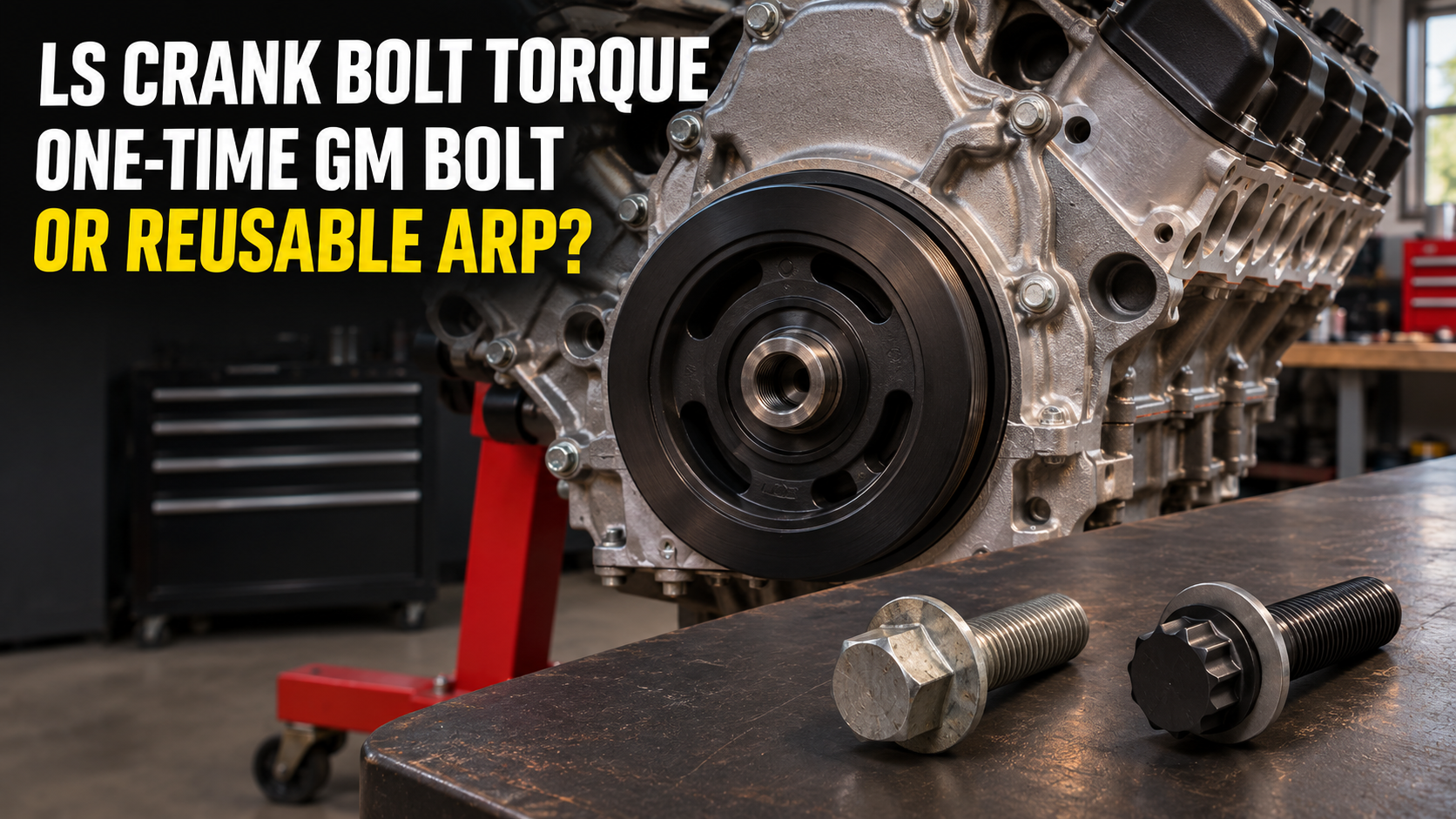
The bolt that holds the harmonic balancer on a Gen III or Gen IV LS engine is easy to treat as an afterthought, until you have to buy one. The factory GM bolt (12557840) is meant to be used once, while an ARP bolt is tightened a completely different way. LS crank bolt torque depends on which bolt you’re holding, how the balancer was seated and which lubricant the instructions call for. Here’s how the bolts in our store compare and where the published procedures disagree.
LS crank bolt torque depends on which bolt you use
The factory bolt is torque-to-yield: it’s tightened to a low torque, then turned a set number of degrees so it stretches. ARP’s bolt is tightened to a single torque value with ARP’s own lubricant. The two methods aren’t interchangeable.
| Bolt | Reuse | Published tightening method | Where the method comes from |
|---|---|---|---|
| GM 12557840 (factory) | One-time use | 37 ft-lb, then a further 140 degrees | ATI’s LS Super Damper instructions |
| ARP 234-2503 | Our listing says ARP fasteners can often be reused if inspected; follow ARP’s guidance | 235 ft-lb using ARP Ultra-Torque lubricant | ARP’s 234-2503 instruction sheet |
| Isayokgo LS balancer bolt 2-pack | Not stated | Not stated (“follow manufacturer torque specifications”) | Store listing |
| Michigan Motorsports balancer bolt (F4300) | Not stated | Not stated | Store listing |
Both lower-priced listings describe their bolts as replacements for GM 12557840, but neither says whether the bolt is itself one-time use or what torque or angle to apply. Get that answer from the seller before you install one. Don’t assume the GM angle procedure or ARP’s torque value carries over to a different bolt.
Seat the balancer before the final bolt goes in
The LS balancer is a press fit on the crank snout. ATI’s instructions call for pressing the damper on with an installer tool, then using the old bolt, torqued to 240 ft-lb, to finish seating it. That bolt is then removed and discarded, and the new bolt goes in for the final tightening.
That 240 ft-lb figure is a seating step, not the final torque for a new factory bolt. Running a new torque-to-yield bolt straight to 240 ft-lb skips the procedure entirely.
Lubricant or thread locker? The instructions don’t agree
This is where published procedures part ways, and it matters because the friction under the bolt head and on the threads changes how much clamping force a given torque produces.
- ARP: lubricate the bolt threads, the underside of the head and the balancer face where the washer sits with ARP Ultra-Torque, then tighten to 235 ft-lb. ARP also says to clean the crank threads first, chasing them with a thread chaser or tap if needed.
- ATI (for its own dampers): with an ARP or other aftermarket bolt, ATI calls for high-temperature RTV on both sides of the washer, 262 red Loctite on the threads and 230 ft-lb. For a new GM bolt, ATI recommends blue or red Loctite for high-performance driving.
If your damper and bolt come from different companies and their instructions conflict, call both before you tighten anything. Don’t mix one company’s torque figure with the other’s lubricant.
LS7 and dry-sump engines take a different bolt
Retailer catalog listings for ARP 234-2503 describe it as an M16 x 2.0 bolt for Gen III/IV LS engines except the LS7, and list ARP 234-2504, a longer bolt, for the LS7. The Isayokgo listing also excludes the LS7, and the Michigan Motorsports listing says it’s for wet-sump LS engines. If your engine is an LS7, or a dry-sump LS or LT version, none of the bolts above are listed for it.
Check the listing details against your engine
- Check the engine list, not just the title. The Isayokgo listing names the LS2 in its title, but the LS2 is missing from its own compatibility list. The Michigan Motorsports listing mentions the LS2 in its introduction but not in its fitment section.
- A part number in a title isn’t a brand. The Isayokgo title includes “234-2503,” ARP’s part number, but the listing’s brand is Isayokgo. ARP’s instructions apply to ARP’s bolt.
- Count what’s in the box. The Isayokgo kit contains two bolts with washers. The Michigan Motorsports listing doesn’t state the quantity or whether a washer is included.
When the bolt goes in during a rebuild
The balancer usually goes on near the end of an LS build, after the rotating assembly is in. Before you get there, it’s worth confirming the crank itself. Our sister site covers LS1 crankshaft end play and the correct thrust clearance and how to check whether an LS crank is bent.
Whichever bolt you choose, you’ll need a way to hold the crank still, a torque wrench that reaches the specified value and, for the factory bolt, a torque-angle gauge. If you’re not set up for that, have a shop do the final tightening.