
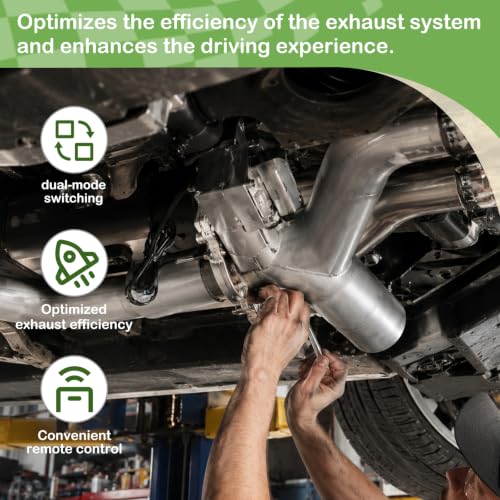
What Does an Electric Exhaust Cutout Do?
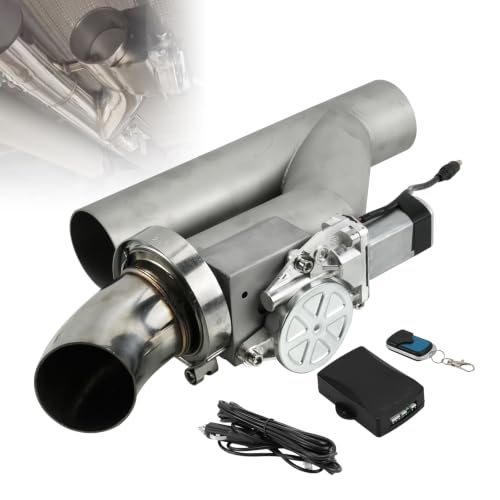
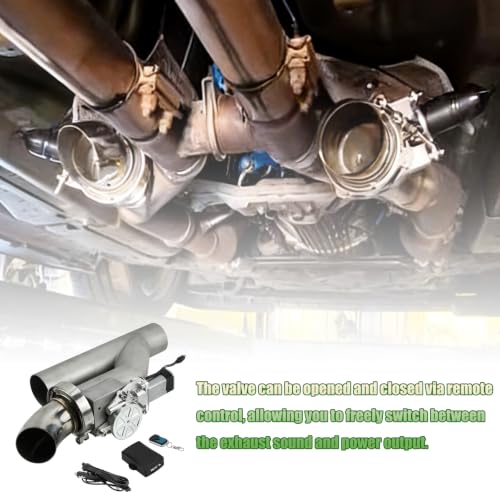
An electric exhaust cutout creates an alternate path through the exhaust system.
When the cutout is:
CLOSED
exhaust continues through the vehicle’s conventional exhaust system, including the downstream resonators, mufflers and tailpipes.
When the cutout is:
OPEN
exhaust can exit through the shorter cutout path.
Depending on where the valve is installed, opening it may bypass some of the exhaust system’s sound-control components.
The most obvious result is usually:
a much louder exhaust.
If the existing exhaust is restrictive, the shorter path may also reduce downstream exhaust restriction.
Why Use an Electronic Cutout?
Traditional manual cutouts require the driver to physically remove or install a block-off plate.
An electric cutout uses a motorized valve instead.
That gives the driver much easier control over the exhaust path when the system is wired correctly.
The basic idea is:
Valve Closed → Normal Exhaust
Valve Open → Shorter Exhaust Path
For a street/strip car, that means you can retain a conventional muffled exhaust while still having access to a much more aggressive exhaust configuration where appropriate.
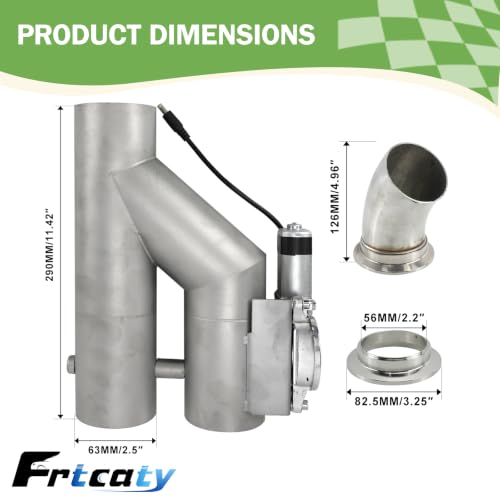
2.5-Inch Exhaust Diameter
This cutout is designed around:
2.5-inch exhaust tubing
which is approximately:
63.5mm
That is one of the most common sizes used in aftermarket performance exhaust systems.
Applications can include:
- Muscle cars
- Performance imports
- Trucks
- Restomods
- Naturally aspirated V8 builds
- Turbocharged projects
- Street/strip cars
- Custom exhaust systems
But universal does not mean every vehicle.
Measure first.
Measure Outside Diameter Before Ordering
One of the easiest exhaust-parts mistakes is assuming the pipe size.
Measure the existing exhaust tubing and determine whether the connection is designed around:
- Outside diameter
- Inside diameter
- Slip-fit sizing
A nominal 2.5-inch exhaust component needs to interface correctly with the rest of the system.
Our How to Install Exhaust Cutout the Right Way guide covers measurement, positioning, welding and wiring considerations in more detail.
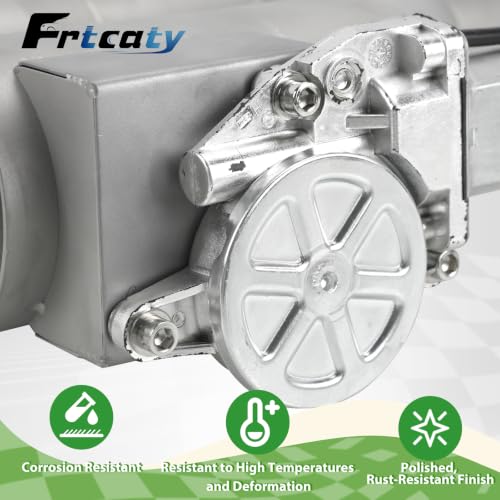
Premium 304 Stainless Steel
The kit is advertised as being manufactured from:
304 stainless steel
304 stainless is widely used in performance exhaust fabrication because of its combination of:
- Corrosion resistance
- Heat resistance
- Strength
- Fabrication characteristics
An exhaust component lives in a particularly harsh environment.
It regularly encounters:
- Exhaust heat
- Condensation
- Road water
- Salt
- Dirt
- Temperature cycling
Using stainless steel can improve durability compared with basic untreated mild-steel components.
Why the Elbow Outlet Matters
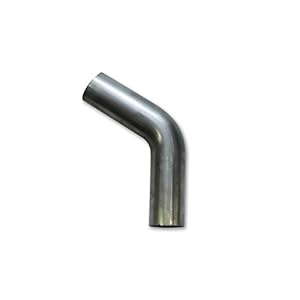
This kit includes an elbow-style exhaust outlet.
That’s more important than it might initially appear.
An open exhaust cutout releases extremely hot exhaust gases underneath the vehicle.
The outlet should not be directed toward:
- Fuel lines
- Brake lines
- Wiring
- Transmission components
- Plastic panels
- Floor insulation
- Fuel tank
- Suspension bushings
An elbow or turn-down allows the fabricator to better control where those gases are discharged.
Don’t Aim the Exhaust Straight at the Floor
An exhaust cutout outlet should have enough clearance to safely release hot exhaust gases.
Pointing the outlet directly toward the floor can create:
- Excessive noise reflection
- Heat concentration
- Clearance problems
- Potential damage to nearby components
The elbow should be oriented according to the available space underneath the vehicle.
The goal is to get hot exhaust away from the car without turning the cutout into a pavement heater.
Universal Fit Design
This cutout is intended for:
universal applications
That means it can potentially be adapted to many cars and trucks with compatible 2.5-inch exhaust systems.
It does not mean the part bolts directly onto every vehicle.
Installation depends on:
- Exhaust diameter
- Available space
- Catalytic converter location
- Muffler location
- Driveshaft clearance
- Floor clearance
- Suspension travel
- Wiring access
Some vehicles will require substantially more fabrication than others.
DIY Fabrication Ready
This product is best treated as a:
custom fabrication component
Installation may require:
- Measuring
- Cutting
- Welding
- Exhaust fitting
- Electrical wiring
- Circuit protection
- Heat shielding
No installation instructions are advertised as being included.
For that reason, professional exhaust installation is recommended if you are not experienced with exhaust fabrication.
Where Should an Exhaust Cutout Be Installed?
Placement is one of the most important parts of the installation.
Potential locations depend on the vehicle’s:
- Headers
- Downpipe
- Catalytic converters
- Mid-pipe
- Resonators
- Mufflers
- Crossmembers
- Driveshaft
You need enough space for both the valve and elbow while maintaining safe ground clearance.
Our How to Install Exhaust Cutout the Right Way guide explains the installation process in detail.
Keep the Motor Away From Extreme Heat
Electronic cutouts contain an electric actuator.
That means cutout placement needs to account for more than just exhaust flow.
Installing the actuator extremely close to:
- Header collectors
- Turbochargers
- Catalytic converters
can expose the motor and wiring to unnecessary heat.
Whenever possible, locate the valve farther downstream while still achieving the desired exhaust bypass.
Heat management matters.
The pipe enjoys being hot.
The electric motor has somewhat different hobbies.
Can an Exhaust Cutout Add Horsepower?
Potentially—but don’t expect a guaranteed horsepower number.
Opening the cutout creates a shorter exhaust path.
If the existing system is restrictive, that may reduce downstream exhaust pressure at high airflow.
Potential gains depend on:
- Engine displacement
- Engine modifications
- Headers
- Turbocharger
- Catalytic converters
- Exhaust diameter
- Muffler restriction
- Engine tuning
A heavily modified engine breathing through a restrictive street exhaust may respond more than a stock engine with an efficient factory system.
For many vehicles, the most dramatic difference will simply be:
sound.
Does an Engine Need Backpressure?
The common claim that an engine simply “needs backpressure” is misleading.
Exhaust-system performance depends on:
- Gas velocity
- Pressure
- Pulse timing
- Scavenging
- Pipe diameter
- Pipe length
Excessive restriction can reduce high-RPM performance.
But simply making the exhaust as large and unrestricted as possible is not automatically ideal for every engine either.
The objective is a properly sized exhaust system for the engine’s airflow requirements.
Turbocharged Engines and Exhaust Cutouts
Electronic cutouts can be especially interesting on turbocharged vehicles because exhaust restriction downstream of the turbine can affect performance.
Opening a properly located cutout may reduce restriction after the turbo.
The actual benefit depends on:
- Turbocharger size
- Downpipe diameter
- Catalytic converter
- Exhaust diameter
- Muffler restriction
- Boost level
- Engine calibration
A cutout should complement a properly designed turbo exhaust system, not compensate for a badly designed one.
Naturally Aspirated Performance Cars
Cutouts are also popular on:
- V8 muscle cars
- Cammed engines
- Street/strip builds
- Modified naturally aspirated engines
Opening the valve can dramatically change the exhaust note.
A cammed V8 through open cutouts is not subtle.
That is generally the point.
Great for Street/Strip Builds
One of the most logical applications for an electric cutout is a vehicle that serves two very different purposes.
During ordinary driving:
Cutout Closed
The exhaust travels through the normal mufflers and tailpipes.
At a track or other appropriate closed-course setting:
Cutout Open
The vehicle gets a shorter exhaust path and a much more aggressive sound.
This gives builders more flexibility than permanently removing the mufflers.
Don’t Bypass Required Emissions Equipment
For street-driven vehicles, cutout placement must account for required emissions-control equipment.
Do not install or operate a cutout in a manner that unlawfully bypasses:
- Catalytic converters
- Oxygen sensors
- Other required emissions equipment
The safest street-oriented layout generally keeps required emissions equipment functioning in the normal exhaust path.
Always verify the laws applicable to your vehicle and location.
Exhaust Cutouts and Street Legality
Exhaust cutout laws vary significantly by jurisdiction.
Potential issues include:
- Exhaust noise limits
- Muffler requirements
- Exhaust bypass prohibitions
- Emissions regulations
For California-oriented readers, our Is My Exhaust Legal? guide provides additional background on exhaust modifications.
Always verify current state and local law before operating an open cutout on public roads.
Wiring the Electric Valve
Electronic exhaust valves need a reliable electrical installation.
Wiring should be protected from:
- Exhaust heat
- Water
- Road debris
- Sharp metal
- Driveshaft movement
- Suspension movement
Use proper:
- Circuit protection
- Connections
- Grounding
- Heat-resistant loom
- Harness retention
Do not route wiring directly alongside hot exhaust tubing.
Fuse the Circuit
Any added electrical circuit should have appropriate overcurrent protection.
A fuse helps protect the wiring if the circuit develops a short.
Install circuit protection according to the controller and motor requirements supplied with the specific kit.
Never simply install the largest fuse that fits.
A fuse protects wiring.
It is not a difficulty-setting selector.
Check Ground Clearance
The valve and elbow add physical bulk to the exhaust system.
Before final welding, check:
- Ride height
- Suspension compression
- Speed-bump clearance
- Driveshaft clearance
- Crossmember clearance
This is especially important on lowered vehicles.
The cutout should not become the lowest component under the car.
Tack Before Final Welding
A good fabrication sequence is:
Measure → Cut → Fit → Tack → Check → Final Weld
Before completing the welds, verify:
- Valve orientation
- Motor clearance
- Elbow direction
- Ground clearance
- Wiring clearance
- Suspension movement
- Driveshaft clearance
Once everything fits correctly, complete the welds.
That process is considerably easier than discovering the valve hits the transmission after you’ve created six inches of beautiful TIG weld.
Check for Exhaust Leaks
After installation, inspect the cutout in both positions.
With the valve closed, check for:
- Ticking
- Soot
- Exhaust smell
- Leakage around the valve
- Leakage around welds
A closed cutout should seal well enough that exhaust follows the intended conventional path.
An exhaust leak can produce noise even when the cutout is supposed to be closed.
Exhaust Sound With the Valve Open
The sound difference can be substantial.
Depending on where the cutout is installed, opening it may bypass:
- Resonators
- Mufflers
- Tailpipes
That can produce an exhaust note that is:
- Louder
- Sharper
- More aggressive
- More raw
Cutout location has a major effect on sound.
A valve installed far upstream will generally produce a more dramatic change than one installed close to the rear muffler.
X-Pipe and H-Pipe Systems
Electronic cutouts can also be incorporated into custom dual-exhaust systems using:
- X-pipes
- H-pipes
The ideal location depends on how the exhaust banks are connected and where the system’s major restrictions are located.
Our X Pipe vs H Pipe: Which Sounds Better? guide explains the differences between these layouts.
Cat-Back and Custom Exhaust Systems
A cutout can be incorporated into a larger custom exhaust project.
If you’re deciding how much of the original system to replace, our Catback Exhaust vs Axleback: Which Wins? guide explains the major differences.
A complete exhaust design should consider:
- Pipe diameter
- Mufflers
- Resonators
- Crossovers
- Cutout position
- Exhaust tips
rather than treating each component independently.
Professional Installation Recommended
The seller specifically recommends professional installation, and that recommendation makes sense.
Installing a universal electronic cutout can involve:
- Exhaust fabrication
- Welding
- Electrical work
- Heat management
- Clearance measurements
A professional exhaust shop can position the valve correctly and fabricate a cleaner system.
DIY installation is possible for experienced builders, but this isn’t the same as bolting on an exhaust tip.
Who Should Buy a 2.5-Inch Electric Exhaust Cutout?
This kit makes sense for builders with a compatible:
2.5-inch exhaust system
who want electronically controlled exhaust bypass capability.
Potential applications include:
- Muscle cars
- Trucks
- Performance imports
- Turbo cars
- Restomods
- Street/strip builds
- Custom exhaust systems
It’s best suited to vehicles where there is enough room for proper fabrication and safe elbow orientation.
Why Buy This 2.5-Inch Electric Exhaust Cutout Kit?
Key features include:
- 2.5-inch exhaust sizing
- Approximately 63.5mm diameter
- 304 stainless-steel construction
- Electric valve operation
- Elbow-style outlet
- Universal fitment
- Suitable for cars and trucks
- Custom fabrication ready
- Corrosion-resistant construction
- On-demand exhaust bypass
- Professional installation recommended
For a custom performance vehicle with a 2.5-inch exhaust, this electronic cutout provides a straightforward way to add an electronically controlled alternate exhaust path while the elbow gives the fabricator greater control over outlet direction.
Specifications at a Glance
Product: Electric Exhaust Cutout Kit With Elbow
Exhaust Diameter: 2.5 inches
Metric Equivalent: Approximately 63.5mm
Material: 304 Stainless Steel
Valve Operation: Electric
Outlet: Elbow / turn-down style
Fitment: Universal
Applications: Cars, trucks and custom builds
Installation: Custom fabrication required
Instructions: Not included
Professional Installation: Recommended
Primary Purpose: Electronically controlled alternate exhaust path
Always verify exhaust diameter, valve dimensions, electrical requirements, underbody clearance and package contents before ordering.






There are no reviews yet.