


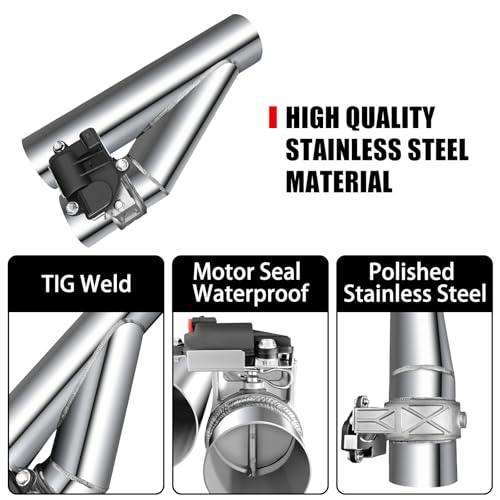
What’s Included?
The documented dual-valve kit includes:
- 2 electric exhaust valves
- 2 angled elbows
- 1 control module
- 2 wireless remotes
- Wiring and installation accessories
That makes it more complete than a replacement valve sold by itself.
A matching current listing can be found through Ubuy’s Peastorm 3-Inch Dual Exhaust Cutout listing.
Designed for Dual 3-Inch Exhaust Systems
This version includes:
two exhaust valves
which makes it especially useful for vehicles with true dual-exhaust layouts.
A typical configuration may look like:
Left Header → 3″ Pipe → Cutout
Right Header → 3″ Pipe → Cutout
before exhaust continues through:
- X-pipe
- H-pipe
- Resonators
- Mufflers
- Tailpipes
The exact positioning depends on the exhaust system.
Our X Pipe vs H Pipe: Which Sounds Better? guide explains how these common dual-exhaust layouts differ.
Three Exhaust Modes
The biggest feature of this kit is the ability to choose between three valve positions.
Fully Closed
With the valves closed, exhaust continues through the vehicle’s normal exhaust path.
That typically means:
Catalytic Converter → Mid-Pipe → Resonator → Muffler → Tailpipe
This is the quieter configuration.
Slightly Open
The partially open setting allows some exhaust to escape through the cutout while the rest continues through the conventional exhaust system.
This can produce a louder, sportier sound without going directly to full-open volume.
Fully Open
Opening the valves completely creates the shortest available bypass route.
Depending on valve placement, this may bypass:
- Resonators
- Mufflers
- Long sections of exhaust tubing
The result can be dramatically louder.
Why Partial-Open Control Is Useful
Traditional electronic cutouts are usually:
OPEN
or:
CLOSED
The slightly-open mode provides a third option.
That can be useful if full-open cutouts are simply too loud for normal use.
Instead of choosing between quiet and neighborhood evacuation, the driver gets a middle setting.
Actual sound depends heavily on:
- Engine
- Headers
- Catalytic converters
- Cutout location
- Exhaust diameter
- Mufflers
- Turbocharger configuration
Two Wireless Remotes
The system includes:
two remote controls
That provides a spare if one remote is:
- Lost
- Damaged
- Left in another vehicle
- Sacrificed to whatever dimension eats key fobs and 10mm sockets
The remotes communicate with the included control module, which operates the two exhaust valves.
One Controller Operates Both Valves
The dual-valve package uses one control module for the pair.
That allows the system to operate both cutouts together rather than requiring two independent control systems.
On a true dual exhaust, synchronized operation is usually preferable.
You generally don’t want one bank whispering through the muffler while the other is auditioning for NASCAR.
3-Inch Exhaust Diameter
The valves are intended for:
3-inch exhaust systems
which corresponds to approximately:
76.2mm
Three-inch exhaust tubing is common on:
- High-output turbo cars
- Modified V8s
- Performance trucks
- Street/strip vehicles
- Restomods
- Custom high-flow exhaust systems
It provides substantially more cross-sectional area than a 2.5-inch pipe.
That doesn’t automatically mean every engine needs it.
3-Inch vs. 2.5-Inch Exhaust
A 3-inch exhaust has significantly more flow area than a 2.5-inch system.
That can be beneficial where engine airflow demands justify the larger tubing.
Common 3-inch applications include:
- Turbocharged engines
- High-horsepower V8s
- Supercharged engines
- Large-displacement engines
- High-output street/strip builds
However, packaging becomes more difficult as tubing diameter increases.
Bigger tubing also means less:
- Ground clearance
- Driveshaft clearance
- Suspension clearance
Choose exhaust diameter according to the complete engine combination.
Measure Before Ordering
Do not assume your exhaust is 3 inches because that’s what the previous owner claimed.
Measure it.
Confirm:
- Outside diameter
- Inside diameter where relevant
- Clamp dimensions
- Existing tubing size
A 3-inch cutout needs to interface correctly with the existing exhaust.
Our How to Install Exhaust Cutout the Right Way guide explains cutout sizing, positioning and installation.
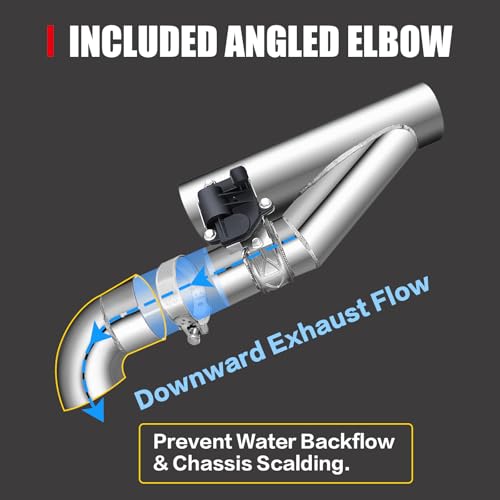
Angled Elbows Included
This kit includes:
two angled elbows
The elbows help control the direction of exhaust gases when the valves are open.
That’s important because open cutouts discharge very hot exhaust underneath the vehicle.
The outlet should not point directly at:
- Fuel lines
- Brake lines
- Wiring
- Fuel tank
- Transmission
- Suspension bushings
- Plastic underbody panels
Correct elbow orientation helps protect nearby components.
Protect the Chassis From Exhaust Heat
The seller specifically markets the angled elbow as a way to help direct exhaust away from the chassis.
That is a legitimate installation concern.
Exhaust gas exiting an open cutout can generate significant localized heat.
Position each outlet so it has:
- Clear discharge space
- Adequate ground clearance
- Distance from fuel system components
- Distance from electrical wiring
- Distance from heat-sensitive panels
Don’t aim a 3-inch open exhaust directly at floor insulation and then wonder why the cabin suddenly smells historically significant.
Clamp-Friendly Installation
The seller describes the cutout assembly as supporting a clamp-style connection.
Clamp connections can make installation easier where the exhaust layout already accepts slip-fit components.
However, universal installations may still require:
- Cutting
- Welding
- Tubing adapters
- Fabrication
- Additional clamps
- Hangers
Do not assume every car can install this kit with hand tools alone.
Welding May Still Be the Best Option
For a permanent performance build, welding can provide:
- Stronger attachment
- Better sealing
- Reduced movement
- Cleaner packaging
A professional exhaust fabricator can position the valves and elbows while preserving clearance.
A good process is:
Measure → Cut → Fit → Tack → Check → Weld
Our How to Install Exhaust Cutout the Right Way guide covers that workflow in more detail.
Universal Fitment
This is a:
universal exhaust component
It is not vehicle-specific.
Compatibility depends on:
- Exhaust diameter
- Available space
- Valve dimensions
- Elbow clearance
- Crossmember position
- Driveshaft location
- Suspension travel
- Ground clearance
The seller specifically advises checking available underbody space before ordering.
That matters even more with the two-valve kit because you need space on both sides of the exhaust system.
Check Space Before Ordering
A 3-inch cutout assembly takes up considerably more room than a straight 3-inch pipe.
Before purchasing, check whether there is adequate space for:
- Valve body
- Electric motor
- Elbow
- Wiring
- Clamps
Also check the system at normal ride height.
If the vehicle is lowered, measure clearance with the actual suspension setup.
Weather-Resistant Electric Motors
The valves use electric motors intended to operate underneath the vehicle.
The seller describes them as waterproof.
For a conservative technical description, it is safer to describe them as:
weather-resistant motors designed for underbody exposure
unless a specific waterproof/IP certification is provided.
Even weather-resistant electronics benefit from thoughtful placement.
Avoid positioning the actuator where it will experience:
- Direct exhaust heat
- Standing water
- Constant road-spray impact
- Physical contact with the chassis
Keep Wiring Away From Heat
The included wiring should be routed away from:
- Headers
- Turbochargers
- Catalytic converters
- Exhaust tubing
- Driveshaft
- Suspension components
Use:
- Secure loom
- Heat protection where necessary
- Proper connectors
- Circuit protection
A wire melting against the exhaust is a remarkably effective way to turn a sound-control modification into an electrical diagnosis.
Can the Cutouts Add Horsepower?
Potentially.
But don’t promise a specific horsepower gain.
Opening the valves reduces the amount of downstream exhaust system the gases have to travel through.
If the normal exhaust is restrictive, that can reduce downstream exhaust pressure.
The result depends on:
- Engine airflow
- Turbocharger
- Headers
- Catalytic converters
- Exhaust diameter
- Muffler restriction
- Engine calibration
Some vehicles may show measurable power gains.
Others primarily get louder.
Turbocharged Applications
A dual 3-inch cutout setup can be particularly interesting on high-output turbo vehicles.
Turbocharged engines generally benefit from minimizing unnecessary restriction downstream of the turbine.
Potential benefits depend on:
- Turbo size
- Downpipe
- Exhaust layout
- Catalytic converter
- Mufflers
- Boost pressure
- Calibration
A cutout is not a substitute for a correctly sized downpipe and exhaust.
V8 Performance Applications
Dual cutouts make obvious sense on many V8 systems with independent left and right exhaust paths.
Potential applications include:
- Muscle cars
- Cammed street cars
- Performance trucks
- Restomods
- Drag-oriented builds
With both valves fully open, exhaust sound can change dramatically.
Especially with long-tube headers.
Nobody is going to confuse that setting with valet mode.
X-Pipe and H-Pipe Installation
The cutouts can potentially be positioned:
- Before an X-pipe
- After an X-pipe
- Before an H-pipe
- After an H-pipe
depending on the desired sound and available space.
The layout changes how the two exhaust banks interact.
Our X Pipe vs H Pipe: Which Sounds Better? article explains the tradeoffs.
Cat-Back Exhaust Integration
These valves can also be added to an existing performance cat-back system.
That gives the driver two personalities:
Normal cat-back exhaust
and:
Open cutout
The partially open mode adds a third sound level between those extremes.
Our Catback Exhaust vs Axleback: Which Wins? guide explains the differences between these common exhaust upgrades.
Check Valve Operation Before Final Installation
Before final welding or clamping, connect the control system and test both valves.
Confirm that:
- Both valves fully open
- Both valves fully close
- Partial-open mode works
- Both motors move consistently
- Remote commands operate both valves
- No wiring becomes hot
Finding an electrical problem on the workbench is significantly easier than finding it after the valves have been welded above the driveshaft.
Test for Exhaust Leaks
After installation, inspect the system with the valves closed.
Look for:
- Ticking
- Soot marks
- Exhaust odor
- Leakage around clamps
- Leakage around welds
- Leakage through the closed valve
A leaking cutout can make the vehicle louder even when the system is supposed to be closed.
Two-Year Warranty
The seller advertises a:
2-year warranty
and states that failed components can be replaced during the warranty period.
Verify current warranty terms before purchase, including:
- Proof-of-purchase requirements
- Labor coverage
- Shipping costs
- Installation damage
- Water or heat damage
- Modified components
A parts warranty does not necessarily cover labor required to remove a welded component.
Street-Legal Considerations
Electric cutouts can create legal issues on street-driven vehicles.
Potential concerns include:
- Exhaust-noise limits
- Muffler requirements
- Exhaust-bypass restrictions
- Emissions laws
For California readers, our Is My Exhaust Legal? guide provides additional background.
Always verify current local and state rules before operating exhaust cutouts on public roads.
Do Not Bypass Required Emissions Equipment
Cutouts should not be installed or operated in a way that unlawfully bypasses required:
- Catalytic converters
- Oxygen sensors
- Emissions components
For a street vehicle, maintain the function of legally required emissions equipment.
A louder exhaust is one thing.
A federal emissions problem is another category of enthusiasm entirely.
Who Should Buy This 3-Inch Dual Electric Exhaust Cutout Kit?
This kit makes the most sense for vehicles with:
dual 3-inch exhaust systems
where the owner wants remote-controlled exhaust sound.
Potential applications include:
- Muscle cars
- Performance trucks
- High-output turbo cars
- Supercharged vehicles
- Restomods
- Street/strip projects
- Custom V8 exhaust systems
It is especially attractive when both exhaust banks require independent valves controlled simultaneously.
Why Buy the Peastorm 3-Inch Dual Exhaust Cutout Kit?
Key features include:
- Two 3-inch electric exhaust valves
- Two angled exhaust elbows
- Dual wireless remotes
- One control module
- Fully open mode
- Fully closed mode
- Slightly open mode
- Weather-resistant electric motors
- Clamp-friendly installation
- Universal custom fitment
- Two-year advertised warranty
- Complete dual-exhaust configuration
For a performance vehicle with a true dual 3-inch exhaust, this kit provides significantly more adjustability than a simple manual cutout while giving the driver three distinct sound settings from a wireless remote.
Specifications at a Glance
Brand: Peastorm
Product: Dual Electric Exhaust Cutout Kit
Exhaust Diameter: 3 inches
Approximate Metric Size: 76.2mm
Number of Valves: 2
Number of Elbows: 2
Controller: 1
Remotes: 2
Operating Modes: Fully Open / Fully Closed / Slightly Open
Motor: Weather-resistant electric
Installation: Clamp/custom fabrication
Fitment: Universal
Warranty: 2 years, according to seller
Primary Application: Dual-exhaust sound and bypass control
Always verify exhaust diameter, physical installation space, wiring requirements and current package contents before ordering.



There are no reviews yet.