

This Is More Than an Exhaust Cutout
A conventional exhaust cutout typically adds a valve that opens an alternate exhaust outlet.
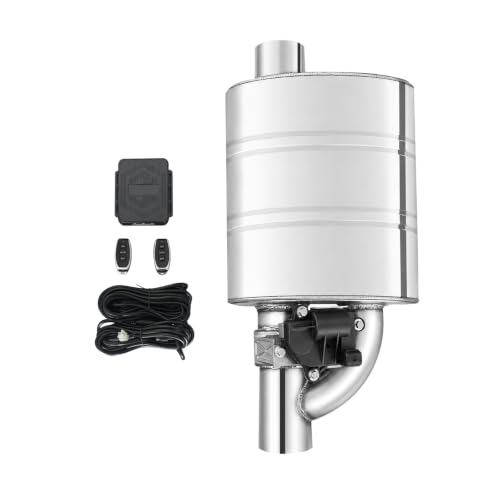
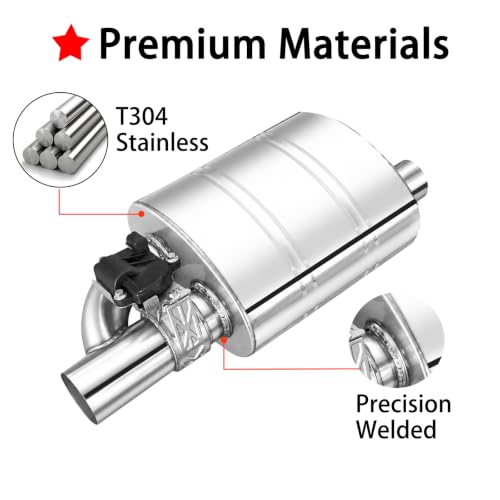
This product combines the valve and muffler into one assembly.
That creates two internal exhaust paths:
OPEN → Straight-Through Performance Path
CLOSED → Muffled Exhaust Path
The result is a compact system capable of changing exhaust character without requiring a completely separate conventional muffler and cutout arrangement.
That makes valved muffler the more accurate description for this product.
Three Exhaust Sound Modes
The system provides three valve positions.
Fully Open
Open the valve completely and exhaust takes the straighter internal path.
This provides:
- Maximum exhaust sound
- More aggressive exhaust character
- Reduced muffler restriction
- Straighter exhaust routing through the assembly
This is the loudest configuration.
Partial Open
The middle setting partially opens the valve.
This can provide a balance between the fully muffled and straight-through modes.
For street-driven vehicles, this may become the most useful setting because it allows more exhaust character without immediately jumping to maximum volume.
Fully Closed
Close the valve and exhaust is routed through the integrated muffler section.
This reduces exhaust volume and creates a deeper, quieter tone.
Three modes give the driver more flexibility than a simple open/closed exhaust valve.
Straight-Through Open Exhaust Path
With the valve fully open, exhaust uses the system’s:
straight-through path
rather than being routed through the muffler section.
Reducing unnecessary direction changes and muffler restriction can improve high-flow exhaust capacity.
Whether that produces additional horsepower depends on the vehicle.
Important factors include:
- Engine airflow
- Turbocharger
- Headers
- Catalytic converters
- Existing exhaust diameter
- Engine modifications
- Engine calibration
Do not assume that opening the valve automatically produces a specific horsepower gain.
Glass-Pack-Style Muffler Path
When the valve closes, exhaust is redirected through the integrated muffler section.
The seller describes this as an:
advanced glass-pack muffler
designed to reduce exhaust volume while retaining a deeper performance-oriented sound.
Glass-pack-style mufflers generally use sound-absorbing material around the exhaust passage to reduce certain frequencies.
The exact exhaust note will vary substantially according to:
- Engine configuration
- Displacement
- Headers
- Catalytic converters
- Resonators
- Exhaust length
- Exhaust tips
No muffler can guarantee a specific sound on every vehicle.
Why Choose a Valved Muffler?
A traditional performance muffler has one fixed sound characteristic.
A valved muffler gives the driver control.
That makes it useful for vehicles that serve multiple purposes.
For example:
Morning Commute → Closed
Normal Driving → Partial
Track / Appropriate Performance Setting → Open
One exhaust system can therefore provide multiple sound levels without physically changing exhaust components.
3-Inch Exhaust Compatibility
This muffler is designed specifically for:
3.0-inch outside-diameter exhaust pipe
which is approximately:
76.2mm
Three-inch exhaust systems are commonly found on:
- Turbocharged performance cars
- Modified V8s
- Supercharged vehicles
- Performance trucks
- Street/strip cars
- High-output custom builds
However, a 3-inch exhaust isn’t automatically correct for every engine.
Exhaust diameter should be matched to the vehicle’s airflow requirements.
3-Inch OD Is Important
The seller specifically identifies fitment as:
3.0-INCH OD PIPE
OD means:
outside diameter.
Measure the existing exhaust before ordering.
Do not assume a nominally advertised exhaust system uses exactly the connection dimensions required by this muffler.
Adapters can sometimes connect different tubing sizes, but installing unnecessary transitions can complicate the exhaust and create additional potential leak points.
Right-Side Exhaust Configuration
This particular version is designed for:
RIGHT-SIDE exhaust installations.
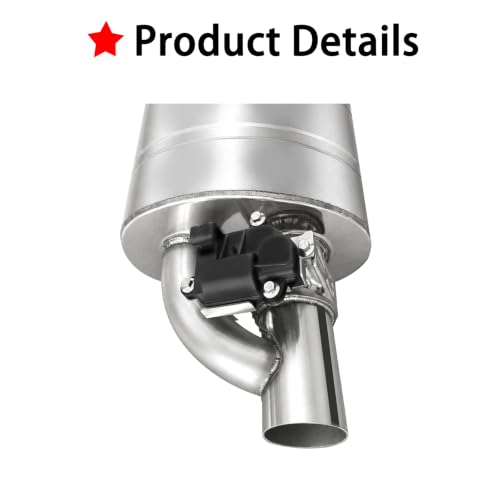
That orientation matters because the valve actuator, muffler body and internal bypass are positioned according to the intended side.
Before ordering, inspect the vehicle from underneath and determine:
- Exhaust direction
- Muffler orientation
- Available space
- Inlet location
- Outlet location
- Actuator clearance
Do not assume a right-side muffler can simply be flipped over to replace a left-side version.
Why Left and Right Orientation Matters
A directional valved muffler needs enough room for:
- Muffler body
- Electric actuator
- Exhaust tubing
- Wiring
Reversing the assembly may position the actuator against:
- Floorpan
- Suspension
- Fuel tank
- Spare-tire well
- Other exhaust components
Correct orientation should be confirmed before ordering.
Two Wireless Remotes Included
The system includes:
two wireless remotes.
One can serve as the primary controller while the second provides a backup.
Wireless operation allows the driver to adjust the valve without adding a conventional permanent switch to the dashboard.
Depending on the controller, the remote commands the electric actuator to move between:
- Open
- Partial
- Closed
positions.
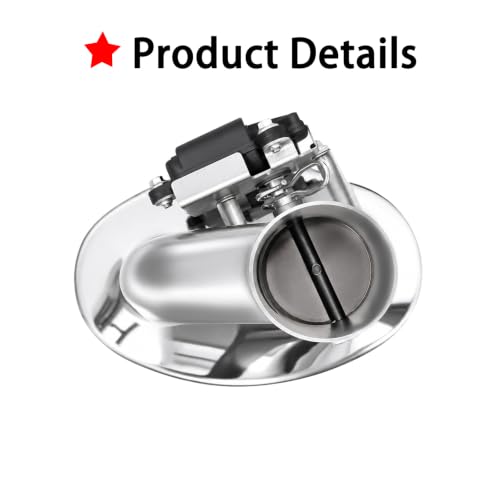
12-Volt Electric Actuator
The valve is powered by a:
12V electric actuator
designed for automotive use.
The actuator physically changes the exhaust path according to commands from the controller.
Installation should provide reliable:
- 12V power
- Ground
- Circuit protection
- Wiring connections
The wiring should be secured and protected from exhaust heat.
Keep Wiring Away From Heat
Valved exhaust systems combine extremely hot mechanical components with electrical components.
That means wiring placement matters.
Keep the harness away from:
- Headers
- Turbochargers
- Catalytic converters
- Muffler surfaces
- Exhaust tubing
Also avoid:
- Driveshafts
- Axles
- Suspension components
- Sharp sheet metal
Use appropriate loom and heat protection where required.
Check Installation Space Before Ordering
The seller specifically warns customers to verify available underbody space.
This is particularly important with a valved muffler because the assembly is physically larger than a simple exhaust valve.
Measure available:
- Length
- Width
- Height
- Ground clearance
Then check surrounding components.
A muffler that fits perfectly according to pipe diameter can still be completely unusable if the actuator wants to occupy the same space as the rear suspension.
Universal Fitment Means Fabrication
This is best treated as a:
universal custom exhaust component
rather than a vehicle-specific bolt-on muffler.
Installation may require:
- Measuring
- Cutting
- Welding
- Clamping
- Exhaust adapters
- Hangers
- Electrical wiring
Professional installation is recommended when custom fabrication is required.
Mock Up Before Welding
Do not permanently weld the muffler into place before confirming its complete orientation.
A better process is:
Measure → Position → Fit → Tack → Check → Final Weld
Before completing the installation, check:
- Muffler clearance
- Actuator clearance
- Ground clearance
- Suspension travel
- Exhaust-tip alignment
- Wiring clearance
Also verify that the valve operates correctly.
Test All Three Valve Positions First
Before final installation, connect the electrical system and operate the valve.
Confirm:
Fully Open → works
Partial Open → works
Fully Closed → works
Listen for:
- Binding
- Grinding
- Unusual actuator noise
The valve should move smoothly through its intended positions.
Testing this before permanent installation can save considerable labor later.
Exhaust Hangers Are Important
The valved muffler should be supported by correctly positioned exhaust hangers.
Do not rely on the tubing or welds alone to support the entire assembly.
Poor exhaust support can cause:
- Cracked welds
- Exhaust leaks
- Rattling
- Premature component failure
The system needs enough movement to accommodate normal engine and exhaust movement without swinging excessively underneath the vehicle.
Check Ground Clearance
A 3-inch exhaust already requires substantial underbody space.
Adding a valved muffler makes packaging even more important.
This is particularly relevant on:
- Lowered cars
- Sports cars
- Custom suspension builds
The actuator and muffler should not become the lowest components underneath the vehicle.
Electric actuators are excellent at moving exhaust valves.
They remain deeply unimpressive as skid plates.
Can a Valved Muffler Improve Performance?
Potentially.
When open, the straighter exhaust path may reduce restriction compared with routing exhaust through the muffler section.
Whether that produces measurable performance depends on the engine and existing exhaust system.
Possible factors include:
- Engine displacement
- Airflow
- Turbocharger size
- Boost
- Headers
- Catalytic converter
- Exhaust diameter
- Engine calibration
The product’s primary guaranteed functional difference is exhaust routing and sound control—not a fixed horsepower increase.
Turbocharged Applications
A 3-inch valved muffler can make sense for many turbocharged performance builds.
Turbo engines often use larger exhaust tubing to reduce restriction downstream of the turbine.
Opening the straight-through path may further reduce downstream muffler restriction.
Potential applications include:
- Turbo four-cylinder cars
- Turbo six-cylinder cars
- Modified European performance cars
- Custom turbo projects
The correct exhaust diameter still depends on the engine and target power level.
V8 Applications
Three-inch tubing is also common on higher-output V8 exhaust systems.
Potential applications include:
- Muscle cars
- Restomods
- LS swaps
- Performance trucks
- Supercharged V8s
- Street/strip builds
For true dual exhaust systems, verify whether you need:
- One muffler
- Two mufflers
- Matching left/right assemblies
before ordering.
Valved Muffler vs. Electric Exhaust Cutout
These products are related but not identical.
Electric Exhaust Cutout
Typically adds:
an alternate exhaust outlet
to an existing exhaust system.
Valved Muffler
Integrates:
quiet and high-flow exhaust paths
into the muffler assembly itself.
A valved muffler can therefore produce a cleaner integrated installation on some builds.
If you’re specifically considering a traditional bypass valve, see our How to Install Exhaust Cutout the Right Way guide.
Valved Muffler vs. Conventional Cat-Back
A conventional cat-back has a fixed exhaust configuration.
A valved system gives the driver additional sound control.
If you’re deciding how much of the factory exhaust to replace, read our Catback Exhaust vs Axleback: Which Wins? guide.
A valved muffler can potentially be incorporated into a custom cat-back system as its primary sound-control component.
X-Pipe and H-Pipe Applications
On a dual-exhaust V8, valved mufflers can be used downstream of an:
- X-pipe
- H-pipe
depending on the vehicle.
Crossover selection can significantly affect exhaust character.
Our X Pipe vs H Pipe: Which Sounds Better? guide explains how these two layouts differ.
Check for Exhaust Leaks
After installation, run the engine and inspect every connection.
Look for:
- Ticking sounds
- Soot
- Exhaust odor
- Loose clamps
- Leaking welds
Test the system in:
- Closed mode
- Partial mode
- Open mode
and verify that valve movement does not create abnormal noises.
One-Year Advertised Warranty
The seller advertises this valved muffler with a:
1-year warranty.
Before purchase, verify the current warranty terms and exclusions.
Determine whether coverage includes:
- Electric actuator
- Controller
- Remotes
- Muffler
- Valve
- Wiring
Also verify whether labor, shipping or removal/reinstallation costs are covered.
Street-Legal Considerations
A valved exhaust can dramatically change vehicle sound.
Local regulations may restrict:
- Exhaust volume
- Modified mufflers
- Exhaust bypass systems
- Use of adjustable exhaust valves
For California-oriented readers, our Is My Exhaust Legal? guide provides additional background.
Always verify current state and local regulations before using the louder setting on public roads.
Preserve Required Emissions Equipment
Do not install the muffler in a manner that unlawfully removes or bypasses required:
- Catalytic converters
- Oxygen sensors
- Emissions equipment
This product is intended to control exhaust routing and sound downstream in a compatible custom exhaust system.
Who Should Buy This 3-Inch Valved Muffler?
This system makes sense for someone building a compatible:
3-inch right-side exhaust
who wants multiple exhaust sound levels without using a separate muffler and cutout assembly.
Potential applications include:
- Turbo cars
- Muscle cars
- Performance trucks
- Restomods
- LS swaps
- Street/strip builds
- Custom cat-back systems
It’s particularly useful when the owner wants a compact integrated system offering both a quieter muffled path and a straight-through performance path.
Why Buy This 3-Inch Right-Side Valved Muffler?
Key features include:
- 3-inch OD exhaust compatibility
- Right-side configuration
- Three exhaust modes
- Fully open setting
- Partial-open setting
- Fully closed setting
- Straight-through open path
- Integrated glass-pack-style muffler path
- 12V electric actuator
- Two wireless remotes
- Universal custom fitment
- Advertised one-year warranty
For a custom 3-inch performance exhaust, this valved muffler gives the driver far more control over exhaust sound than a fixed performance muffler while packaging the bypass and muffler functions into one assembly.
Specifications at a Glance
Product: Electric Valved Muffler Exhaust Kit
Pipe Size: 3 inches OD
Approximate Metric Size: 76.2mm
Orientation: Right Side
Valve: Electric
Voltage: 12V
Control: Wireless Remote
Remotes: 2
Modes: Fully Open / Partial Open / Fully Closed
Open Path: Straight-through
Closed Path: Glass-pack-style muffler
Fitment: Universal / custom
Advertised Warranty: 1 year
Primary Application: Adjustable performance exhaust sound control
Important: Verify that your vehicle uses compatible 3-inch OD tubing, requires the right-side orientation, and has sufficient physical space for the muffler and actuator before ordering.





There are no reviews yet.