

Why Choose an OPTIMA YELLOWTOP?
The D75/25 isn’t just another replacement battery.
Its biggest advantage is the ability to combine starting performance with repeated cycling capability.
That makes it particularly well suited to vehicles equipped with:
- High-powered car audio systems
- Aftermarket amplifiers and subwoofers
- Winches
- Auxiliary lighting
- Alarm systems
- Dash cameras
- Additional electronics
- Commercial electrical equipment
- Other high-current accessories
A normal starting battery can work perfectly well in a stock vehicle. Once you start adding significant electrical loads, however, battery and charging-system demands change.
Our Car Audio System Guide explains why the battery, alternator, power wiring and grounds become increasingly important as amplifier power increases.
Built for High-Power Car Audio Systems
The D75/25 YELLOWTOP makes particular sense for modified vehicles with aftermarket audio.
Amplifiers can demand substantial current, especially when a high-powered subwoofer amplifier is operating near its rated output.
If you’ve experienced:
- Headlights dimming with bass
- Amplifier shutdowns
- Voltage drops
- Slow cranking after listening with the engine off
- Repeated battery discharge
- Electrical instability at high volume
the vehicle’s electrical system deserves attention.
Our Best Car Amplifier Setup Guide covers why serious audio systems require more than a large amplifier. Battery health, alternator capacity, cable size and grounding all matter.
A better battery helps provide electrical reserve, but remember: a battery cannot compensate indefinitely for an alternator that cannot support the vehicle’s total electrical demand.
Dual-Purpose Starting and Deep-Cycle Capability
This is where the YELLOWTOP separates itself from a conventional starting battery.
The D75/25 is designed for both:
Engine starting
and
Cyclic/deep-cycle operation
That matters when electrical accessories continue consuming power when alternator output is low or the engine isn’t running.
OPTIMA rates the D75/25 at:
48Ah C20 capacity
and:
100 minutes reserve capacity at 25 amps
Reserve capacity is particularly useful when comparing automotive batteries because it indicates how long a battery can sustain a standardized electrical load before reaching its defined discharged voltage.
620 Cold Cranking Amps
The D75/25 delivers:
620 CCA
Cold Cranking Amps measures the battery’s ability to supply starting current under cold conditions.
That provides substantial engine-starting capability while preserving the YELLOWTOP’s cycling characteristics.
It’s worth noting that a dedicated starting battery may offer higher CCA in the same general size.
The advantage of the D75/25 isn’t simply chasing the biggest CCA number possible.
It’s the combination of:
Starting power + reserve capacity + cycling capability.
SPIRALCELL Technology
OPTIMA’s distinctive battery construction uses its SPIRALCELL TECHNOLOGY rather than conventional flat lead plates.
The design uses tightly wound cells made with high-purity lead.
OPTIMA states that its SPIRALCELL construction uses 99.99% pure lead and is designed to deliver consistent power while offering excellent resistance to vibration.
That spiral construction is also why OPTIMA batteries look dramatically different internally from traditional flat-plate batteries.
AGM Construction
The D75/25 is an Absorbent Glass Mat (AGM) battery.
In an AGM battery, electrolyte is absorbed into fiberglass mat separators rather than remaining as freely flowing liquid inside the case.
This construction contributes to several advantages for performance and enthusiast applications:
- Maintenance-free operation
- Spill-resistant construction
- Strong vibration resistance
- Flexible mounting possibilities
- Good cycling capability
- Fast recharge characteristics
For a battery mounted in an unconventional location, always follow OPTIMA’s installation and venting requirements rather than assuming every mounting orientation is appropriate for every vehicle.
Up to 15 Times More Vibration Resistant
Performance cars, off-road trucks and commercial vehicles can subject a battery to significantly more vibration than a normal commuter.
OPTIMA states that the YELLOWTOP offers 15 times the vibration resistance of a standard flooded battery.
That makes it particularly attractive for:
- Off-road trucks
- 4×4 builds
- Performance cars
- Work trucks
- Rough-road vehicles
- Vehicles with stiff suspension
- Competition-inspired builds
The battery still needs to be secured with a proper hold-down.
A vibration-resistant battery bouncing around loose in the engine bay is still a battery bouncing around loose in the engine bay.
Up to Three Times Longer Life
OPTIMA rates the YELLOWTOP for up to three times longer life compared with standard flooded batteries under appropriate operating conditions.
Actual battery life depends heavily on:
- Charging-system health
- State of charge
- Climate
- Accessory loads
- Parasitic draw
- Storage conditions
- Frequency and depth of discharge
Keeping an AGM battery chronically undercharged will shorten its life regardless of how impressive the marketing brochure looks.
Faster Recharging
Another advantage of the YELLOWTOP design is its recharge capability.
OPTIMA recommends specific charging parameters for its YELLOWTOP batteries, including the D75/25.
For normal alternator charging, OPTIMA specifies:
13.65–15.0 volts
For battery-charger use, OPTIMA recommends a voltage-regulated charging system appropriate for AGM batteries.
If your battery repeatedly goes dead, don’t automatically assume the battery is defective.
Check the charging system.
Our guide, Why Is My Battery Light On?, explains how alternator problems, drive-belt failures, wiring faults and charging-control problems can leave even a healthy battery discharged.
100-Minute Reserve Capacity
The D75/25 carries a 100-minute reserve capacity at 25 amps.
Reserve capacity measures how long the battery can continue supplying a standardized 25-amp load at approximately 80°F before its voltage reaches the specified cutoff.
Think of reserve capacity as electrical endurance rather than starting punch.
That’s particularly relevant for vehicles equipped with:
- Audio systems
- Auxiliary lighting
- Electric accessories
- Winches
- Communication equipment
- Additional control modules
Dual Top and Side Terminals
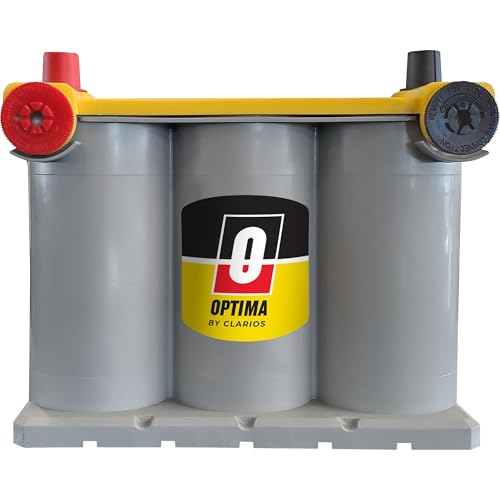
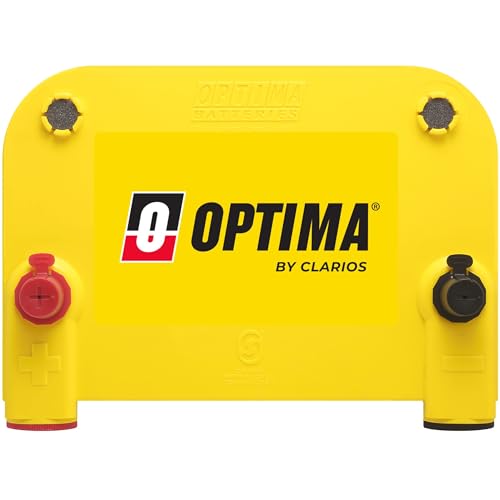
The D75/25 uses OPTIMA’s Type A/S dual-terminal configuration, providing both top and side terminals.
This can make the battery useful in applications that require different cable arrangements.
However, terminal clearance matters.
If unused side terminals are close to bodywork, brackets or other conductive surfaces, they must be protected from accidental contact.
Always verify:
- Positive/negative terminal orientation
- Cable reach
- Hood clearance
- Battery tray dimensions
- Hold-down compatibility
before purchasing.
Perfect for Performance and Modified Vehicles
The D75/25 YELLOWTOP is particularly appealing for modified cars because electrical demand tends to grow as the build evolves.
It starts innocently enough.
Stereo.
Then an amplifier.
Then another amplifier.
Then gauges.
Then auxiliary pumps.
Then additional lighting.
Then somehow there’s enough wiring under the hood to operate a small regional airport.
A dual-purpose AGM battery provides a stronger electrical foundation for builds that demand more than a factory replacement starting battery was intended to deliver.
Great Choice for Trucks With Winches
Winches create enormous electrical loads.
During winching, alternator output may not be sufficient to supply the entire current demand continuously, forcing the battery to contribute significant energy.
That makes cycling capability particularly valuable.
OPTIMA specifically identifies YELLOWTOP batteries as appropriate for vehicles with substantial accessory loads.
Remember that the battery is only one part of a proper winch electrical system.
Also verify:
- Alternator capacity
- Cable gauge
- Ground connections
- Winch wiring
- Terminal condition
- Circuit protection
- Battery mounting
Don’t Ignore Your Alternator
Installing an expensive AGM battery doesn’t repair a failing charging system.
If charging voltage is low, the battery will eventually discharge.
If charging voltage is excessive, the battery and vehicle electronics can be damaged.
Before blaming a battery, inspect:
- Alternator output
- Battery cables
- Chassis grounds
- Engine grounds
- Fusible links
- Main charging cables
- Parasitic current draw
Our What Is a Fusible Link? guide explains how high-current protection near the battery, alternator and power-distribution system works.
Modern Vehicles May Require Battery Registration
Don’t assume battery replacement ends when the terminals are tightened.
Some newer vehicles use intelligent battery-management systems that monitor battery:
- Chemistry
- Capacity
- State of charge
- Temperature
- Age
- Charging history
These vehicles may require battery registration or coding after replacement.
Read our What Is Battery Registration, and Does Your Car Need It? guide before installing a different battery type or capacity in a modern vehicle.
Diagnose Before Replacing the Battery
Repeated dead batteries don’t automatically mean the battery is bad.
The actual cause could be:
- Weak alternator
- Parasitic drain
- Corroded battery cables
- Loose terminals
- Poor engine ground
- Faulty charging control
- Electrical accessory staying awake
- Improperly wired aftermarket equipment
Our Diagnose the Car Before Replacing Parts Guide explains how checking battery condition, charging voltage and voltage drop can prevent unnecessary parts replacement.
Replacing a battery without fixing the parasitic draw that killed it is basically buying the problem a fresh lunch.
OPTIMA D75/25 vs. Conventional Starting Battery
| Feature | D75/25 YELLOWTOP | Conventional Starting Battery |
|---|---|---|
| Starting capability | Yes | Yes |
| Deep-cycle capability | Yes | Usually limited |
| AGM construction | Yes | Usually no |
| Maintenance free | Yes | Varies |
| High accessory loads | Excellent application | Depends on battery |
| Car audio | Excellent application | Depends on demand |
| Winch applications | Well suited | Often less suitable |
| Vibration resistance | Up to 15× standard flooded battery | Lower |
| Dual terminals | Yes | Depends on model |
Is the OPTIMA D75/25 YELLOWTOP Worth It?
If your vehicle is basically stock and only needs dependable starting power, a dedicated starting battery may be all you need.
The OPTIMA D75/25 YELLOWTOP becomes much more compelling when your vehicle has substantial electrical demands.
It’s especially well suited for:
Performance cars with additional electronics
Cars with aftermarket amplifiers and subwoofers
Trucks with winches or auxiliary lighting
Vehicles subjected to significant vibration
Applications where repeated cycling is expected
Instead of choosing between starting performance and deep-cycle capability, the YELLOWTOP is designed to provide both.
Why Buy the OPTIMA D75/25 YELLOWTOP?
The D75/25 combines the characteristics enthusiasts actually care about:
- 620 CCA starting power
- 48Ah C20 capacity
- 100-minute reserve capacity
- Dual-purpose starting and cycling design
- AGM construction
- SPIRALCELL technology
- Dual top and side terminals
- Maintenance-free operation
- Fast recharge capability
- Up to 15× vibration resistance
- Up to 3× longer life versus standard flooded batteries
For a high-demand street car, audio build, truck or accessory-loaded vehicle, the OPTIMA D75/25 YELLOWTOP AGM Battery provides a serious upgrade over a basic flooded starting battery.
Fitment Reminder
Before ordering, confirm:
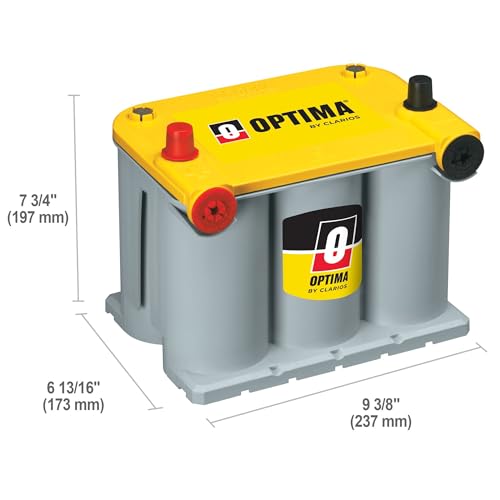
Battery dimensions: 9.38 × 6.81 × 7.75 inches
Weight: 37.8 lb
Voltage: 12V
CCA: 620
Capacity: 48Ah
Reserve Capacity: 100 minutes
Terminal Type: Dual top/side A/S
OPTIMA Model: D75/25
Part Numbers: 8042-218 / 9042-218
Always confirm vehicle-specific battery fitment, terminal orientation and hold-down compatibility before installation.







There are no reviews yet.