

1.28kWh of Stored Energy
The DUMFUME battery stores approximately:
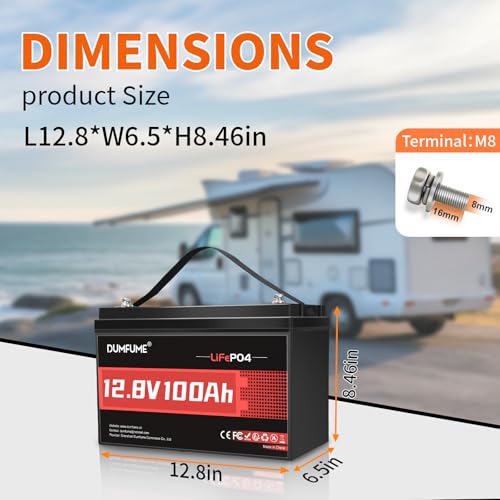
12.8V × 100Ah = 1,280Wh
or:
1.28kWh
That is the real headline specification for a deep-cycle battery.
Energy capacity determines how long the battery can operate devices before needing to be recharged.
For example, ignoring conversion losses and BMS limitations:
- A 100-watt load could theoretically operate for about 12.8 hours.
- A 500-watt load could theoretically operate for about 2.5 hours.
- A 1,000-watt load could theoretically operate for roughly 1.3 hours.
Actual runtime will be lower because of inverter losses, temperature, wiring resistance, battery cutoffs and the electrical efficiency of the connected equipment.
Still, 1.28kWh is substantial energy storage in a battery weighing just over 22 pounds.
Built for RVs and Campers
The DUMFUME 100Ah battery is especially well suited to auxiliary power systems in:
- RVs
- Camper vans
- Travel trailers
- Caravans
- Truck campers
- Overland builds
- Portable power systems
Typical loads may include:
- LED lighting
- Water pumps
- USB chargers
- Refrigerators
- Fans
- Small inverters
- Laptops
- Televisions
- Communications equipment
- Auxiliary electronics
The battery should be connected through properly sized wiring, fuses or circuit breakers and a compatible lithium charging system.
Excellent for Off-Grid Power Storage
LiFePO4 batteries have become popular for solar and off-grid applications because they can tolerate repeated cycling better than many traditional lead-acid batteries.
Potential installations include:
- Solar battery banks
- Remote cabins
- Portable solar systems
- Emergency backup systems
- Mobile workshops
- Field equipment
- Communications systems
The DUMFUME battery can also be connected in series and parallel configurations when the installation is designed correctly.
Supports Up to 4S4P Battery Banks
According to the supplied specifications, these batteries support configurations up to:
4 batteries in series
and:
4 parallel strings
or:
4S4P
A four-battery series string creates approximately:
51.2V nominal
Four parallel strings can provide:
400Ah total capacity
A complete 4S4P system using 16 identical 100Ah batteries would therefore contain roughly:
20.48kWh of nominal stored energy
Battery-bank construction requires significantly more planning than simply attaching batteries together.
All batteries should be:
- Same model
- Same chemistry
- Similar age
- Similar state of charge
- Properly balanced before connection
Cable lengths and conductor sizes should also be designed so current is shared evenly between parallel batteries.
Integrated 100A BMS
The battery includes an integrated:
100-amp Battery Management System
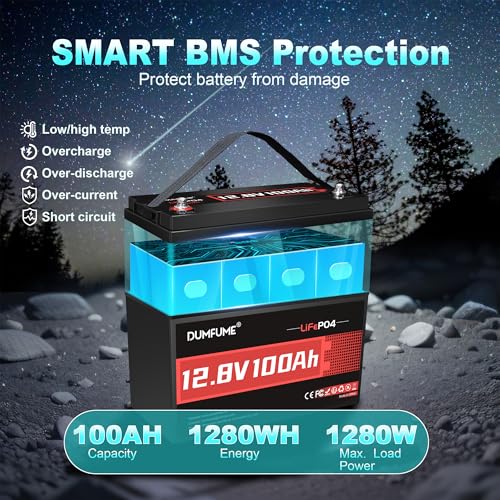
The BMS monitors and protects the lithium cells.
According to the supplied specifications, protection includes:
- Overcharge
- Over-discharge
- Overcurrent
- Short circuit
- Overheating
This electronic protection is one of the major advantages of a properly designed LiFePO4 battery.
The BMS helps prevent operation outside safe electrical limits.
However, the 100A rating also represents an important system-design constraint.
Understand the 100A BMS Limit
With a nominal battery voltage of 12.8V, a 100A output corresponds to approximately:
1,280 watts DC
before considering voltage sag and conversion losses.
That means a 12V inverter should be sized with the BMS limit in mind.
For example, a nominal 1,000-watt inverter may require well over 80 amps from the battery under heavy load.
A 1,500-watt inverter can potentially demand more current than a 100A BMS permits.
Always compare:
- Continuous inverter power
- Inverter efficiency
- Peak surge current
- Battery BMS current rating
- Cable capacity
- Fuse rating
A 100Ah rating tells you how much energy the battery stores.
It does not mean the battery can deliver unlimited current.
Not an Automotive Starting Battery
This is the most important warning on the page.
Do not use the DUMFUME 100Ah LiFePO4 battery as an engine-starting battery.
The manufacturer specifically states that the battery is not recommended for:
- Automotive starting
- Engine cranking
- Golf carts
- Jacks
- Equipment-starting applications
Starting motors can demand several hundred amps for a short period.
This battery’s 100A BMS is designed around deep-cycle power delivery, not starter-motor surge current.
Using it as a starter battery could cause the BMS to disconnect or potentially damage the battery.
If you’re diagnosing an actual car starting problem, use our Car Has Power but Won’t Start guide instead of substituting a deep-cycle battery for the proper automotive starting battery.
22.05-Pound Lightweight Design
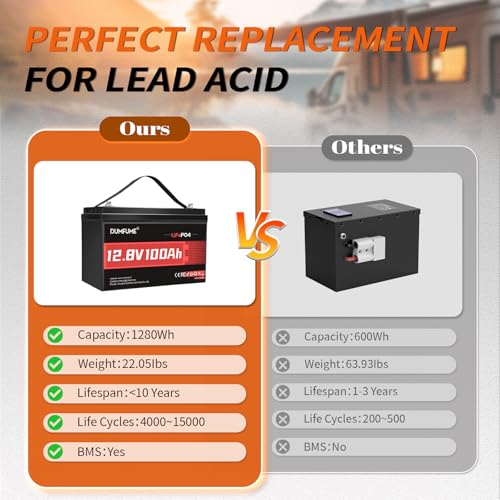
The DUMFUME Group 31 battery weighs approximately:
22.05 pounds
The supplied comparison lists a conventional 100Ah AGM battery at roughly:
63.9 pounds
That means the lithium battery can save more than:
40 pounds
in a single-battery installation.
That weight reduction is especially useful in:
- Camper vans
- Trailers
- Boats
- Mobile power systems
- Overland vehicles
- Portable battery boxes
With multiple batteries, the weight savings can become dramatic.
Four batteries at 22 pounds each weigh roughly 88 pounds.
Four 64-pound AGM batteries would approach 256 pounds.
That’s a difference you can feel before you’ve even started wiring anything.
High Energy Density
The DUMFUME battery combines:
100Ah capacity
with:
22.05-pound weight
That provides much higher energy-per-pound than conventional lead-acid batteries.
Higher energy density is valuable where:
- Space is limited
- Vehicle payload matters
- Batteries need to be portable
- Multiple batteries are being installed
- Weight distribution matters
This is one of the primary reasons lithium batteries have become increasingly popular in RV, marine and off-grid systems.
Grade A LiFePO4 Cells
The battery is advertised as using:
Grade A lithium iron phosphate cells
LiFePO4 is one of the most widely used lithium chemistries for stationary and mobile energy-storage applications.
Advantages typically include:
- Strong cycle life
- Stable voltage
- Low maintenance
- High energy density
- Good thermal stability
- Deep-cycle capability
Actual long-term battery performance still depends on cell quality, BMS calibration, operating temperature and charging practices.
Up to 4,000+ Cycles at 100% Depth of Discharge
DUMFUME advertises:
4,000+ cycles at 100% DOD
6,000+ cycles at 80% DOD
and:
15,000+ cycles at 60% DOD
DOD means Depth of Discharge.
For example:
A 100% DOD cycle means using essentially the battery’s full usable capacity.
An 80% DOD cycle means using roughly 80Ah from a 100Ah battery.
A 60% DOD cycle means using roughly 60Ah.
In general, batteries tend to last longer when they are cycled less deeply.
These figures should be treated as manufacturer cycle-life ratings under specified testing conditions rather than a guaranteed lifespan in every installation.
Why LiFePO4 Usually Outlasts Lead-Acid in Cycling Applications
A conventional lead-acid battery generally prefers to remain near full charge.
Repeated deep discharges can shorten its lifespan significantly.
LiFePO4 batteries are far better suited to applications where the battery regularly charges and discharges.
That makes lithium especially useful for:
- Solar systems
- RV house batteries
- Marine house banks
- Portable energy storage
- Backup systems
The key distinction is that this battery is designed to be cycled, not used for engine cranking.
Stable Voltage Under Load
LiFePO4 batteries generally maintain relatively stable output voltage throughout much of their usable capacity.
That can benefit equipment including:
- Inverters
- Refrigerators
- Electronics
- Lighting
- Communications equipment
- DC appliances
Lead-acid voltage tends to decline more gradually as the battery discharges.
Lithium voltage remains relatively stable and then drops more rapidly near the end of usable capacity.
This is one reason relying only on voltage to estimate lithium battery state-of-charge can be misleading.
Use a LiFePO4-Compatible Charger
Do not automatically charge this battery with any charger designed for lead-acid batteries.
Use a charging system specifically compatible with:
12.8V LiFePO4 chemistry
Avoid chargers with uncontrolled:
- Equalization modes
- Desulfation pulses
- High-voltage reconditioning
- Lead-acid repair modes
Those functions are designed for lead-acid chemistry and may not be appropriate for lithium batteries.
The charger, solar controller or DC-to-DC charger should follow the battery manufacturer’s recommended charge-voltage limits.
RV Alternator Charging Requires Planning
If you’re installing this battery in an RV, camper van or overland vehicle, don’t simply connect it directly to the vehicle alternator without understanding the charging system.
Lithium batteries can accept high charging current.
That can place substantial demand on an alternator designed around lead-acid charging behavior.
Depending on the vehicle, the better solution may involve a properly sized:
DC-to-DC charger
This can help:
- Control charging current
- Provide appropriate lithium charging voltage
- Protect the alternator
- Manage vehicles with smart alternators
- Isolate the house battery from the starter battery
The starter battery and house battery have very different jobs.
Don’t make one battery pretend to be both unless the system was specifically designed that way.
High-Strength ABS Case
The battery uses a high-strength ABS enclosure designed for mobile and outdoor applications.
The supplied specifications describe the case as:
- Impact resistant
- Heat resistant
- Weather resistant
- Fire resistant
However, the battery is explicitly described as:
Not waterproof
That matters.
Do not mount it where it can be submerged or continuously exposed to rain, bilge water or direct spray.
Use an appropriate battery enclosure when the installation environment demands additional protection.
Marine Use Means House Power, Not Engine Starting
The product may be described as a Group 31 marine battery, but that does not automatically mean it’s a marine starter battery.
Its appropriate marine roles include:
- Cabin lighting
- Electronics
- Refrigeration
- Pumps within current limits
- Inverters
- House electrical systems
Do not use it to crank a boat engine unless the manufacturer specifically approves that application.
The same distinction applies on land:
Deep-cycle battery ≠ starting battery.
Temperature Matters
The seller notes that battery performance requires temperatures of approximately:
5°C / 41°F or higher
and specifically warns buyers to verify suitability for lower-temperature use.
This is important because LiFePO4 charging behavior at low temperatures differs significantly from lead-acid chemistry.
Charging lithium iron phosphate cells below their approved temperature range can damage them.
If you plan to use this battery in:
- Winter RV camping
- Snow-country cabins
- Unheated trailers
- Cold marine environments
verify whether the battery includes low-temperature charging protection.
If low-temperature charging protection is not specifically documented, don’t assume it has it.
Storage and Maintenance
The seller recommends charging and discharging the battery at least:
once every six months
during extended storage.
LiFePO4 batteries typically have low self-discharge, making them attractive for seasonal systems.
Before long-term storage:
- Disconnect unnecessary loads
- Verify state of charge
- Store within the manufacturer’s temperature range
- Check the battery periodically
- Keep terminals clean and protected
- Do not leave the battery completely discharged
A BMS protects against many faults, but it cannot compensate indefinitely for poor storage practices.
Proper Fusing Is Essential
Any high-capacity battery can deliver dangerous fault current.
A fuse or circuit breaker should be installed near the battery positive terminal.
The protective device should be sized for:
- Battery BMS current
- Cable ampacity
- Normal load
- Inverter requirements
Never size the fuse based only on what the equipment might consume.
The fuse’s primary job is protecting the wire.
Our What Is a Fusible Link? Fusible Link vs. Fuse Explained guide explains why high-current electrical circuits require proper overcurrent protection.
The basic lesson applies equally well to an RV battery bank:
If the battery cable is capable of becoming a heating element, it needs appropriate protection.
Proper Cable Size Matters
A 100A system requires substantial conductors.
Undersized cables can cause:
- Voltage drop
- Heat
- Reduced inverter performance
- Premature BMS cutoff
- Electrical fire risk
Cable size depends on:
- Maximum current
- Cable length
- System voltage
- Allowable voltage drop
Keep high-current battery cables as short as practical and use properly crimped terminals.
Electrical systems don’t care how nice the battery is if the wiring between the battery and the load is terrible.
Can You Use It With a Car Audio System?
Potentially as part of a properly engineered auxiliary electrical system—but this battery should not replace the vehicle’s starter battery.
If used for auxiliary audio power, the installation needs proper:
- Isolation
- Charging control
- Cable sizing
- Grounding
- Fusing
- BMS compatibility
Our Car Audio System Guide covers the electrical fundamentals behind high-powered automotive audio systems.
For most street vehicles, simply adding a lithium house battery without understanding alternator behavior and battery isolation is not a good plan.
Battery Light On in Your Vehicle?
If you’re using a dual-battery camper or overland setup and the vehicle’s battery warning light comes on, investigate the charging system immediately.
Our Why Is My Battery Light On? guide covers:
- Alternator failure
- Voltage-regulator faults
- Wiring problems
- Broken belts
- Charging fuses
- Ground faults
An auxiliary battery bank cannot compensate indefinitely for a failed vehicle alternator.
Do You Need Battery Registration?
The DUMFUME battery is primarily intended as a house or storage battery, not as a direct replacement for the main battery in a modern vehicle.
If you’re considering replacing a vehicle’s factory AGM battery with lithium, read our What Is Battery Registration, and Does Your Car Need It? guide first.
Many modern vehicles regulate alternator output according to:
- Battery chemistry
- Capacity
- Temperature
- Age
- State of charge
Changing chemistry from lead-acid to LiFePO4 is not something that should be done solely because the new battery fits in the tray.
Again, this particular DUMFUME battery is not recommended as a vehicle starting battery anyway.
Best Applications for the DUMFUME 100Ah LiFePO4
This battery makes the most sense for:
- RV house battery systems
- Camper vans
- Travel trailers
- Caravans
- Marine house-power systems
- Solar storage
- Off-grid cabins
- Portable battery boxes
- Backup power systems
- Auxiliary DC systems
It is not intended for:
- Engine starting
- Automotive starter replacement
- Golf-cart propulsion
- Hydraulic jacks
- Starter motors
- High-surge equipment exceeding the BMS rating
Why Buy the DUMFUME Group 31 LiFePO4 Battery?
For deep-cycle applications, the specifications are compelling.
Key features include:
- 12.8V nominal voltage
- 100Ah capacity
- 1.28kWh stored energy
- 100A integrated BMS
- 22.05-pound lightweight construction
- Group 31-style format
- LiFePO4 chemistry
- Grade A cells
- Up to 4S4P expansion
- 4,000+ advertised cycles at 100% DOD
- 6,000+ advertised cycles at 80% DOD
- 15,000+ advertised cycles at 60% DOD
- Overcharge protection
- Over-discharge protection
- Overcurrent protection
- Short-circuit protection
- Over-temperature protection
- High-strength ABS case
- Low-maintenance operation
If you’re building an RV, camper, solar or off-grid electrical system and want substantially less weight than a conventional 100Ah AGM battery, the DUMFUME 12V 100Ah LiFePO4 Group 31 Battery offers a strong combination of capacity, portability and deep-cycle capability.
Just remember the most important specification:
This is an energy-storage battery—not an engine-starting battery.






There are no reviews yet.