
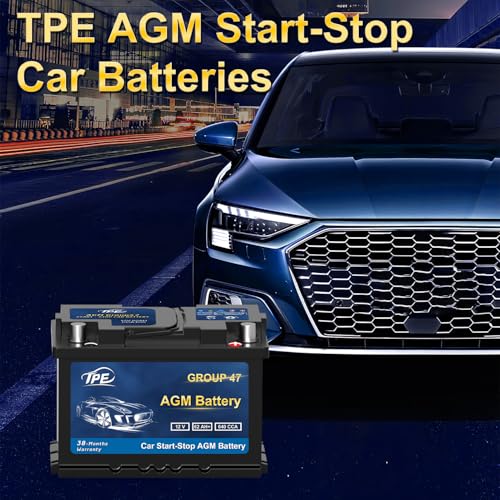
Group 47 and H5 Battery Size
One of the most important specifications on this battery is:
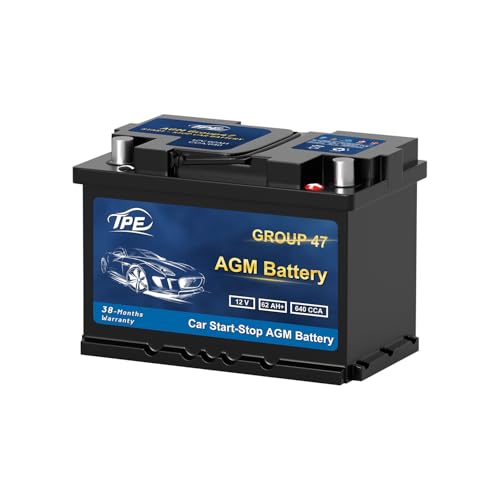
Group 47 / H5
Group 47 is the common North American BCI designation, while H5 is widely used for the corresponding European battery format.
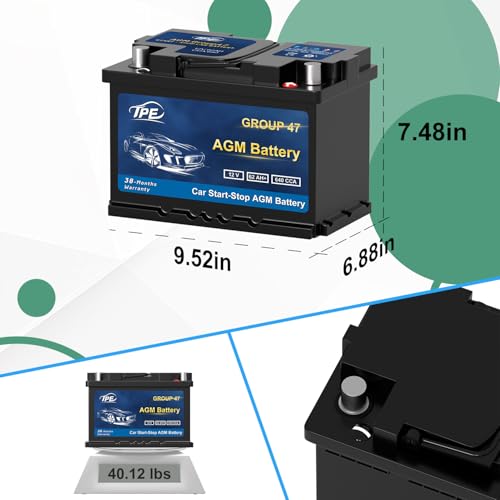
The TPE battery measures approximately:
9.52 inches long
6.88 inches wide
7.48 inches tall
Those dimensions should be compared directly with your existing battery and battery tray.
Don’t purchase a replacement based only on voltage.
A battery can be electrically powerful enough to start the engine and still be physically wrong for the vehicle.
62Ah Battery Capacity
The TPE H5 AGM battery provides:
62 amp-hours of capacity
Amp-hour capacity represents the amount of stored electrical energy available under standardized conditions.
That’s increasingly important in modern vehicles because the battery has to support much more than the starter motor.
Modern vehicles may continue powering:
- Alarm systems
- Keyless-entry receivers
- Infotainment systems
- Telematics
- Driver-assistance modules
- Body-control modules
- Electric accessories
- Memory circuits
- Start-stop systems
A 62Ah battery provides useful reserve for vehicles designed around this capacity range.
640–700 Cold Cranking Amps
The seller rates the battery between:
640 and 700 CCA
with 640 CCA commonly used as the headline specification.
Cold Cranking Amps describe how much current a battery can provide under standardized cold-temperature conditions while maintaining sufficient voltage.
CCA becomes especially important when:
- Temperatures drop
- Engine oil becomes thicker
- Starter demand rises
- Battery output naturally falls
The TPE Group 47’s starting output is appropriate for many vehicles originally specified with an H5 AGM battery in this performance range.
Always compare the CCA rating with the manufacturer’s minimum requirement for your vehicle.
100-Minute Reserve Capacity
The TPE Group 47 carries a:
100-minute reserve-capacity rating
Reserve capacity indicates how long a fully charged battery can provide a standardized 25-amp electrical load before reaching its specified cutoff voltage.
This gives an indication of how much electrical reserve the battery provides if:
- The alternator stops charging
- Accessories operate while the engine is off
- Start-stop operation repeatedly cycles the battery
Reserve capacity becomes increasingly useful as vehicles gain more electrical equipment.
AGM Technology
AGM stands for:
Absorbent Glass Mat
Instead of allowing liquid electrolyte to move freely inside the battery case, AGM batteries hold the electrolyte in fiberglass separators positioned between the lead plates.
This construction provides several advantages over conventional flooded batteries.
Benefits can include:
- Better vibration resistance
- Improved cycle durability
- Low maintenance
- Spill-resistant construction
- Strong charge acceptance
- Consistent starting performance
AGM batteries have become common equipment in newer vehicles because modern electrical systems place greater demands on the battery.
Designed for Start-Stop Vehicles
The TPE Group 47 AGM battery is marketed for vehicles equipped with:
automatic start-stop technology
Start-stop systems place significantly more cycling demand on a battery than a traditional starting system.
A conventional vehicle may start once during a trip.
A start-stop vehicle can restart the engine dozens of times.
During those engine-off periods, electrical equipment may remain active, including:
- Climate controls
- Infotainment
- Lighting
- Vehicle computers
- Safety systems
That’s why vehicles originally equipped with AGM batteries should generally continue using the battery technology specified by the manufacturer.
Don’t Replace an AGM Battery With a Standard Flooded Battery Just to Save Money
If the factory battery is AGM, installing a conventional flooded battery may reduce battery life or interfere with start-stop operation.
AGM batteries are designed to handle repeated charging and discharging better than conventional starter batteries.
Always check the original battery label or service information before changing battery chemistry.
Going from AGM to a cheaper conventional battery may work initially.
That doesn’t mean it’s the correct replacement.
Up to Twice the Cycle Life
TPE advertises this battery as providing:
up to twice the cycle life of conventional batteries
That claim should be understood as a manufacturer comparison rather than a guaranteed doubling of lifespan in every vehicle.
Actual battery life depends heavily on:
- Charging voltage
- Temperature
- Start-stop frequency
- Driving habits
- Parasitic draw
- Battery state of charge
- Storage conditions
- Alternator performance
AGM technology generally handles cycling better than a traditional flooded starter battery, which is one of the reasons it is widely used in start-stop applications.
Lower Self-Discharge
TPE advertises a self-discharge rate of:
less than 8% after 90 days
Low self-discharge can be useful for vehicles that spend periods parked.
Examples include:
- Weekend cars
- Secondary vehicles
- Seasonal vehicles
- Collector cars
However, the vehicle itself can still discharge the battery through parasitic electrical loads.
Modern cars may continue powering control modules, alarms, keyless-entry receivers and telematics while parked.
If the vehicle sits for long periods, consider an AGM-compatible battery maintainer.
Maintenance-Free Construction
The TPE Group 47 is designed as a:
maintenance-free battery
Unlike older serviceable flooded batteries, there is no routine requirement to open the battery and add distilled water.
You should still periodically inspect:
- Battery terminals
- Cable condition
- Ground connections
- Hold-down hardware
- Battery case
- Charging voltage
Maintenance-free does not mean the charging system no longer needs maintenance.
Leak-Resistant AGM Design
The AGM construction also helps reduce the risk of electrolyte leakage associated with traditional flooded batteries.
This can be particularly useful in vehicles where the battery is mounted:
- Under the hood
- In the trunk
- Under the cargo floor
- Beneath a seat
Always follow the vehicle manufacturer’s battery venting requirements where applicable.
AGM construction does not automatically mean a factory vent connection should be ignored.
Increased Vibration Resistance
AGM batteries generally offer better resistance to vibration than conventional flooded designs.
This can help in vehicles subjected to:
- Rough roads
- Stiff suspension
- Frequent commuting
- Performance driving
- Poor pavement
Repeated vibration can damage internal battery structures over time.
A secure battery hold-down remains essential regardless of battery technology.
Left-Negative / Right-Positive Terminal Layout
The advertised terminal orientation is:
Negative terminal: left
Positive terminal: right
Check your existing battery before ordering.
Terminal orientation matters because battery cables are normally designed for a specific layout.
Never stretch, cross or sharply bend battery cables in order to make an incorrect battery fit.
Measure Before Ordering
TPE specifically recommends physically comparing the replacement battery with the one already installed.
Verify:
- Length
- Width
- Height
- Terminal orientation
- Hold-down design
- Cable reach
- CCA requirement
- Battery chemistry
The advertised dimensions are:
9.52 × 6.88 × 7.48 inches
Those measurements are more reliable for physical fitment than assuming every battery advertised as “H5” will work in every H5 application.
Battery Registration May Be Required
Many newer vehicles using Group 47/H5 AGM batteries also use intelligent battery-management systems.
When the battery is replaced, the vehicle may need to be told that a new battery has been installed.
This procedure may be called:
- Battery registration
- Battery adaptation
- Battery reset
- Battery coding
Our What Is Battery Registration, and Does Your Car Need It? guide explains how modern charging systems monitor battery age, capacity and state of charge.
Why Battery Registration Matters
Some intelligent charging systems adjust alternator output as the battery ages.
If the vehicle continues believing the old battery is installed, it may apply an inappropriate charging strategy to the replacement battery.
Depending on the application, this can contribute to:
- Reduced battery life
- Start-stop problems
- Charging warnings
- Energy-management messages
Follow the battery replacement procedure for the exact vehicle.
Battery Light On?
If the battery warning lamp stays illuminated while the engine is running, replacing the battery may not solve the problem.
The battery light normally points toward a charging-system fault.
Potential causes include:
- Alternator failure
- Voltage-regulator problems
- Broken accessory belt
- Charging-cable damage
- Main fuse failure
- Fusible-link failure
- Poor grounds
- Battery-monitoring faults
Our Why Is My Battery Light On? diagnostic guide explains what to test before firing the parts cannon.
Check the Charging Fuse and Fusible Link
High-current charging circuits often contain special circuit protection.
Depending on the vehicle, that may include:
- Fusible links
- Mega fuses
- Strip fuses
- Battery terminal fuse blocks
If one of these opens, the alternator may work but its current may never reach the battery.
Read our What Is a Fusible Link? Fusible Link vs. Fuse Explained guide for more information on diagnosing high-current automotive circuits.
Never bypass failed circuit protection with ordinary wire.
Rapid Clicking When Starting
Rapid clicking from the starter area commonly indicates system voltage dropping too far during cranking.
Possible causes include:
- Weak battery
- Discharged battery
- Loose terminal
- Corroded cable
- Poor ground
- Starter fault
- Charging-system problem
Our Rapid Clicking When Starting a Car guide walks through the diagnostic process.
A battery should be properly tested before replacement.
Car Has Power but Won’t Start?
Dashboard lights don’t prove the battery is healthy.
Interior electronics require far less current than the starter motor.
A vehicle can have:
- Working lights
- Radio
- Instrument cluster
- Power locks
and still fail to crank because battery voltage collapses under load.
Use our Car Has Power but Won’t Start guide to separate battery problems from starter, wiring and control-system faults.
Is 640 CCA Enough?
That depends entirely on the vehicle.
Never choose an automotive battery solely because the physical dimensions match.
Compare the new battery’s CCA rating with the original specification.
The TPE battery is advertised at:
640–700 CCA
If your vehicle requires substantially more cranking current, select a battery that meets the factory specification.
CCA is particularly important for vehicles operated in cold climates.
Is 62Ah the Correct Capacity?
Again, compare it with the original battery.
This battery provides:
62Ah
Many modern battery-management systems are calibrated around a specific battery-capacity range.
Installing a dramatically different capacity can alter charging behavior or require coding.
When possible, replace the original battery with one using:
- Same chemistry
- Similar Ah rating
- Correct physical size
- Correct terminal layout
- Equal or greater required CCA
AGM Battery and Car Audio Systems
A quality AGM battery can provide a strong electrical foundation for vehicles with moderate aftermarket audio systems.
However, installing an AGM battery doesn’t increase alternator output.
High-powered systems still require adequate:
- Alternator capacity
- Power wiring
- Grounding
- Circuit protection
Our Car Audio System Guide explains how the complete electrical system works together.
Should You Upgrade to a Bigger Battery?
Bigger isn’t automatically better.
A larger battery may provide more:
- Reserve capacity
- Amp-hour capacity
- CCA
but it must still fit properly and remain compatible with the charging system.
Modern vehicles can be especially sensitive to battery specification changes.
The best replacement is usually a battery that matches the manufacturer’s required:
size + chemistry + capacity + cranking performance
rather than simply the largest battery you can squeeze into the tray.
Who Should Buy the TPE Group 47 AGM Battery?
This battery makes the most sense for drivers whose vehicles require a compatible:
Group 47 / H5 AGM battery
with specifications near:
62Ah
640–700 CCA
and:
100RC
It is particularly suitable for vehicles with:
- Automatic start-stop
- Extensive factory electronics
- AGM battery requirements
- Moderate accessory loads
Why Buy the TPE Group 47 H5 AGM Battery?
Key specifications include:
- Group 47 / H5 size
- 12V nominal voltage
- 62Ah capacity
- 640–700 CCA
- 100-minute reserve capacity
- AGM technology
- Start-stop capability
- Maintenance-free construction
- Leak-resistant design
- Improved vibration resistance
- Advertised low self-discharge
- Left-negative / right-positive terminal layout
For a vehicle originally designed around an H5-size AGM battery, the TPE Group 47 62Ah AGM Battery provides a practical replacement with strong starting output and the cycling capability demanded by many modern start-stop systems.
Specifications at a Glance
Brand: TPE
Model: AGM-Group47
Battery Type: AGM lead-acid
BCI Group: 47
European Size: H5
Voltage: 12V
Capacity: 62Ah
Cold Cranking Amps: 640–700 CCA
Reserve Capacity: 100 minutes
Length: 9.52 inches
Width: 6.88 inches
Height: 7.48 inches
Negative Terminal: Left
Positive Terminal: Right
Application: Automotive starting / compatible start-stop vehicles
Maintenance: Maintenance-free
Always verify year, make, model, engine, battery size and factory battery specification before ordering.







There are no reviews yet.