

Dual-Purpose Starting and Deep-Cycle Performance
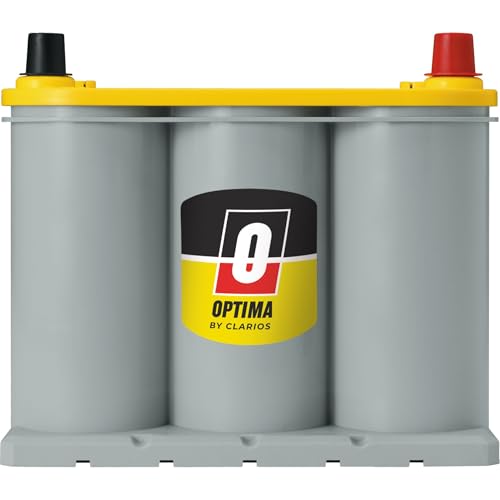
The biggest reason to choose the D35 YELLOWTOP over a conventional starting battery is its ability to perform two jobs.
It can:
start the engine
and:
support repeated charge/discharge cycles
That distinction matters in modern modified vehicles.
A standard starting battery is optimized to deliver a large burst of current for a few seconds and then immediately recharge from the alternator.
A dual-purpose YELLOWTOP can tolerate more frequent cycling when accessories continue operating with the engine off.
OPTIMA specifically lists the D35 among its dual-purpose batteries designed for engine-starting and cyclic applications.
620 Cold Cranking Amps
The D35 delivers:
620 CCA
That’s substantial starting power for compatible Group 35 applications.
Cold Cranking Amps measure how much current the battery can deliver under standardized cold-temperature conditions while maintaining usable voltage.
A strong CCA rating helps when:
- Temperatures fall
- Oil becomes thicker
- Starter demand rises
- Engine compression is high
For most compatible four-cylinder and six-cylinder applications, 620 CCA provides significant starting capability.
Always compare the rating with your vehicle manufacturer’s minimum requirement.
48Ah Capacity
The D35 provides:
48 amp-hours
That is particularly important for modified vehicles with continuous electrical loads.
Examples include:
- Car alarms
- Dash cams
- Audio amplifiers
- GPS trackers
- Air-suspension controllers
- Pumps
- Auxiliary electronics
OPTIMA has specifically pointed to the D35 YELLOWTOP for Group 35 vehicles with aftermarket stereo systems, dash cams and alarms because it can be deep-cycled more effectively than a REDTOP.
100-Minute Reserve Capacity
The D35 provides:
100 minutes of reserve capacity
Reserve capacity measures how long a fully charged battery can support a standardized 25-amp load before reaching its specified discharge voltage.
That gives the D35 more endurance for accessory use than a comparable starting-focused battery.
Reserve capacity is especially relevant if:
- The alternator fails
- Accessories run with the engine off
- The battery is cycled repeatedly
OPTIMA uses reserve capacity as a useful comparison for electrical endurance under load.
SPIRALCELL TECHNOLOGY
The D35 uses OPTIMA’s traditional:
SPIRALCELL TECHNOLOGY
This construction uses tightly wound lead plates instead of conventional flat plates.
OPTIMA describes the design as using:
99.99% pure lead
The spiral construction helps provide:
- Strong current delivery
- Low internal resistance
- Good charge acceptance
- High vibration resistance
- Durable cyclic performance
The distinctive cylindrical-cell construction is one of the defining features of traditional OPTIMA REDTOP and YELLOWTOP batteries.
AGM Construction
AGM stands for:
Absorbent Glass Mat
The electrolyte is absorbed within fiberglass separators rather than freely moving around inside the battery.
Benefits include:
- Maintenance-free operation
- Spill-resistant construction
- High vibration resistance
- Flexible mounting capability
- Strong charge acceptance
- Good cycle durability
This makes AGM technology especially useful in modified vehicles, off-road applications and cars with stiff suspension.
Up to 15 Times More Vibration Resistant
OPTIMA advertises YELLOWTOP batteries as providing substantially more vibration resistance than conventional flooded batteries.
That can matter in:
- Off-road vehicles
- Performance cars
- Stiffly sprung vehicles
- Trucks
- Rough-road applications
Repeated vibration can damage internal battery structures.
The D35 is designed to tolerate more abuse than a typical flooded battery.
The battery still needs to be securely mounted.
Even a vibration-resistant battery shouldn’t be allowed to freestyle around the engine bay.
Up to Three Times Longer Life
OPTIMA advertises up to:
3x longer life versus conventional flooded batteries
under suitable conditions.
Actual service life still depends heavily on:
- Charging voltage
- Depth of discharge
- Temperature
- Storage conditions
- Parasitic draw
- Alternator health
Keeping the battery fully charged whenever possible is one of the best ways to extend its life.
Ideal for Car Audio Systems
This is one of the strongest applications for the D35.
OPTIMA itself recommends YELLOWTOP batteries when vehicles have significant electrical accessories such as aftermarket audio amplifiers.
A D35 can better tolerate the repeated cycling that occurs when an audio system operates with the engine off.
Our Car Audio System Guide explains how the battery, alternator, amplifiers, grounding and cable size work together.
Remember:
A better battery stores more energy.
It does not increase alternator output.
Great for Dash Cams and Security Systems
Dash cameras and alarm systems are relatively small loads, but they can operate for hours after the vehicle is parked.
That adds up.
A continuous parasitic draw can slowly discharge a standard starting battery.
The D35’s deep-cycle capability makes it better suited to vehicles that regularly support these electrical loads.
Suitable for Cars That Sit
Weekend cars and performance builds may spend significant periods parked.
Modern vehicles can continue drawing current from:
- Alarm systems
- Keyless-entry receivers
- Telematics
- ECUs
- Dash cams
OPTIMA notes that parasitic draw can discharge even a healthy battery surprisingly quickly.
If the vehicle sits for extended periods, use a compatible AGM battery maintainer.
Faster Recharge Capability
YELLOWTOP batteries are designed with strong charge acceptance.
That allows them to recover more effectively after accessory use or repeated cycling.
However, recharge time still depends on:
- Alternator output
- Charging voltage
- Battery state of charge
- Vehicle electrical load
- Temperature
A battery cannot recharge faster than the charging system allows.
OPTIMA YELLOWTOP Charging
OPTIMA classifies the D35 as one of its dual-purpose AGM batteries and provides specific voltage-regulated charging guidance for the YELLOWTOP family.
When using an external charger, use a charger compatible with:
high-performance AGM batteries
Avoid using an unknown charger simply because the clamps fit.
OPTIMA’s own charger documentation specifically includes YELLOWTOP batteries under its high-performance AGM profile.
Fully Charged YELLOWTOP Voltage
OPTIMA states that a fully charged YELLOWTOP typically measures around:
13.0 to 13.2 volts
at open circuit.
That is slightly higher than the typical open-circuit voltage of a fully charged REDTOP.
If the battery voltage is significantly lower after resting, it may need charging or testing.
REDTOP vs. YELLOWTOP
The distinction is straightforward.
Choose REDTOP if:
- The primary job is engine starting
- Electrical system is mostly stock
- Accessories are modest
- Engine-off accessory use is minimal
Choose YELLOWTOP if:
- Vehicle has significant aftermarket electronics
- Audio system draws substantial current
- Accessories operate with the engine off
- Battery is cycled repeatedly
- You want starting plus deep-cycle capability
OPTIMA specifically recommends the D35 YELLOWTOP over the Group 35 REDTOP when aftermarket electrical accessories are present.
D35 vs. Group 35 REDTOP
OPTIMA notes that the D35 YELLOWTOP offers:
48Ah
versus:
44Ah
for the Group 35 REDTOP.
The REDTOP may offer more pure cranking output, while the YELLOWTOP adds cyclic capability and greater usable electrical reserve.
That makes the D35 particularly attractive for modified street cars.
Battery Light On?
If the battery warning lamp illuminates while the engine is running, don’t immediately blame the battery.
The warning usually indicates a problem with the charging system.
Potential causes include:
- Alternator failure
- Voltage regulator fault
- Broken belt
- Damaged charging cable
- Poor ground
- Main fuse failure
- Fusible link problem
Our Why Is My Battery Light On? guide explains how to diagnose the charging system before replacing parts.
Check Fusible Links and High-Current Fuses
The alternator and battery are connected through high-current wiring.
Depending on the vehicle, the circuit may be protected by:
- Fusible links
- Mega fuses
- Strip fuses
- Battery terminal fuses
Our What Is a Fusible Link? Fusible Link vs. Fuse Explained guide covers how these circuits work.
A new YELLOWTOP cannot charge if an open fusible link has disconnected it from the alternator.
Rapid Clicking When Starting
If the starter rapidly clicks instead of cranking, possible causes include:
- Low battery state of charge
- Loose terminal
- Corroded cable
- Poor engine ground
- Starter problem
- Charging-system fault
Our Rapid Clicking When Starting a Car guide walks through the diagnosis.
Don’t assume every clicking starter needs a battery.
Car Has Power but Won’t Start?
A vehicle may still have functioning lights and electronics while the battery is too weak to crank the starter.
The starter requires far more current than the radio or dashboard.
If your vehicle powers up but doesn’t crank, use our Car Has Power but Won’t Start troubleshooting guide.
Possible causes include:
- Battery
- Starter
- Relay
- Ignition switch
- Ground circuit
- Immobilizer
Battery Registration on Modern Cars
Some newer vehicles require battery registration after replacement.
The vehicle may track:
- Battery age
- Capacity
- State of charge
- Charging history
Our What Is Battery Registration, and Does Your Car Need It? guide explains why battery replacement sometimes requires a scan-tool procedure.
If the factory battery uses a specific AGM capacity, keep the replacement specification as close as possible unless the vehicle supports coding changes.
Maintenance-Free
The D35 is designed to be maintenance-free.
There’s no routine requirement to add water or check electrolyte levels.
You should still inspect:
- Battery terminals
- Cable condition
- Ground connections
- Hold-down
- Charging voltage
Maintenance-free does not mean diagnosis-free.
Flexible Mounting
The sealed AGM design allows greater mounting flexibility than conventional flooded batteries.
That can be useful in:
- Performance builds
- Custom battery relocations
- Off-road vehicles
- Restomods
Always follow OPTIMA and vehicle mounting instructions.
Maintain safe terminal clearance and secure the battery properly.
Who Should Buy the OPTIMA D35 YELLOWTOP?
The D35 is especially well suited to compatible Group 35 vehicles with:
- Aftermarket stereo systems
- Dash cameras
- Alarm systems
- Auxiliary lighting
- Air suspension
- Additional electronics
- Repeated engine-off accessory use
It’s an excellent middle ground between a traditional starting battery and a dedicated deep-cycle battery.
Why Buy the OPTIMA D35 YELLOWTOP?
Key features include:
- 620 Cold Cranking Amps
- 48Ah C20 capacity
- 100-minute reserve capacity
- Dual-purpose starting and deep-cycle design
- SPIRALCELL TECHNOLOGY
- 99.99% pure lead
- AGM construction
- Strong vibration resistance
- Fast recharge capability
- Maintenance-free operation
- Excellent accessory-load capability
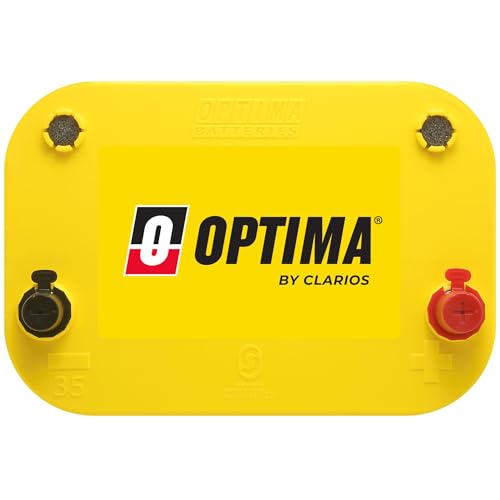
- SAE top terminals
For vehicles that need reliable starting performance but also regularly cycle the battery through audio equipment, accessories or engine-off loads, the OPTIMA D35 YELLOWTOP AGM Battery is a much better match than a conventional starting-only battery.
Specifications at a Glance
Brand: OPTIMA Batteries
Series: YELLOWTOP
Model: D35
Battery Type: Dual-Purpose AGM
Voltage: 12V
Cold Cranking Amps: 620 CCA
C20 Capacity: 48Ah
Reserve Capacity: 100 minutes
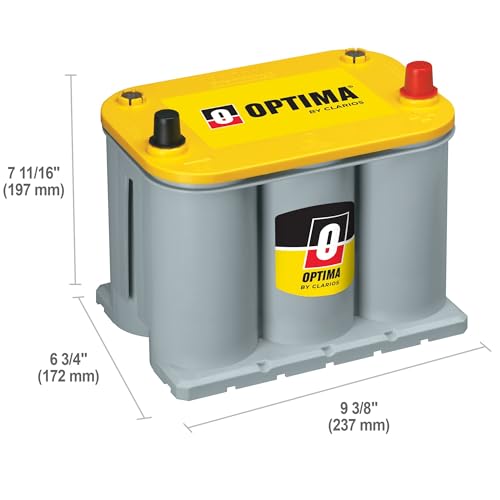
Length: 9 5/16 inches
Width: 6 13/16 inches
Height: 7 5/8 inches
Weight: 36.4 lb
Terminal Type: SAE top posts
Technology: SPIRALCELL
Primary Use: Engine starting + cyclic/deep-cycle loads
Maintenance: Maintenance-free
OPTIMA currently lists the D35 among its YELLOWTOP batteries covered by a 36-month free-replacement warranty for noncommercial automotive/light-truck and car-audio use.








There are no reviews yet.