

What Is an H7 / Group 94R Battery?
H7 and 94R are commonly used to describe the same general automotive battery size.
You’ll frequently see batteries advertised as:
H7
LN4
or:
BCI Group 94R
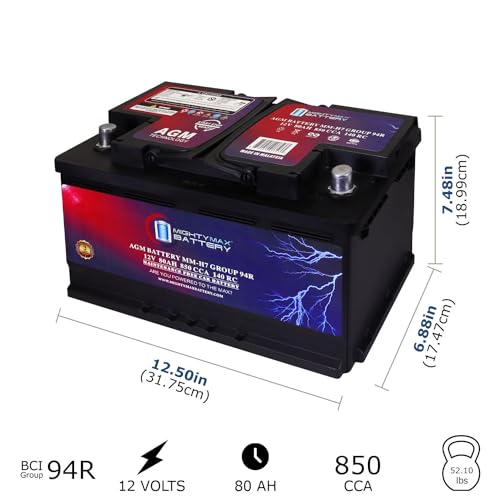
The MM-H7 measures approximately:
12.50 inches long
6.88 inches wide
7.48 inches tall
That makes it considerably longer than smaller European-format batteries such as H5 and H6.
Measure the battery tray before ordering.
850 Cold Cranking Amps
One of the strongest specifications of the MM-H7 is its:
850 CCA
Cold Cranking Amps measure the battery’s ability to supply high current under standardized cold-temperature conditions while maintaining sufficient voltage.
Strong CCA performance becomes especially important when:
- Temperatures fall
- Engine oil thickens
- Starter demand increases
- The battery ages
An 850CCA rating provides substantial starting capability for compatible applications.
However, CCA isn’t a universal fitment specification.
Always compare the battery against the minimum rating required by your vehicle manufacturer.
80Ah Battery Capacity
The Mighty Max MM-H7 provides:
80 amp-hours
That is substantial capacity for an automotive starting battery.
Modern vehicles may continue drawing electrical power even when the engine isn’t running.
Loads can include:
- Security systems
- Telematics
- Infotainment
- Keyless-entry receivers
- Body-control modules
- Driver-assistance systems
- Climate-control electronics
- Start-stop equipment
Higher capacity provides additional stored energy to support these systems.
140-Minute Reserve Capacity
The MM-H7 carries a:
140-minute reserve-capacity rating
Reserve capacity indicates how long a fully charged battery can supply a standardized 25-amp load before reaching its specified cutoff voltage.
A larger reserve can be particularly useful in modern vehicles with substantial electrical demand.
It also provides additional electrical endurance if the alternator stops charging.
That doesn’t mean you should keep driving indefinitely with the battery warning light illuminated.
You’re operating on borrowed electrons at that point.
Designed for Start-Stop Applications
The MM-H7 is marketed for compatible vehicles using automatic start-stop technology.
Start-stop operation places considerably more cycling demand on a battery than a conventional starting system.
During normal driving, the engine may stop and restart repeatedly while systems such as:
- Climate control
- Lighting
- Infotainment
- Safety electronics
- Vehicle computers
remain active.
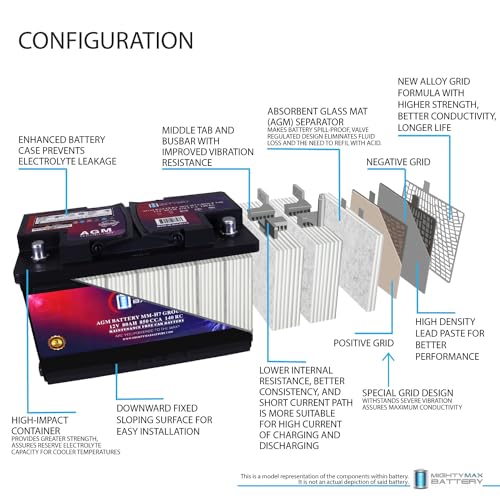
AGM batteries are commonly used in these applications because they offer better cycling capability and charge acceptance than traditional flooded starting batteries.
AGM Technology
AGM stands for:
Absorbent Glass Mat
In an AGM battery, electrolyte is held within fiberglass separators between the battery plates instead of freely moving around the battery case.
Advantages can include:
- Strong starting output
- Improved cycling capability
- Better vibration resistance
- Spill-resistant construction
- Good charge acceptance
- Maintenance-free operation
These characteristics make AGM batteries particularly useful in newer vehicles with complex electrical systems.
Deep-Discharge Recovery Does Not Make It a Dedicated Deep-Cycle Battery
Mighty Max advertises the MM-H7 as having good:
deep-discharge recovery
That’s useful, particularly in start-stop service.
However, I would not market the MM-H7 as a dedicated deep-cycle battery.
Its primary role is still:
automotive starting and start-stop operation
A dedicated deep-cycle battery is a better choice for applications involving repeated extended discharges, such as:
- RV house systems
- Solar storage
- Marine house loads
- Large engine-off inverters
Repeatedly running an automotive battery completely flat will still shorten its lifespan.
High Discharge Output
Starting an engine requires a tremendous amount of current over a short period.
The MM-H7’s combination of:
850 CCA
and:
AGM construction
is designed specifically for this type of high-current demand.
A healthy battery should maintain enough voltage during cranking for the starter and vehicle electronics to operate correctly.
Strong Vibration Resistance
Mighty Max describes the MM-H7 as being designed to withstand:
- Shock
- Vibration
- Harsh operating environments
- Temperature changes
Vibration resistance matters because repeated physical movement can damage internal battery components.
The battery must still be securely attached to the factory hold-down.
A battery bouncing around the engine bay isn’t an advanced suspension component.
Maintenance-Free Design
The sealed AGM design means there is no routine requirement to:
- Add water
- Check electrolyte levels
- Open battery caps
You should still periodically inspect:
- Battery terminals
- Cables
- Ground connections
- Battery case
- Hold-down hardware
- Charging voltage
Maintenance-free refers to electrolyte maintenance, not the entire electrical system.
Spill-Resistant AGM Construction
Because the electrolyte is absorbed into the internal glass mat, AGM batteries provide greater resistance to leakage than conventional serviceable flooded batteries.
This can be especially useful when batteries are installed:
- Under the hood
- In the trunk
- Under a seat
- Beneath a cargo floor
Always retain factory venting arrangements when the vehicle requires them.
Flexible Mounting
Mighty Max states that the MM-H7 can be mounted in multiple positions but should not be installed upside down.
That provides more installation flexibility than a traditional flooded battery.
However, automotive battery fitment still needs to follow the vehicle manufacturer’s requirements.
Check:
- Battery orientation
- Vent connection
- Hold-down
- Terminal clearance
- Cable routing
The ability to mount a battery differently does not automatically make a different mounting position appropriate for your vehicle.
Check the H7 Dimensions
The advertised dimensions are:
12.50 × 6.88 × 7.48 inches
Compare those dimensions with the battery currently installed.
Pay particular attention to length.
An H7 battery is substantially longer than smaller European-format batteries.
Check:
- Tray dimensions
- Hold-down location
- Terminal position
- Cable reach
- Hood clearance
- Vent connection
H5, H6, H7 and H8 Are Not the Same Size
This is important when shopping for European-format automotive batteries.
The sizes progressively get longer.
An H7 should not automatically be substituted for an H6 simply because the terminal orientation looks correct.
Some vehicles have battery trays capable of accepting multiple sizes.
Others don’t.
Verify the exact application.
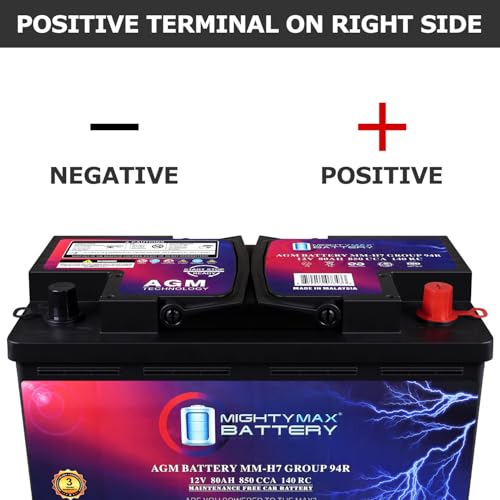
Left-Negative / Right-Positive Polarity
The MM-H7 uses:
Negative terminal: left
Positive terminal: right
when viewed from the terminal side in the specified orientation.
Compare this arrangement directly with your existing battery.
Never force battery cables to reach an incorrect terminal configuration.
Does Your Vehicle Require AGM?
If the factory battery is AGM, the safest replacement is generally another correctly specified AGM battery.
Replacing an AGM battery with a conventional flooded battery may affect:
- Start-stop operation
- Battery lifespan
- Charge acceptance
- Cycling performance
- Energy-management behavior
Check the original battery label before ordering.
Battery Registration May Be Required
This becomes particularly important with H7/94R batteries because they’re commonly found in newer vehicles with intelligent charging systems.
Some vehicles need the replacement battery registered with the battery-management system.
Our What Is Battery Registration, and Does Your Car Need It? guide explains why.
Battery registration can tell the vehicle that a new battery has been installed so its charging strategy can be adjusted appropriately.
Match the Battery Capacity When Coding
Some vehicles allow battery capacity and chemistry to be coded separately.
If the original battery was:
AGM 80Ah
then another correctly sized:
AGM 80Ah
replacement can simplify compatibility.
Don’t assume that physically fitting the battery completes the replacement procedure.
Modern cars have managed to make even battery replacement involve software.
Battery Light On?
If your battery warning light stays illuminated while the engine is running, replacing the battery may not fix the underlying problem.
The warning usually relates to the charging system.
Potential causes include:
- Alternator failure
- Voltage regulator failure
- Broken belt
- Charging-cable damage
- Poor ground
- Battery sensor problem
- Main charging fuse failure
Our Why Is My Battery Light On? guide explains how to diagnose the system.
Check the Fusible Link Before Condemning the Alternator
High-current charging circuits frequently use:
- Fusible links
- Mega fuses
- Strip fuses
- Battery-mounted fuse blocks
An open circuit can prevent alternator output from reaching the battery.
Our What Is a Fusible Link? Fusible Link vs. Fuse Explained guide explains what these devices do and how they differ from ordinary fuses.
Rapid Clicking When Starting
Rapid clicking is often caused by system voltage dropping below what the starter solenoid requires.
Possible causes include:
- Discharged battery
- Weak battery
- Loose terminal
- Corroded cable
- Bad ground
- Starter fault
- Charging-system problem
Our Rapid Clicking When Starting a Car diagnostic guide walks through the problem.
A load test or cranking-voltage test can reveal problems that resting voltage won’t.
Car Has Power but Won’t Start
Dashboard lights don’t prove a battery is healthy.
The starter can require hundreds of amps.
Interior electronics need only a fraction of that current.
If your vehicle has power but won’t crank, use our Car Has Power but Won’t Start guide.
The problem could involve:
- Battery
- Starter
- Relay
- Wiring
- Ground
- Ignition switch
- Immobilizer
Diagnose Before Buying Another Battery
Starting and charging problems are frequently misdiagnosed.
Our Diagnose the Car Before Replacing Parts guide explains why basic testing should come before parts replacement.
Check:
- Resting battery voltage
- Cranking voltage
- Charging voltage
- Voltage drop
- Parasitic current
The parts cannon remains remarkably effective at turning diagnostic uncertainty into shipping notifications.
MM-H7 and Car Audio Systems
An 80Ah AGM battery provides useful electrical capacity for vehicles with aftermarket audio equipment.
It can help support:
- Amplifiers
- DSP processors
- Additional electronics
Our Car Audio System Guide explains how the battery, alternator and wiring work together.
Remember that the battery does not increase alternator output.
A high-powered audio system may still require:
- High-output alternator
- Larger power cable
- Improved grounds
- Proper circuit protection
Check Alternator Capacity
An 80Ah battery can store a substantial amount of energy.
But once discharged, that energy has to be replaced.
If the vehicle continuously consumes more current than the alternator produces, the battery will eventually discharge regardless of capacity.
Before adding large electrical loads, understand the charging system’s actual output.
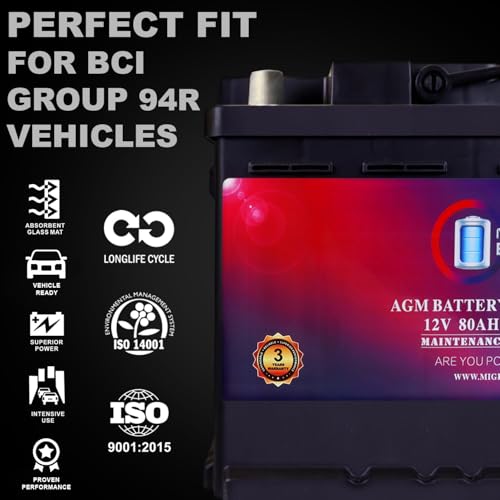
3-Year Warranty
Mighty Max advertises the MM-H7 with a:
3-year warranty
Before purchase, review the complete warranty terms for:
- Replacement coverage
- Commercial-use exclusions
- Proof-of-purchase requirements
- Shipping responsibility
- Installation requirements
Warranty length is useful, but the complete terms determine what is actually covered.
ISO-Certified Manufacturing and CE Compliance
Mighty Max states that its batteries are produced in an ISO-certified facility and designed to meet applicable CE requirements.
These manufacturing and compliance claims can provide useful context when comparing replacement batteries.
However, certification does not replace proper application matching.
The battery still needs to meet the vehicle manufacturer’s specifications.
Who Should Buy the Mighty Max MM-H7?
The MM-H7 makes the most sense for vehicles requiring approximately:
H7 / Group 94R dimensions
12V AGM technology
80Ah capacity
and:
850CCA starting output
It is particularly attractive for compatible vehicles with:
- Automatic start-stop
- Large factory electrical systems
- Extensive electronics
- Moderate aftermarket accessories
- High starting-current requirements
Why Buy the Mighty Max MM-H7?
Key specifications include:
- H7 / BCI Group 94R size
- 12V AGM construction
- 80Ah capacity
- 850 Cold Cranking Amps
- 140-minute reserve capacity
- Start-stop capability
- High-discharge output
- Deep-discharge recovery capability
- Maintenance-free construction
- Spill-resistant AGM design
- Shock and vibration resistance
- Left-negative/right-positive polarity
- 3-year advertised warranty
For a vehicle originally designed around an H7/94R AGM battery, the Mighty Max MM-H7 offers an impressive combination of starting current, capacity and reserve performance.
Specifications at a Glance
Brand: Mighty Max Battery
Model: MM-H7
BCI Group: 94R
DIN Size: H7
Battery Type: AGM
Voltage: 12V
Capacity: 80Ah
Cold Cranking Amps: 850 CCA
Reserve Capacity: 140 minutes
Length: 12.50 inches
Width: 6.88 inches
Height: 7.48 inches
Terminal Layout: Left Negative / Right Positive
Primary Application: Automotive starting / compatible start-stop vehicles
Maintenance: Maintenance-free
Warranty: 3 years, according to Mighty Max
Always verify exact year, make, model, engine, battery size and factory battery requirements before ordering.





There are no reviews yet.