
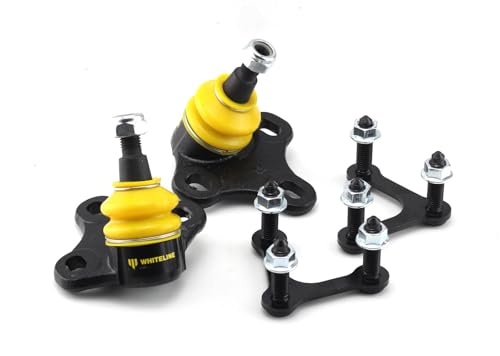
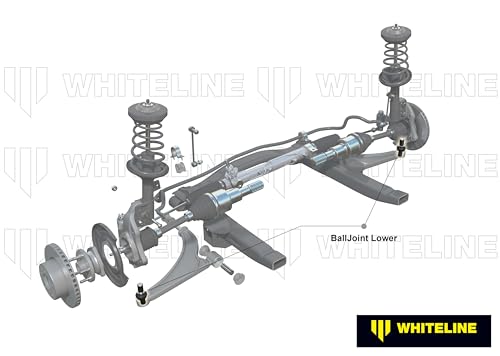
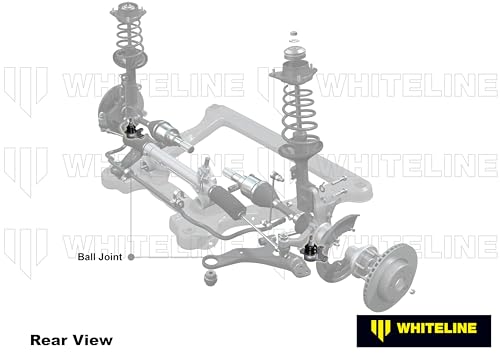
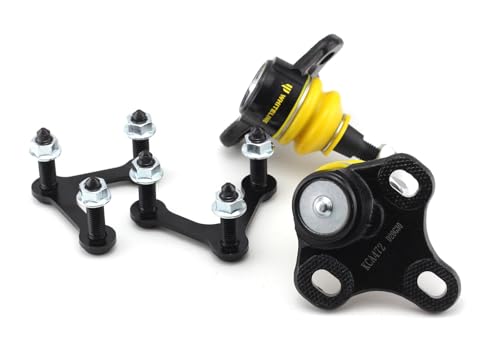
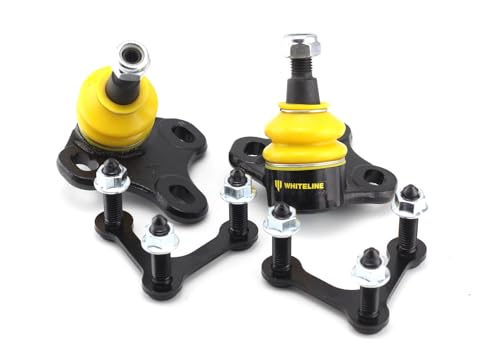
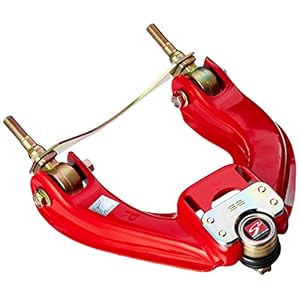
What Does the Whiteline KCA472 Do?
Lowering changes more than ride height.
When a Golf is lowered, the relationship between the:
- Control arms
- Ball joints
- Steering tie rods
- Steering knuckles
- Chassis mounting points
also changes.
Those changes can affect:
Roll center
Bump steer
Camber behavior
Suspension travel
and ultimately how effectively the front tires remain in contact with the road during hard cornering.
The KCA472 is designed to address those geometry changes.
What Is Roll Center?
Roll center is a theoretical point determined by suspension geometry around which the vehicle body tends to roll.
The relationship between the vehicle’s center of gravity and roll center influences how the chassis reacts to lateral acceleration.
Lowering a vehicle changes suspension-arm angles.
That can move the roll center.
And importantly, the roll center doesn’t necessarily move downward by the same amount as the body.
On some suspension designs, lowering the car substantially can move the roll center enough to increase the effective distance between it and the vehicle’s center of gravity.
That’s the roll moment arm.
A larger roll moment can increase the chassis’ tendency to roll even though the car itself sits lower.
Yes, you can lower a car and accidentally make part of its suspension geometry worse.
Physics remains deeply inconsiderate of Instagram.
Why Correct Roll Center on a Lowered Golf?
Whiteline’s KCA472 is designed to raise the front roll center toward a more favorable position after the suspension has been lowered.
Correcting the roll center can help reduce excessive suspension compression at the heavily loaded outside front tire during cornering.
Potential benefits include:
- Improved front-end grip
- Reduced body roll tendency
- More consistent tire loading
- Improved cornering response
- Better steering behavior
- Improved tire contact
- More predictable suspension movement
This becomes increasingly valuable as grip levels increase.
A Golf running ordinary street tires at commuting speeds places considerably less demand on suspension geometry than one running sticky tires at an autocross or track day.
What Is Bump Steer?
Bump steer describes a change in wheel toe as the suspension moves through compression and rebound.
Ideally, suspension movement should produce controlled and predictable toe behavior.
But changing ride height changes the relationship between suspension and steering components.
If those components move through incompatible arcs, the wheel can steer slightly as the suspension travels.
That means the vehicle can change direction even though the driver hasn’t changed steering-wheel position.
That’s bump steer.
What Does Bump Steer Feel Like?
Excessive bump steer can make a vehicle feel:
- Nervous over uneven pavement
- Unstable during compression
- Inconsistent through corners
- Sensitive to bumps
- Difficult to place precisely
- Unpredictable during aggressive driving
The driver may feel like the steering is reacting to road imperfections rather than simply transmitting information about them.
On a significantly lowered car, correcting suspension geometry can therefore be more useful than adding another component whose primary engineering specification is “stiffer.”
Additional Negative Camber
The KCA472 also provides approximately half a degree of additional negative camber adjustment.
Negative camber means the top of the wheel leans inward relative to the bottom when viewed from the front.
During cornering, the outside tire experiences substantial lateral loading.
Body roll and suspension movement can cause the tire’s contact patch to become less favorable relative to the pavement.
Adding appropriate negative camber helps maintain tire contact during hard cornering.
Potential benefits include:
- Improved cornering grip
- Better outside-tire contact
- More predictable front-end response
- Reduced outside-edge tire wear during aggressive driving
But more negative camber isn’t automatically better.
The correct setting depends on the vehicle’s:
- Ride height
- Tires
- Suspension
- Driving environment
- Alignment
- Intended use
Better Tire Contact During Cornering
One of the KCA472’s main objectives is maintaining a more effective front tire contact patch.
During aggressive cornering, the outside front tire carries a substantial portion of the vehicle’s lateral load.
That’s especially important on a front-wheel-drive Golf because the front tires may simultaneously be responsible for:
Steering
Cornering
Acceleration
and potentially most of the braking load.
Asking the front tires to do everything while giving them poor suspension geometry isn’t exactly helping.
Roll-center correction and additional camber can help the front suspension use available tire grip more effectively.
Is KCA472 Only for Lowered Cars?
That’s where this product makes the most sense.
The KCA472 is specifically intended as a geometry correction kit, so its value increases when ride height has been altered enough to affect control-arm and steering geometry.
A stock-height Golf doesn’t necessarily need correction for a geometry problem it doesn’t have.
For a lowered vehicle, however, correcting geometry can become an important part of completing the suspension setup.
Lowering Springs and Roll Center
Moderate lowering springs can improve:
- Appearance
- Center-of-gravity height
- Spring rate
- Body control
But lowering also changes suspension-arm angles.
The further the vehicle is lowered, the more important it becomes to understand those geometry changes.
Pro Street’s Complete Guide to Lowering Springs explains how ride height affects suspension behavior and why the lowest setup isn’t necessarily the fastest.
KCA472 With Coilovers
The KCA472 can be particularly relevant for Golfs running adjustable coilovers.
Coilovers make changing ride height easy.
Unfortunately, the suspension doesn’t receive an email informing it that you’ve changed the geometry.
Lowering the chassis significantly may require correcting:
- Roll center
- Bump steer
- Camber
- Toe
- Suspension travel
This is why a properly developed lowered car involves considerably more than measuring the fender-to-ground distance.
Roll Center Correction vs. Stiffer Springs
These modifications solve different problems.
Stiffer Springs
Increase resistance to suspension compression and body movement.
Roll Center Correction
Changes the geometric relationship between suspension components and the chassis.
You can install extremely stiff springs to control unwanted body movement created partly by poor geometry.
Or you can correct the geometry and allow the springs and dampers to operate from a more favorable starting point.
For serious performance builds, geometry matters.
Does KCA472 Improve Turn-In?
It can contribute to better front-end response.
Correcting roll-center behavior and adding appropriate negative camber can improve the way the outside front tire loads during cornering.
That can make the front end feel:
More immediate
More planted
More consistent
More predictable
Especially during aggressive driving.
Can It Reduce Understeer?
Potentially.
Understeer occurs when the front tires reach their available cornering grip before the rear tires.
Improving front tire contact and suspension geometry can increase the front axle’s ability to generate lateral grip.
That’s particularly useful on a front-wheel-drive Golf.
However, handling balance depends on the entire vehicle.
That includes:
- Tires
- Alignment
- Springs
- Dampers
- Sway bars
- Bushings
- Differential
- Vehicle weight
- Driver inputs
No ball joint possesses supernatural powers.
Tire Wear Benefits
Whiteline also identifies tire wear as a potential benefit.
That might sound strange considering the kit can add negative camber.
But tire wear during aggressive driving isn’t simply determined by static camber.
If the outside tire rolls heavily onto its outer shoulder during cornering, it can rapidly wear that section of tread.
Maintaining a more favorable contact patch under load can help distribute wear more evenly during performance driving.
For a street-only car, alignment settings should remain appropriate for everyday use.
Installation
Installing the KCA472 is more involved than installing a sway bar or strut brace because you’re modifying critical suspension geometry components.
Typical installation considerations include:
- Safely raise and support the vehicle.
- Remove the appropriate front suspension components.
- Remove the factory ball joints.
- Install the Whiteline correction components according to the supplied instructions.
- Verify component orientation.
- Torque all suspension fasteners correctly.
- Verify steering and suspension clearance.
- Set ride height.
- Perform a complete professional alignment.
Because the kit directly influences geometry, installation accuracy matters.
This isn’t the component where “looks about right” qualifies as an alignment specification.
Alignment Is Required
After installing KCA472, a professional wheel alignment should be considered mandatory.
At minimum, verify:
- Front camber
- Front toe
- Caster
- Steering-wheel centering
- Left-to-right differences
If the vehicle is used for track days or autocross, alignment settings can then be optimized around tire temperature and wear data.
For a street vehicle, use more conservative specifications to maintain stability and tire life.
Corner Balancing a Modified Golf
If the Golf is equipped with height-adjustable coilovers and is being built for serious performance driving, consider having the vehicle corner balanced before final alignment.
Corner balancing adjusts individual ride heights to optimize weight distribution across the four tires.
A comprehensive chassis setup might therefore follow this sequence:
Set ride height
→ Install geometry correction components
→ Corner balance
→ Perform alignment
→ Test
→ Fine-tune
That’s considerably more productive than lowering the car until the tires disappear behind the fenders and declaring victory.
Build a Complete Golf Suspension
The KCA472 works best as part of a properly planned suspension package.
Depending on the intended use, complementary modifications can include:
- Performance tires
- Lowering springs
- Coilovers
- Performance dampers
- Sway bars
- Performance bushings
- Upgraded end links
- Chassis bracing
- Limited-slip differential
- Performance alignment
For a street-oriented build, Pro Street’s Daily Driver Suspension Setup That Actually Works provides a useful framework for improving handling without destroying ride quality.
Who Should Buy Whiteline KCA472?
The KCA472 makes the most sense for drivers with a lowered compatible Volkswagen Golf who want to address suspension geometry rather than simply continue adding stiffness.
It’s particularly relevant for:
Lowered street cars
where geometry has been altered by springs or coilovers.
Autocross Golfs
where front tire contact and steering precision are critical.
Track-day builds
where consistent suspension behavior under high lateral load matters.
Aggressively lowered vehicles
where control-arm and steering geometry have moved substantially away from their original positions.
Is the Whiteline KCA472 Worth It?
For the right lowered Volkswagen Golf, the Whiteline KCA472 Front Roll Center and Bump Steer Correction Kit addresses something many suspension builds overlook:
geometry.
Lowering a car changes the position of suspension components.
Correcting those changes can help the suspension operate closer to the geometry engineers intended while still retaining the benefits of reduced ride height.
The KCA472 offers:
Front roll-center correction
Bump-steer correction
Approximately 0.5° additional negative camber adjustment
Improved front tire contact
Better performance-oriented suspension geometry
For a mildly lowered street car, it may be one component among many.
For a heavily modified Golf used for autocross or track days, correcting geometry can be substantially more valuable than simply installing even stiffer springs.
Because at some point, the solution to suspension geometry isn’t another spring rate.
It’s geometry.
Shop Volkswagen suspension, chassis and performance components through Pro Street Online.






There are no reviews yet.