

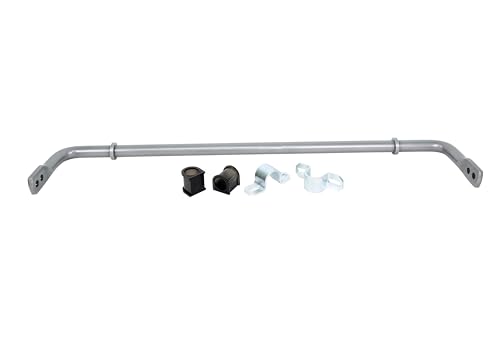
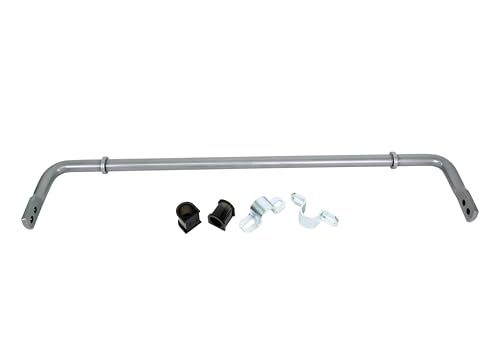
What Vehicles Fit Whiteline BHR98XXZ?
The Whiteline BHR98XXZ is designed specifically around the high-performance Hyundai Elantra N application.
| Years | Make | Model | Engine |
|---|---|---|---|
| 2022 | Hyundai | Elantra N | 2.0L Turbo |
| 2023 | Hyundai | Elantra N | 2.0L Turbo |
| 2024 | Hyundai | Elantra N | 2.0L Turbo |
| 2025 | Hyundai | Elantra N | 2.0L Turbo |
Important: Don’t automatically list this as fitting the standard Elantra, Elantra N Line or Elantra Hybrid. The Elantra N is a distinct performance application with chassis and suspension differences.
For your Pro Street product database, I’d list the primary fitment simply as:
2022–2025 Hyundai Elantra N 2.0L Turbo
Why Upgrade the Elantra N Rear Sway Bar?
The Elantra N already has a sophisticated performance chassis.
But changing rear roll stiffness allows the driver to alter how the vehicle distributes cornering load between the front and rear axles.
A larger performance rear sway bar can provide:
- Reduced body roll
- Sharper transitional response
- Increased rear roll stiffness
- More responsive rotation
- Reduced tendency toward understeer
- Greater chassis-tuning flexibility
For a front-wheel-drive performance car, that’s particularly useful.
How Does a Rear Sway Bar Work?
The sway bar connects the left and right sides of the suspension.
During straight-line driving, when both wheels move in roughly the same direction, the bar has relatively little influence.
During cornering, however, the outside suspension compresses while the inside suspension unloads.
That difference twists the sway bar.
The bar resists that twisting motion, effectively increasing roll stiffness.
A larger or stiffer bar provides greater resistance.
The result is reduced body roll and a change in handling balance.
Why Increase Rear Roll Stiffness on a Front-Wheel-Drive Car?
Front-wheel-drive vehicles naturally place enormous demands on their front tires.
The front tires may be responsible for:
Steering
Acceleration
Cornering
and most of the vehicle’s braking.
During aggressive cornering, the front tires can become overloaded before the rear tires.
That’s understeer.
Increasing rear roll stiffness can shift some of the handling balance toward the rear axle and make the car more willing to rotate.
The result can be a more neutral chassis.
27mm Rear Sway Bar
The BHR98XXZ uses a substantial 27mm rear stabilizer bar.
Diameter matters because sway-bar torsional stiffness changes significantly as bar diameter increases.
However, diameter isn’t the only factor determining effective stiffness.
Actual performance also depends on:
- Bar material
- Bar geometry
- Lever-arm length
- Mounting location
- Adjustment position
So don’t assume that every 27mm bar behaves identically.
Whiteline engineered the BHR98XXZ specifically for the Elantra N chassis.
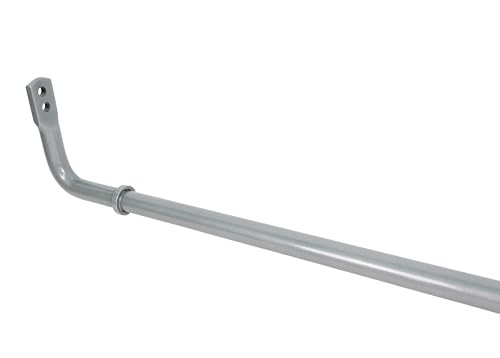
Two-Position Adjustment
One of the most useful features of BHR98XXZ is its two-position adjustment.
Changing the sway-bar end-link mounting location changes the effective lever arm.
Generally:
Longer effective arm = softer
Shorter effective arm = stiffer
That gives Elantra N owners another suspension tuning variable.
Softer Setting
For most street-driven cars, start here.
The softer position generally provides:
- More conservative rear behavior
- Reduced body roll compared with stock
- Less aggressive rotation
- Better tolerance for uneven pavement
- More predictable wet-road behavior
Stiffer Setting
The firmer position can provide:
- Faster chassis rotation
- Greater rear roll stiffness
- Sharper transitions
- Reduced understeer
- More aggressive performance behavior
More stiffness isn’t automatically faster.
The correct setting depends on tires, alignment, dampers, track conditions and driver preference.
Can the BHR98XXZ Reduce Understeer?
That’s one of the main reasons to install a larger rear sway bar on a front-wheel-drive performance car.
Increasing rear roll stiffness can help change the car’s front-to-rear handling balance.
The Elantra N may feel more willing to rotate into a corner rather than asking the front tires to carry virtually the entire conversation.
That’s particularly valuable during:
- Autocross
- Tight track sections
- Canyon driving
- Fast transitions
- Corner entry
But remember that changing handling balance works in both directions.
What About Lift-Off Oversteer?
Increasing rear roll stiffness can make a front-wheel-drive vehicle more responsive when the driver suddenly lifts the throttle during cornering.
Weight transfers forward.
Rear tire loading changes.
The chassis can rotate.
With a larger rear sway bar, that rotation may occur more readily.
Experienced drivers may use this behavior deliberately.
Inexperienced drivers should learn the vehicle’s new balance gradually.
Start with the softer setting and get familiar with the car before deciding that the stiffest possible setting is obviously better because race car.
Does the Elantra N Need a Rear Sway Bar?
“Need” is doing some heavy lifting.
The stock Elantra N is already an extremely capable performance sedan.
This upgrade makes more sense for drivers who want to tune its existing handling characteristics.
It’s particularly relevant for:
Autocross competitors
who want faster rotation through tight transitions.
Track-day drivers
who want additional chassis adjustability.
Performance street builds
where steering and chassis response are priorities.
Modified Elantra N builds
running upgraded tires, alignment and suspension components.
Rear Sway Bar vs. Lowering Springs
These modifications influence different parts of vehicle behavior.
Lowering Springs
Primarily affect:
- Ride height
- Center of gravity
- Spring rate
- Suspension travel
- Vertical body movement
Rear Sway Bar
Primarily affects:
- Roll stiffness
- Chassis balance
- Left-to-right suspension interaction
- Understeer/oversteer characteristics
That’s why the two modifications can work together.
Pro Street’s Complete Guide to Lowering Springs explains how lowering influences suspension geometry and handling.
Does a Larger Sway Bar Ruin Ride Quality?
One advantage of sway-bar tuning is that it can increase roll stiffness without dramatically increasing vertical spring rate.
When both rear wheels move together, the sway bar contributes relatively little additional resistance.
When the wheels move differently, the bar becomes active.
That means a larger sway bar can reduce body roll while retaining more straight-line ride comfort than substantially stiffer springs.
However, single-wheel bumps may become more noticeable.
You don’t get additional roll stiffness completely free.
Physics apparently has refused to join the rewards program.
Pairing BHR98XXZ With Better Tires
Before chasing suspension adjustments, remember that the tires ultimately create the grip.
A performance rear sway bar can improve how the chassis uses available tire grip, but it can’t create traction beyond what the tires can provide.
For an Elantra N used aggressively, prioritize:
- Quality performance tires
- Proper tire pressures
- Correct alignment
- Suspension tuning
- Driver development
Then start fine-tuning chassis balance.
Alignment Considerations
Installing a rear sway bar by itself doesn’t normally change static:
- Camber
- Caster
- Toe
Therefore, an alignment isn’t automatically required solely because BHR98XXZ was installed.
However, if you’re simultaneously installing:
- Lowering springs
- Coilovers
- Adjustable control arms
- Camber components
- Other suspension geometry parts
then have the vehicle professionally aligned afterward.
Installation
Whiteline describes the BHR98XXZ as designed for straightforward vehicle-specific installation.
Typical installation involves:
- Safely raise and support the vehicle.
- Locate the factory rear stabilizer bar.
- Disconnect the rear end links.
- Remove the factory sway-bar mounting brackets.
- Remove the original stabilizer bar.
- Install the appropriate bushings and hardware.
- Position the Whiteline 27mm bar.
- Reconnect the end links.
- Select the desired adjustment position.
- Torque all hardware to specification.
- Verify clearance through suspension movement.
Always follow Whiteline’s supplied installation procedure and Hyundai torque specifications.
Inspect the End Links
A larger performance sway bar can place greater loads through the end links.
Inspect the factory links for:
- Play
- Torn boots
- Bent studs
- Loose joints
- Corrosion
- Damaged threads
For aggressive track use, upgraded end links may eventually become a worthwhile complementary modification.
Street Setup
For a street-driven Elantra N, the softer position is the logical starting point.
Drive the car in different conditions before changing anything.
Pay attention to:
- Corner entry
- Mid-corner balance
- Throttle-off behavior
- Uneven pavement
- Wet-road response
- High-speed transitions
Then decide whether additional rear stiffness actually improves the car.
Suspension tuning works considerably better when adjustments are based on vehicle behavior instead of “I paid for two holes, therefore we’re using the aggressive one.”
Autocross Setup
The BHR98XXZ should be especially interesting for autocross.
Autocross rewards:
- Quick rotation
- Rapid transitions
- Immediate steering response
- Controlled body movement
Front-wheel-drive cars can benefit from rear roll stiffness because it helps reduce front-end push during tight transitions.
The adjustable design gives drivers another tuning option as tire grip and surface conditions change.
Track-Day Setup
Track driving places sustained loads on the chassis.
A well-balanced setup should consider:
Tires + pressures + alignment + springs + dampers + sway bars + brakes + driver input.
Use the BHR98XXZ as a tuning tool rather than treating maximum rear stiffness as an automatic upgrade.
A high-speed track may favor different balance than a tight autocross course.
That’s why adjustability matters.
Build a Balanced Elantra N Suspension
The best suspension package isn’t necessarily the stiffest one.
For a performance street Elantra N, consider the complete system:
- Performance tires
- Alignment
- Springs or coilovers
- Dampers
- Sway bars
- Bushings
- End links
Pro Street’s Daily Driver Suspension Setup That Actually Works explains why maintaining suspension compliance can actually produce more usable grip on imperfect roads.
Is the Whiteline BHR98XXZ Worth It?
For a 2022–2025 Hyundai Elantra N, the Whiteline BHR98XXZ offers a straightforward way to add another level of chassis tuning.
You get:
27mm rear sway bar
Two-position adjustability
Increased rear roll stiffness
Reduced body roll
Greater chassis rotation
Potentially reduced understeer
Vehicle-specific installation
The Elantra N doesn’t need to be rescued from bad factory handling.
Far from it.
The BHR98XXZ is for drivers who want to take an already capable chassis and tune its behavior around their tires, driving style and intended use.
And that’s usually a much better reason to modify suspension than simply buying whatever part has the largest diameter printed on the box.
Shop Hyundai and performance suspension components through Pro Street Online.







There are no reviews yet.