
There is one wrinkle: Subaru specialists also list KTA291 for the 2008–2010 STI, while maintaining 2011–2014 for the WRX.
For Pro Street’s vehicle database, I’d therefore use 2011–2014 WRX/WRX STI as the conservative manufacturer-confirmed U.S. application, then separately verify 2008–2010 STI fitment before enabling those years.
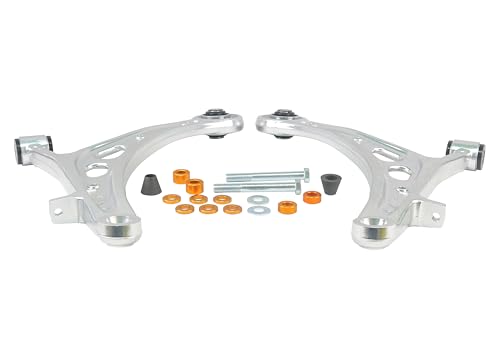
Whiteline KTA291 Specifications
Part Number: KTA291
Position: Front
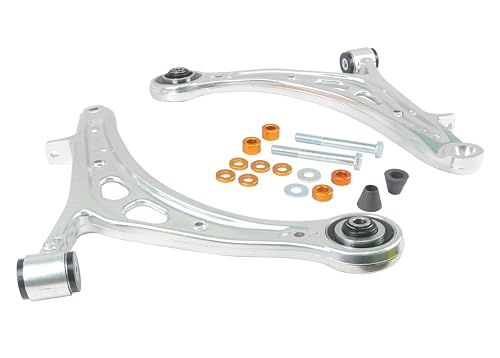
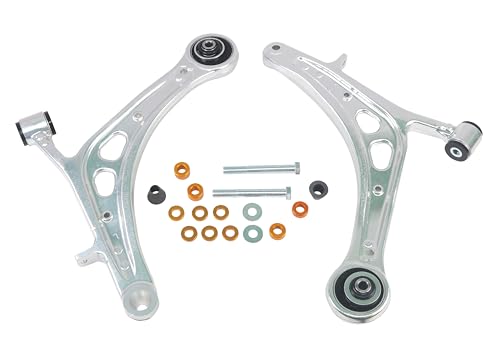
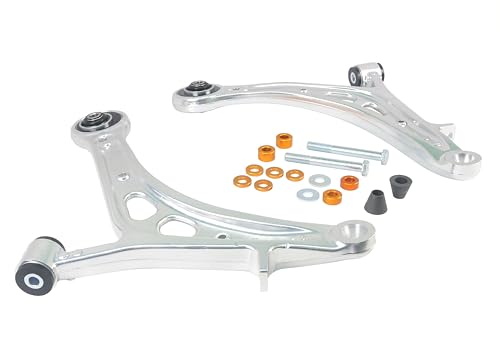
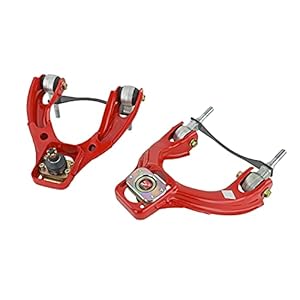
Component: Lower control-arm pair
Construction: Lightweight alloy
Quantity: 2 arms
Geometry: Fixed performance geometry
Caster: +0.5° fixed caster
Additional Feature: Anti-lift correction
Alignment Required: Yes
Installation Time: Approximately 3 hours
Recommended Installation: Suspension specialist
Important: Whiteline specifies models without headlight-leveling sensor.
That last detail belongs prominently in your ProStreetOnline listing. It’s exactly the sort of tiny fitment qualifier that becomes considerably less tiny after somebody discovers it halfway through installation.
Why Replace the Factory WRX Control Arms?
A lower control arm determines important aspects of front suspension geometry while locating the wheel as the suspension moves.
Under hard cornering, the arm must resist substantial longitudinal and lateral forces.
Whiteline designed KTA291 to improve several areas simultaneously:
- Reduce control-arm weight
- Increase steering precision
- Reduce unwanted toe change
- Improve suspension geometry
- Increase caster
- Provide anti-lift geometry
- Improve turn-in response
The result is considerably different from simply replacing a worn factory arm with another OE-style component.
Lightweight Alloy Construction
One of KTA291’s major selling points is its alloy construction.
Whiteline says these arms provide a substantial weight reduction compared with the original equipment components. Because some of the control arm’s mass contributes to unsprung suspension weight, reducing it can improve the suspension’s ability to react to road inputs.
It’s conceptually similar to reducing wheel weight.
Less mass for the suspension to control can improve responsiveness without simply making everything stiffer.
+0.5 Degrees of Caster
Whiteline builds +0.5 degrees of fixed caster into the KTA291 geometry.
Caster is the fore-aft inclination of the steering axis when viewed from the side of the vehicle.
Increasing positive caster can contribute to:
- Better directional stability
- Improved steering feel
- Increased dynamic negative camber during steering
- Better front tire contact while cornering
That makes caster particularly useful on performance-oriented WRX and STI setups.
Why Caster Helps Cornering Grip
When you turn the steering wheel, caster affects how the outside front wheel changes camber.
Additional positive caster can generate more favorable dynamic camber during cornering.
That can help keep the outside tire’s contact patch working effectively when the car is heavily loaded.
This is especially useful on a front-heavy AWD performance platform where extracting front-end grip is critical.
Anti-Lift Geometry
Whiteline also identifies KTA291 as providing anti-lift correction.
Anti-lift geometry changes how suspension forces react during acceleration.
On a powerful AWD car, controlling suspension movement under acceleration can help make the chassis feel more composed when power is applied exiting a corner.
It’s not adding grip out of thin air.
It’s changing how the suspension uses the grip already available.
Improved Steering Precision
Whiteline uses an oversized heavy-duty crush tube in the forward bushing location.
The objective is reducing unwanted movement of the control arm during hard cornering.
Whiteline specifically describes a reduction in toe change, contributing to sharper steering precision and improved turn-in.
That’s important because alignment isn’t simply a static number measured while the vehicle sits on an alignment rack.
Bushings and suspension components deform under load.
The less unwanted movement occurring under cornering forces, the more consistently the suspension can maintain its intended geometry.
Synthetic Elastomer Rear Bushings
The rear-mounted bushing combines Whiteline’s synthetic elastomer material with a sealed bearing assembly.
This allows the control arm to move through its intended suspension arc while controlling unwanted movement in other directions.
That’s a more sophisticated approach than simply making every bushing brutally stiff.
Suspension components still need to move.
The trick is allowing movement in the direction the engineer intended rather than every direction physics can negotiate.
KTA291 for Street Cars
These arms aren’t limited to dedicated track cars.
A properly aligned street WRX can benefit from:
- More precise steering
- Improved turn-in
- Better control-arm location
- Reduced unwanted alignment movement
- Improved front suspension response
The tradeoff is that performance-oriented bushings and geometry may transmit more feedback than the original comfort-focused components.
For a street build, suspension should still be treated as a complete system.
Explore Pro Street’s suspension and handling technical content through My Pro Street.
KTA291 With Lowering Springs
These control arms can work particularly well as part of a properly developed lowered WRX or STI.
Lowering changes:
- Control-arm angle
- Suspension travel
- Roll center
- Static alignment
- Dynamic alignment behavior
That means throwing lowering springs onto the car isn’t necessarily the end of the suspension conversation.
The KTA291 arms provide engineered geometry changes intended to improve how the front suspension behaves during performance driving.
KTA291 With Coilovers
Coilovers provide considerably more setup flexibility.
A serious WRX/STI suspension package might combine:
Quality coilovers → KTA291 control arms → sway bars → adjustable links → performance alignment → corner balance
The objective isn’t accumulating the longest possible list of aftermarket components.
It’s getting the components to work together.
Wheel Alignment Is Required
Whiteline specifically lists a front wheel alignment as required after KTA291 installation.
That’s important because these arms intentionally alter suspension geometry.
After installation, verify:
- Camber
- Caster
- Toe
- Steering-wheel position
- Left/right alignment consistency
For performance use, alignment can then be optimized around tire choice and driving conditions.
Street vs. Track Alignment
The ideal alignment depends heavily on intended use.
A daily-driven WRX needs to balance:
Grip + stability + tire life
A track-focused STI can accept a more aggressive setup prioritizing:
Cornering grip + temperature management + response
KTA291 gives the suspension a stronger foundation, but the final alignment determines how that geometry is actually used.
What Else Should You Inspect?
When replacing the lower control arms, inspect:
- Ball joints
- Tie-rod ends
- Wheel bearings
- Front sway-bar links
- Sway-bar bushings
- Struts or coilovers
- Steering rack components
- CV boots
- Subframe hardware
Installing expensive alloy arms while leaving a worn ball joint in place would be an impressively inefficient way of improving steering precision.
Is Whiteline KTA291 Worth It?
For a performance-oriented 2011–2014 Subaru WRX or STI, the Whiteline KTA291 is considerably more than a replacement lower control arm.
Whiteline combines lightweight alloy construction with engineered caster and anti-lift geometry, upgraded bushings and improved control-arm location. The result is intended to reduce unwanted toe movement while making the front suspension more precise during turn-in, mid-corner and corner exit.
For enthusiasts building a serious street, autocross or track suspension, that’s exactly the kind of modification that can make the rest of the suspension package work more effectively.
Shop suspension and chassis upgrades through Pro Street Online.
For manufacturer specifications and fitment, see the clean Whiteline KTA291 product page.





There are no reviews yet.