
Why Front Control Arm Bushings Matter
The front lower control arm helps maintain the wheel’s position relative to the chassis.
Its bushings must allow controlled suspension movement while resisting unwanted deflection.
During braking, acceleration and cornering, substantial forces travel through these mounting points.
The basic load path looks like:
Tire → Hub → Control Arm → Bushings → Chassis
If the bushings are worn, the control arm can move farther than intended.
That means the wheel alignment can effectively change while you’re driving.
Symptoms of Worn Control Arm Bushings
Common symptoms can include:
- Loose steering response
- Wandering at highway speeds
- Clunking from the front suspension
- Steering movement during braking
- Uneven tire wear
- Poor straight-line stability
- Reduced steering precision
- Vibration
- Unpredictable handling
- Visible cracking in the bushings
Some symptoms overlap with worn ball joints, tie rods and wheel bearings, so inspect the entire front suspension before replacing components.
Why Bushings Affect Steering Precision
Alignment specifications are measured while the vehicle is stationary.
But suspension loads change dramatically once the vehicle starts moving.
If a worn control arm bushing allows the arm to shift under cornering load, the wheel’s effective alignment changes.
That can make steering feel vague or delayed.
The driver turns the steering wheel.
The tire generates lateral force.
The worn bushing compresses.
Then the suspension finally reacts.
Removing excessive compliance creates a more direct response.
Why Bushings Affect Braking
Control arm bushings also experience substantial longitudinal loads under braking.
As the front tires generate braking force, those forces are transmitted through the control arms.
Excessively worn bushings can allow the wheel to move fore and aft relative to the chassis.
That movement can contribute to:
- Steering instability
- Brake wander
- Changes in caster
- Reduced confidence during hard braking
Fresh performance bushings help keep the control arm positioned more consistently.
Whiteline Synthetic Elastomer Construction
Whiteline uses an advanced synthetic elastomer formulation designed around three important characteristics:
Elasticity
The bushing still needs to articulate as the suspension moves.
Memory
The material should return to its intended shape after being loaded.
Durability
Suspension bushings operate in an unpleasant environment filled with heat, dirt, moisture and repeated mechanical loading.
The objective isn’t simply making the bushing as hard as possible.
It’s controlling unwanted movement without eliminating the articulation required for normal suspension travel.
Performance Bushings vs. Factory Rubber
Factory rubber bushings are designed around a broad set of requirements.
Manufacturers have to consider:
- Ride comfort
- Noise isolation
- Vibration
- Cost
- Durability
- Handling
Performance-oriented bushings shift that compromise toward improved suspension control.
Potential advantages include:
- More direct steering
- Reduced control-arm movement
- More consistent alignment
- Improved cornering response
- Better braking stability
The tradeoff can be a modest increase in noise, vibration or harshness depending on the vehicle and suspension configuration.
Restoring an Older Suspension
Performance bushings aren’t only useful for heavily modified vehicles.
Replacing deteriorated original bushings can make an enormous difference on an older car.
Rubber deteriorates with:
- Age
- Heat
- Oil contamination
- Ozone
- Mileage
- Repeated suspension movement
A vehicle can have relatively low mileage and still have badly deteriorated bushings simply because of age.
W53312 With Lowering Springs
Lowering springs typically increase the importance of maintaining accurate suspension geometry.
Reduced ride height changes the control arm’s operating position and can increase loads on aging bushings.
Fresh control arm bushings help ensure the suspension reacts predictably at its new ride height.
W53312 With Coilovers
Coilovers can increase:
- Spring rate
- Tire grip
- Cornering loads
- Steering response
If the control arm is still moving around on deteriorated factory bushings, some of those improvements are being lost through suspension compliance.
Replacing worn bushings allows the control arms to maintain their intended position more effectively.
Street Performance
For a street-driven vehicle, control arm bushings need to balance response and refinement.
Solid mounts might provide maximum control, but they’re generally unnecessary for a street car.
Synthetic elastomer bushings provide a middle ground between soft factory rubber and completely rigid suspension mounting.
Autocross
Autocross places particularly high demands on front suspension bushings because of repeated rapid directional changes.
The car may transition through:
Hard braking → Turn-in → Cornering → Acceleration → Immediate direction change
Any unwanted control-arm movement can make those transitions less predictable.
Reducing bushing compliance can help sharpen response.
Track Driving
Track driving adds sustained lateral and braking loads.
Under these conditions, maintaining suspension geometry becomes increasingly important.
Performance control arm bushings can complement:
- Performance tires
- Coilovers
- Sway bars
- Adjustable end links
- Alignment components
- Chassis bracing
Suspension components work as a system.
Installing expensive dampers while ignoring destroyed control arm bushings is essentially putting racing shoes on someone with a broken ankle.
Tire Wear
Worn bushings can contribute to inconsistent alignment.
That can cause abnormal tire wear even when the vehicle measured correctly during its last alignment.
Remember:
Static alignment isn’t necessarily dynamic alignment.
If the wheel moves significantly under load because of bushing deflection, the tire doesn’t remain at the alignment angle measured on the rack.
Installation
Replacing pressed control arm bushings is generally more involved than installing sway-bar bushings.
A typical procedure includes:
- Safely raise and support the vehicle.
- Remove the front wheels.
- Inspect the suspension.
- Disconnect components necessary to remove the lower control arms.
- Remove the control arms.
- Remove the original bushings.
- Clean and inspect the bushing bores.
- Lubricate components according to Whiteline instructions.
- Press/install the W53312 bushings.
- Reinstall the control arms.
- Torque suspension hardware correctly.
- Set the vehicle at operating ride height where required.
- Perform a complete wheel alignment.
- Road-test the vehicle.
- Reinspect all hardware.
Some installations may require a hydraulic press or specialized bushing removal tools.
Alignment After Installation
A professional alignment is strongly recommended after replacing front lower control arm bushings.
Control arm position directly affects suspension geometry.
Have the technician check:
- Front toe
- Camber
- Caster
- Steering-wheel centering
- Left-to-right alignment consistency
Don’t spend several hours replacing suspension bushings and then skip the alignment.
That’s like rebuilding an engine and deciding oil is an optional accessory.
Inspect These Components at the Same Time
While the front control arms are removed, inspect:
- Ball joints
- Tie-rod ends
- Sway-bar links
- Sway-bar bushings
- Wheel bearings
- CV boots where applicable
- Struts or coilovers
- Steering-rack boots
- Brake hoses
- Control-arm mounting hardware
Replacing multiple worn components simultaneously can save considerable labor.
Is Whiteline W53312 Worth It?
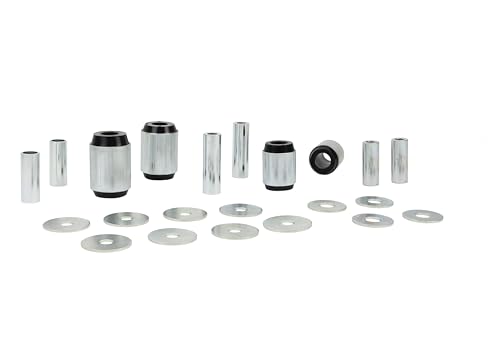
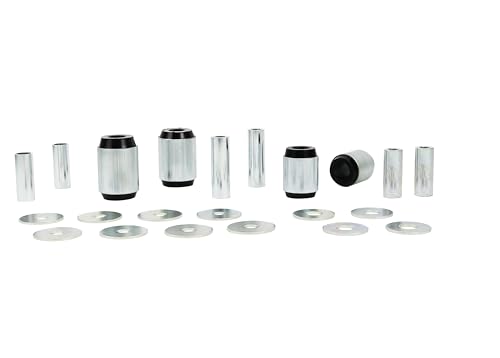
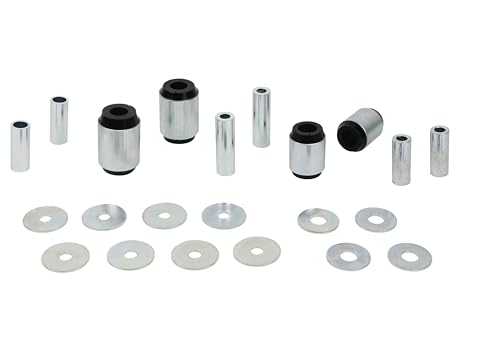
The Whiteline W53312 Front Lower Control Arm Bushing Kit is designed to replace worn factory bushings with a more performance-oriented synthetic elastomer solution.
For vehicles suffering from deteriorated lower control arm bushings, the upgrade can help restore:
- Steering precision
- Suspension stability
- Braking consistency
- Alignment control
- Handling response
It’s particularly worthwhile when refreshing an older suspension or supporting other performance modifications.
Horsepower gets considerably more attention.
Unfortunately, horsepower doesn’t help much when the front wheels are changing direction independently because the control arm bushings surrendered ten years ago.







There are no reviews yet.