


What Does a Rear Sway Bar Do?
A sway bar connects the left and right sides of the suspension.
When both wheels move together, such as traveling over a smooth rise in the road, the sway bar has relatively little influence.
During cornering, however, the outside suspension compresses while the inside suspension unloads.
That twists the sway bar.
The bar resists that twisting motion and helps control body roll.
The basic relationship is:
Outside suspension compression → Sway bar twists → Roll resistance increases
Why Upgrade the Rear Sway Bar?
Manufacturers tune factory suspension around many priorities:
- Ride comfort
- Predictable handling
- Tire choice
- Wet-weather stability
- Cost
- Noise and vibration
- Average driver behavior
That often means performance cars are deliberately tuned toward mild understeer.
Increasing rear roll stiffness can change that balance.
A performance rear sway bar can provide:
- Reduced body roll
- Sharper transitional response
- More responsive turn-in
- Improved chassis balance
- Reduced understeer
- More predictable performance driving
Reducing Understeer
Understeer occurs when the front tires lose cornering grip before the rear tires.
The vehicle wants to continue traveling toward the outside of the corner despite additional steering input.
Increasing rear roll stiffness can help alter that balance.
Instead of simply making the entire suspension dramatically stiffer, a rear sway bar allows chassis balance to be changed selectively.
That’s one reason rear sway-bar upgrades are popular on performance street cars.
Better Transitional Response
Body roll isn’t only noticeable during long corners.
It also affects rapid transitions.
Think about:
- Highway lane changes
- Autocross slaloms
- S-curves
- Canyon roads
- Track transitions
A heavier-duty sway bar can reduce the delay between steering input and chassis response.
The car can feel more immediate because the body isn’t spending as much time rolling before the suspension reaches a stable cornering attitude.
Polyurethane Bushings Included
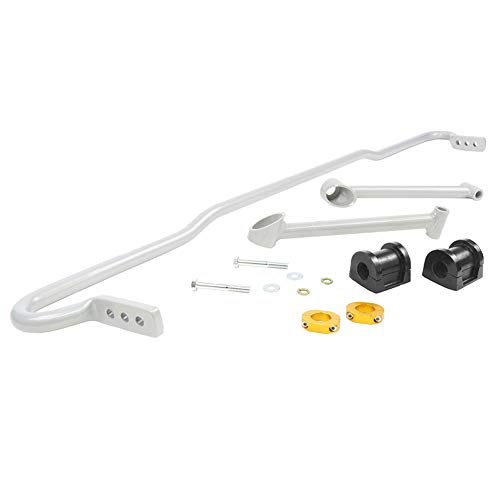
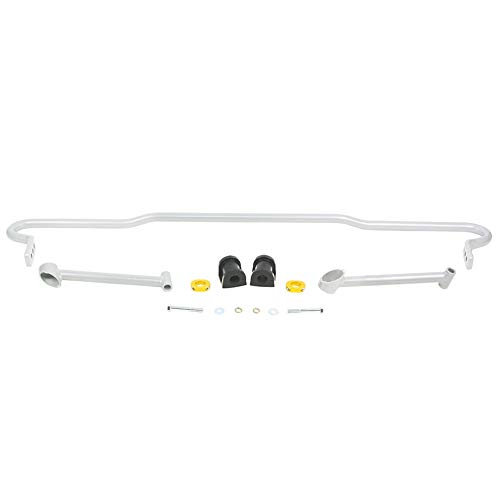
The BSR49XZ includes polyurethane sway-bar mounting bushings.
These bushings secure the bar to the chassis while allowing it to rotate as the suspension moves.
Compared with soft factory rubber, performance polyurethane generally reduces unwanted movement at the mounting points.
This helps the sway bar react more directly to suspension movement.
Why Sway Bar Bushings Matter
Installing a performance sway bar while retaining worn mounting bushings can reduce the effectiveness of the upgrade.
If the bar moves excessively inside its chassis mounts, some suspension movement occurs before the sway bar begins resisting roll effectively.
Fresh performance bushings help maintain more consistent bar positioning.
Upgraded Brackets Included
Whiteline also supplies upgraded mounting brackets with the BSR49XZ.
That’s important because increasing sway-bar stiffness can increase the loads transferred into the mounting points.
A larger performance bar doesn’t operate in isolation.
The system includes:
Sway Bar
Mounting Bushings
Brackets
End Links
Chassis Mounts
All of those components have to work together.
Inspect the End Links
The BSR49XZ description doesn’t mean you should ignore the existing sway-bar end links.
Inspect them carefully during installation.
Look for:
- Loose ball joints
- Torn boots
- Bent links
- Damaged mounting studs
- Excessive movement
- Corrosion
A heavy-duty sway bar can place additional loads through the links.
Installing a performance bar with destroyed factory end links is a wonderfully efficient way to create new suspension noises.
Does a Rear Sway Bar Affect Ride Quality?
Usually less than dramatically increasing spring rates.
That’s one of the major advantages of sway-bar tuning.
Springs affect suspension movement almost continuously.
Sway bars have their greatest influence when the left and right suspension move differently.
That means a sway-bar upgrade can substantially improve roll control while maintaining relatively reasonable ride quality.
However, very stiff bars can make the suspension feel less independent over uneven pavement.
Performance Street Driving
For street-driven performance vehicles, a rear sway bar can provide one of the best handling improvements per dollar.
Drivers may notice:
- Less body roll
- More immediate steering response
- Improved rear response
- Better cornering balance
- Reduced front-end push
The vehicle can feel more agile without requiring extremely stiff springs.
Autocross
Autocross is practically a laboratory experiment for sway bars.
Rapid left-right transitions expose excessive body roll immediately.
A performance rear bar can improve response through:
- Slaloms
- Sweepers
- Hairpins
- Rapid transitions
- Trail-braking sections
Adjusting rear roll stiffness is also a common way to fine-tune chassis balance.
Track Use
On track, sway bars work together with:
- Spring rates
- Dampers
- Tire pressures
- Alignment
- Ride height
- Differential setup
A rear sway bar shouldn’t be considered an isolated modification.
It’s one part of the complete chassis setup.
The objective isn’t maximum stiffness.
It’s balance.
Bigger Isn’t Automatically Better
A common mistake is assuming the stiffest available sway bar must provide the best handling.
It doesn’t work that way.
Too much rear roll stiffness can reduce rear grip and make the vehicle overly eager to rotate.
That might sound entertaining.
It becomes substantially less entertaining when it happens halfway through a wet freeway on-ramp.
Suspension tuning is about achieving the correct front-to-rear balance for the vehicle and driver.
BSR49XZ With Lowering Springs
Lowering springs typically reduce the vehicle’s center of gravity and increase spring rate.
Adding a performance rear sway bar can further reduce roll and tune chassis balance.
The combination can work particularly well for street performance when properly matched.
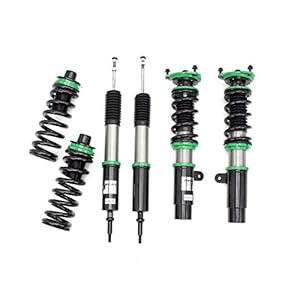
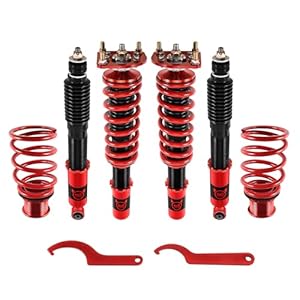
BSR49XZ With Coilovers
Coilovers provide even greater suspension tuning flexibility.
A complete setup may involve:
Set ride height
→ Select spring/damper settings
→ Install sway bars
→ Correct suspension geometry
→ Perform alignment
→ Road or track test
→ Fine-tune sway-bar settings where applicable
Suspension tuning should be approached as a system rather than a collection of random stiff parts.
Installation
General installation includes:
- Safely raise and support the vehicle.
- Remove components necessary to access the rear sway bar.
- Disconnect the sway-bar end links.
- Remove the factory mounting brackets.
- Remove the original sway bar.
- Compare the factory and Whiteline components.
- Lubricate the supplied polyurethane bushings appropriately.
- Position the bushings on the BSR49XZ.
- Install the upgraded brackets.
- Connect the end links.
- Verify exhaust and suspension clearance.
- Torque all hardware correctly.
- Set the vehicle at normal operating ride height.
- Road-test.
- Reinspect mounting hardware.
Always follow the supplied Whiteline installation instructions and vehicle-specific torque specifications.
Does BSR49XZ Require an Alignment?
Installing a sway bar normally doesn’t directly change:
- Camber
- Caster
- Toe
Therefore, a wheel alignment generally isn’t required solely because the sway bar was replaced.
However, if other suspension components are installed simultaneously, an alignment may be appropriate.
Maintenance
Polyurethane sway-bar bushings should be installed using the appropriate lubricant.
Periodically inspect:
- Bushing condition
- Mounting brackets
- End links
- Adjustment points
- Fasteners
Listen for new squeaks, clunks or knocks after installation.
Performance suspension components aren’t particularly subtle when something becomes loose.
Is Whiteline BSR49XZ Worth It?
The Whiteline BSR49XZ Heavy Duty Rear Sway Bar is designed for drivers looking to improve chassis response without relying exclusively on stiffer springs.
By increasing rear roll stiffness, the bar can help reduce body roll, improve transitional response and alter front-to-rear handling balance.
The inclusion of polyurethane bushings and upgraded mounting brackets makes it a more complete suspension upgrade.
For a performance street, autocross or track-oriented vehicle, it’s exactly the kind of modification that can make a car feel noticeably more responsive without adding a single horsepower.
Which is unfortunate for dyno-sheet bragging rights but excellent for actually driving the thing.






There are no reviews yet.