

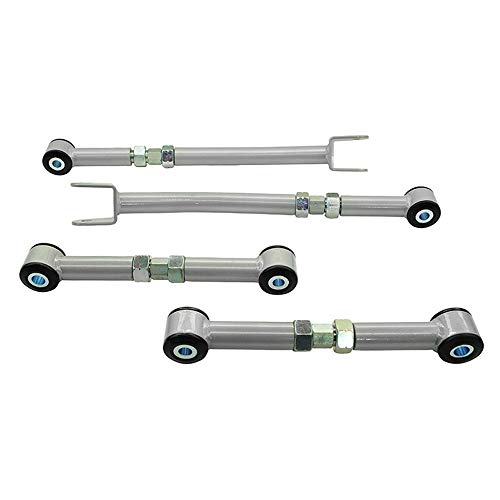
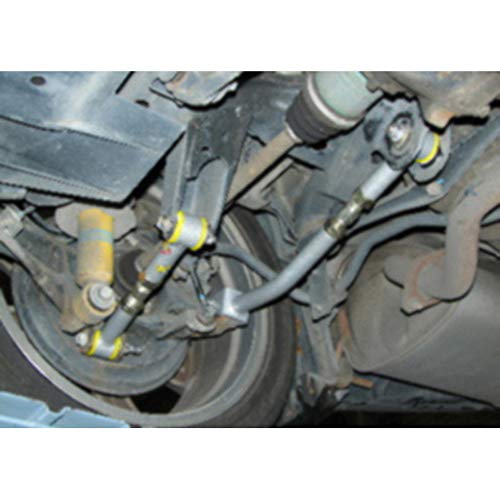
Why Adjustable Rear Control Arms Matter
Factory suspension geometry is designed around a specific ride height.
Once a vehicle is lowered, several things can change.
The wheels may develop additional negative camber, rear toe can move outside the desired range and the factory eccentric adjustments may not provide enough correction.
KTA124 provides additional mechanical adjustment so the suspension can be aligned around the vehicle’s actual setup.
Rear Camber Adjustment
Camber describes the angle of the wheel when viewed from the front or rear.
When the top of the tire leans inward, the wheel has negative camber.
Some negative camber is useful during performance driving because it helps maintain tire contact during cornering.
Too much can contribute to:
- Inner tire wear
- Reduced straight-line tire contact
- Reduced braking performance
- Poor tire utilization
Adjustable arms allow camber to be set according to the vehicle’s actual use.
Rear Toe Adjustment
Toe is equally important.
Viewed from above, toe describes whether the wheels point slightly toward or away from each other.
Incorrect rear toe can cause:
- Rapid tire wear
- Poor straight-line stability
- Wandering
- Nervous handling
- Unpredictable corner entry
In fact, incorrect toe can destroy tires much faster than moderate negative camber.
KTA124 provides additional adjustment to bring rear toe back into the desired range.
Rear Track Adjustment
Track describes the lateral position and spacing of the wheels.
Because KTA124 replaces multiple suspension links with adjustable components, it provides greater control over the rear suspension’s overall geometry.
This can be particularly useful on heavily modified vehicles where wheel fitment, ride height and alignment have all changed from factory specifications.
Turnbuckle-Style Adjustment
One of the strongest features of KTA124 is its left/right-hand threaded adjustment system.
This allows the effective length of the arm to be changed without removing it from the vehicle.
Rotate the adjuster one direction and the arm becomes longer.
Rotate it the opposite direction and the arm becomes shorter.
That allows the alignment technician to make precise changes while the arms remain installed.
Low-Compliance Bushings
Whiteline equips the KTA124 arms with performance-oriented low-compliance bushings.
Factory rubber bushings are designed to isolate:
- Noise
- Vibration
- Harshness
Unfortunately, soft bushings can also allow suspension geometry to move under load.
Reducing excessive compliance helps maintain more consistent wheel positioning during acceleration, braking and cornering.
More Predictable Suspension Behavior
Static alignment is only part of suspension setup.
The real question is what happens when the vehicle is moving.
During hard cornering, the suspension experiences substantial lateral loads.
Soft bushings can deform under those loads, effectively changing wheel alignment.
Lower-compliance bushings help reduce those unintended geometry changes.
That can provide:
- More predictable cornering
- Sharper response
- Improved steering feedback
- More consistent rear grip
- Better transitional behavior
KTA124 for Lowered Vehicles
Lowered vehicles are one of the primary applications for adjustable rear control arms.
The typical situation looks like this:
Install lowering springs or coilovers
→ Ride height decreases
→ Rear camber increases
→ Toe changes
→ Factory adjustment runs out
→ Adjustable arms become necessary
That’s why suspension geometry should always be checked after changing ride height.
Lowering the car is only half the job.
KTA124 With Coilovers
Coilovers provide a much wider range of ride-height adjustment than conventional lowering springs.
That also means they can create larger changes in suspension geometry.
For a coilover-equipped vehicle, the correct setup sequence should generally be:
Install coilovers
→ Set final ride height
→ Allow suspension to settle
→ Corner balance if necessary
→ Adjust KTA124 arms
→ Perform complete four-wheel alignment
→ Road or track test
Don’t align the suspension before finalizing ride height.
Unless your alignment shop needs additional revenue.
KTA124 With Lowering Springs
Lowering springs typically create a smaller geometry change than aggressively lowered coilovers.
However, the factory adjustment range can still become insufficient.
KTA124 allows the suspension to be corrected even when lowering springs push camber or toe beyond the original adjustment range.
Tire Wear
One of the most practical benefits of proper rear alignment is tire life.
A vehicle running excessive negative camber combined with incorrect toe can destroy the inner shoulders of its rear tires surprisingly quickly.
Proper adjustment helps maintain more consistent tire contact.
That’s particularly important with expensive performance tires.
Street Performance
For a street-driven vehicle, alignment should balance:
Handling
Stability
Tire wear
Ride quality
The objective isn’t necessarily maximum negative camber.
It’s the correct alignment for how the vehicle is actually driven.
KTA124 provides the adjustment range needed to achieve that setup.
Autocross
Autocross drivers can use rear alignment as another chassis-tuning tool.
Camber and toe influence:
- Turn-in
- Rotation
- Transitional response
- Rear grip
- Stability
Adjustable control arms make those settings easier to fine-tune and reproduce.
Track Use
Track vehicles place even greater demands on suspension geometry.
KTA124 can be used alongside:
- Coilovers
- Performance sway bars
- Adjustable end links
- Performance tires
- Chassis bracing
- Corner balancing
The goal is to create a complete suspension package rather than simply collecting the stiffest components available.
Installation
Installing KTA124 involves replacing four factory rear suspension arms.
General installation includes:
- Safely raise and support the vehicle.
- Remove the rear wheels.
- Inspect the existing suspension.
- Measure the factory control-arm lengths.
- Remove the original arms.
- Set KTA124 approximately to the original dimensions.
- Install the Whiteline arms.
- Verify suspension clearance.
- Set the vehicle at normal operating ride height.
- Perform preliminary adjustment.
- Torque mounting hardware correctly.
- Perform a complete four-wheel alignment.
- Tighten all adjustment locking hardware.
- Road-test the vehicle.
- Recheck all fasteners.
Always follow Whiteline installation instructions and factory torque specifications.
Alignment Is Mandatory
KTA124 directly changes rear suspension geometry.
A professional alignment isn’t optional after installation.
Have the technician check:
- Rear camber
- Rear toe
- Front camber
- Front toe
- Thrust angle
- Steering-wheel centering
For track vehicles, alignment settings should be selected based on tire choice, suspension configuration and intended use.
Inspect the Rest of the Rear Suspension
While installing KTA124, inspect:
- Wheel bearings
- Sway-bar links
- Sway-bar bushings
- Dampers
- Springs
- CV boots where applicable
- Differential mounts
- Subframe bushings
- Brake hoses
- Remaining suspension bushings
There’s little point installing precision adjustable control arms while another 15-year-old bushing nearby has already spiritually departed the vehicle.
Who Should Buy Whiteline KTA124?
KTA124 makes the most sense for vehicles that:
- Have been lowered
- Run coilovers
- Need additional rear camber adjustment
- Need additional rear toe adjustment
- Have aggressive wheel and tire fitment
- Are used for autocross
- Are used for track driving
- Need more precise rear suspension geometry
A stock-height street car with alignment already within specification may not require this level of adjustment.
Is Whiteline KTA124 Worth It?
The Whiteline KTA124 Adjustable Rear Control Arm Kit provides substantially greater control over rear suspension geometry than fixed factory arms.
With four complete adjustable arms, low-compliance bushings and turnbuckle-style on-car adjustment, the kit allows camber, toe and track to be fine-tuned around the vehicle’s actual ride height and suspension configuration.
That’s particularly important on lowered performance cars where factory adjustment has reached its limits.
Because getting a car lower is easy.
Getting all four tires pointed where they’re actually supposed to go afterward requires slightly more engineering.



There are no reviews yet.