

Symptoms of Worn Control Arm Bushings
Common symptoms include:
- Loose or vague steering
- Front suspension clunks
- Wandering at highway speeds
- Steering movement during braking
- Uneven tire wear
- Poor straight-line stability
- Reduced steering response
- Excessive vibration
- Unpredictable handling
- Visible cracking or separation
These symptoms can overlap with worn ball joints, tie rods and wheel bearings, so the complete front suspension should be inspected before replacing parts.
Why the Rear Control Arm Bushing Is Important
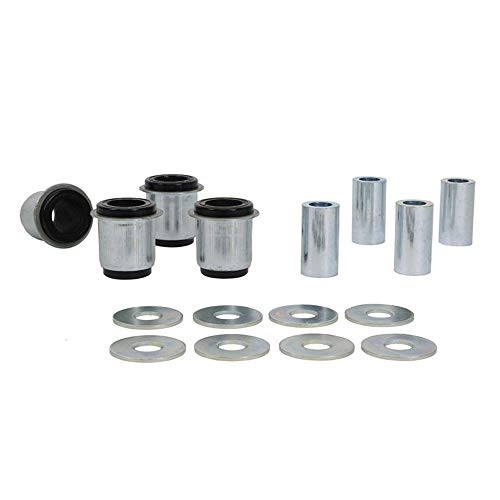
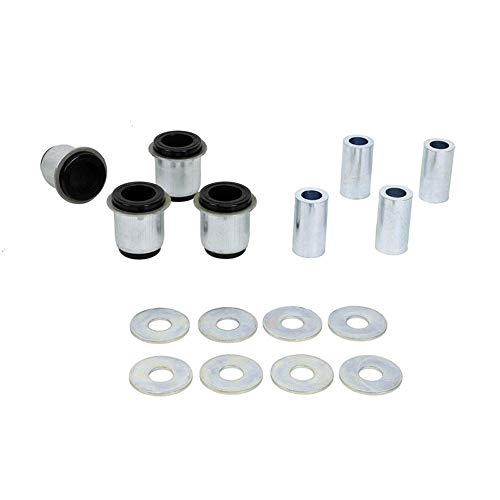
The W53377A specifically replaces the rear inner mounting bushing of the front lower control arm.
That mounting point experiences significant loads during braking.
As the tire generates braking force, that force travels through the hub and control arm into the chassis.
A deteriorated rear control arm bushing can allow the arm to move longitudinally.
That movement can alter:
- Caster
- Toe
- Wheel position
- Steering response
Fresh bushings help keep the control arm more consistently located.
Improved Steering Precision
A worn bushing introduces a delay between steering input and suspension response.
The driver turns the steering wheel.
The tire develops lateral force.
The worn bushing deflects.
The control arm moves.
Then the chassis reacts.
Reducing excessive compliance helps make that relationship more direct.
The result can be improved steering precision and more predictable front-end response.
Better Braking Stability
Hard braking places substantial longitudinal load through the lower control arms.
If the rear bushings are excessively soft or damaged, the control arms can shift under those loads.
That can make the vehicle:
- Wander under braking
- Pull unpredictably
- Feel unstable
- Require steering correction
Fresh performance bushings help maintain more consistent suspension geometry during braking.
Whiteline Synthetic Elastomer
Whiteline uses an advanced synthetic elastomer formulation designed to provide a balance between suspension control and necessary articulation.
Important characteristics include:
Elasticity – allowing normal suspension movement.
Memory – returning to the intended shape after loading.
Durability – resisting repeated suspension loads and environmental exposure.
The objective isn’t simply to create the hardest possible bushing.
Suspension bushings still need to move.
The goal is eliminating movement you don’t want while preserving movement the suspension actually needs.
Factory Rubber vs. Performance Bushings
Factory rubber bushings prioritize:
- Ride comfort
- Noise isolation
- Vibration reduction
- Low maintenance
- Production cost
Performance-oriented bushings shift that compromise toward:
- Steering precision
- Alignment consistency
- Reduced control-arm movement
- More immediate suspension response
There may be a modest increase in noise, vibration or harshness depending on the vehicle.
That’s the traditional suspension equation:
Less compliance = more feedback
Physics continues refusing to include a free lunch.
Great Replacement for Aging Factory Bushings
Control arm bushings don’t need to be completely destroyed before replacement becomes worthwhile.
Rubber deteriorates from:
- Age
- Heat
- Ozone
- Oil contamination
- Road debris
- Mileage
- Repeated suspension movement
On older performance vehicles, deteriorated bushings can make the suspension feel considerably worse even when the shocks and springs remain healthy.
W53377A With Lowering Springs
Lowering springs change the static operating position of the control arms.
That can place additional demands on aging factory bushings.
Replacing worn bushings helps maintain more consistent suspension geometry after lowering.
W53377A With Coilovers
Coilovers commonly increase spring rate and suspension response.
High-performance tires can also substantially increase cornering loads.
If the lower control arms are still moving around on worn factory bushings, some of that additional suspension precision is being lost through compliance.
Performance bushings help the rest of the suspension work more consistently.
Better Tire Wear
Control arm movement can contribute to dynamic alignment changes.
That means the alignment measured while the vehicle is stationary may not represent what the wheels are doing under load.
Worn bushings can therefore contribute to:
- Inner tire wear
- Outer tire wear
- Feathering
- Irregular tread wear
Replacing deteriorated bushings and performing a proper alignment can help restore more predictable tire contact.
Street Performance
For a street-driven performance vehicle, synthetic elastomer bushings offer a useful middle ground between soft factory rubber and rigid motorsport mounting solutions.
The goal is sharper response without making every expansion joint feel like the chassis has filed a personal complaint.
Autocross
Autocross creates rapid changes in suspension load.
The vehicle repeatedly transitions between:
Braking → Turn-in → Cornering → Acceleration → Direction change
Reduced control-arm movement can make these transitions more predictable.
Track Use
Track driving increases:
- Braking loads
- Cornering loads
- Tire grip
- Suspension temperatures
Maintaining suspension geometry becomes increasingly important under these conditions.
W53377A bushings can complement upgrades such as:
- Coilovers
- Performance sway bars
- Adjustable end links
- Roll-center correction
- Performance alignment
- High-grip tires
Installation
Replacing lower control arm bushings can require substantially more work than replacing sway-bar bushings.
General installation includes:
- Safely raise and support the vehicle.
- Remove the front wheels.
- Inspect the complete suspension.
- Disconnect components necessary to remove the lower control arms.
- Remove the control arms.
- Remove the original rear bushings.
- Clean and inspect the bushing mounting surfaces.
- Install the W53377A bushings according to Whiteline instructions.
- Reinstall the control arms.
- Torque hardware correctly.
- Set the suspension at normal operating ride height where required.
- Perform a complete alignment.
- Road-test.
- Reinspect mounting hardware.
Depending on the application, specialized bushing removal or pressing equipment may be required.
Alignment Is Recommended
Because lower control arm position influences suspension geometry, a professional alignment should be performed after installation.
Check:
- Front toe
- Camber
- Caster
- Steering-wheel centering
- Left/right alignment consistency
Don’t spend several hours rebuilding the front suspension and then decide the alignment can wait until next month.
Your tires will conduct their own experiment in the meantime.
Inspect These Components During Installation
While servicing the lower control arms, inspect:
- Ball joints
- Front control arm front bushings
- Tie-rod ends
- Sway-bar links
- Sway-bar bushings
- Wheel bearings
- Struts or coilovers
- Steering rack boots
- CV boots where applicable
- Brake hoses
Replacing multiple worn components while the suspension is already apart can save significant labor later.
Who Should Buy Whiteline W53377A?
The W53377A makes the most sense for vehicles with:
- Worn factory control arm bushings
- Loose steering response
- Lowering springs
- Coilovers
- Performance tires
- Street-performance suspension
- Autocross setups
- Track-oriented suspension
It can function as both a replacement part and a performance suspension upgrade.
Is Whiteline W53377A Worth It?
The Whiteline W53377A Front Lower Control Arm Rear Bushing Kit replaces a critical suspension mounting point with Whiteline’s performance synthetic elastomer material.
Reducing unwanted control-arm movement can improve steering response, braking stability and alignment consistency while restoring suspension behavior lost through deteriorated factory bushings.
They’re small components performing a surprisingly important job.
Because apparently keeping the front wheels pointed consistently in the intended direction is useful.







There are no reviews yet.