
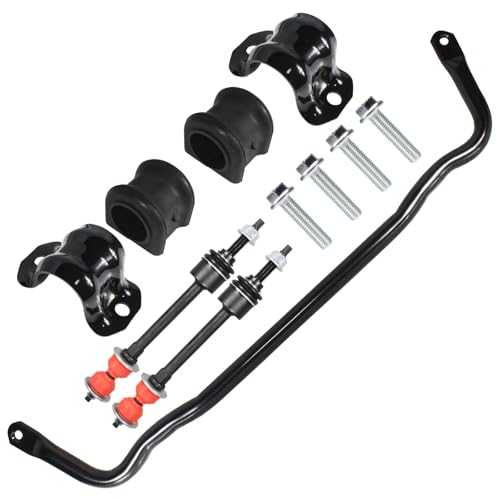
What’s Included?
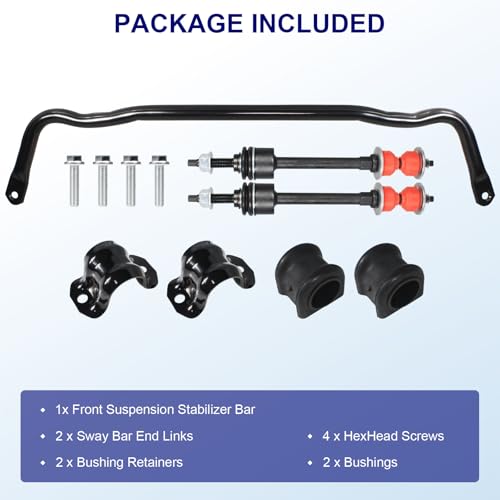
This is a complete front sway-bar replacement package containing:
- 1 × Front suspension stabilizer bar
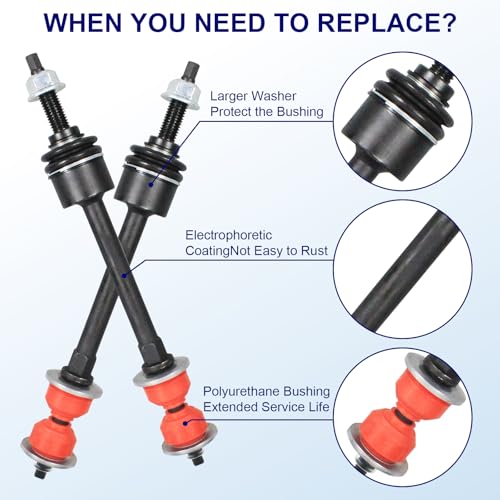
- 2 × Front sway bar end links
- 2 × Sway bar mounting bushings
- 2 × Bushing retainers
- 4 × Hex-head mounting screws
Replacing the bar, bushings and links together can make sense on higher-mileage trucks where several components have deteriorated simultaneously.
What Does the Ram 1500 Front Sway Bar Do?
The front stabilizer bar connects the left and right sides of the front suspension.
During cornering, the outside suspension compresses while the inside suspension unloads.
The difference in suspension movement twists the sway bar.
The bar resists that twisting motion and helps control body roll.
A properly functioning front stabilizer system helps improve:
- Cornering stability
- Steering response
- Lane-change behavior
- Highway stability
- Suspension control
- Driver confidence
That’s particularly important on a full-size pickup with a relatively high center of gravity.
Symptoms of Worn Ram 1500 Sway Bar Components
Common symptoms can include:
- Clunking over bumps
- Knocking from the front suspension
- Excessive body roll
- Loose steering response
- Increased chassis movement
- Damaged sway bar bushings
- Loose sway bar links
- Corroded mounting hardware
If the sway bar itself is bent, heavily corroded or damaged, replacing the complete assembly may be preferable to servicing only the bushings.
Why Sway Bar Links Matter
The end links connect the stabilizer bar to the suspension.
When an end link develops excessive play, suspension movement can occur before the sway bar begins transferring load effectively.
Worn links frequently produce a noticeable:
Clunk — knock — clunk
while traveling over uneven pavement.
Replacing the links at the same time as the sway bar eliminates another common wear point from the system.
Why Sway Bar Bushings Matter
The center bushings secure the sway bar to the chassis while allowing the bar to rotate.
As the original bushings deteriorate, the bar can develop excessive movement inside its mounts.
That can contribute to:
- Clunking
- Reduced sway-bar effectiveness
- Poor bar positioning
- Increased suspension movement
This kit includes replacement bushings and retainers rather than requiring the original hardware to be reused.
Heavy-Duty Replacement Construction
The replacement stabilizer bar uses corrosion-resistant materials intended to withstand normal underbody exposure.
That’s important because the sway bar is continuously exposed to:
- Water
- Road debris
- Mud
- Sand
- Road salt
- Temperature changes
The stabilizer bar also experiences repeated torsional loads whenever the truck corners or travels across uneven surfaces.
Better Body-Roll Control
A functioning front sway bar helps resist excessive chassis lean.
This can be particularly noticeable during:
- Highway ramps
- Emergency maneuvers
- Rapid lane changes
- Curving roads
- Loaded driving
The objective of this replacement kit is to restore the truck’s intended stabilizer-system performance rather than radically alter its handling characteristics.
Daily Driving
For an older Ram 1500 used as a daily driver, replacing worn sway bar components can restore a more controlled and predictable feel.
A truck with worn bushings and end links may gradually develop loose handling over thousands of miles.
Because the deterioration happens slowly, drivers sometimes don’t realize how much suspension response has been lost until fresh components are installed.
Towing and Hauling
A properly functioning suspension is especially important when the truck is used for towing or hauling.
The sway bar doesn’t increase the truck’s payload or towing capacity.
It does, however, contribute to chassis roll control.
Never exceed the manufacturer’s rated capacities simply because suspension components have been replaced.
Off-Road Use
The 4WD Ram 1500 may encounter considerably more suspension articulation off pavement.
After off-road use, inspect the sway bar system for:
- Bent links
- Impact damage
- Loose hardware
- Damaged bushings
- Bar-to-chassis contact
A stabilizer bar mounted underneath a truck has a surprisingly good view of every rock you failed to avoid.
Installation
General installation involves:
- Park the truck on a level surface.
- Safely raise and support the vehicle as required.
- Inspect the complete front suspension.
- Disconnect both front sway bar end links.
- Support the original stabilizer bar.
- Remove the sway bar mounting retainers.
- Remove the original bar and bushings.
- Compare the replacement components with the originals.
- Install the supplied sway bar bushings.
- Position the new stabilizer bar.
- Install the supplied retainers and hardware.
- Install the replacement K80894-style end links.
- Torque all hardware to factory specifications.
- Verify suspension and steering clearance.
- Road-test the truck.
- Reinspect all mounting hardware.
Always follow the appropriate Ram factory service procedures for the specific model year.
Does Installation Require an Alignment?
Normally, no.
The sway bar and end links don’t directly determine:
- Camber
- Caster
- Toe
Replacing them generally doesn’t require a wheel alignment unless other alignment-related suspension components are disturbed.
Inspect the Front Suspension While You’re There
When installing the kit, also inspect:
- Upper control arms
- Lower control arms
- Ball joints
- Tie-rod ends
- Wheel bearings
- Front shocks
- CV boots
- Steering components
Suspension noises frequently have more than one source, particularly on higher-mileage trucks.
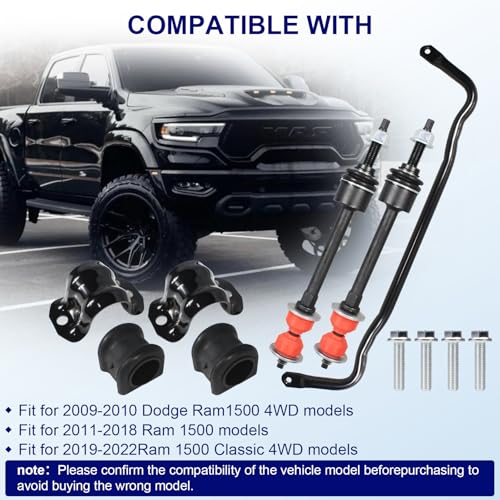
ZNB 55398938AC Fitment Summary
2011–2018 Ram 1500
4WD models
2019–2022 Ram 1500 Classic
4WD models
Verify before ordering
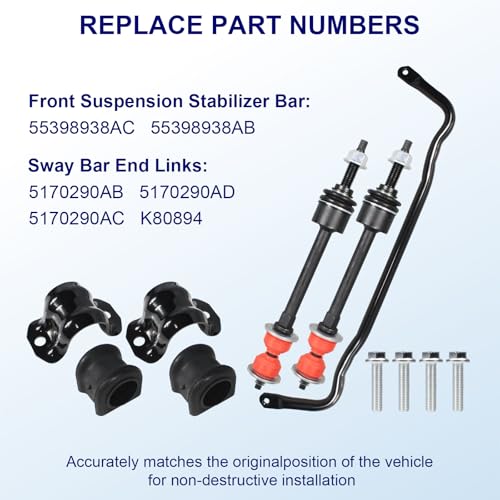
Check for OE sway bar numbers:
55398938AC / 55398938AB
and end-link numbers:
K80894 / 5170290AD / 5170290AB / 5170290AC







There are no reviews yet.