
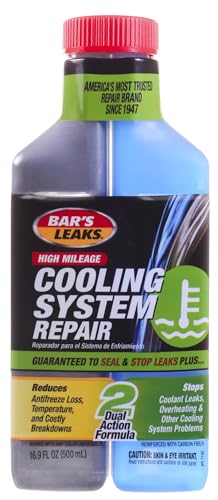
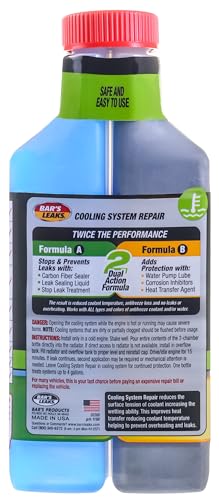
How Does Bar’s Leaks High Mileage Cooling System Repair Work?
There are really two jobs happening inside the bottle.
1. Sealing Minor Coolant Leaks
The 1150 formula uses a carbon-fiber sealing component along with liquid sealing ingredients intended to accumulate around small leak paths.
The goal isn’t to somehow magically rebuild a damaged radiator.
Instead, the sealing material is intended to help close small openings where coolant is escaping.
Potential applications can include minor leakage from areas such as:
- Radiators
- Cooling-system connections
- Small gasket seepage
- Heater-system leaks
- Minor cooling-system porosity
There is a massive difference between minor seepage and a component that has physically failed.
If your radiator tank has split open like the Grand Canyon, chemistry isn’t putting it back together.
Xtreme Cool Is More Than Just Stop-Leak
One feature separating Bar’s Leaks 1150 from basic leak-sealing products is its Xtreme Cool additive.
According to Bar’s Leaks’ technical documentation, Xtreme Cool reduces coolant surface tension and increases its wetting ability. The intended result is improved heat transfer between hot engine surfaces and the coolant.
Better heat transfer can help reduce coolant temperature under certain operating conditions.
That doesn’t mean the product gives an undersized radiator magical additional capacity.
If your engine is overheating because the electric fans don’t work, the thermostat is stuck closed, the water-pump impeller has failed, or the radiator is badly restricted, those problems still need to be repaired.
Our Why Is My Car Overheating? diagnostic guide explains how overheating patterns can help distinguish airflow, coolant-flow, thermostat, radiator, water-pump, and internal engine problems.
Read the Pro Street overheating diagnostic guide
When Does Cooling-System Stop-Leak Make Sense?
Stop-leak products are controversial because they frequently get blamed for problems caused by using them in the wrong situation.
There are situations where a product like Bar’s Leaks 1150 can make practical sense.
Older Daily Drivers
Suppose you’ve got a 180,000-mile commuter with a small radiator seep.
Replacing the radiator immediately would obviously be the preferred permanent repair, but the economics of an older vehicle aren’t always that simple.
A cooling-system treatment may provide another option while you plan the mechanical repair.
Small Coolant Leaks
Minor leaks are the most logical application.
If coolant slowly disappears but the system still holds most of its pressure and the vehicle isn’t suffering severe overheating, a sealing product has a much more reasonable job ahead of it.
Vehicles Near the End of Their Practical Service Life
Sometimes the repair estimate exceeds the value of the vehicle.
Dropping thousands of dollars into a $2,500 commuter doesn’t automatically become financially intelligent just because it’s mechanically correct.
Bar’s Leaks itself positions High Mileage Cooling System Repair as an option that may be worth trying before facing an expensive repair or replacing an older vehicle.
When Should You NOT Rely on Bar’s Leaks 1150?
This part matters.
Cooling-system repair additives should never replace diagnosis when the vehicle is showing signs of serious mechanical failure.
Do not assume stop-leak will repair:
- A severely cracked radiator
- A burst coolant hose
- Failed electric cooling fans
- A slipping or broken water-pump belt
- A failed water pump
- A thermostat stuck closed
- Severe radiator restriction
- A warped cylinder head
- Major head-gasket failure
- A cracked engine block or cylinder head
If the engine is actively overheating, stop driving it until you know why.
Continuing to operate an overheating engine can turn a relatively inexpensive cooling-system repair into warped cylinder heads, head-gasket failure, or complete engine damage.
Can Stop-Leak Clog a Radiator or Heater Core?
This is the question every enthusiast eventually asks.
And there’s a legitimate reason.
Radiators and heater cores contain extremely narrow passages. Excessive sealing material, existing corrosion, contaminated coolant, or repeated use of stop-leak products can contribute to restrictions.
That’s why these products shouldn’t become routine maintenance.
If you’re adding another bottle every few months because the coolant keeps disappearing, the car isn’t being repaired.
It’s being subscribed to stop-leak.
Find the actual leak.
A healthy cooling system should maintain its coolant level without repeatedly requiring sealant.
Check the Cooling System Before Adding Anything
Before using Bar’s Leaks 1150, inspect the cooling system with the engine completely cold.
Check:
- Radiator and reservoir coolant level
- Upper and lower radiator hoses
- Heater hoses
- Radiator seams and tanks
- Water-pump area
- Thermostat housing
- Coolant reservoir
- Cooling fans
- Drive belts
- Coolant condition
Look for dried white, green, pink, orange, blue, or yellow residue around connections.
Dried coolant frequently leaves evidence long after the liquid itself has evaporated.
If you can’t find the leak visually, a cooling-system pressure test is usually the next move.
Don’t Confuse an Overheating Problem With an ECT Sensor Problem
Modern cars make cooling-system diagnosis slightly more interesting because the temperature displayed to the driver ultimately depends on electronic information.
An engine-coolant-temperature sensor fault can produce incorrect temperature information and diagnostic trouble codes without necessarily indicating an actual cooling-system failure.
For example, P0115 indicates a coolant-temperature sensor circuit malfunction. Low coolant can complicate the reading, but P0115 itself primarily points toward an electrical circuit problem rather than something a bottle of cooling-system treatment can repair.
Read the Pro Street P0115 diagnostic guide
Likewise, P0128 typically indicates that the engine isn’t reaching its expected operating temperature quickly enough. A thermostat stuck open is one of the most common causes.
Read the Pro Street P0128 diagnostic guide
Again, additives can’t fix electronics or a mechanically failed thermostat.
Diagnosis first. Bottle second.
Is Bar’s Leaks 1150 Safe for Different Coolant Types?
According to Bar’s Leaks, High Mileage Cooling System Repair can be used with common antifreeze types and colors, including conventional and extended-life coolant formulations. The manufacturer’s technical information also states that it works with 50/50 coolant mixtures or water and can be used in gasoline, turbocharged, and diesel engines.
Always check the vehicle manufacturer’s cooling-system requirements before introducing any additive.
Coolant specifications have become considerably more complicated than choosing between “green stuff” and “other green stuff.”
Is Bar’s Leaks 1150 Worth Trying?
For a minor cooling-system leak on an older or high-mileage vehicle, Bar’s Leaks 1150 occupies a useful middle ground.
It’s considerably cheaper and easier than tearing apart a cooling system, and its combination of sealing agents, corrosion protection, water-pump lubrication, and heat-transfer additive makes it more comprehensive than a basic emergency stop-leak treatment.
But expectations matter.
This is best viewed as a repair aid or temporary-to-intermediate solution for appropriate minor leaks, not a substitute for replacing a physically failed component.
If you’re trying to keep an aging commuter alive, dealing with a small cooling-system seep, or simply want an option before committing to a major repair, Bar’s Leaks 1150 High Mileage Cooling System Repair deserves consideration.
If the engine is repeatedly overheating, however, diagnose the cooling system before pouring anything into it.
Because the cheapest repair is usually the one you make before the temperature gauge starts auditioning for a SpaceX launch.



There are no reviews yet.