

The Classic Symptom: Your Coolant Level Keeps Dropping
One of the most frustrating cooling-system problems is unexplained coolant loss.
You fill the reservoir to the proper mark.
A few drives later, it’s down slightly.
You inspect underneath the car and find nothing.
Welcome to the glamorous world of chasing microscopic coolant leaks.
A small leak can allow coolant to escape only when the system reaches operating temperature and becomes pressurized. The liquid may hit a hot engine or radiator surface and evaporate before creating a puddle.
If you’re experiencing this problem, don’t automatically assume the radiator needs stop-leak. Pro Street’s guide to finding a coolant leak when you can’t see one can help narrow down where the coolant is actually going.
That distinction matters because an external radiator seep and an internal engine coolant leak are very different problems.
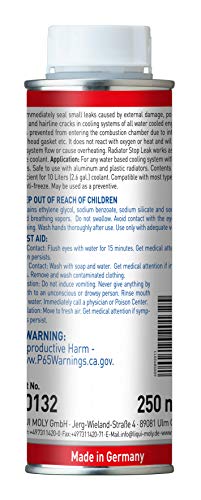
How Does Liqui Moly Radiator Stop Leak Work?
Radiator sealing additives circulate with the engine coolant.
When coolant reaches a small leak path, the sealing material is intended to accumulate around that opening and reduce or stop coolant from escaping.
Liqui Moly specifically positions Radiator Stop Leak for small defects such as porous solder joints and hairline cracks.
That makes it particularly relevant to older radiators where aging materials or minor physical damage have produced leakage without causing complete component failure.
The important phrase remains small leak.
A cracked plastic radiator tank with a visible opening isn’t a hairline crack anymore.
That’s a broken radiator.
Can Liqui Moly Radiator Stop Leak Fix Stone Damage?
Radiators live in a fairly hostile location.
They’re positioned directly behind the grille where air needs to reach them—which unfortunately means road debris gets an invitation too.
Small rocks and other debris can strike delicate radiator fins and tubes. Most impacts merely bend fins, but occasionally an impact can create a small coolant leak.
Liqui Moly specifically lists leaks caused by stone impacts among the applications for Radiator Stop Leak.
For a very small puncture or seep, a sealing additive can therefore be an attractive alternative when immediate radiator replacement isn’t practical.
But inspect the damage first.
If a radiator tube is crushed, split, or visibly leaking under pressure, replacement or professional repair remains the proper solution.
What About Porous Solder Joints?
Older radiator construction can develop leakage around soldered joints as the radiator ages.
Years of:
- Heat cycling
- Cooling-system pressure
- Vibration
- Corrosion
- Coolant degradation
can eventually expose weaknesses in an aging radiator.
These leaks can be incredibly small.
Sometimes you’ll see dried coolant residue around the affected area rather than an active drip.
This is another situation where Liqui Moly Radiator Stop Leak may be useful because porous soldering points are specifically among its intended applications.
Can Radiator Stop Leak Prevent Engine Damage?
Liqui Moly states that Radiator Stop Leak helps protect the combustion chamber against damage caused by coolant entering where it shouldn’t.
That deserves some context.
A stop-leak additive should not be considered a cure for serious internal engine damage.
If coolant is entering the combustion chamber because of a badly failed head gasket, cracked cylinder head, or damaged engine block, the engine needs mechanical diagnosis and repair.
Symptoms of a potentially serious internal coolant leak include:
- Persistent white exhaust smoke after warm-up
- Unexplained coolant loss
- Cooling-system pressure shortly after a cold start
- Repeated overheating
- Coolant contamination in the oil
- Misfires after the vehicle sits
- Bubbles entering the coolant reservoir
- Sweet-smelling exhaust
Those symptoms deserve investigation before another bottle gets invited to the cooling system.
Can You Use Liqui Moly Radiator Stop Leak With a Heater Core?
Liqui Moly specifies the product for cooling-water and heating systems.
Since the heater core is effectively a small radiator inside the HVAC system, engine coolant circulates through extremely narrow passages inside it.
That is also why you should avoid overdosing cooling-system sealing products.
A product designed to seal small openings needs to be used according to its instructions. More isn’t automatically better.
If one bottle is good, three bottles do not make it three times better.
That’s not chemistry. That’s optimism.
Will Radiator Stop Leak Clog a Radiator?
This is one of the most common concerns surrounding any cooling-system sealant.
Modern radiators and heater cores contain narrow coolant passages. A cooling system that already contains rust, scale, old sealant, contaminated coolant, or significant deposits deserves extra caution before another additive is introduced.
Before using a stop-leak product, inspect coolant condition.
Coolant should not resemble:
- Mud
- Rust soup
- Thick sludge
- Oil-contaminated milkshake
- A science experiment abandoned in 1997
If the system is heavily contaminated, diagnose and service it properly rather than adding another material.
For more information about the risks and tradeoffs involved, see our Pro Street guide on whether radiator stop-leak can damage a cooling system.
Radiator Stop Leak vs. Replacing the Radiator
This is where purchasing decisions become easier.
Consider Liqui Moly Radiator Stop Leak when:
- The leak is very small
- Coolant loss is gradual
- The radiator has a minor seep
- You suspect a porous solder joint
- A small stone impact caused leakage
- Immediate radiator replacement isn’t practical
- You’re trying to extend the useful life of an older vehicle
Replace or repair the component when:
- The radiator tank is visibly cracked
- A hose has split
- Coolant is rapidly escaping
- The radiator is severely corroded
- The cooling system cannot maintain pressure
- The radiator is internally restricted
- The engine repeatedly overheats
- The water pump has mechanically failed
Stop-leak should be a strategic repair option—not a substitute for understanding what’s actually broken.
What If the Car Is Overheating?
A coolant leak can absolutely cause overheating.
As coolant escapes, the system eventually loses enough fluid that its ability to absorb and transfer engine heat deteriorates.
But coolant loss is only one possible cause.
Overheating can also result from:
- Failed radiator fans
- Restricted radiator airflow
- Stuck thermostat
- Failed water pump
- Collapsed radiator hose
- Air trapped in the cooling system
- Clogged radiator
- Incorrect coolant mixture
- Head-gasket failure
If the temperature gauge climbs primarily while the vehicle is sitting in traffic, the diagnostic path can be very different from a vehicle that overheats only at highway speed.
Pro Street’s Car Cooling System Guide and symptom-based cooling-system articles can help isolate these conditions before replacing parts.
Diagnose Before You Pour
Before adding Liqui Moly Radiator Stop Leak, start with a cold engine and inspect:
- Radiator
- Radiator tanks and seams
- Upper radiator hose
- Lower radiator hose
- Hose clamps and connections
- Thermostat housing
- Water pump
- Heater hoses
- Coolant reservoir
- Coolant level and condition
Pay particular attention to dried residue.
Coolant leaks often leave colored or chalky deposits behind after the liquid evaporates.
If nothing is visible, pressure testing the cooling system can reveal leaks that only appear once the system is under pressure.
This is especially valuable when the only symptom is a reservoir that gradually loses coolant.
Is Liqui Moly Radiator Stop Leak Worth Using?
Liqui Moly Radiator Stop Leak 250 ml makes the most sense for small, difficult-to-find cooling-system leaks where the underlying component has not suffered major structural failure.
Its intended applications—including hairline cracks, porous soldering points, stone-impact leaks, and gradual coolant loss—make it particularly relevant for aging vehicles where a small cooling-system seep has developed.
The important part is using it for the problem it was designed to solve.
A tiny radiator seep?
Reasonable candidate.
A cooling system mysteriously losing a small amount of coolant?
Worth investigating.
A radiator that looks like someone hit it with a pickaxe?
Put the bottle down.
Ultimately, cooling-system additives work best when they’re treated as one tool in the repair toolbox, not as liquid replacements for radiators, water pumps, thermostats, or head gaskets.
For small leaks, however, Liqui Moly Radiator Stop Leak offers a convenient option that may keep coolant inside the system where it belongs.
And coolant is considerably more useful inside your engine than decorating your driveway.







There are no reviews yet.