
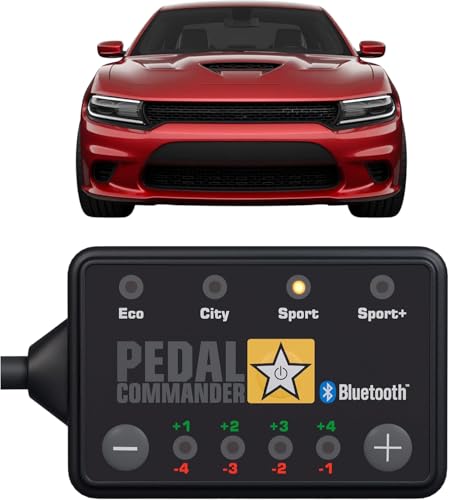
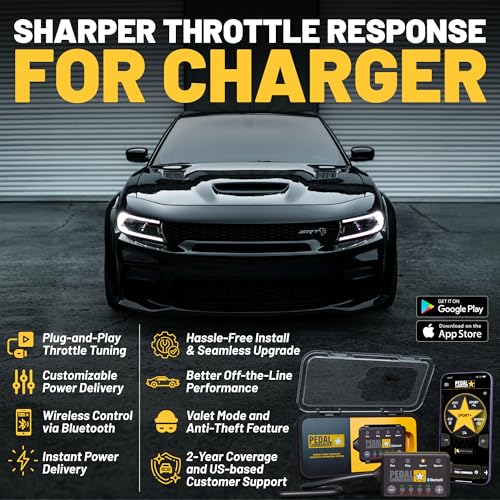


What Is the Pedal Commander?
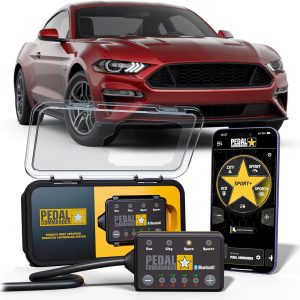
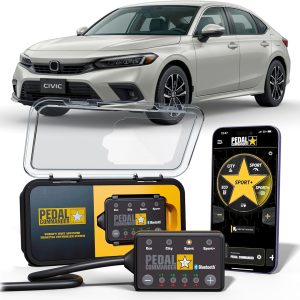
The Pedal Commander is an electronic throttle response controller that installs inline with the Charger’s accelerator-pedal sensor.
Once connected, it changes the electronic signal sent when the driver presses the accelerator. Depending on the selected mode and sensitivity level, it can make the pedal feel softer, more progressive, or considerably more aggressive.
The Pedal Commander changes:
- Accelerator sensitivity
- Partial-throttle response
- How quickly the vehicle reacts to pedal movement
- The perceived delay between pressing the pedal and acceleration
It does not directly change:
- Peak horsepower
- Peak torque
- Ignition timing
- Fuel delivery
- Supercharger boost
- Transmission gearing
- Engine displacement
The Charger may feel faster because the engine responds sooner to a smaller pedal movement.
The engine itself is not producing additional power.
That difference is important because a throttle controller is a drivability upgrade, not an engine tune.
Compatible Dodge Charger Models
According to the supplied product information, this Pedal Commander application is compatible with 2007–2024 Dodge Charger models, including:
- SE
- SXT
- R/T
- Scat Pack
- SRT
- Hellcat
- Daytona
The product is intended for compatible V6- and V8-powered Charger models.
Because the Charger lineup changed considerably between 2007 and 2024, owners should verify the exact product part number for their:
- Model year
- Trim
- Engine
- Transmission
- Accelerator-pedal connector
- Market configuration
A 2007 Charger SE and a late-production supercharged Hellcat may share a nameplate, but ordering electronics based only on the word “Charger” is how return labels are born.
Exact fitment should always be confirmed before installation.
Why Does the Dodge Charger Have Throttle Lag?
Modern Dodge Charger models use electronic throttle control.
When the driver presses the accelerator, the pedal sends a signal to the vehicle’s computer. The control system then determines how quickly and how far to open the throttle.
Manufacturers use this programming to balance:
- Smoothness
- Fuel economy
- Emissions
- Traction control
- Transmission operation
- Passenger comfort
- Drivability
- Engine protection
That calibration can make the accelerator feel less direct than some performance-minded drivers prefer.
You press the pedal.
The Charger receives the request.
It checks traction.
It checks torque management.
It considers the condition of the rear tires.
Then it responds.
The Pedal Commander is designed to reduce that perceived hesitation by altering the relationship between pedal movement and throttle request.
Four Adjustable Driving Modes
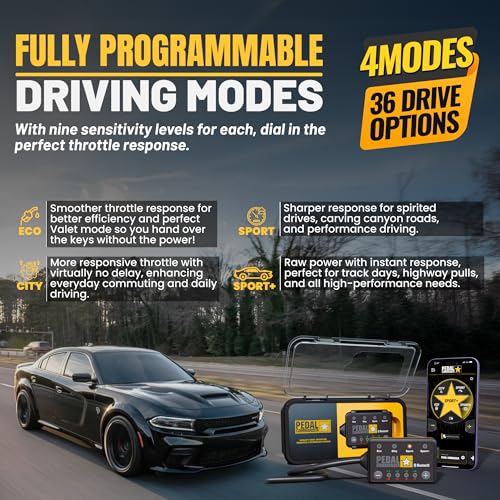
The Pedal Commander includes four primary driving modes:
- Eco
- City
- Sport
- Sport+
Each mode changes accelerator sensitivity.
Eco Mode
Eco mode softens the accelerator response.
It can be useful for:
- Daily commuting
- Wet or slippery roads
- Heavy traffic
- Long highway trips
- Smooth low-speed driving
- High-powered models where progressive control is important
Eco mode does not physically reduce engine horsepower.
Instead, it requires more pedal movement to request the same level of throttle opening.
This can make the Charger easier to drive smoothly and may encourage more gradual acceleration.
It is also useful when the goal is to arrive without turning every stoplight into an informal exhibition event.
Does Eco Mode Improve Fuel Economy?
Eco mode may help a driver use the accelerator more smoothly, which can support more efficient driving habits.
It does not guarantee better fuel economy.
Actual fuel consumption still depends on:
- Driving speed
- Traffic
- Vehicle condition
- Tire pressure
- Engine
- Vehicle weight
- Weather
- Driver behavior
Eco mode changes pedal sensitivity.
It does not negotiate with a 6.4-liter HEMI on your behalf.
City Mode
City mode provides a moderate increase in throttle response.
It is designed for everyday situations such as:
- Commuting
- Urban driving
- Stop-and-go traffic
- Highway merging
- Normal street use
- Drivers who want a sharper pedal without an aggressive feel
For many Charger owners, City mode may provide the best daily-driving balance.
The accelerator feels more alert than stock but remains easier to control than the more aggressive Sport settings.
This can be especially useful on V6 models, where owners may want a more immediate response without permanently altering engine software.
Sport Mode
Sport mode provides a stronger increase in accelerator sensitivity.
It may improve the driving experience during:
- Highway passing
- Rolling acceleration
- Spirited street driving
- Back-road driving
- Manual-transmission rev matching
- Performance-oriented commuting
The engine responds more aggressively to smaller pedal movements.
Again, this does not create additional horsepower.
It simply makes the available power feel more accessible during partial-throttle driving.
Sport mode may be the most useful setting for owners who want a noticeable difference without the extreme sensitivity of Sport+.
Sport+ Mode
Sport+ provides the most aggressive throttle response.
Small accelerator movements can create a much stronger throttle request, making the Charger react quickly when the driver presses the pedal.
This mode may appeal to drivers who want:
- Maximum pedal sensitivity
- Immediate partial-throttle response
- Aggressive highway acceleration
- Quicker access to wide-open throttle
- A more dramatic driving feel
Sport+ should be used carefully, particularly in:
- Rain
- Snow
- Heavy traffic
- Parking lots
- High-output HEMI models
- Scat Pack Chargers
- Hellcat models
- Vehicles with worn or low-grip tires
Maximum sensitivity is not automatically maximum performance.
A high-powered Charger already has enough torque to create traction problems without help from an impatient right foot.
Adjustable Sensitivity Settings
Pedal Commander controllers commonly provide multiple adjustment levels within each driving mode.
This allows the owner to fine-tune the response instead of choosing only between stock and maximum sensitivity.
A driver may prefer:
- A low Eco setting for wet roads
- A mild City setting for commuting
- A moderate Sport setting for highway driving
- A lower Sport+ setting for occasional spirited use
The best configuration depends on:
- Engine output
- Tires
- Road conditions
- Driving style
- Traffic
- Weather
- Personal preference
A setting that feels perfect in an SXT may feel unnecessarily aggressive in a supercharged Hellcat.
The useful part is not simply having an extreme mode.
It is being able to choose the level of response that fits the car and the situation.
Pedal Commander on the Charger SE and SXT
The Charger SE and SXT are commonly equipped with V6 engines and are often used as daily drivers.
A throttle controller may make these models feel:
- More responsive from a stop
- More alert during highway merging
- Quicker during passing
- Less soft at partial throttle
- More engaging in normal driving
It will not give a V6 Charger the torque or exhaust note of a HEMI.
It can, however, make the power already available respond more immediately.
For owners who want a noticeable change without an ECU tune, the Pedal Commander can offer a reversible alternative.
Pedal Commander on the Charger R/T
The Charger R/T uses HEMI V8 power and already offers strong low-speed torque.
The Pedal Commander can make that torque feel easier to access by sharpening the throttle-response curve.
This may be noticeable during:
- Rolling acceleration
- Highway passing
- Low-speed street driving
- On-ramp acceleration
- Manual shifting on applicable models
The R/T does not need more encouragement to sound good.
A sharper throttle simply makes it easier to request the noise.
Sport or a moderate Sport+ setting may feel dramatically different from stock, so owners should increase sensitivity gradually.
Pedal Commander on the Charger Scat Pack
The Charger Scat Pack already produces substantial naturally aspirated V8 power.
A throttle controller can make the car feel even more immediate, especially during partial-throttle driving.
Potential benefits include:
- Stronger perceived response
- Quicker reaction during passing
- Sharper street-driving feel
- Adjustable sensitivity without an ECU flash
However, smooth control remains important.
An aggressive pedal setting can make it easier to overwhelm the rear tires, particularly on cold pavement or in poor weather.
Start conservatively.
The 6.4-liter HEMI is not lacking motivation.
Pedal Commander on Charger SRT Models
SRT Chargers were engineered with higher-performance engines, brakes, cooling systems, and chassis components.
On these models, a more responsive pedal can improve the sense of connection between the driver and engine.
However, maximum sensitivity may not always provide the best control.
This is especially relevant during:
- Corner exits
- Wet-road driving
- Track use
- Low-speed maneuvering
- High-speed transitions
- Performance driving with traction control reduced
Smooth throttle application matters.
Sport+ may feel exciting, but a well-controlled Sport setting may be easier to drive quickly and consistently.
The fastest driver is not necessarily the one making the largest ankle movement.
Pedal Commander on the Charger Hellcat
The Hellcat is the model where restraint becomes particularly important.
A supercharged Charger already has more than enough power to create traction problems at road-legal speeds.
The Pedal Commander may make the throttle feel:
- More immediate
- More aggressive
- Less filtered
- Quicker during partial-throttle acceleration
It does not increase supercharger boost or horsepower.
It changes how rapidly the driver requests the power already available.
Hellcat owners should begin with a low City or Sport setting and increase sensitivity carefully.
Jumping directly to maximum Sport+ in a supercharged rear-wheel-drive sedan is less of a calibration strategy and more of a tire-company sponsorship application.
Pedal Commander on Daytona Models
The Daytona name has appeared on different Charger configurations depending on the year.
Owners should verify exact engine and product compatibility rather than assuming that every Daytona package uses the same electronics.
On compatible models, the Pedal Commander performs the same basic function:
- It changes pedal sensitivity
- It sharpens or softens throttle response
- It does not add horsepower
- It does not perform a conventional ECU flash
The effect may feel different depending on the engine, transmission, gearing, and factory calibration.
Anti-Theft Function
The product description includes an Anti-Theft feature.
On supported Pedal Commander versions, Anti-Theft mode is designed to restrict or disable normal accelerator response when activated.
This can provide an additional layer of theft deterrence when the Charger is parked.
Depending on the specific controller version, app, and current service terms, Anti-Theft functionality may require:
- App activation
- Account configuration
- A supported device version
- A subscription or service plan
Owners should verify the current Anti-Theft terms before purchasing.
The feature should be treated as an additional deterrent rather than a complete security system.
It does not replace:
- Factory immobilizers
- Alarm systems
- Secure parking
- GPS recovery systems
- Steering-wheel locks
- Sensible key security
A Charger is still a Charger.
Parking it under a streetlight with the windows down is not a security plan.
Smartphone App Control
The Pedal Commander can be controlled through a compatible mobile application.
Depending on the product version and available software features, owners may be able to:
- Change driving modes
- Adjust throttle sensitivity
- View the current setting
- Configure Anti-Theft mode
- Store preferred settings
App control is useful because the physical module is normally installed near the accelerator-pedal area.
Instead of reaching under the dashboard, the driver can configure the controller from a smartphone.
Changes should only be made while parked or when it is safe.
A phone-controlled throttle system is convenient.
Experimenting with it during a highway pull is not.
Plug-and-Play Installation
The Pedal Commander installs at the Charger’s accelerator-pedal harness.
It does not normally require:
- Wire cutting
- Soldering
- ECU flashing
- Drilling
- Engine disassembly
- Permanent dashboard modification
A typical installation process includes:
- Park the Charger securely.
- Turn off the engine.
- Keep the key or key fob away from the vehicle.
- Allow the electrical system to power down.
- Locate the accelerator-pedal connector.
- Disconnect the factory harness.
- Connect the Pedal Commander inline.
- Mount the controller securely.
- Route the wiring away from all pedals.
- Pair the controller with the app.
- Select a conservative initial setting.
- Test the pedal carefully before driving.
Installation is commonly described as relatively quick, although access can vary by model year.
All wiring must be secured away from:
- The accelerator pedal
- Brake-pedal travel
- Parking-brake components
- Steering components
- Driver foot movement
A loose wire near the pedals is not a minor cosmetic issue.
It is a safety problem.
Does the Pedal Commander Leave a Trace on the ECU?
The supplied product description says the controller leaves no digital trace on the ECU.
The Pedal Commander does not perform a conventional ECU software flash. It operates by modifying the accelerator-pedal signal through an inline connection.
That makes it different from a tuner that may alter:
- Fuel maps
- Ignition timing
- Torque management
- Transmission behavior
- Rev limits
- Boost settings
- Internal throttle mapping
The Pedal Commander is also designed to be removable.
However, “no digital trace” should not be interpreted as an unconditional warranty guarantee.
Warranty decisions can depend on:
- The failed component
- Whether the accessory contributed to the failure
- Dealer findings
- Manufacturer policies
- Applicable consumer-protection laws
The most accurate description is that the controller is reversible and does not perform a traditional ECU reflash.
Does the Pedal Commander Add Horsepower?
No.
The Pedal Commander does not increase:
- Horsepower
- Torque
- Supercharger boost
- Fuel flow
- Airflow capacity
- Engine displacement
- Exhaust flow
- Transmission gearing
It changes the pedal-response curve.
A more aggressive mode can make the Charger feel faster because less pedal movement produces a stronger throttle request.
At wide-open throttle, however, the engine still has the same maximum output it had before installation.
That means claims about guaranteed explosive launches or faster zero-to-60 times should be treated carefully.
Acceleration depends on:
- Tire grip
- Road surface
- Launch technique
- Transmission behavior
- Engine output
- Vehicle weight
- Weather
- Traction-control intervention
The controller may help the driver request full throttle sooner.
It does not create more power or traction.
Will It Improve Zero-to-60 Times?
A throttle controller may change how quickly the accelerator reaches a large throttle request, but it does not guarantee a quicker zero-to-60 time.
A wide-open-throttle acceleration run depends on many factors, including:
- Tire temperature
- Tire compound
- Surface preparation
- Launch RPM
- Transmission calibration
- Engine output
- Wheelspin
- Traction control
- Vehicle weight
A more sensitive pedal can actually make some launches harder to control.
On a high-powered Charger, a smoother setting may deliver a cleaner launch than maximum Sport+.
The best acceleration setting is the one that allows the driver to apply power effectively.
Not necessarily the one that feels most dramatic in a parking lot.
Works With Intakes and Exhaust Systems
The supplied description says the Pedal Commander can work alongside common intake and exhaust modifications.
Compatible types of upgrades may include:
- Cold air intakes
- Performance air filters
- Cat-back exhaust systems
- Axle-back systems
- Mid-pipes
- Headers
- Performance mufflers
These modifications perform different functions.
An intake or exhaust may change airflow and engine sound.
The Pedal Commander changes accelerator response.
It does not increase the horsepower gain from an intake or exhaust, but it may make the engine and exhaust react more immediately during acceleration.
It does not create more HEMI roar.
It simply helps the driver request it sooner.
Pedal Commander Versus an ECU Tune
A throttle controller and an ECU tune should not be confused.
Pedal Commander
The Pedal Commander changes:
- Accelerator sensitivity
- Partial-throttle response
- Perceived throttle delay
It generally does not change:
- Fuel delivery
- Ignition timing
- Peak horsepower
- Peak torque
- Transmission programming
- Rev limits
- Supercharger control
ECU Tune
A proper ECU tune may change:
- Fuel maps
- Ignition timing
- Torque management
- Transmission behavior
- Cooling-fan operation
- Rev limits
- Throttle mapping
- Boost control
A tune may create actual horsepower gains when properly calibrated.
The Pedal Commander is intended primarily as a reversible throttle-response modification.
It is better suited to owners who want a different pedal feel without rewriting engine-management software.
Advantages
- Sharper accelerator response
- Eco, City, Sport, and Sport+ modes
- Adjustable sensitivity
- Smartphone app control
- Anti-Theft functionality on supported versions
- Plug-and-play installation
- Reversible design
- No conventional ECU flash
- Compatible with multiple Charger trims when properly matched
- Works alongside many intake and exhaust modifications
- Useful for commuting, highway driving, and spirited street use
Disadvantages
- Does not add horsepower
- Does not increase torque
- Does not guarantee faster zero-to-60 times
- Sport+ may be overly sensitive
- High-output Scat Pack and Hellcat models require careful adjustment
- Anti-Theft terms may vary by product version
- It does not replace an ECU or transmission tune
- Exact fitment must be confirmed
- Some drivers may prefer the factory throttle calibration
Is the Pedal Commander Worth It for a Dodge Charger?
The Pedal Commander makes the most sense for a Charger owner who:
- Dislikes the factory pedal response
- Wants sharper partial-throttle acceleration
- Prefers a reversible modification
- Does not want an ECU flash
- Wants multiple response settings
- Values driving feel more than dyno numbers
- Wants optional app and Anti-Theft features
It makes less sense for an owner expecting:
- Additional horsepower
- Additional torque
- Guaranteed quicker drag-strip times
- Better traction
- A replacement for engine tuning
- A substitute for a transmission tune
- A mechanical throttle conversion
The Pedal Commander should be viewed as a throttle-response and drivability upgrade.
It changes how quickly the Charger reacts to accelerator movement.
It does not change the engine’s maximum potential.
Final Thoughts
The Dodge Charger has always offered an unusual combination of practicality and attitude.
It can carry passengers, commute comfortably, run errands, and still provide enough rear-wheel-drive character to make tire shops feel like long-term business partners.
The Pedal Commander does not add power to that formula.
It focuses on one specific area: accelerator response.
Eco mode can soften the pedal for relaxed driving or poor weather. City mode can sharpen everyday response. Sport provides a more aggressive street feel, while Sport+ offers the most immediate throttle mapping.
App control makes the system easier to adjust, while Anti-Theft functionality may add another layer of protection on compatible versions.
The controller will not turn an SXT into an R/T.
It will not turn an R/T into a Scat Pack.
It will not turn a Scat Pack into a Hellcat.
And it definitely will not make a Hellcat sensible.
What it can do is make the Charger respond more immediately when the driver presses the accelerator.
For owners frustrated by a soft factory pedal, that may be enough to make the car feel new again.
Frequently Asked Questions
Does the Pedal Commander add horsepower to a Dodge Charger?
No. It changes accelerator sensitivity but does not increase peak horsepower or torque.
Which Dodge Charger models are compatible?
According to the supplied product information, it fits compatible 2007–2024 Charger models including SE, SXT, R/T, Scat Pack, SRT, Hellcat, and Daytona trims.
Does the Pedal Commander work on a Charger SXT?
The supplied compatibility information includes V6-powered Charger models such as the SXT. Exact model-year and part-number fitment should be confirmed.
Can it be used on a Charger R/T?
Yes, according to the supplied product listing. It can sharpen throttle response on compatible HEMI-powered R/T models.
Does it work with a Charger Scat Pack?
The product information includes Scat Pack applications. Owners should begin with a moderate setting because of the 6.4-liter HEMI’s torque output.
Can Pedal Commander be installed on a Hellcat?
The supplied listing includes Hellcat models. Exact compatibility should be confirmed, and sensitivity should be increased gradually.
Does it require an ECU tune?
No. It connects at the accelerator-pedal harness and does not perform a conventional ECU software reflash.
Does it leave a digital trace on the ECU?
The product description states that it does not rewrite or flash the ECU. Owners should not interpret that as an unconditional warranty guarantee.
How does the Anti-Theft feature work?
On supported versions, Anti-Theft mode is designed to restrict normal accelerator operation when activated. App, subscription, and feature terms may vary.
Will the Pedal Commander improve zero-to-60 times?
It does not add power. A sharper pedal may help the driver request throttle sooner, but quicker acceleration times are not guaranteed.
Does it work with a cold air intake or exhaust?
The product is intended to operate alongside common intake and exhaust modifications. Each modification serves a different purpose.
Can the Pedal Commander be removed?
Yes. The inline installation is designed to be reversible.





There are no reviews yet.