



What Is the Pedal Commander?
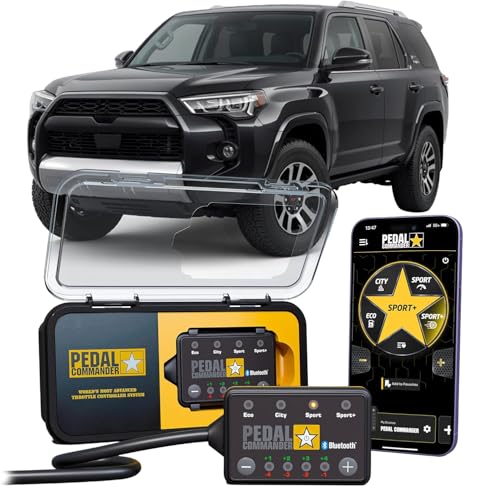
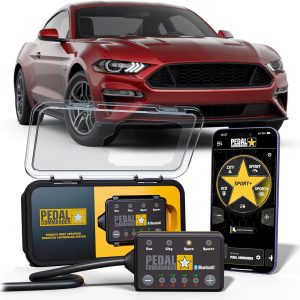
The Pedal Commander is an inline electronic throttle response controller.
It installs between the 4Runner’s accelerator-pedal position sensor and the factory wiring harness. Once connected, the device modifies the pedal signal according to the selected driving mode and sensitivity setting.
The Pedal Commander changes:
- Accelerator sensitivity
- Partial-throttle response
- The amount of pedal travel needed to request acceleration
- The perceived delay between pressing the pedal and engine response
- How aggressive or progressive the accelerator feels
It does not directly change:
- Peak horsepower
- Peak torque
- Fuel-injection tables
- Ignition timing
- Transmission gearing
- Axle ratios
- Engine displacement
- Towing capacity
- Payload capacity
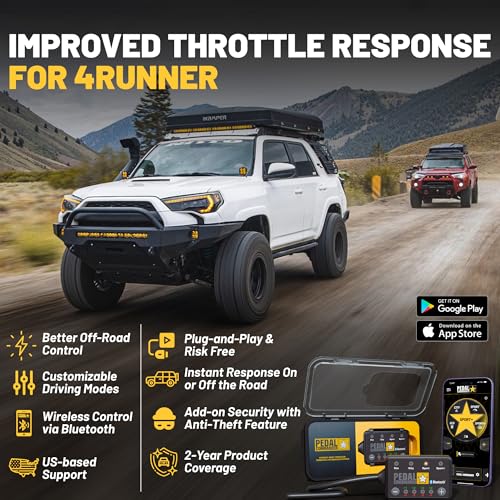
Pedal Commander describes the 4Runner controller as offering four modes and 36 settings while using vehicle-specific throttle calibration.
The 4Runner may feel quicker because a smaller pedal movement can request a stronger throttle response.
That is not the same as producing additional engine power.
Toyota 4Runner Compatibility
According to Pedal Commander’s current product listing, the applicable controller supports the N280-generation 2010–2024 Toyota 4Runner with the:
- 2.7-liter four-cylinder
- 4.0-liter V6
The product page also lists compatibility across 4Runner trims and submodels including:
- SR5
- SR5 Premium
- Limited
- Trail Edition
- TRD Off-Road
- TRD Off-Road Premium
- TRD Pro
- TRD Sport
- Nightshade
- Venture Edition
Pedal Commander specifically identifies the N280 application as covering 2010–2024 models.
Owners should still confirm the exact part number using the vehicle’s:
- Model year
- Engine
- Trim
- Accelerator-pedal connector
- Drivetrain
- Market configuration
A 2010 rear-wheel-drive four-cylinder SR5 and a 2024 TRD Pro are both fifth-generation 4Runners, but there are enough differences between them that electronic accessories should be ordered by verified fitment rather than enthusiasm.
Important Note About the 2.7-Liter 4Runner
The supplied product description says the controller works with both the 2.7-liter four-cylinder and 4.0-liter V6.
That statement needs context.
Toyota offered the 2.7-liter four-cylinder in the 2010 4Runner, but only in a rear-wheel-drive SR5 configuration. Toyota rated that engine at 157 horsepower and 178 pound-feet of torque. The four-cylinder was paired with a four-speed automatic, while four-wheel-drive models used the 4.0-liter V6.
The 2.7-liter engine was not a regular option throughout the entire 2010–2024 production run.
By 2024, every 4Runner used the 4.0-liter V6. Toyota rated the 2024 engine at 270 horsepower and 278 pound-feet of torque.
Therefore, the most accurate description is:
- The Pedal Commander application may support applicable 2.7-liter fifth-generation trucks.
- Most 2010–2024 4Runners use the 4.0-liter V6.
- Buyers should confirm the exact model year and engine rather than assuming both engines were offered throughout the entire generation.
Why Does the Toyota 4Runner Have Throttle Lag?
The fifth-generation 4Runner uses electronic throttle control.
Instead of a physical throttle cable, the accelerator-pedal sensor communicates the driver’s request to the engine-control unit. The ECU then determines how aggressively to respond.
Toyota’s factory calibration must balance:
- Smooth acceleration
- Fuel economy
- Emissions
- Traction control
- Transmission operation
- Driveline protection
- Passenger comfort
- Low-speed off-road control
That broad calibration can make the accelerator feel less immediate than some drivers expect.
The softness may become more noticeable when the 4Runner has:
- Larger tires
- Heavier wheels
- A suspension lift
- Steel bumpers
- A winch
- Skid plates
- A rooftop tent
- Recovery gear
- Camping equipment
- Additional passengers and cargo
You press the pedal.
The 4Runner receives the request.
It considers engine speed, traction, transmission behavior, vehicle load, and the collection of overlanding equipment that was supposedly purchased to simplify life.
Then it accelerates.
The Pedal Commander is designed to reduce that perceived hesitation by changing accelerator sensitivity.
Four Driving Modes
The Pedal Commander provides four main modes:
- Eco
- City
- Sport
- Sport+
Each mode changes the way the 4Runner responds to pedal movement.
Pedal Commander confirms that the 4Runner controller offers these four modes with nine adjustment levels per mode, producing 36 total settings.
Eco Mode
Eco mode softens accelerator response.
It requires more pedal movement to request the same amount of throttle, creating a more progressive pedal feel.
Eco mode may be useful for:
- Rock crawling
- Technical trails
- Snow and ice
- Wet pavement
- Stop-and-go traffic
- Trailer maneuvering
- Long highway drives
- Drivers who prefer smooth acceleration
Pedal Commander specifically promotes Eco mode as a useful setting for controlled power delivery during technical off-road driving.
Why Eco Mode Can Be Useful Off Road
Aggressive throttle response is not always desirable on a trail.
During rock crawling or low-speed obstacle work, a softer pedal can help reduce:
- Sudden wheelspin
- Abrupt vehicle movement
- Unwanted weight transfer
- Loss of traction
- Lurching over obstacles
The goal is not always to access power more quickly.
Sometimes the goal is to apply exactly the amount of power the tires can use.
That is where Eco mode may be more valuable than Sport+.
Does Eco Mode Improve Fuel Economy?
Eco mode may encourage smoother accelerator inputs, which could support more efficient driving habits.
It does not guarantee better fuel economy.
Actual mileage still depends on:
- Vehicle weight
- Tire size
- Tire pressure
- Roof racks
- Cargo
- Driving speed
- Road grade
- Wind
- Driver behavior
A softer pedal may help reduce unnecessary acceleration.
It cannot make a lifted 4Runner with 35-inch tires and a rooftop tent suddenly develop the aerodynamics of a Prius.
City Mode
City mode provides a moderate increase in throttle sensitivity.
It is intended for everyday situations such as:
- Commuting
- Urban traffic
- Stop-and-go driving
- Highway merging
- Parking-lot maneuvering
- General street use
For many owners, City mode may offer the best daily-driving balance.
The accelerator can feel more alert than stock without becoming overly aggressive at low speed.
This may be especially useful on 4Runners equipped with:
- Larger tires
- Heavy wheels
- Steel bumpers
- Winches
- Drawer systems
- Roof racks
- Camping equipment
City mode cannot remove the added weight.
It can make the 4Runner feel less hesitant while carrying it.
Sport Mode
Sport mode produces a stronger increase in accelerator sensitivity.
It may improve the driving feel during:
- Highway merging
- Passing
- Climbing grades
- Open-road acceleration
- Faster trail sections
- Driving with heavier accessories
- Spirited street use
The engine responds more aggressively to smaller pedal movements.
Sport mode does not increase horsepower or torque.
It makes the existing output feel easier to access during partial-throttle driving.
For many 4Runner owners, Sport mode may deliver the most noticeable response improvement without making the pedal as sensitive as Sport+.
Sport+ Mode
Sport+ provides the most aggressive throttle response.
Small pedal movements can produce a much stronger throttle request, making the 4Runner react quickly during acceleration.
Sport+ may appeal to drivers looking for:
- Maximum pedal sensitivity
- Immediate street response
- Quicker access to full throttle
- Stronger highway merging feel
- Aggressive open-trail response
However, Sport+ is not automatically the best mode for difficult trails.
Too much accelerator sensitivity can make precise low-speed control harder during:
- Rock crawling
- Mud
- Snow
- Loose gravel
- Steep climbs
- Technical descents
- Wet pavement
The supplied description calls Sport+ useful for demanding trails, but terrain matters.
On open desert tracks or faster trails, aggressive response may feel useful. During technical crawling, Eco or a mild City setting may provide better control.
Maximum sensitivity is not the same as maximum capability.
Sometimes the obstacle is defeated with careful throttle control rather than treating the accelerator like a doorbell.
36 Adjustable Throttle Settings
Each of the four modes includes nine sensitivity levels.
That produces 36 total settings.
This allows the driver to fine-tune the pedal rather than choosing only between stock response and maximum aggression.
Possible configurations might include:
- Eco -4 for technical crawling
- Eco -2 for snow
- City -1 for everyday commuting
- City +2 for larger tires
- Sport -2 for highway driving
- Sport +2 for open-road passing
- Sport+ at a low level before testing maximum response
The best setting depends on:
- Terrain
- Tire size
- Vehicle weight
- Engine
- Weather
- Traction
- Driving style
- Additional equipment
A setting that feels ideal on a stock SR5 may feel too aggressive on a lifted TRD Pro carrying several hundred pounds of recovery and camping gear.
The correct setting is the one that produces predictable control.
Not necessarily the one that makes the first test drive most dramatic.
Smartphone App Control
The Pedal Commander can be adjusted through its mobile app.
Depending on the hardware version and supported app features, the driver may be able to:
- Change driving modes
- Adjust sensitivity
- View the active setting
- Save preferred configurations
- Activate Anti-Theft functionality
- Control the unit without reaching into the footwell
Pedal Commander’s 4Runner product page states that the app supports mode changes and Anti-Theft control.
The supplied product description says modes can be adjusted in real time without stopping.
Technically, the app may allow mode changes while the vehicle is operating. From a safety standpoint, adjustments should be made only when the driver can do so without distraction.
Changing a throttle setting while moving is one thing.
Looking down at a phone while approaching a freeway merge is another.
Pedal Commander Anti-Theft Mode
The supplied product description does not emphasize Anti-Theft, but Pedal Commander currently lists Anti-Theft as available for the 2010–2024 4Runner application.
On supported units, Anti-Theft mode is designed to disable normal accelerator operation through the mobile app.
Pedal Commander currently describes the feature as subscription-based, with listed pricing of:
- $0.99 per month
- $9.99 per year
The company also states that Anti-Theft is an additional security measure and does not guarantee complete theft prevention.
Anti-Theft mode should therefore supplement—not replace—other security measures such as:
- Factory immobilizers
- Alarm systems
- Secure key storage
- GPS tracking
- Steering-wheel locks
- Secure parking
- Trailhead awareness
Disabling the accelerator may make theft more difficult.
It does not make the entire 4Runner disappear from a tow truck’s field of vision.
Pedal Commander for the 4.0-Liter V6
The overwhelming majority of fifth-generation 4Runners use Toyota’s 4.0-liter V6.
For 2024, Toyota rated the engine at:
- 270 horsepower
- 278 pound-feet of torque
Toyota also rated 2024 models to tow up to 5,000 pounds when properly equipped.
A Pedal Commander may make the V6 feel:
- More responsive from a stop
- More immediate during merging
- Quicker during highway passing
- Less hesitant with larger tires
- More alert when carrying additional weight
- Sharper on open trails
It does not increase the engine’s factory output.
At wide-open throttle, the engine still produces the same peak horsepower and torque.
The difference is in how quickly the throttle request builds as the accelerator is pressed.
This can be especially noticeable because the 4.0-liter V6 relies on engine speed rather than turbocharged low-rpm torque. A sharper pedal may make the powertrain feel more eager even though its maximum output remains unchanged.
Pedal Commander for the 2.7-Liter Four-Cylinder
Toyota offered a 2.7-liter four-cylinder in the 2010 rear-wheel-drive SR5.
Toyota rated that engine at:
- 157 horsepower
- 178 pound-feet of torque
It was paired with a four-speed automatic transmission.
On a compatible 2.7-liter model, the Pedal Commander may make the vehicle feel:
- More responsive in city traffic
- Quicker to react from a stop
- Less delayed during merging
- More immediate at partial throttle
It will not give the four-cylinder the output of the V6.
It can only change how quickly the available power is requested.
Because the 2.7-liter application is uncommon and limited to early fifth-generation configurations, owners should carefully verify fitment before ordering.
Pedal Commander for the 4Runner SR5
The SR5 is one of the most common 4Runner trims and serves as the foundation for daily drivers, family vehicles, and modified off-road builds.
A Pedal Commander may improve the SR5 driving experience by providing:
- Sharper daily response
- Better-feeling highway merges
- Adjustable pedal sensitivity
- Softer low-speed trail control
- Compensation in pedal feel for added accessories
For a mostly stock SR5, City mode may be enough.
For a modified SR5 with larger tires and heavier bumpers, a moderate Sport setting may feel more appropriate.
Pedal Commander for TRD Off-Road Models
The TRD Off-Road and TRD Off-Road Premium include equipment designed for more demanding terrain.
Depending on the year, these models may include systems such as:
- Electronic locking rear differential
- Multi-Terrain Select
- Crawl Control
- Off-road suspension components
Toyota notes that Crawl Control regulates engine speed and braking during difficult low-speed terrain, allowing the driver to focus on steering.
A Pedal Commander does not replace these systems.
Instead, it changes accelerator sensitivity when the driver is controlling the throttle manually.
Useful mode choices may include:
- Eco for rock crawling
- City for mixed trail conditions
- Sport for open dirt roads
- Sport+ for faster, high-traction trail sections
The best setting depends on the terrain—not the badge on the rear hatch.
Pedal Commander for the TRD Pro
The TRD Pro is the most trail-focused version of the fifth-generation 4Runner.
The 2024 TRD Pro included equipment such as:
- Fox internal-bypass shocks
- TRD-tuned front springs
- Nitto Terra Grappler tires
- TRD wheels
- Aluminum front skid plate
- Electronic locking rear differential
- Crawl Control
- Multi-Terrain Select
Toyota describes the TRD Pro as the most off-road-capable version of the lineup.
The Pedal Commander may complement a TRD Pro by giving the driver more choice in pedal sensitivity.
That does not necessarily mean Sport+ should be selected every time the pavement ends.
For technical terrain, Eco may provide more precise control. On an open trail, Sport may feel more responsive. The benefit is adjustability rather than simply making every pedal input more aggressive.
Pedal Commander for the Limited
The 4Runner Limited is more road-focused than the TRD models.
Toyota equipped the 2024 Limited with full-time four-wheel drive and a Torsen center differential, while Limited and TRD Sport models also used the X-REAS suspension system for improved road manners.
A Pedal Commander may make sense for Limited owners who want:
- Sharper commuting response
- More immediate highway passing
- Less pedal delay
- Adjustable response for poor weather
- A more responsive road-driving feel
City mode may be the most practical daily setting, while Sport can provide a more noticeable improvement during highway use.
Pedal Commander for the TRD Sport
The TRD Sport was developed as a more road-oriented version of the 4Runner.
Toyota equipped the 2024 TRD Sport with X-REAS suspension intended to improve on-road handling.
A sharper pedal may fit the TRD Sport’s road-focused character by improving:
- Highway merging
- Passing response
- Urban acceleration
- Open-road driving feel
Sport mode may make the SUV feel more eager without requiring changes to the factory ECU programming.
It will not make the 4Runner handle like a sports car.
The badge says Sport.
The curb weight still has access to the same scale.
Pedal Commander With Larger Tires
Larger tires are among the most common fifth-generation 4Runner modifications.
They can improve:
- Ground clearance
- Off-road traction
- Sidewall durability
- Obstacle clearance
- Appearance
They can also increase:
- Rotational mass
- Unsprung weight
- Effective gearing
- Braking effort
- Fuel consumption
A 4Runner with larger tires may feel slower to accelerate because the engine and drivetrain must work harder to rotate the heavier, taller tire.
The Pedal Commander may improve perceived throttle response, but it does not mechanically correct the effects of larger tires.
It cannot change:
- Axle ratios
- Tire weight
- Tire diameter
- Transmission gearing
- Engine output
- Vehicle mass
Pedal Commander itself markets the controller as useful for restoring a more responsive feel to modified 4Runners with lift kits, larger tires, and heavy bumpers.
That description should still be interpreted correctly.
The controller may sharpen the pedal.
It does not regear the differentials.
Pedal Commander With Lift Kits and Overland Equipment
A typical overland build may include:
- Suspension lift
- Larger tires
- Steel front bumper
- Rear swing-out bumper
- Winch
- Skid plates
- Roof rack
- Rooftop tent
- Drawer system
- Refrigerator
- Recovery boards
- Additional fuel and water
Every one of those accessories adds weight or aerodynamic drag.
The Pedal Commander cannot remove that weight.
It may, however, make the vehicle feel more alert by increasing the throttle request earlier in the pedal’s travel.
This can improve perceived response during:
- Highway travel
- Passing
- Hill climbing
- Dirt-road driving
- Pulling away with a loaded vehicle
Owners should still recognize when a mechanical upgrade is more appropriate.
A heavily modified 4Runner may benefit from:
- Correct axle gearing
- Appropriate tire pressure
- Reduced unnecessary cargo
- Proper suspension setup
- Brake upgrades
- Transmission temperature monitoring
A throttle controller changes pedal feel.
It is not a substitute for building the vehicle correctly.
Pedal Commander for Rock Crawling
Rock crawling rewards precision more than aggression.
A softer accelerator can make it easier to:
- Maintain slow wheel speed
- Prevent tire slip
- Control weight transfer
- Ease onto ledges
- Avoid sudden movement
- Protect driveline components
Eco mode may therefore be the most useful Pedal Commander setting for technical crawling.
This is an important distinction because throttle controllers are frequently marketed as ways to make the accelerator more responsive.
In technical terrain, reducing sensitivity may be the better performance choice.
The advantage is not merely having Sport+.
It is having the option not to use it.
Pedal Commander for Mud, Sand, and Dirt
Different surfaces require different pedal behavior.
Mud
Excessive sensitivity may create unnecessary wheelspin.
A moderate City or Sport setting may work better than maximum Sport+.
Sand
Maintaining momentum can be important, so a stronger throttle response may feel useful.
However, abrupt pedal inputs can still dig the tires deeper.
Dirt Roads
City or Sport may provide a more responsive feel during elevation changes and faster trail sections.
Snow and Ice
Eco mode may make it easier to apply power gradually.
The Pedal Commander does not improve traction.
It changes how the driver requests the power that reaches the tires.
Pedal Commander for Highway Driving
The 4Runner is not known for explosive highway acceleration, particularly when loaded with passengers, cargo, and off-road equipment.
A more aggressive pedal map may make the SUV feel more responsive when:
- Entering a freeway
- Passing slower traffic
- Climbing a grade
- Accelerating into a lane opening
- Rejoining traffic after slowing
Sport mode may reduce the amount of pedal travel needed to request stronger acceleration.
It does not make the engine produce more power.
At wide-open throttle, the same 4.0-liter V6 is still doing the work.
The improvement is in immediacy rather than output.
Pedal Commander for Towing
Toyota rated the 2024 4Runner to tow up to 5,000 pounds with a maximum tongue weight of 500 pounds when properly configured.
The Pedal Commander may make the 4Runner feel more responsive while towing:
- Small campers
- Utility trailers
- Boats
- Off-road trailers
- Motorcycle trailers
It may improve the feel of:
- Highway merging
- Grade climbing
- Passing
- Pulling away from a stop
It does not increase:
- Towing capacity
- Tongue-weight rating
- Brake capacity
- Cooling capacity
- Hitch strength
- Payload rating
- Gross combined weight rating
For towing, City or a mild Sport setting may provide a useful balance.
Sport+ may make the accelerator too abrupt, particularly during low-speed maneuvering or on slippery roads.
The trailer does not care how exciting the pedal feels.
It cares whether the driver remains smooth.
Tool-Free Plug-and-Play Installation
Pedal Commander describes the 4Runner installation as a plug-and-play process that takes approximately 15 minutes without special tools.
A typical installation process includes:
- Park the 4Runner securely.
- Turn off the engine.
- Keep the key or key fob away from the vehicle.
- Allow the electrical system to power down.
- Locate the accelerator-pedal connector.
- Disconnect the factory harness.
- Connect the Pedal Commander inline.
- Secure the controller module.
- Route all wiring away from the pedals.
- Pair the device with the app.
- Select a conservative initial setting.
- Test the pedal before normal driving.
Installation generally does not require:
- Wire cutting
- Soldering
- Drilling
- ECU flashing
- OBD-II port use
- Engine disassembly
- Permanent interior changes
All wiring must be secured away from:
- Accelerator-pedal travel
- Brake-pedal movement
- Driver footwear
- Parking-brake components
- Steering components
A loose cable near the pedals is not a minor cosmetic flaw.
It is a safety issue that should be corrected before driving.
Does the Pedal Commander Alter the ECU?
The Pedal Commander does not perform a conventional ECU software flash.
It works through the accelerator-pedal circuit rather than rewriting the 4Runner’s engine calibration.
It does not normally alter:
- Fuel maps
- Ignition timing
- Emissions programming
- Transmission programming
- Rev limits
- Factory engine tables
Pedal Commander states that the 4Runner controller does not leave traces on the ECU and is designed to be removable.
That said, claims such as “zero residual data” or “zero diagnostic codes” should not be interpreted as a guarantee that no installation issue could ever trigger a fault.
A poorly seated connector, damaged wiring, incorrect installation procedure, or incompatible unit could potentially create an accelerator-pedal-related diagnostic problem.
The most accurate description is:
- It does not perform a conventional ECU reflash.
- It is designed to be reversible.
- Removing it restores the original pedal signal path.
- Proper installation and correct fitment still matter.
Does It Preserve the Factory Warranty?
Pedal Commander markets the product as warranty-friendly and states that it does not void the 4Runner warranty.
However, aftermarket warranty questions are more nuanced than a single marketing sentence.
A manufacturer or dealer may evaluate:
- Which component failed
- Whether the accessory contributed to the failure
- Installation quality
- Vehicle modifications
- Diagnostic findings
- Applicable consumer-protection laws
The Pedal Commander’s reversible design and lack of a conventional ECU flash may reduce certain concerns compared with an engine tune.
That is not the same as guaranteeing approval of every future warranty claim.
Does the Pedal Commander Add Horsepower?
No.
The Pedal Commander does not increase:
- Horsepower
- Torque
- Fuel flow
- Airflow capacity
- Engine displacement
- Compression ratio
- Towing capacity
- Payload capacity
It changes accelerator sensitivity.
The 4Runner may feel faster because less pedal movement requests a greater throttle response.
At wide-open throttle, however, the engine still produces the same maximum output.
That means a Pedal Commander should not be described as a traditional performance power upgrade.
It is a response and drivability upgrade.
Will It Make the 4Runner Accelerate Faster?
A more aggressive throttle map may help the driver request full throttle sooner.
That does not guarantee a measurable improvement in acceleration.
Actual performance depends on:
- Engine output
- Vehicle weight
- Tire size
- Tire grip
- Elevation
- Transmission behavior
- Road grade
- Cargo
- Driver input
Once the accelerator is fully depressed, the Pedal Commander cannot make the engine produce more than its factory output.
The vehicle may feel more eager during partial-throttle driving.
That is where most owners are likely to notice the biggest difference.
Pedal Commander Versus an ECU Tune
A throttle controller and an ECU tune are different products.
Pedal Commander
The Pedal Commander changes:
- Accelerator sensitivity
- Partial-throttle response
- Perceived pedal delay
It generally does not change:
- Fuel delivery
- Ignition timing
- Peak horsepower
- Peak torque
- Transmission calibration
- Engine protection tables
ECU Tune
A properly developed ECU tune may change:
- Fuel mapping
- Ignition timing
- Torque management
- Transmission behavior
- Throttle mapping
- Rev limits
- Engine-response strategies
A tune may alter actual engine behavior and, in some cases, produce measurable output gains.
The Pedal Commander is primarily a reversible pedal-response modification.
It is better suited to owners who want adjustable throttle feel without rewriting the factory ECU software.
Advantages
- Sharper accelerator response
- Four driving modes
- 36 sensitivity settings
- Mobile app control
- Anti-Theft available on supported units
- Quick plug-and-play installation
- Does not use the OBD-II port
- No conventional ECU flash
- Reversible design
- Useful for highway driving
- Adjustable for off-road terrain
- May improve perceived response with larger tires
- Compatible with multiple fifth-generation trims when correctly matched
Disadvantages
- Does not add horsepower
- Does not increase torque
- Does not increase towing capacity
- Does not correct axle gearing
- Sport+ may be too sensitive for technical trails
- Aggressive settings may reduce low-speed precision
- App changes can distract the driver
- Anti-Theft requires a subscription
- Exact fitment should be confirmed
- The 2.7-liter engine was not offered throughout the full generation
- Warranty coverage cannot be universally guaranteed
- It does not replace an ECU or transmission tune
Is the Pedal Commander Worth It for a Toyota 4Runner?
The Pedal Commander may be worth considering for a 4Runner owner who:
- Dislikes the factory pedal response
- Wants sharper highway merging
- Runs larger tires or heavier wheels
- Has added overland equipment
- Wants a softer pedal for technical trails
- Prefers adjustable response
- Does not want an ECU tune
- Wants a reversible modification
- Values driving feel more than horsepower numbers
It makes less sense for someone expecting:
- More horsepower
- More torque
- Increased towing capacity
- Better axle gearing
- Guaranteed fuel-economy gains
- A replacement for an engine tune
- A cure for excessive vehicle weight
- Guaranteed faster acceleration
The Pedal Commander is best understood as a throttle-response and drivability upgrade.
It changes the way the 4Runner reacts to accelerator input.
It does not change the engine’s maximum output or the vehicle’s mechanical capabilities.
Final Thoughts
The fifth-generation Toyota 4Runner lasted from 2010 through 2024 because owners valued what it did well.
It was durable, capable, easy to modify, and refreshingly uninterested in reinventing itself every three years.
Its conservative throttle response is part of that old-school personality—but it is not something every owner enjoys.
The Pedal Commander gives drivers more control over how the accelerator behaves.
Eco mode can soften response for rock crawling, snow, or trailer maneuvering. City mode can improve everyday drivability. Sport can sharpen highway merging and passing, while Sport+ provides the most aggressive response for drivers who want the strongest change from stock.
The 36 settings allow the system to be tailored to a stock commuter, a lifted trail rig, or an overland build carrying enough equipment to establish a temporary government.
It will not add horsepower.
It will not regear the axles.
It will not make a 4Runner loaded with steel bumpers, camping gear, water, fuel, and 35-inch tires feel genuinely lightweight.
What it can do is make the accelerator feel more immediate without a conventional ECU tune or permanent wiring modification.
For owners frustrated by the stock pedal calibration, that may be enough to make a familiar 4Runner feel considerably more responsive.
Frequently Asked Questions
Does the Pedal Commander add horsepower to a Toyota 4Runner?
No. It changes accelerator sensitivity but does not increase peak horsepower or torque.
Which Toyota 4Runner years are compatible?
Pedal Commander currently lists an N280 application for 2010–2024 Toyota 4Runner models. Exact fitment should be confirmed by year and engine.
Does it work with the 4.0-liter V6?
Yes, the manufacturer lists the 2010–2024 4.0-liter V6 application.
Does it work with the 2.7-liter four-cylinder?
Pedal Commander lists the 2.7-liter application, but Toyota offered that engine only in limited early fifth-generation configurations, including the 2010 rear-wheel-drive SR5.
Is it compatible with the TRD Pro?
Pedal Commander lists TRD Pro compatibility within the 4Runner product family. Exact model-year fitment should still be verified.
Is the Pedal Commander good for off-road driving?
It can be useful because the response is adjustable. Eco may improve low-speed control, while Sport or Sport+ may feel more responsive on open trails.
Which mode is best for rock crawling?
Eco mode is generally the most appropriate starting point because it softens the pedal and supports gradual power application.
Does it help with larger tires?
It may improve perceived throttle response, but it does not correct the gearing changes caused by oversized tires.
Does the Pedal Commander use the OBD-II port?
No. It connects at the accelerator-pedal sensor.
Does it alter the ECU?
It does not perform a conventional ECU reflash or change the factory engine tables.
Can it cause a diagnostic code?
The device is designed not to create fault codes when correctly installed, but an incorrect connection, damaged wiring, or incompatible controller could potentially cause a pedal-sensor-related issue.
How long does installation take?
Pedal Commander estimates approximately 15 minutes without special tools.
Can it be removed?
Yes. The inline installation is designed to be reversible.
Does it include Anti-Theft?
Pedal Commander currently lists Anti-Theft as available for the N280 4Runner application. The service requires a subscription after setup.








There are no reviews yet.