
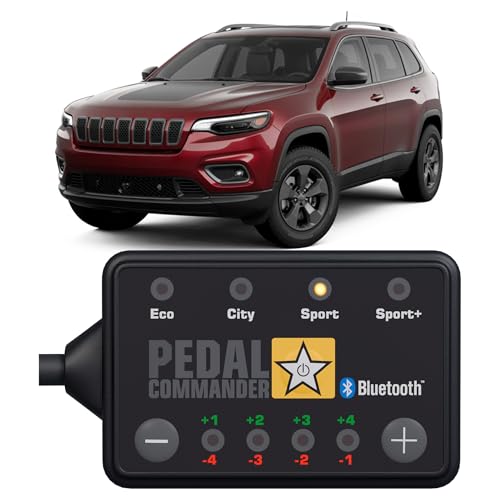

What Is the Pedal Commander?
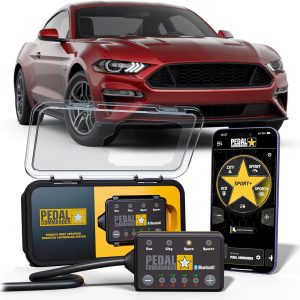
The Pedal Commander is an inline electronic throttle response controller.
It installs between the Cherokee’s accelerator-pedal sensor and the factory wiring harness. Once connected, it modifies the pedal signal according to the selected driving mode and sensitivity setting.
The Pedal Commander changes:
- Accelerator-pedal sensitivity
- Partial-throttle response
- The amount of pedal movement needed to request acceleration
- The perceived delay between pedal input and vehicle response
- How progressive or aggressive the accelerator feels
It does not directly change:
- Peak horsepower
- Peak torque
- Turbocharger boost
- Fuel-injection mapping
- Ignition timing
- Transmission gear ratios
- Final-drive ratios
- Towing capacity
- Payload capacity
The Cherokee may feel quicker because a smaller pedal movement can request more throttle.
That is not the same as creating additional engine output.
A throttle controller is therefore best understood as a drivability modification, not a traditional horsepower upgrade.
Compatible 2014–2023 Jeep Cherokee Models
According to the supplied product information, this Pedal Commander application is intended for compatible 2014–2023 Jeep Cherokee models, including trims and versions such as:
- Sport
- Latitude
- Latitude Plus
- Latitude Lux
- Altitude
- Limited
- North
- Overland
- Upland
- Trailhawk
Trim availability varied by model year and market.
The engine list supplied for this controller includes:
- 2.0-liter turbocharged four-cylinder
- 2.4-liter four-cylinder
- 3.2-liter V6
Those engines were not all offered during every year of the 2014–2023 production run. The 2.0-liter turbo arrived later in the Cherokee’s life, while the 2.4-liter and 3.2-liter engines were available across broader portions of the generation.
For example, the final 2023 Cherokee lineup was significantly reduced and included a 2.4-liter four-cylinder in the Altitude Lux, while earlier years offered a wider range of powertrain and trim combinations.
Owners should confirm the exact Pedal Commander part number using the vehicle’s:
- Model year
- Engine
- Trim
- Drivetrain
- Accelerator-pedal connector
- Market specification
A 2014 Cherokee Sport and a 2023 Trailhawk may share the same basic platform, but that does not make every electronic accessory automatically interchangeable.
Why Does the Jeep Cherokee Have Throttle Lag?
The Cherokee uses an electronic accelerator system.
Instead of a mechanical cable opening the throttle body directly, the accelerator pedal sends a signal to the powertrain-control system. The vehicle then determines how much torque to request based on operating conditions.
Those calculations can involve:
- Pedal position
- Engine speed
- Transmission gear
- Vehicle speed
- Traction-control intervention
- Engine temperature
- Emissions strategy
- Requested torque
- Vehicle load
- Stability-control activity
The factory calibration is designed to balance:
- Smooth acceleration
- Fuel economy
- Emissions
- Transmission operation
- Traction
- Driveline protection
- Passenger comfort
- Low-speed control
That balance can make the pedal feel less direct than some drivers prefer.
The softened response may be more noticeable when the Cherokee is:
- Carrying several passengers
- Loaded with luggage
- Climbing a grade
- Merging into fast traffic
- Passing at highway speeds
- Equipped with a roof basket
- Carrying bicycles or cargo overhead
- Running heavier all-terrain tires
- Traveling at higher elevations
You press the accelerator.
The Cherokee evaluates the engine, transmission, traction, cargo load, road grade, and whatever has been strapped to the roof in the name of outdoor recreation.
Then it responds.
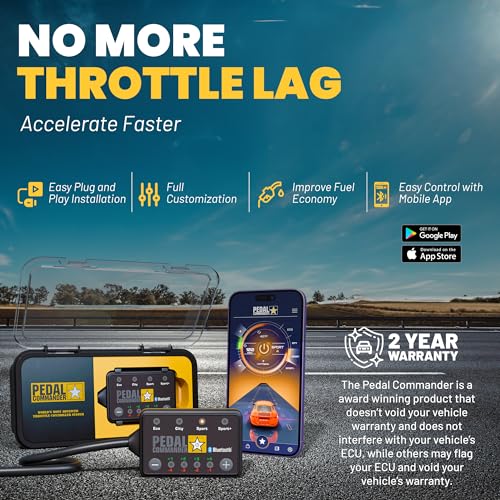
The Pedal Commander is intended to reduce that perceived delay by changing the pedal-response curve.
Four Pedal Commander Driving Modes
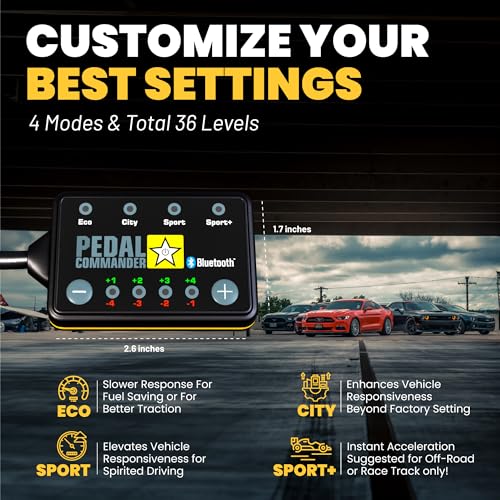
The controller offers four primary driving modes:
- Eco
- City
- Sport
- Sport+
Each mode changes how aggressively the Cherokee responds to accelerator movement.
Eco Mode
Eco mode softens the pedal response.
It requires more pedal travel to request the same amount of throttle, creating a smoother and more progressive accelerator feel.
Eco mode may be useful for:
- Stop-and-go traffic
- Wet pavement
- Snow and ice
- Long highway drives
- Low-speed parking
- Technical off-road terrain
- Drivers who prefer gradual acceleration
- Maneuvering with passengers and cargo
Eco mode does not reduce the engine’s maximum available output.
It changes how quickly that output is requested.
Can Eco Mode Improve Fuel Economy?
Eco mode may encourage gentler acceleration and reduce abrupt pedal inputs.
That may support more efficient driving habits, but it does not guarantee an improvement in fuel economy.
Actual mileage still depends on:
- Engine
- Driving speed
- Tire pressure
- Vehicle weight
- Cargo
- Roof racks
- Aerodynamic drag
- Road grade
- Wind
- Driver behavior
A softer accelerator can help the driver use less throttle.
It cannot make a roof basket, kayak carrier, and cargo box stop interacting with the atmosphere.
City Mode
City mode provides a moderate increase in throttle sensitivity.
It is intended for everyday situations such as:
- Commuting
- Urban traffic
- Stop-and-go driving
- Highway merging
- Parking-lot maneuvering
- Normal street use
For many Cherokee owners, City mode may provide the best daily-driving balance.
The vehicle can feel more responsive than stock without becoming excessively sensitive at low speed.
City mode may be especially useful when the Cherokee is carrying:
- Passengers
- Luggage
- Camping equipment
- A roof rack
- Bikes
- Recovery equipment
- Heavier all-terrain tires
The Pedal Commander cannot remove the weight or drag created by those additions.
It can make the accelerator feel less hesitant while moving them.
Sport Mode
Sport mode provides a stronger increase in pedal sensitivity.
It may improve the driving feel during:
- Highway merging
- Passing
- Grade climbing
- Open-road acceleration
- Driving with passengers and cargo
- Faster dirt-road travel
- Spirited street driving
Sport mode allows the powertrain to react more aggressively to smaller pedal inputs.
It does not add horsepower or torque.
Instead, it makes the engine’s existing output feel easier to access during partial-throttle driving.
For many drivers, Sport mode may provide the most noticeable improvement without making the accelerator as aggressive as Sport+.
Sport+ Mode
Sport+ provides the most aggressive accelerator response.
A relatively small pedal movement can request a much stronger throttle response, making the Cherokee react quickly during acceleration.
Sport+ may appeal to drivers who want:
- Maximum pedal sensitivity
- Immediate partial-throttle response
- Faster access to full throttle
- A dramatic change from the factory pedal feel
- Stronger highway merging response
It should be used carefully during:
- Wet weather
- Snow
- Loose gravel
- Mud
- Technical trail driving
- Heavy traffic
- Low-speed parking
- Driving with unsecured cargo
Sport+ does not “make the engine roar” by creating more power.
It requests the engine’s available output more aggressively.
Maximum sensitivity is not always maximum capability.
On a technical trail, smooth power delivery is often more useful than making the accelerator react as though it has just been insulted.
36 Adjustable Throttle Settings
The Pedal Commander provides nine adjustment levels within each of its four driving modes.
That produces 36 total settings.
This allows the driver to fine-tune the accelerator rather than choosing only between the stock calibration and maximum response.
Possible combinations might include:
- Eco -4 for snow or slippery roads
- Eco -2 for low-speed trail driving
- City -1 for commuting
- City +2 for a loaded family trip
- Sport -2 for highway driving
- Sport +2 for stronger passing response
- Sport+ at a low level before trying maximum sensitivity
The best setting depends on:
- Engine
- Vehicle weight
- Passenger load
- Cargo
- Tire choice
- Weather
- Terrain
- Driver preference
A setting that feels appropriate in a 2.4-liter front-wheel-drive Cherokee may feel unnecessarily sharp in a turbocharged 2.0-liter model or a Trailhawk on loose terrain.
The correct setting is the one that provides predictable control.
Not necessarily the one that produces the biggest reaction during the first five minutes.
Smartphone App Control
The Pedal Commander can be adjusted through a compatible smartphone application.
Depending on the controller version and currently supported app functions, the driver may be able to:
- Change driving modes
- Adjust sensitivity
- View the active setting
- Save preferred configurations
- Control the unit without reaching into the footwell
- Use supported security features
App control can be useful because the physical controller is typically mounted near the driver’s lower dashboard or accelerator-pedal area.
Settings should be changed while parked or when doing so will not distract the driver.
Being able to alter pedal sensitivity from a phone is convenient.
Trying to do it while entering a freeway with three passengers giving directions is less so.
Pedal Commander for the 2.4-Liter Cherokee
The naturally aspirated 2.4-liter four-cylinder was used extensively throughout the KL-generation Cherokee.
In the 2023 Cherokee Altitude Lux, the 2.4-liter engine produced 180 horsepower and 171 pound-feet of torque.
A Pedal Commander may make a 2.4-liter Cherokee feel:
- More responsive from a stop
- Sharper during city driving
- Quicker to react during highway merging
- Less hesitant when loaded
- More immediate at partial throttle
It does not increase the engine’s output beyond its factory rating.
The controller may make the 2.4-liter engine feel more eager because less pedal travel is required to request stronger acceleration.
That distinction matters.
The Pedal Commander can alter how quickly the driver accesses the available power.
It cannot give the 2.4-liter engine the output of the turbocharged 2.0-liter or the 3.2-liter V6.
Pedal Commander for the 3.2-Liter V6
The 3.2-liter Pentastar V6 was offered in many Cherokee trims and was popular with drivers who wanted stronger acceleration, higher towing capability in properly equipped models, or the additional performance associated with the Trailhawk.
A Pedal Commander may make a 3.2-liter Cherokee feel:
- More immediate during passing
- Sharper during highway merging
- More responsive when carrying cargo
- Quicker to react on steep grades
- More alert during normal street driving
The controller does not increase V6 horsepower or torque.
It changes how aggressively the accelerator requests the engine’s existing output.
Because the V6 already provides stronger performance than the base four-cylinder, drivers should increase sensitivity gradually.
A moderate City or Sport setting may provide better real-world control than maximum Sport+.
Pedal Commander for the 2.0-Liter Turbo
The turbocharged 2.0-liter four-cylinder was introduced later in the Cherokee’s production run.
A compatible Pedal Commander may make a 2.0-liter turbo Cherokee feel:
- More immediate at lower speeds
- Sharper during highway merging
- Quicker during passing
- More alert while climbing grades
- More responsive with passengers and cargo
The controller does not increase:
- Turbocharger boost
- Fuel delivery
- Horsepower
- Torque
- Charge-air cooling
- Engine calibration
It only changes accelerator sensitivity.
A turbocharged engine can already produce strong low- and midrange torque, so aggressive settings should be approached gradually, particularly on wet roads or loose surfaces.
The turbo does not need extra boost from the Pedal Commander.
It only receives a more enthusiastic request from the accelerator.
Pedal Commander for the Cherokee Trailhawk
The Cherokee Trailhawk was the most off-road-focused version of the KL platform.
Depending on model year, Trailhawk equipment could include:
- Four-wheel drive
- Increased ground clearance
- Protective skid plates
- Recovery hooks
- Off-road-oriented suspension
- Terrain-management systems
- More aggressive tires
The Pedal Commander may complement a Trailhawk by allowing the driver to select different accelerator behavior for different terrain.
Potential starting points include:
- Eco for rocks and technical terrain
- City for mixed trail and street use
- Sport for open dirt roads
- Sport+ only where traction and space permit aggressive response
Sport+ is not automatically the best off-road setting.
On technical terrain, a softer pedal may make it easier to:
- Avoid wheelspin
- Maintain slow vehicle speed
- Control weight transfer
- Ease over obstacles
- Prevent abrupt movement
The most valuable off-road feature may not be making the pedal more sensitive.
It may be having the ability to make it less sensitive.
Pedal Commander for the Cherokee Limited and Overland
Limited and Overland trims emphasized comfort, technology, and road use.
A Pedal Commander may appeal to these owners by improving:
- Daily responsiveness
- Highway passing
- Merging
- Grade climbing
- Loaded family-trip performance
- Accelerator feel during normal commuting
City mode may be the most practical everyday setting.
Sport mode may provide a more noticeable improvement during highway driving.
The controller will not transform a comfort-focused Cherokee into a performance SUV.
It can make the accelerator stop feeling as though every request requires written approval.
Pedal Commander for the Cherokee Altitude and Latitude
Altitude and Latitude models make up a large portion of the used Cherokee market.
These vehicles are commonly used for:
- Daily commuting
- Family transportation
- Road trips
- Light trail travel
- Winter driving
- Carrying outdoor equipment
A Pedal Commander may improve the driving feel by providing:
- Sharper response from a stop
- More immediate highway merging
- Adjustable sensitivity for poor weather
- Better-feeling response when loaded
- A softer pedal for snow or low-traction conditions
For most daily-driven Cherokees, City mode may provide the best combination of response and control.
Does It Restore Power Lost to Roof Racks?
No.
The supplied description claims that the Pedal Commander can restore power lost to wind drag from roof racks and loaded crossbars.
That is not mechanically accurate.
A roof rack, cargo box, bicycle rack, kayak carrier, or loaded crossbar can increase aerodynamic drag. That additional resistance requires the engine to work harder at speed.
The Pedal Commander cannot reduce that drag.
It does not change:
- Vehicle aerodynamics
- Engine horsepower
- Gear ratios
- Vehicle weight
- Roof-rack weight
- Frontal area
What it can do is make the accelerator feel more responsive by requesting additional throttle earlier in the pedal’s travel.
The Cherokee may feel less hesitant.
It has not recovered any horsepower.
The roof rack is still up there disturbing the air and reminding the fuel gauge about every outdoor hobby the owner has accumulated.
Pedal Commander for Fully Loaded Family Trips
A Cherokee carrying passengers, luggage, coolers, and roof-mounted cargo may feel less responsive than it does when driven alone.
The additional weight affects acceleration because the engine must move more mass.
The Pedal Commander cannot remove that mass or improve the engine’s maximum output.
It may make the vehicle feel more responsive during:
- Freeway entry
- Passing
- Grade climbing
- Pulling away from a stop
- Rejoining traffic
That can make the Cherokee feel more confident during a loaded road trip.
However, claims that the controller creates “safer merging” should be interpreted cautiously.
A sharper response may help the driver access acceleration sooner, but safe merging still depends on:
- Available space
- Driver judgment
- Vehicle load
- Tire condition
- Weather
- Traffic speed
- Engine performance
The Pedal Commander can change pedal response.
It cannot make traffic decisions for the driver.
Pedal Commander for Highway Merging and Passing
Highway driving is one of the situations where a throttle controller may feel most noticeable.
A more aggressive pedal map can reduce the amount of accelerator movement needed when the driver:
- Enters a freeway
- Passes slower traffic
- Climbs an incline
- Accelerates into a lane opening
- Rejoins traffic after slowing
The Cherokee may respond sooner to the driver’s pedal input.
That can improve the sense of immediacy.
At full throttle, however, the engine still produces the same maximum output it did before installation.
The Pedal Commander changes how quickly the driver requests power.
It does not create more of it.
Pedal Commander With Roof Racks and Crossbars
Roof racks and crossbars are common Cherokee accessories.
They may carry:
- Bicycles
- Skis
- Kayaks
- Cargo boxes
- Camping equipment
- Recovery boards
- Luggage
These accessories can add weight and aerodynamic drag.
The Pedal Commander may make the vehicle feel more responsive while carrying them, but it cannot compensate mechanically for their effects.
It does not improve:
- Aerodynamics
- Horsepower
- Torque
- Fuel economy
- Payload capacity
- Roof-load rating
Owners should also remain within Jeep’s specified roof-load and payload limits.
A sharper pedal does not increase how much equipment the roof or vehicle can safely support.
Pedal Commander for Off-Road Driving
Different surfaces require different accelerator behavior.
Rocks and Technical Trails
Eco mode may provide better low-speed control.
A softer pedal can help reduce:
- Sudden wheelspin
- Lurching
- Abrupt weight transfer
- Unwanted throttle spikes
Dirt Roads
City or a mild Sport setting may improve response while keeping the vehicle manageable.
Mud
Too much sensitivity can create unnecessary wheelspin.
A moderate response may work better than maximum Sport+.
Sand
Quicker response may help maintain momentum, but abrupt throttle inputs can still cause the tires to dig.
Snow and Ice
Eco mode may make power easier to apply gradually.
The Pedal Commander does not create traction.
It changes how the driver requests the power that reaches the tires.
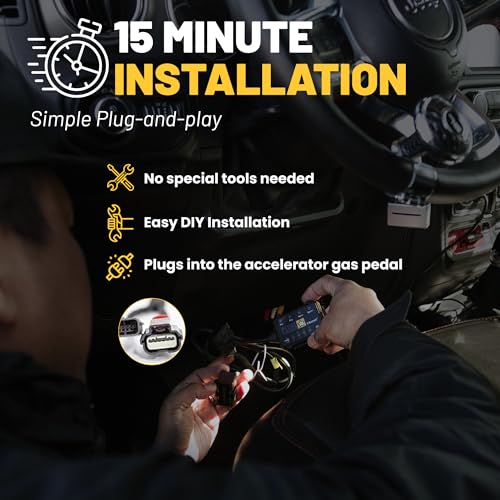
Plug-and-Play Installation
The supplied product information describes the Pedal Commander as a tool-free, plug-and-play modification.
It connects between the Cherokee’s accelerator-pedal sensor and the factory wiring harness.
A typical installation process includes:
- Park the Cherokee securely.
- Turn off the engine.
- Remove the key or move the key fob away from the vehicle.
- Allow the electrical system to power down.
- Locate the accelerator-pedal connector.
- Disconnect the factory harness.
- Connect the Pedal Commander inline.
- Secure the module.
- Route all wiring away from the pedals.
- Pair the controller with the smartphone app.
- Select a conservative initial setting.
- Test the accelerator before normal driving.
Installation generally does not require:
- Cutting wires
- Soldering
- Drilling
- ECU flashing
- OBD-II port use
- Engine disassembly
- Permanent interior modifications
All wiring must be secured away from:
- Accelerator-pedal movement
- Brake-pedal travel
- Driver footwear
- Steering components
- Parking-brake hardware
A loose wire in the pedal area is not merely untidy.
It is a safety issue that must be corrected before driving.
Does the Pedal Commander Alter the ECU?
The Pedal Commander does not perform a conventional ECU software flash.
It works through the accelerator-pedal signal rather than rewriting the Cherokee’s factory engine calibration.
It does not normally alter:
- Fuel maps
- Ignition timing
- Emissions programming
- Turbocharger calibration
- Transmission software
- Rev limits
- Factory engine tables
The unit is designed to be reversible. Removing it restores the original connection between the accelerator pedal and factory harness.
However, claims that the product will always leave “no trace” or can never cause a diagnostic code should be treated carefully.
A fault could potentially occur because of:
- An improperly seated connector
- Installation while the electrical system is active
- Damaged wiring
- An incompatible controller
- Connector corrosion
- A hardware failure
The most accurate description is that the Pedal Commander does not reflash the ECU and is designed to be removable.
Does It Preserve the Factory Warranty?
Because the Pedal Commander does not perform a traditional ECU flash, it may create fewer warranty concerns than an engine tune.
That does not amount to a universal guarantee that every future warranty claim will be approved.
A dealer or manufacturer may evaluate:
- Which component failed
- Whether the accessory contributed to the issue
- Installation quality
- Diagnostic findings
- Other vehicle modifications
- Applicable consumer-protection laws
The responsible claim is that the controller is reversible and does not rewrite factory engine software.
That is different from promising unconditional warranty coverage.
Does the Pedal Commander Add Horsepower?
No.
The Pedal Commander does not increase:
- Horsepower
- Torque
- Turbocharger boost
- Fuel flow
- Airflow capacity
- Compression
- Engine displacement
- Towing capacity
- Payload capacity
It changes accelerator sensitivity.
The Cherokee may feel faster because less pedal travel requests a greater throttle response.
At wide-open throttle, the engine still produces the same maximum output.
That means the Pedal Commander should not be marketed as a conventional power modification.
It is a throttle-response controller.
Will It Make the Cherokee Accelerate Faster?
A more aggressive pedal map may allow the driver to request full throttle sooner.
That does not guarantee a measurable improvement in acceleration times.
Actual performance depends on:
- Engine output
- Vehicle weight
- Passenger load
- Cargo
- Tire grip
- Transmission behavior
- Road grade
- Elevation
- Weather
- Driver input
Most drivers are likely to notice the greatest difference during partial-throttle driving.
That is where the altered pedal curve can make the Cherokee feel considerably more responsive.
Pedal Commander Versus an ECU Tune
A throttle controller and an ECU tune are different modifications.
Pedal Commander
The Pedal Commander changes:
- Accelerator sensitivity
- Partial-throttle response
- Perceived pedal delay
It generally does not change:
- Fuel delivery
- Ignition timing
- Peak horsepower
- Peak torque
- Turbocharger boost
- Transmission calibration
ECU Tune
A properly developed ECU tune may change:
- Fuel mapping
- Ignition timing
- Torque management
- Turbocharger control
- Transmission behavior
- Throttle mapping
- Rev limits
A tune may produce measurable engine-output changes.
The Pedal Commander is primarily a reversible drivability modification for owners who want a different pedal feel without rewriting factory software.
Advantages
- Sharper accelerator response
- Eco, City, Sport, and Sport+ modes
- 36 sensitivity settings
- Smartphone app control
- Plug-and-play installation
- No conventional ECU flash
- Does not require the OBD-II port
- Fully reversible
- Useful for highway merging and passing
- Adjustable for slippery or off-road conditions
- May improve perceived response when loaded
- Compatible with several Cherokee engines when correctly matched
Disadvantages
- Does not add horsepower
- Does not increase torque
- Does not reduce aerodynamic drag
- Does not increase towing capacity
- Does not increase payload capacity
- Sport+ may be too sensitive on loose terrain
- Aggressive settings may reduce low-speed precision
- Exact engine and model-year fitment must be confirmed
- It cannot compensate mechanically for roof-rack drag
- Warranty approval cannot be universally guaranteed
- Incorrect installation could potentially trigger a fault
- It does not replace an ECU or transmission tune
Is the Pedal Commander Worth It for a Jeep Cherokee?
The Pedal Commander may be worth considering for a Cherokee owner who:
- Dislikes the factory accelerator response
- Wants sharper highway merging
- Regularly carries passengers and cargo
- Uses roof racks or crossbars
- Wants adjustable pedal response
- Drives in snow or poor weather
- Takes a Trailhawk off road
- Prefers a reversible modification
- Does not want an ECU tune
- Values driving feel more than horsepower numbers
It makes less sense for someone expecting:
- Additional horsepower
- More torque
- Improved aerodynamics
- Increased towing capacity
- Increased payload capacity
- Guaranteed fuel-economy gains
- A replacement for engine tuning
- Guaranteed faster acceleration
The Pedal Commander is best understood as a throttle-response and drivability upgrade.
It changes how quickly the Cherokee reacts to the accelerator.
It does not change the engine’s maximum output or the vehicle’s physical limits.
Final Thoughts
The 2014–2023 Jeep Cherokee was designed to be several vehicles at once.
It could handle school runs, commuting, road trips, winter weather, light trails, and—when equipped as a Trailhawk—terrain that would make many ordinary compact crossovers immediately begin searching for pavement.
The Pedal Commander does not change the Cherokee’s engine, transmission, or four-wheel-drive system.
It changes the accelerator.
Eco mode can soften response for slippery roads, technical trails, or relaxed driving. City mode may improve everyday responsiveness. Sport can sharpen highway merging and passing, while Sport+ provides the strongest change from the factory calibration.
The 36 settings give owners room to tailor the pedal to the engine, terrain, cargo load, and driving style.
It will not restore horsepower lost to roof-rack drag.
It will not increase towing capacity.
It will not make a Cherokee carrying five people, luggage, bicycles, and a cargo box forget that mass and aerodynamics remain annoyingly real.
What it can do is make the vehicle react more immediately without a conventional ECU tune or permanent wiring modification.
For drivers frustrated by the factory pedal response, that may be enough to make the Cherokee feel considerably more alert.
Frequently Asked Questions
Does the Pedal Commander add horsepower to a Jeep Cherokee?
No. It changes accelerator sensitivity but does not increase peak horsepower or torque.
Which Jeep Cherokee years are compatible?
The supplied listing identifies compatible 2014–2023 KL-generation Cherokee models. Exact fitment should be confirmed using the model year, engine, and pedal connector.
Does it work with the 2.4-liter engine?
The supplied compatibility information includes applicable 2.4-liter Cherokee models. The 2023 Cherokee Altitude Lux used a 2.4-liter engine rated at 180 horsepower and 171 pound-feet.
Does it work with the 3.2-liter V6?
The supplied product information includes compatible 3.2-liter V6 applications. Exact model-year and part-number fitment should be verified.
Does it work with the 2.0-liter turbo?
The supplied listing includes compatible 2.0-liter turbo applications from applicable later model years. The controller does not increase turbo boost or engine output.
Is the Pedal Commander compatible with the Trailhawk?
The supplied compatibility information includes Trailhawk models. Exact fitment should still be confirmed by year and engine.
Can it restore power lost to a roof rack?
No. It cannot reduce aerodynamic drag or restore horsepower. It may make the accelerator feel more responsive while the rack is installed.
Is it useful when the Cherokee is fully loaded?
It may improve perceived response during merging, passing, and grade climbing. It does not reduce vehicle weight or increase power.
Which mode is best for highway driving?
City or a moderate Sport setting may provide the best balance between response and smoothness.
Which mode is best for technical trails?
Eco or a mild City setting may provide better low-speed control than Sport+.
Does the Pedal Commander alter the ECU?
It does not perform a conventional ECU reflash or rewrite factory engine programming.
Can it cause a diagnostic code?
It is designed to operate without generating faults when correctly installed, but an incorrect connection, damaged wiring, or incompatible controller could potentially cause a pedal-related code.
Does installation require cutting wires?
No. The unit is described as a plug-and-play inline controller.
Can the Pedal Commander be removed?
Yes. The installation is designed to be reversible.




There are no reviews yet.